

Hacker Architects Carves a Volcanic Desert Home from Concrete, Oak, and Glass in Central Oregon
Cascading platforms anchored to bedrock follow a pumice-covered hillside in Bend, framing high desert views across 7,600 square feet.


Central Oregon's high desert is a landscape shaped by fire, both geological and literal. Lava flows as recent as 1,300 years ago left behind basalt columns, cinder cones, and pumice-blanketed slopes. More recently, a large wildfire cleared the forest on this particular hillside near Bend, exposing the undulating terrain and leaving behind weathered snags, the skeletal remains of burned trees still standing like sentinels. It is precisely this charged, post-fire landscape that Hacker Architects chose to work with rather than against for the Tetherow Overlook House, a 7,600-square-foot residence that treats the desert not as a backdrop but as its primary collaborator.
What makes the project genuinely compelling is how it refuses to simplify the relationship between building and ground. Three concrete plinths, anchored to bedrock roughly fifteen feet below the surface, establish a series of cascading platforms that follow the gentle slope of the sandy hillside. Atop these plinths sit three distinct wood-clad volumes, each housing a different programmatic zone: garage and studio, bedrooms, and dining. The gaps between these volumes are not leftover space. They are calibrated to produce microclimates that shift with the seasons, offering varying degrees of shelter from the intense desert sun and wind. The architecture does not merely sit on the land; it negotiates with it.
Timber Volumes and Volcanic Mass


The exterior language splits into two clear material families. Rectangular volumes clad in coarse wood slats reference the texture of the weathered snags that dot the surrounding site, their rough grain a deliberate echo of bark stripped and bleached by fire and sun. Cedar battens wrap continuously over windows and solid walls alike, maintaining a consistent surface that reads as a single monolithic mass even where glass hides behind the cladding. Against these warm, fibrous volumes stand the faceted concrete and plaster masses, chamfered and carved to evoke the region's columnar basalt and obsidian formations. The contrast is stark but earned: two material logics drawn directly from what the site offers.
Structurally, a steel floor system allows the window assemblies to cantilever from thin steel supports, which means the glass can disappear down into the floor framing and up past the roof framing. The result is a reading of glass spanning uninterrupted from ceiling to parapet, dissolving the boundary between the controlled interior and the raw desert beyond.
Living on Multiple Levels


The main floor is not a single plane but a series of interconnected platforms, each occupying its own level. A media lounge, living room, and kitchen step down the slope in sequence, distinct in elevation yet open to one another. The dining room perches in a volume above the kitchen, a few steps up, where its elevated position creates an intimate zone separated from the more public areas below. It is a spatial strategy that gives each activity its own register without resorting to walls or doors.
A finely crafted timber screen staircase connects the levels, layering interior views and filtering light as it passes between floors. The stair treads themselves are hollow white oak boxes with mitered joints, detailed to allow the wood to expand and contract with seasonal humidity changes. This is not decoration; it is an acknowledgment that in the high desert, where temperature swings are dramatic, materials need room to breathe.
The Upper Floor and Private Quarters


The upper level holds the primary bedroom suite, an open workspace, a gallery that overlooks the double-height living room, and two guest bedrooms. Corner fireplaces in freestanding concrete volumes anchor the bedrooms, grounding them against walls of floor-to-ceiling glass that frame the high desert vista: snow-covered fields in winter, tawny pumice slopes in summer. The decision to place the workspace adjacent to the gallery, rather than sequestered in a separate wing, reflects the owners' art-forward lifestyle. Conceptual modern art is not relegated to dedicated display walls; it occupies the same visual field as the landscape.
Silver plaster on the interior walls provides a neutral, luminous surface that shifts tone with the quality of light throughout the day. Against this, Oregon white oak ceilings, floors, and cabinetry create warmth without competing for attention. The palette is rich but minimal, a deliberate restraint that lets the art collection and the views do the talking.
Material Precision at Close Range


In the kitchen, polished concrete floors meet stone countertops and black cabinetry, a darker, denser material register that differentiates the working heart of the house from the lighter living zones. A light wood island with stools offers a more casual counterpoint. The concrete column that punctuates the space is left exposed, a reminder of the structural system operating beneath the surface finishes.
Even the bathroom vanities, built from light wood with dual sinks and wall-mounted taps, follow the same logic of careful joinery and material honesty. Nothing in the house pretends to be something it is not. Concrete reads as concrete. Oak reads as oak. Steel reads as steel. The discipline is consistent from the entry's patinated steel pivot door to the smallest interior detail.
Corridors as Landscape Frames


Circulation in the Tetherow Overlook House is never neutral. Corridors are flanked by vertical timber slat screens on one side and expansive glazing on the other, creating compressed, directional spaces that open suddenly onto panoramic views of distant wetlands, river landscapes, and snow-covered terrain. The slat screens filter and modulate light, casting rhythmic shadows across polished concrete floors that shift as the sun moves. These are not hallways; they are constructed viewing experiences.
The dining area pushes this approach to its most dramatic expression. A timber table with benches faces a wall of tall glass that frames the snowy landscape like a painting, though one that changes hourly. Deep roof overhangs control solar gain while exterior louvers shade specific sections of glass, a passive strategy that keeps the interior comfortable without relying heavily on mechanical systems. The house is all-electric, running on air-source heat pumps for forced-air cooling paired with water-heated radiant floors, but the architecture itself does much of the climate work.
Why This Project Matters
The Tetherow Overlook House succeeds because it treats context as more than scenery. The pumice, the basalt, the burned snags, the lava-formed topography: these are not aesthetic references applied to an otherwise generic house. They are the generative logic of the project, informing everything from the chamfered geometry of the plaster masses to the coarse texture of the wood cladding to the cascading section that follows the slope. Hacker Architects understood that designing for this site meant designing from this site.
More broadly, the project offers a convincing model for how a large, luxurious residence can engage seriously with landscape and climate without sacrificing spatial ambition. The multi-level living arrangement, the calibrated microclimates between volumes, the all-electric mechanical strategy, and the passive solar controls all demonstrate that sophistication and responsibility are not competing values. In a region increasingly shaped by wildfire and drought, that alignment feels less like a luxury and more like a necessity.
Tetherow Overlook House by Hacker Architects. Located in Bend, Oregon, United States. 7,600 sq ft. Photography by Jeremy Bittermann.
About the Studio
Share Your Own Work on uni.xyz
If projects like this are the kind of work you want to make, uni.xyz is a place to publish your own, find collaborators, and enter design competitions.


Popular Articles
Popular articles from the community


FCC Arquitectura Expands a Portuguese Granite House with a Board-Marked Concrete Wing
In Portugal, JV House pairs a cleaned-up whitewashed and granite dwelling with a timber-shuttered concrete extension, courtyards and a garden pool.

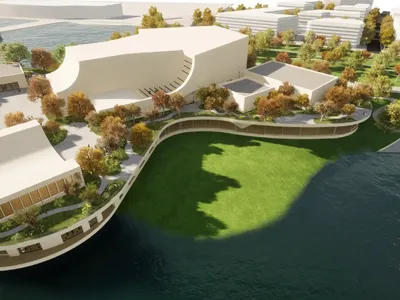
The Amber Palace Opera: A Geological Fiction Surfaces on Tallinn's Baltic Waterfront
Pierre Brillard reimagines a Baltic legend as a public landscape, opera house, and waterfront promenade rooted in Tallinn's coastal identity.
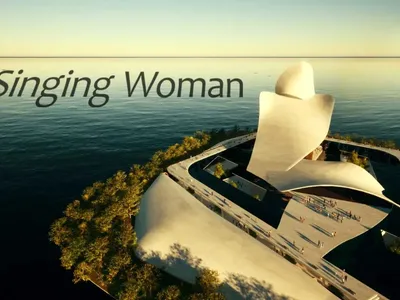
Singing Woman: An Opera House That Performs Before the Curtain Rises
Ovidiu Cristian Pavel's conceptual opera house translates Estonia's choral identity into a sculpted waterfront landmark facing the Baltic Sea.

Aquadapt: An Underwater Habitat That Rewrites Its Rooms by the Hour
Curved modules ring the seabed while one shell shifts from breakfast room to cinema, farm and football pitch as residents' needs change.

Similar Reads
You might also enjoy these articles


Hodi-Mandai Geram
Project Function: Preservation and revitalization of the Intangible heritage and socio-spatial identity of the Hodi by Housing, Cultural Memory Center, Sacred Grove, landscape, local tourism economy


Olio Towers: A Mid-Rise for Performers That Fuses Housing, Rehearsal, and Stage
Located blocks from Houston's Theater District, this modular tower stacks living units around a central performance atrium.

Oasis: Modular Green Housing Carved into Dhaka's Urban Fabric
A shortlisted Plugin Housing entry reclaims unauthorized settlements in Dhaka with stepped concrete volumes, green roofs, and ventilation-driven design.

Black Hole: A Floating Megastructure for the Post-Physical Era
Emiliano Mazzarotto envisions a spherical, self-scaling arena where e-sports, digital hotels, and holographic stadiums replace traditional public space.

Explore Architecture Competitions
Discover active competitions in this discipline

Challenge to reimagine the Iron Throne

Photograph architecture without architects

Illustrate the lost glory of Angkor Wat - Render Challenge

Design challenge to reuse E-waste
Comments (0)
Please login or sign up to add comments
No comments yet. Be the first to comment!