
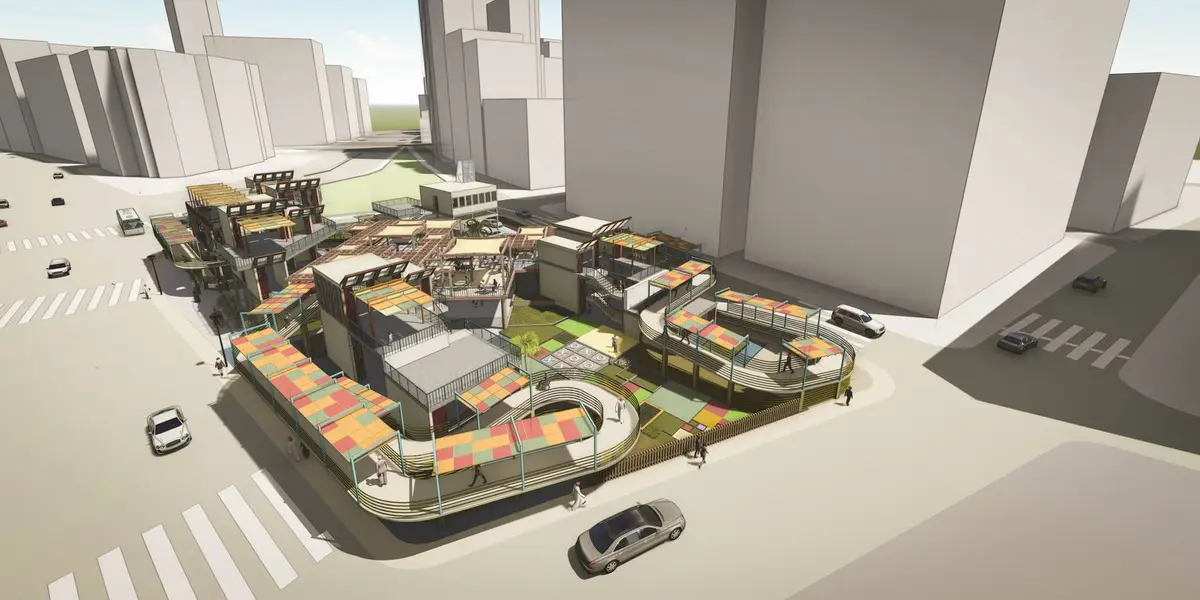
The Expandables: A Childcare Center That Breathes with the Climate
Expandable panels, wind-driven ventilation, and age-zoned planning let this arid-climate kindergarten shift between open and closed configurations.


What if a building for children could grow and shrink like a living organism, opening its walls to catch sea breezes on mild mornings and sealing itself shut against scorching afternoon dust? The Expandables proposes exactly that: a childcare center in an arid, high-humidity coastal climate where architecture replaces air conditioning as the primary comfort strategy. Through a system of operable panels, wind-channeling courtyards, and age-specific zoning, the building treats environmental responsiveness not as an add-on but as its fundamental spatial logic.
Shortlisted in Form Follows Climate 2020, the project was designed by Alireza Bagheri, Homa Gks, and Shadi Farrokhbalaghi. The site sits near a large body of water, which paradoxically worsens thermal comfort: seawater evaporation raises humidity levels well beyond what a typical arid climate would produce, rendering conventional evaporative cooling ineffective and making natural perspiration sluggish. The designers responded not by piling on mechanical systems but by studying prevailing north winds and sea breezes through CFD simulations, then organizing the entire building to work with those air patterns.
A Courtyard System That Channels the Sea Breeze
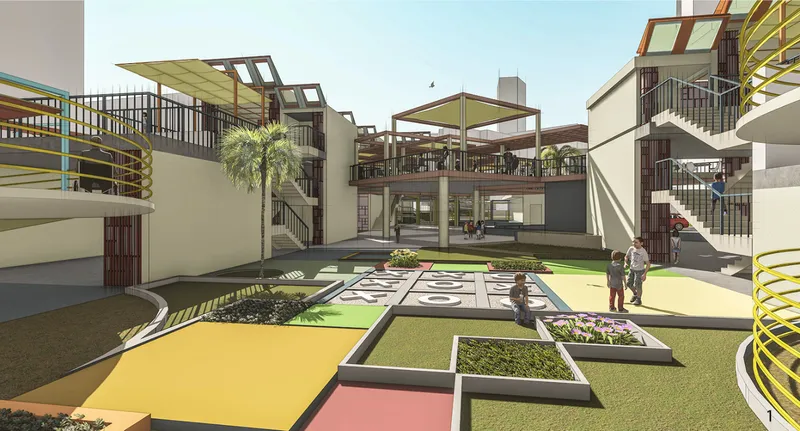
The central courtyard is the engine of the whole scheme. Pressure differentials between sea and land push cooler northern air across the site, and the building massing is arranged to catch those breezes, funnel them through corridors and courtyards, and distribute ventilation deep into interior zones. The courtyard's colorful patterned ground plane is more than playful decoration; it defines circulation paths and play zones while keeping the surface reflective enough to reduce ground-level heat absorption. Low volumes surrounding the courtyard avoid creating wind shadows, ensuring air reaches even the most sheltered corners.
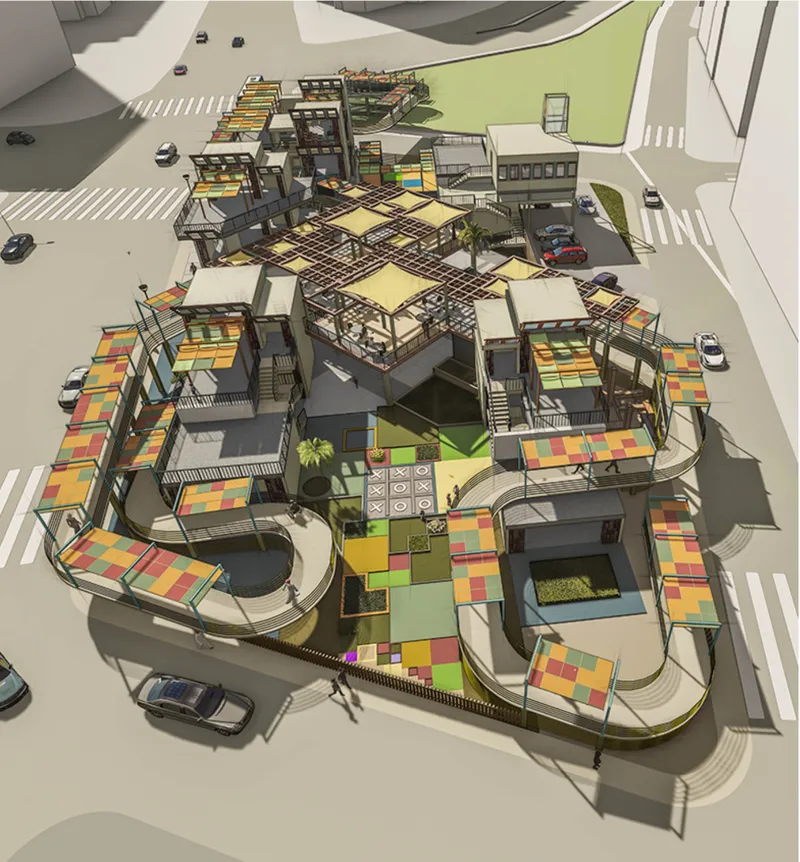
From above, the clustered volumes and yellow canopy structures read as an archipelago of shaded microclimates. The multicolored tiled facades give the complex a child-scaled identity, but their arrangement is driven by airflow logic: gaps between volumes serve as wind corridors, and the canopies provide shade without blocking cross-ventilation overhead.
Rooftop Canopies and the Layered Section
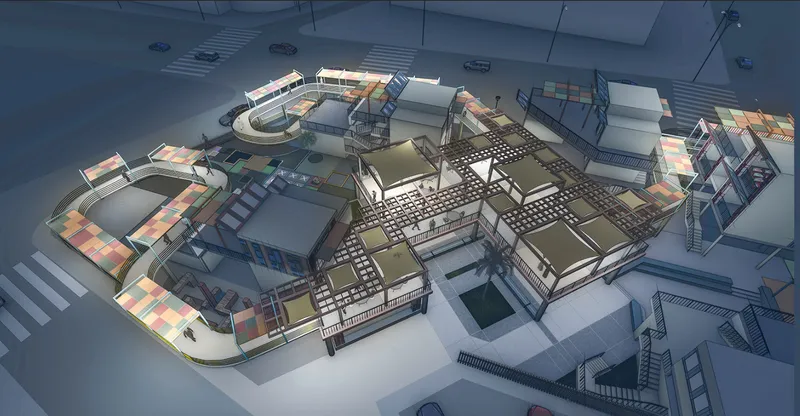
The evening-light view reveals a low-rise complex laced with pergolas and rooftop courtyards that function as a second ground plane. These elevated outdoor spaces serve two purposes: they provide additional ventilated play and learning environments for older children (aged 3 to 7), and they act as thermal buffers, shading the occupied rooms below. The building stays deliberately low, which limits solar gain on vertical surfaces and keeps the entire complex within a pedestrian, child-friendly scale. Supporting functions like kitchens, offices, and service rooms are positioned strategically to buffer sensitive zones from heat and noise, creating a thermal gradient from the building's protective edges to its breeze-washed core.
Timber Lattice and the Interior Climate
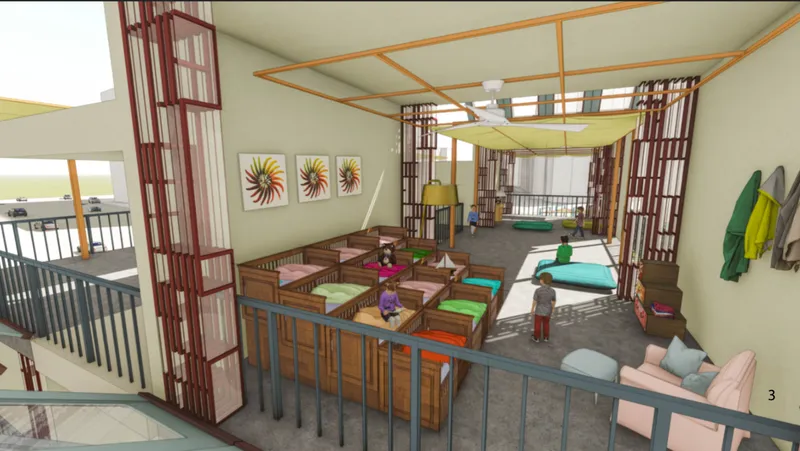
Inside, the classrooms trade hard partitions for timber lattice screens that filter light and allow air to pass between rooms. Children sit at low tables in a warm, materially legible space where the structure is visible and tactile. The lattice is part of the project's multi-stage adaptive panel system: in favorable conditions, panels open fully so classrooms expand into shaded outdoor terraces; in moderate conditions, the lattice filters dust and pollutants while maintaining airflow; in extreme heat, panels close entirely to create sealed, mechanically cooled rooms. Mechanical cooling is not eliminated but demoted to a last resort, activated only when environmental conditions overwhelm passive strategies.
Curving Pathways and Age-Zoned Planning
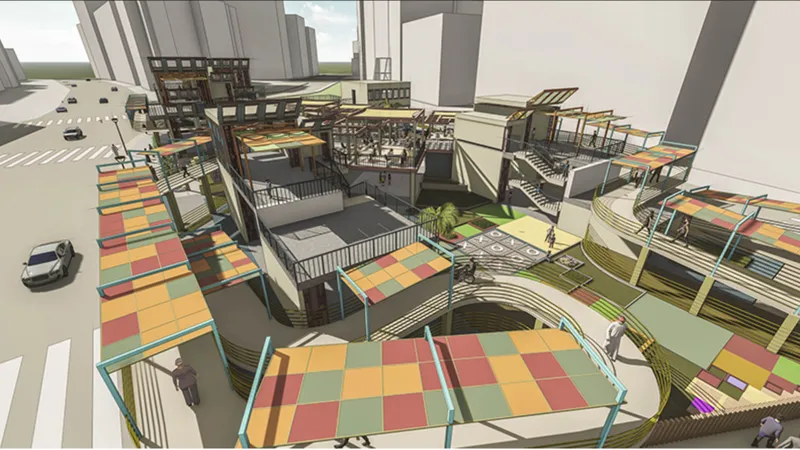
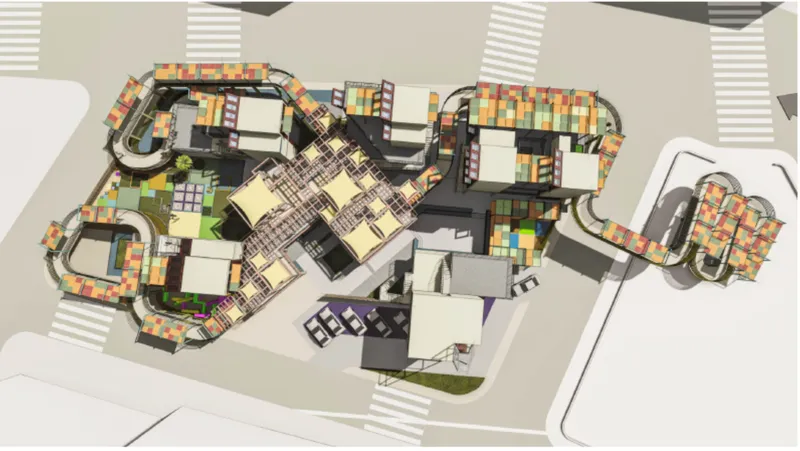
The elevated perspective shows how curving pathways link the tiled volumes, creating a non-hierarchical circulation network where children move between indoor classrooms, semi-open corridors, and rooftop play areas without crossing service zones or encountering vehicular traffic. The plan view makes the age-based zoning strategy legible: infants (0 to 2 years) occupy zones with the highest air filtration and lowest exposure to dust; toddlers (2 to 3 years) inhabit semi-open environments with controlled airflow; and children aged 3 to 7 enjoy the greatest access to natural ventilation and outdoor integration. Vertical circulation is distributed evenly across the complex to maintain accessibility and safety for all age groups.
The organic layout of interconnected volumes around central courtyards is not arbitrary; it emerges from the CFD analysis, which mapped how wind moves through the urban fabric. Parking zones are pushed to the periphery, keeping the heart of the complex car-free and focused entirely on the microclimate needs of its youngest occupants.
Why This Project Matters
Most childcare facilities in hot climates default to hermetically sealed boxes with centralized HVAC. The Expandables argues that this approach is both energetically wasteful and developmentally limiting for children, who benefit from sensory contact with outdoor environments. By treating the building envelope as a variable rather than a constant, the designers propose a third category between indoor and outdoor that shifts throughout the day and across seasons. The multi-stage panel system is simple in concept but spatially transformative: a classroom that was enclosed at noon can become a breeze-washed terrace by late afternoon.
What distinguishes the project from other climate-responsive proposals is its refusal to treat comfort as a single set-point. Instead, comfort is zoned by age, by time of day, and by spatial depth within the building. Infants get the most protection; older children get the most exposure. The architecture does not impose a universal solution but calibrates its response to the vulnerability and developmental needs of each user group. For a competition asking how form follows climate, the answer here is precise: form follows climate, but it also follows the child.
View the Full Project
About the Designers
Designers: Alireza Bagheri, Homa Gks, Shadi Farrokhbalaghi
Enter a Design Competition on uni.xyz
uni.xyz runs architecture and design competitions year-round that reward proposals with spatial conviction and real site intelligence.
Project credits: The Expandables by Alireza Bagheri, Homa Gks, Shadi Farrokhbalaghi Form Follows Climate 2020 (uni.xyz).


Popular Articles
Popular articles from the community


David Ortega Stacks a Two-Story Mexico City Penthouse Around a Steel Stair and a Pergola-Shaded Roof Terrace
In Colonia Roma, a 300 m² penthouse uses oak joinery, a planted steel stair and a slatted roof pergola to make a new-build apartment feel like a house.

LT2A and OPEN Architectes Thread a Brick and Glass High School Through a Wooded Belgian Campus
In Braine-l'Alleud, a 3,000 m² wing for Collège Cardinal Mercier pairs pale brick with a glazed colonnade, deferring to a small chapel and a dense wood.

Juan García Correa, John González and Claudia Rueda Sink a Circular Amphitheater into a Manizales Engineering Building
On the La Nubia campus in Manizales, Colombia, the S1 Building folds labs and offices into a hillside of ramped lawns that double as a campus route.

David Macias Steps a Doorless Stone and Plaster House Down a Tropical Colombian Hillside
In the humid hills of Colombia, Threshold House replaces the front door with an open void and terraces its 850 m² down the slope instead of fighting it.

Similar Reads
You might also enjoy these articles

Yenisei Monitoring Center: A Sun-and-Moon Sphere Anchors a Research Campus on Siberia's Great River
In Krasnoyarsk, shifting square blocks, a glazed central sphere and descending window rhythms turn river science into a public spectacle on the Yenisei.
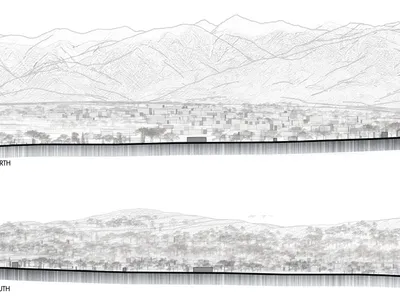
Andretta Artist's Village: A Node-Based Masterplan That Lets the Hills Write the Plan
A cultural landscape strategy for Palampur's artist colony threads studios, residences and stages along a porous spine shaped by the Dhauladhar terrain.
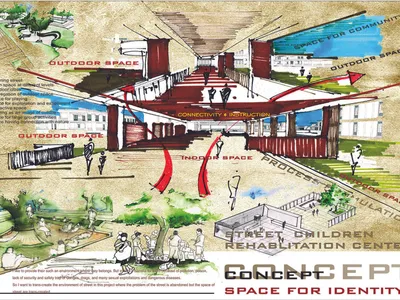
Street Children Rehabilitation Center: A Brick Campus That Eases Children From Street to Safety
A low-rise courtyard campus where learning streets, uthans and shaded verandahs stage a gradual passage from street into protective, family-scale life.

The NEON Culture: A Field of Pavilions Built for the 24-Hour City
Smaran Alva spreads galleries, stages, clubs and markets across a varied site, treating light, sound and ramped movement as the real building materials.

Explore Climate Responsive Competitions
Discover active competitions in this discipline

Challenge to reimagine the Iron Throne

Photograph architecture without architects

Illustrate the lost glory of Angkor Wat - Render Challenge

Design challenge to reuse E-waste
Comments (0)
Please login or sign up to add comments
No comments yet. Be the first to comment!