
The Experiential Food Arcadia: Closing the Loop Between Market, Farm, and Table
A shortlisted Urban Meal Mine entry transforms the urban market into an architectural ecosystem of food production, exchange, and decomposition.


What if a market did more than sell food? What if it grew it, composted it, treated the waste it generated, and taught the neighborhood how the whole cycle works? The Experiential Food Arcadia proposes exactly that: an architectural framework where food production, exchange, consumption, and decomposition collapse into a single shared ground. The building is not a backdrop to commerce. It is an active participant in the ecological cycle, organizing agricultural zones, laboratories, artisanal workshops, and modular production units within one continuous system.
Designed by Sharon So, Adabelle Poon, and Verena Leung, the project was shortlisted in the Urban Meal Mine competition. The brief asked designers to rethink sustainable farming within urban contexts. This team responded by refusing to separate the market from the farm, the kitchen from the compost heap, or the resident from the producer. The result is a dense, layered proposal where architecture mediates between human activity and natural cycles.
A Zigzag Spine Across a Pixelated Landscape
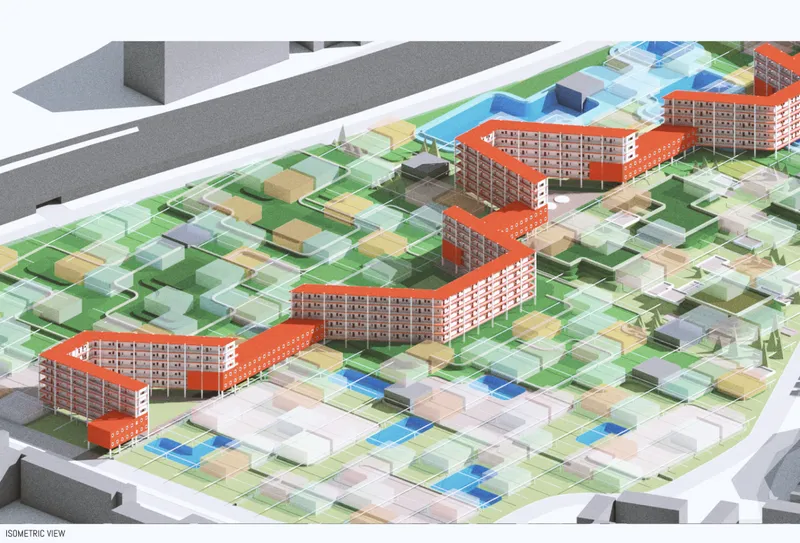
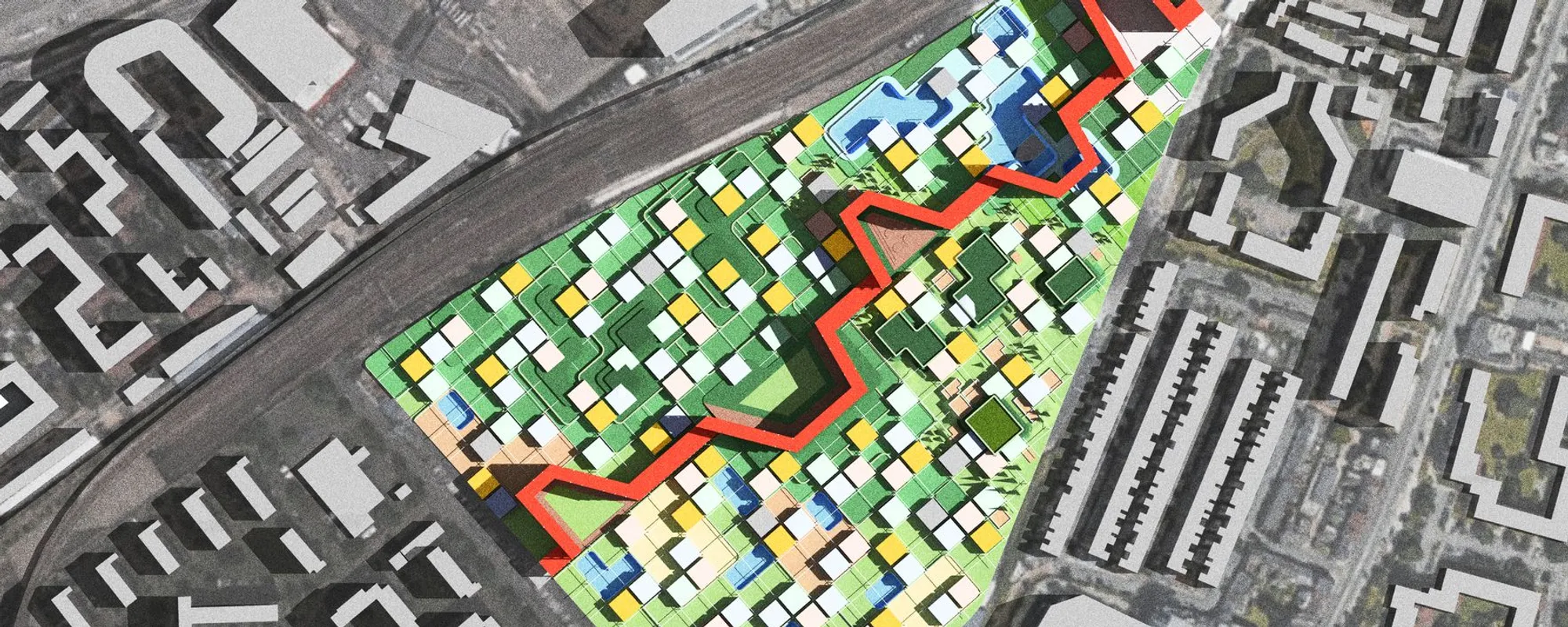
The isometric site drawing reveals the project's signature move: residential bars with orange roofs arranged in a zigzag pattern across a green, pixelated landscape. This is no arbitrary geometry. The zigzag creates pockets of outdoor space between each bar, generating courtyards and farming zones that are sheltered yet accessible. The green terrain reads almost like a gridded agricultural surface, suggesting that the ground plane itself is productive rather than decorative.
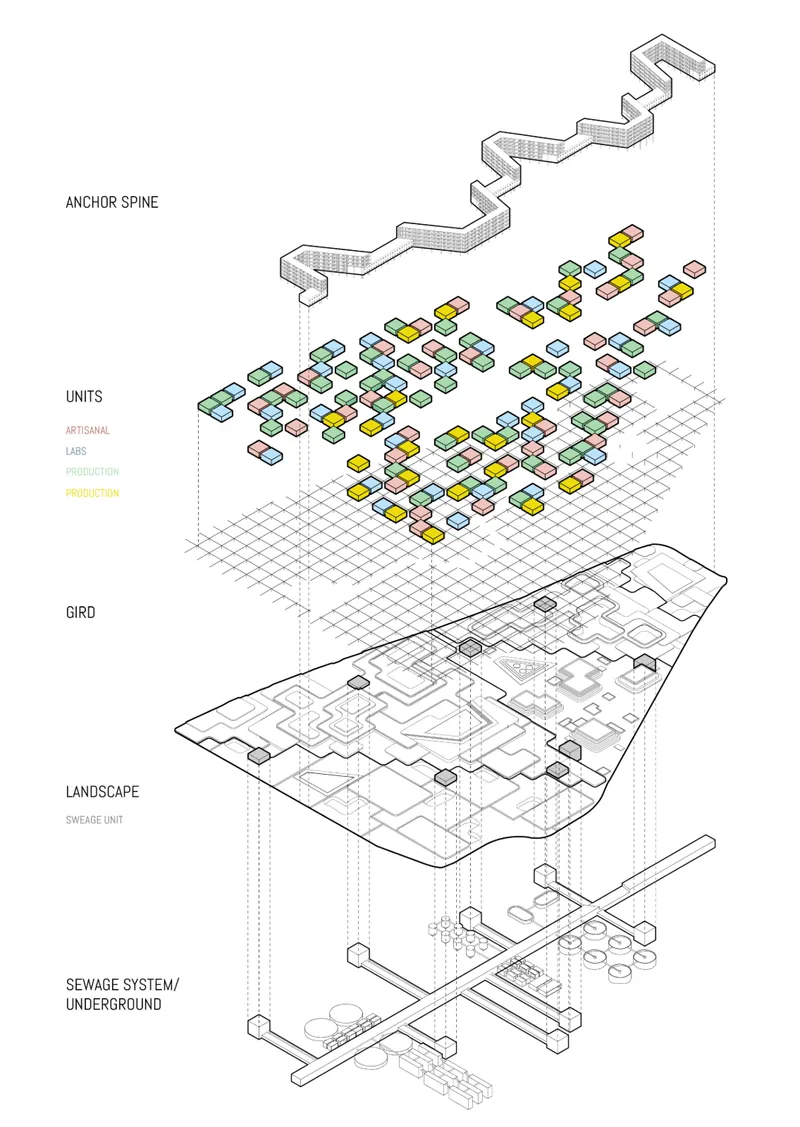
An exploded axonometric peels the project apart to expose its organizational logic. At the center sits what the designers call the anchor spine, a structural and circulatory backbone around which all community spaces are arranged. Above it, color-coded housing units (orange, green, blue, pink) stack and interlock, each color likely corresponding to a distinct programmatic function. Below ground, a sewage treatment layer sits integrated into the architecture itself, closing the waste loop before it ever leaves the site. Composting and waste management are not afterthoughts bolted onto a finished building; they are embedded in its section.
Terraces Where Production Meets Public Life
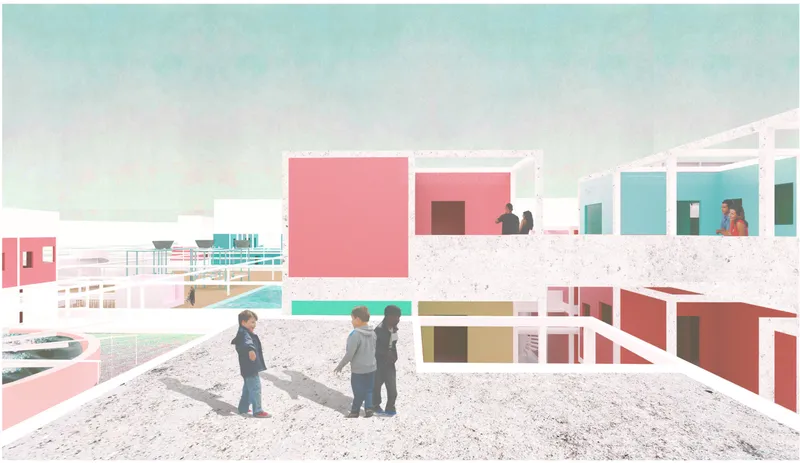
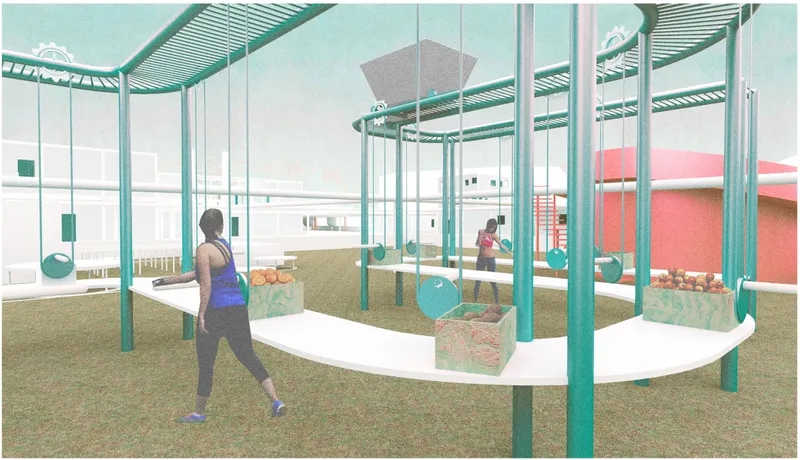
The rendered terraces reveal how the project translates its diagrammatic ambitions into lived experience. Figures stand on a white, open terrace surrounded by pink and turquoise cubic volumes under a pale sky. There is a deliberate casualness to these spaces: they are not grand plazas or formal promenades. They are platforms where residents might encounter food drying on racks, seedlings in trays, or neighbors exchanging produce. The cubic volumes suggest modular units that can shift between lab, workshop, and retail functions depending on community need.
An adjacent interior rendering shows a covered exercise structure supported by green steel columns and topped with a canopy roof. The choice of exposed steel and open-air framing signals a low-cost, easily assembled construction system. These are not polished commercial interiors. They are robust frameworks that invite inhabitation and adaptation, reinforcing the project's emphasis on flexibility over fixity.
Courtyards and Covered Walkways as Connective Tissue
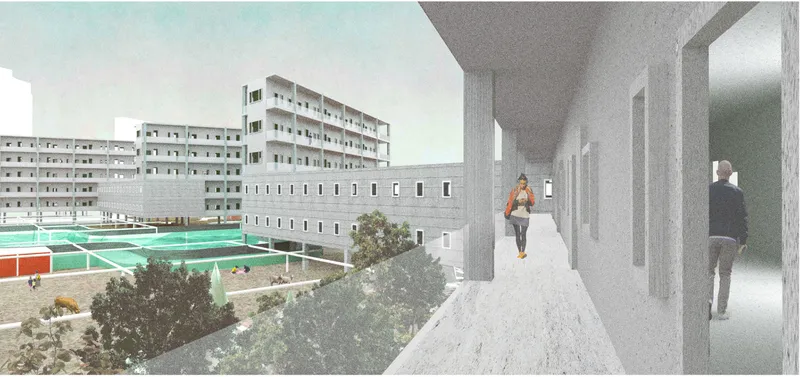
A covered walkway with concrete columns overlooks a residential block and planted courtyards, capturing the project's spatial rhythm. The anchor spine does not just organize program; it generates a sequence of threshold conditions. You move from covered to open, from paved to planted, from social to productive. Balconies and rooftops offer additional layers of engagement, allowing residents and visitors to farm, exchange goods, and learn at multiple elevations. The line between living space and productive space dissolves.
A Modular Taxonomy of Food-Centered Functions
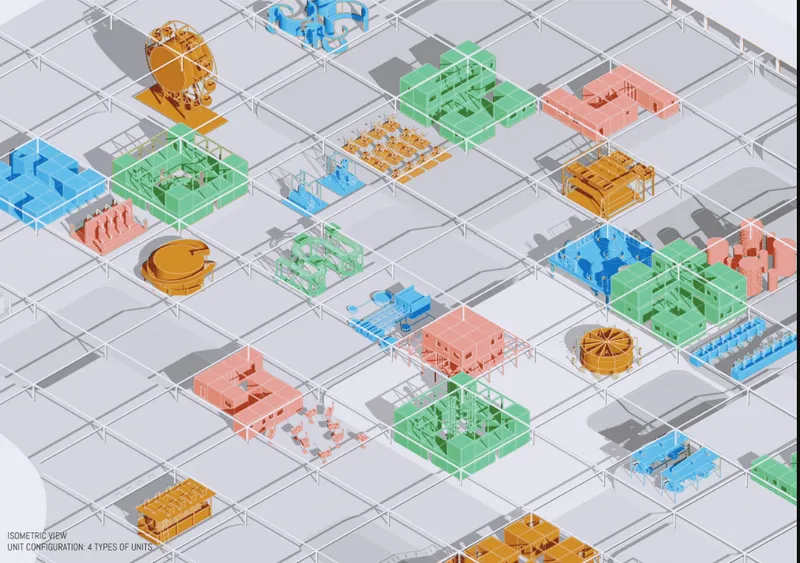
The final isometric drawing lays out a modular grid populated by color-coded unit types in orange, green, blue, and pink. Each color maps to a distinct use, from agricultural production to artisanal workshops to laboratory spaces. The grid is not rigid; it is a framework for combinatorial possibility. Swap a lab for a drying room. Replace a retail stall with a composting bay. The system accommodates seasonal shifts, economic fluctuations, and evolving community priorities without requiring structural overhaul.
This modularity is the project's most pragmatic contribution. Sustainable urban food systems are inherently unpredictable. Crop yields change, community interests shift, new technologies emerge. By designing adaptable units rather than fixed rooms, the team ensures the architecture can evolve alongside the food cycle it supports. Education, innovation, and local economic development all find a place within this flexible matrix.
Why This Project Matters
The Experiential Food Arcadia takes a position that most urban agriculture proposals avoid: it insists that the waste stream belongs inside the building, not outside it. By integrating composting, sewage treatment, and waste management into the architectural section, the designers confront the uncomfortable reality that sustainable food systems are circular, not linear. The building does not just produce and sell food. It decomposes, recycles, and regenerates within its own walls.
More broadly, the project redefines what an urban market can be. Markets have historically been spaces of transaction. Sharon So, Adabelle Poon, and Verena Leung propose a market that is also a farm, a classroom, a laboratory, and a living room. It suggests that when architecture takes the full food cycle seriously, the distinction between producer and consumer, between nature and city, begins to collapse. That collapse is not a problem to solve. It is the design strategy.
View the Full Project
About the Designers
Designers: Sharon So, Adabelle Poon, Verena Leung
Enter a Design Competition on uni.xyz
uni.xyz runs architecture and design competitions year-round that reward proposals with spatial conviction and real site intelligence.
Project credits: The Experiential Food Arcadia by Sharon So, Adabelle Poon, Verena Leung Urban Meal Mine (uni.xyz).



Popular Articles
Popular articles from the community


Co-Life: Senior Housing Design That Reconnects Older Adults With the City
Co-Life reimagines senior housing design through healing gardens, shared streets, workshops, and a sustainable community across generations.

Hill & Cross Opera: Sculptural Opera House Architecture Shaped by Tallinn’s Landscape and Identity
Hill & Cross Opera reimagines opera house architecture in Tallinn through its sculptural hill, civic plaza, glass wave and a luminous cross.

Co-life: Sustainable Architecture for Age-Friendly Community Living
Co-life reimagines sustainable architecture for seniors through courtyards, rammed earth, shared gardens, and spaces designed for belonging.

The Earth Pod: 3D Printed Homes for Resilient Refugee Communities
The Earth Pod reimagines refugee housing through 3D printed homes made from clay, combining resilience, self-sufficiency, and rapid shelter.


Similar Reads
You might also enjoy these articles

Bao Huynh Watercolor Atelier: A Serene Art Retreat in Hội An
Bao Huynh Watercolor Atelier in Hội An blends multifunctional art spaces, sustainable design, local materials, and family-friendly living in a serene environment.

Atelier Macri Concept Store Interior Design by CASE-REAL
Atelier Macri store features a "ko" counter, walnut wood details, cork displays, blending retail, gallery, and seamless customer experiences.

Manuel Vargas Izquierdo Stadium and High-Performance Sports Center: Architectural Excellence in Jalpa de Méndez
The Manuel Vargas Izquierdo Stadium blends sustainable design, inclusive sports facilities, and cultural-inspired architecture, revitalizing Jalpa de Méndez’s public spaces.

KAKR Buluh Awar Hall: Revitalizing Community and Ecology Through Bamboo Architecture
Community built bamboo hall revitalizes Buluh Awar village, empowering youth, restoring ecology, celebrating vernacular craftsmanship through sustainable architecture and culture.


Comments (0)
Please login or sign up to add comments
No comments yet. Be the first to comment!