

Screen: A Prison That Reverses the Logic of Digital Isolation
Three architectural stages of filter, reform, and reflect guide inmates from darkness back toward self-awareness and identity.


What if a prison operated like the inverse of a screen? Not the flat glass rectangles that absorb attention and fragment identity, but a spatial sequence that slows perception down, filters noise out, and returns something to the person passing through it. That is the provocation at the center of "Screen," a conceptual prison designed around three stages of transformation: Filter, Reform, and Reflect. Each stage corresponds to a distinct architectural condition, and each is calibrated to restore what the designers call the inmate's "Golden Light," a metaphor for personal restraint and self-awareness.
Designed by Nahal Jafari and Nick Penner, Screen was shortlisted in the Switching Prisons competition. The brief asked entrants to rethink incarceration through architecture, and Jafari and Penner responded with a scheme that rejects the punitive blankness of conventional prison typologies. Instead of reinforcing isolation, their design leverages architectural psychology, using light, sequence, and spatial proportion to move inmates through a deliberate process of rehabilitation.
A Central Shaft of Golden Light
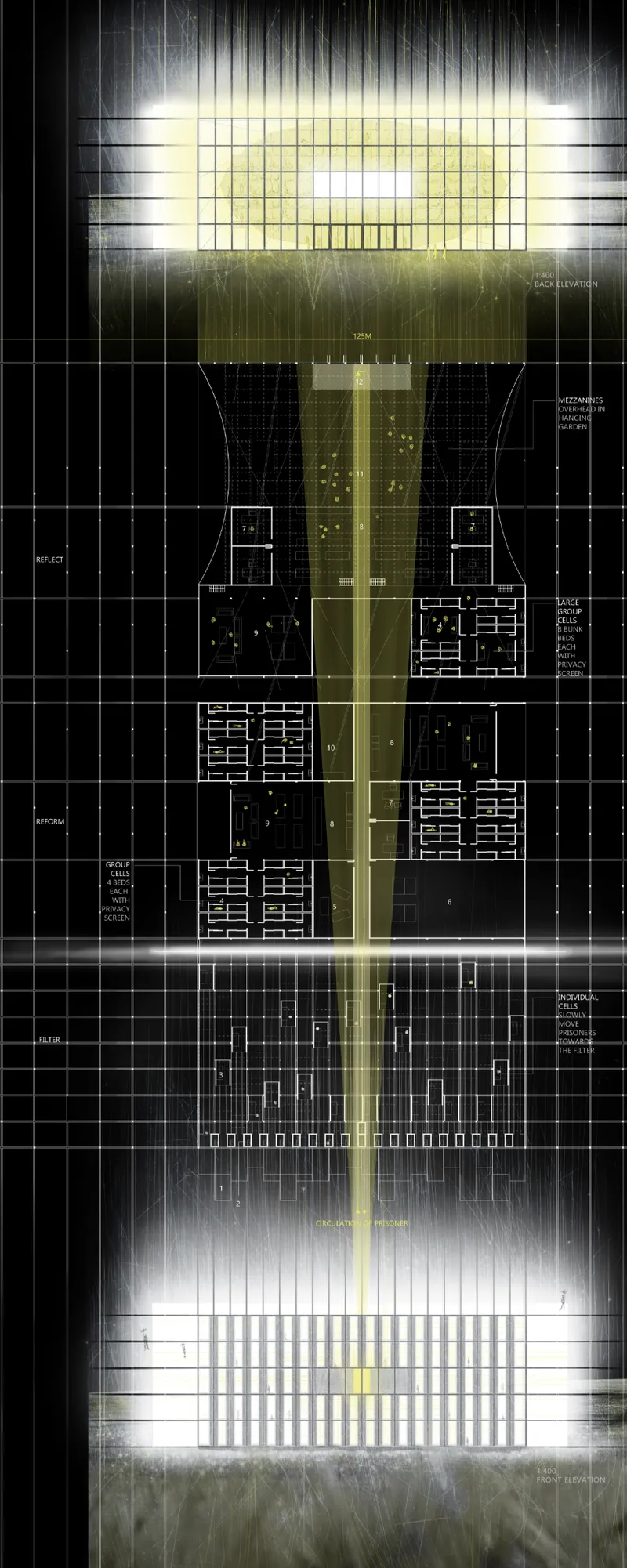
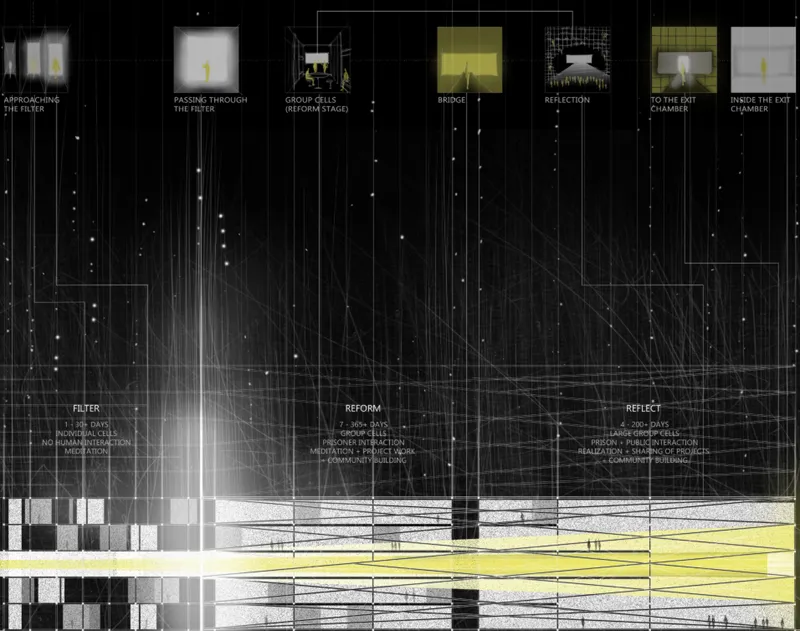
The section drawings reveal the building's organizational spine: a central vertical circulation shaft bathed in yellow light, flanked by the programmatic zones of the three stages. The grid ceiling above the shaft controls how light enters, filtering it in a way that directly mirrors the project's conceptual framework. Everything hinges on this luminous core. It is both the literal and metaphorical center of gravity, the element inmates move toward and through as they progress from entry to reintegration.
The sectional elevation annotates the spatial sequence more explicitly, mapping movement diagrams from the Filter zone through Reform and into Reflect. What stands out is how the architecture compresses and expands around the inhabitant. Tight, stripped-back spaces give way to increasingly open, multi-level environments. The progression is not just symbolic; it is experiential, built into the dimensions and proportions of each room.
Yellow Glass and the Threshold of Entry
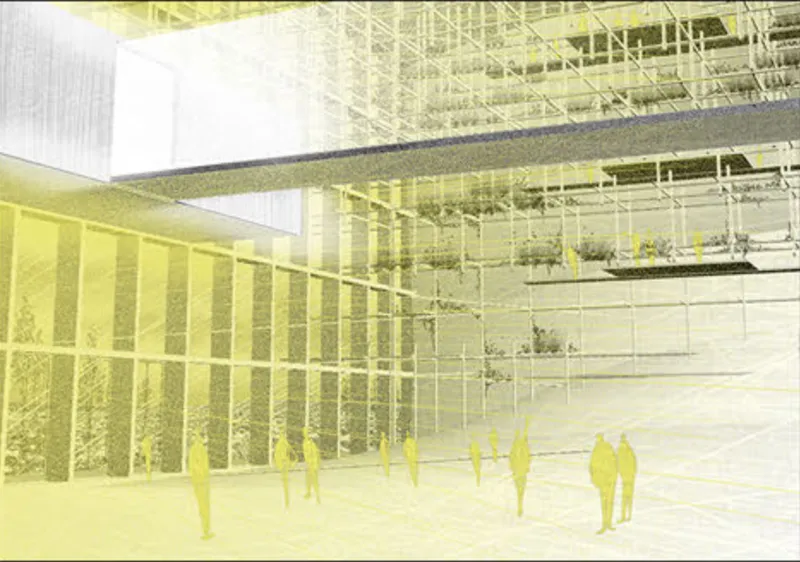
The entry plaza sets the tone immediately. Yellow glass walls enclose the threshold space, casting the entire ground plane in warm, amber light. Figures move beneath an exposed structural ceiling that makes no attempt to conceal its bones. There is something honest about this: the building does not pretend to be anything other than an institution, but it signals from the first step that this institution operates differently. The golden hue is not decorative. It is the project's central material argument, a chromatic cue tied to the idea of restoring inner light.
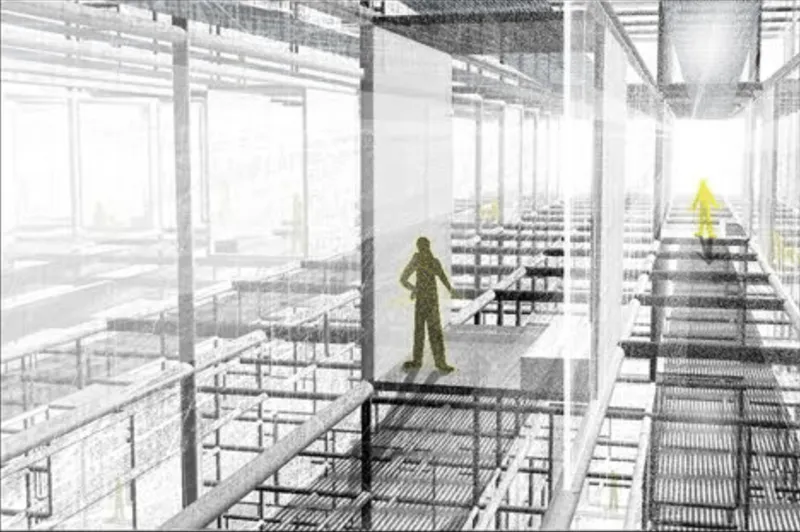
Deeper inside, the interior rendering of a metal grate platform overlooking terraced seating below suggests how the Reform stage might function. A single figure stands elevated, surveying a communal space that steps down in section. The relationship between observation and participation is deliberate: inmates occupy positions that shift between watching and engaging, reinforcing discipline through spatial awareness rather than surveillance cameras and guard towers.
Double Heights, Diagonal Bracing, and the Reflect Stage
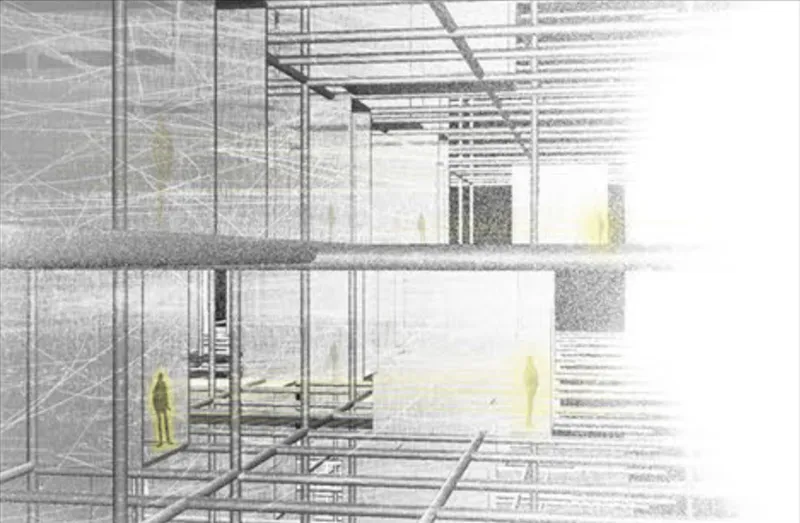
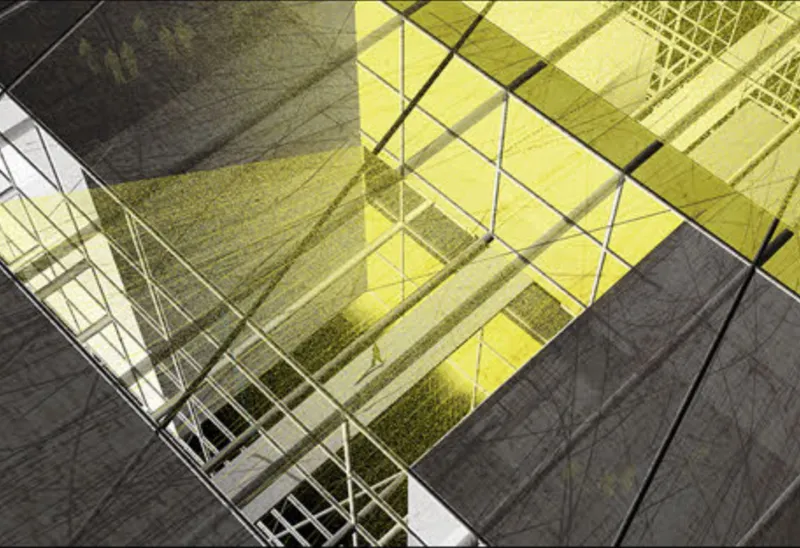
The section perspective through the Reflect stage reveals double-height spaces connected by open stairs, with figures occupying multiple levels simultaneously. The exposed structural frame reads less like a cage and more like a scaffold for communal life. These multi-use spaces are designed for contemplation and eventual reintegration, and the architecture communicates that openness through generous vertical proportions and visual connectivity between floors.
The axonometric view looking down into the yellow-tinted atrium confirms what the sections suggest: diagonal structural bracing creates rhythm and visual complexity without partitioning the space into cells. Figures at ground level appear small against the building's volume, a reminder that the architecture here is scaled to aspiration rather than confinement. The atrium acts as the culmination of the three-stage sequence, a space where the restored "Golden Light" is no longer metaphor but environment.
Why This Project Matters
Prison design is one of architecture's most ethically charged territories, and most proposals either default to utopian naivety or pragmatic grimness. Screen occupies a more interesting position. By framing incarceration as a deliberate spatial sequence, Jafari and Penner avoid the trap of treating rehabilitation as an afterthought bolted onto a punitive box. The Filter, Reform, and Reflect stages give the building a legible narrative, one that inmates experience physically as they move through the structure.
The metaphor of the screen, inverted from a device that darkens consciousness into an architecture that restores it, is sharp and timely. It gives the project a conceptual backbone that is easy to grasp yet rich enough to sustain the spatial complexity on display in the drawings. For a shortlisted competition entry, Screen demonstrates a mature understanding of how light, sequence, and proportion can do work that policies and programs alone cannot.
View the Full Project
About the Designers
Designers: Nahal Jafari, Nick Penner
Enter a Design Competition on uni.xyz
uni.xyz runs architecture and design competitions year-round that reward proposals with spatial conviction and real site intelligence.
Project credits: Screen by Nahal Jafari, Nick Penner Switching Prisons (uni.xyz).


Popular Articles
Popular articles from the community

Temporary Home for Dogs: A Reversed Zoo Rethinks Animal Shelter Architecture
In Bucharest, a sinuous corridor and freed landscape flip the logic of containment, designing a shelter that works to make itself unnecessary.
Tsunami Convergenics: Turning Catastrophic Ocean Forces into Underwater Housing Infrastructure
A speculative underwater settlement off the coast of Onagawa, Japan, treats tsunamis and typhoons as energy sources rather than threats.

Singing Woman: An Opera House That Performs Before the Curtain Rises
Ovidiu Cristian Pavel's conceptual opera house translates Estonia's choral identity into a sculpted waterfront landmark facing the Baltic Sea.

The Amber Palace Opera: A Geological Fiction Surfaces on Tallinn's Baltic Waterfront
Pierre Brillard reimagines a Baltic legend as a public landscape, opera house, and waterfront promenade rooted in Tallinn's coastal identity.

Similar Reads
You might also enjoy these articles

Shakur's House: Exposed Brick as an Interior Organiser in a 168 m² Mashhad Residence
Brick moves indoors in this Mashhad residence, where masonry walls, glass partitions and teal planes sequence a compact home without closing it off.

Day and Night Park: A Time-Based Urban Newsstand in Beijing
A temporary urban newsstand in Beijing blending travel, light, and reading through poetic colors, compact form, and community-focused design.

Modernist Patio Renovation in El Masnou, Barcelona by Oliver Segura Arquitectura + Cebrià Arquitectura
Modernist patio renovation blending tradition and innovation with a movable pool, leveled floors, and Catalan materials in El Masnou.
Alto Residencial Coop: Cooperative Housing Development in Santiago de Compostela by Carbajo Barrios Arquitectos
A linear cooperative housing complex blending white volumes and perforated metal façades, enhancing community living, natural light, privacy, and urban integration.

Comments (0)
Please login or sign up to add comments
No comments yet. Be the first to comment!