
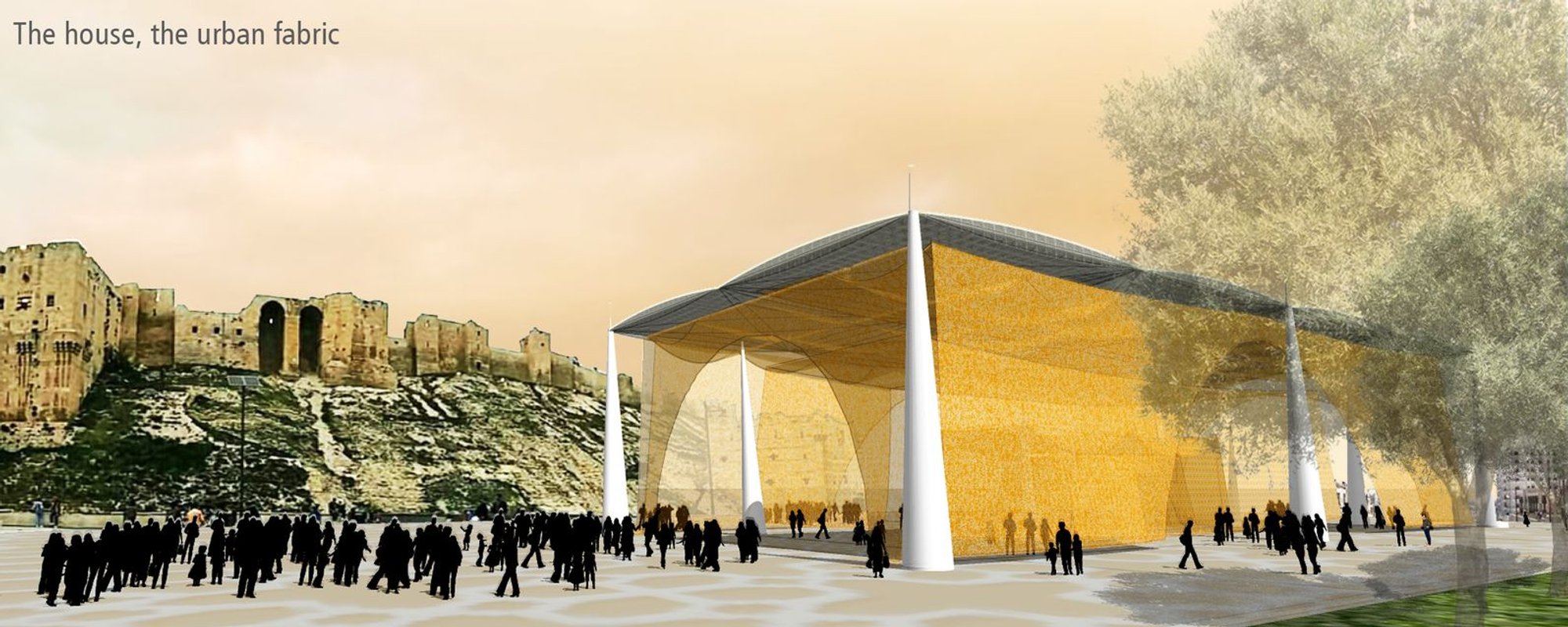
The House, The Urban Fabric: Reclaiming Aleppo Through Urban Reconstruction Architecture
A vision of urban reconstruction architecture that rebuilds Aleppo by restoring its social memory, public spaces, and community identity.

In the heart of Aleppo—a city shaped by centuries of cultural exchange, craftsmanship, and collective memory—the scars of recent conflict remain deeply inscribed upon its urban landscape. The House, The Urban Fabric is an architectural proposal that confronts these layers of history and destruction with a restorative vision rooted in urban reconstruction architecture. Created by Tatiana P, fabian3412, and Arkiworks, the project seeks to rebuild not merely structures, but the very essence of Syrian urban life: its traditions, its circulation patterns, and the communal spirit embedded within its historic neighborhoods.
Through a careful reading of Aleppo’s past and the lived routines of its residents, the project builds upon what existed, acknowledges what was lost, and imagines how the city can reunify in the future. Its design philosophy is grounded in preserving the cultural diary of Syrians—understanding their homes, their souks, their courtyards, and the intricate web of alleyways that once stitched together a thriving community.
From Traditional City to Gathered City
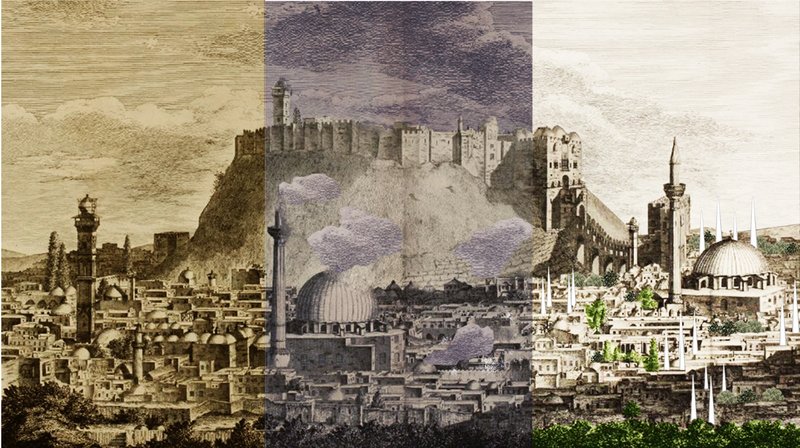
The project positions Aleppo within three overlapping temporal frames:
- Traditional City – The historic, thriving Aleppo with its courtyards, stone façades, shaded markets, and layered public life.
- Destroyed City – A fractured, wounded urban fabric left in the wake of conflict.
- Gathered City – A hopeful future forged through collective regeneration and renewed spatial identity.
The architects map these phases not as separate chapters but as a continuum. The goal is to guide Aleppo from its current state toward a cohesive urban future where public spaces heal, protect, and celebrate community resilience.
The Urban Fabric as Foundation
At the heart of the proposal lies a deep study of Syrian courtyard architecture and the social rituals it sustains. By examining how people move through their neighborhoods—how they pass from alleys into iwans, into courtyards, into communal spaces—the design reconstructs the city from its most intimate scale.
Key Components of the Urban Fabric
- The Cell (The House): Each home becomes a building block of memory and identity.
- The Courtyard: A climatic and social core that organizes everyday life.
- The Alleyway: A connective rhythm where neighbors meet, children play, and communities interact.
- Public Facilities: Spaces designed for gathering, worship, exchange, and debate.
By re-establishing these foundational elements, the project rethreads the textures of Aleppo’s historical fabric—one courtyard, one alley, one gathering space at a time.
Restoring Aleppo’s Essential Public Places
The project prioritizes spaces where Syrians become a community again—locations where memory can be restored, where cultural identity is reclaimed, and where the city begins to recognize itself.
This involves a phased architectural and landscape strategy:
1. Consolidation
- Stabilizing ruins through minimal intervention.
- Protecting water sources and reintroducing jasmine and native plants.
- Honoring fragments of heritage without erasing the marks of war.
2. Rehabilitation
- Restoring old structures and extending them with lightweight, adaptable spatial systems.
- Reimagining historic markets and public nodes as flexible civic spaces.
3. Landscaping
- Using rehabilitated, medium-height, and flowering vegetation to soften damaged urban areas.
- Rebuilding ecological continuity around the Aleppo Citadel.
4. New Building System
A new architectural language emerges, characterized by:
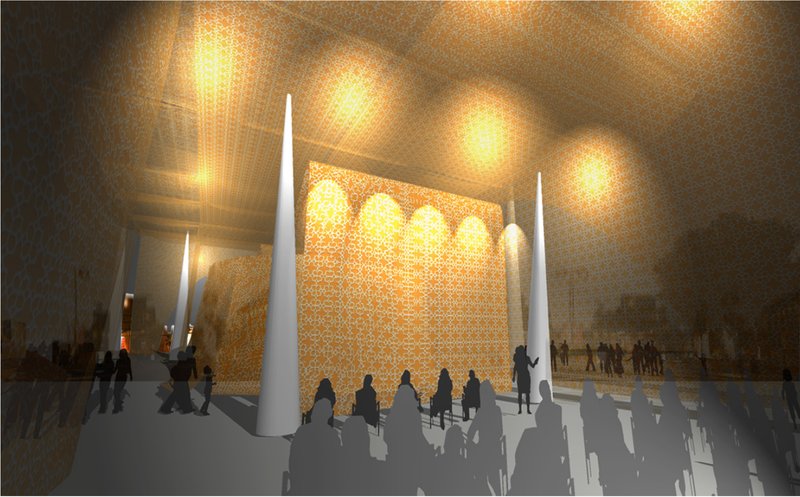
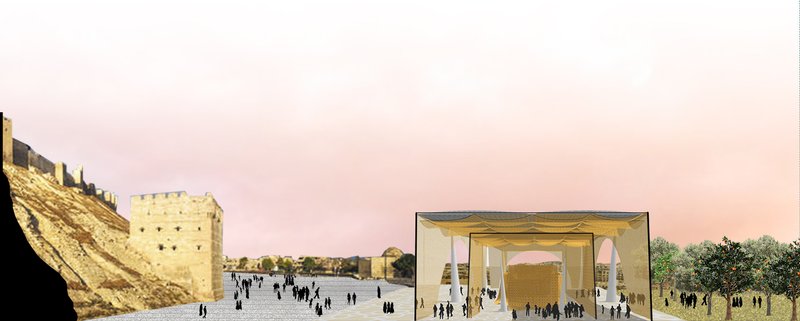
- Clear roofs allowing filtered sunlight.
- Interior and exterior textiles inspired by Syrian geometric patterns.
- Pillars supporting a translucent canopy that frames monumental views.
This hybrid architecture—both contemporary and deeply rooted in tradition—becomes a symbol of renewal.
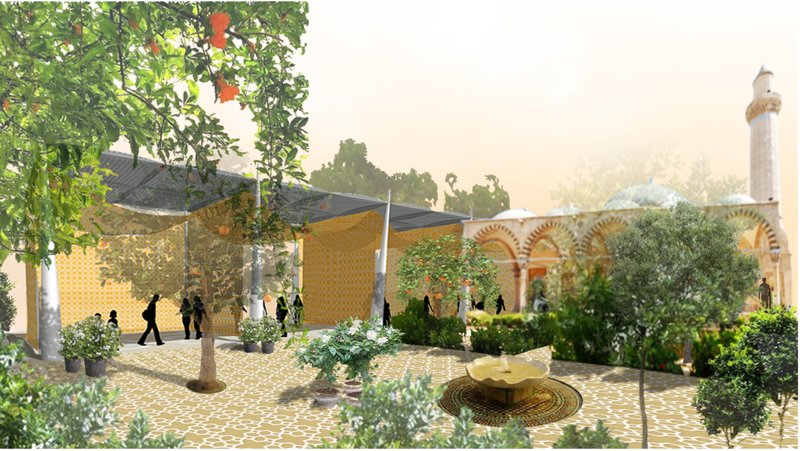
Textile Architecture: A Cultural and Climatic Strategy
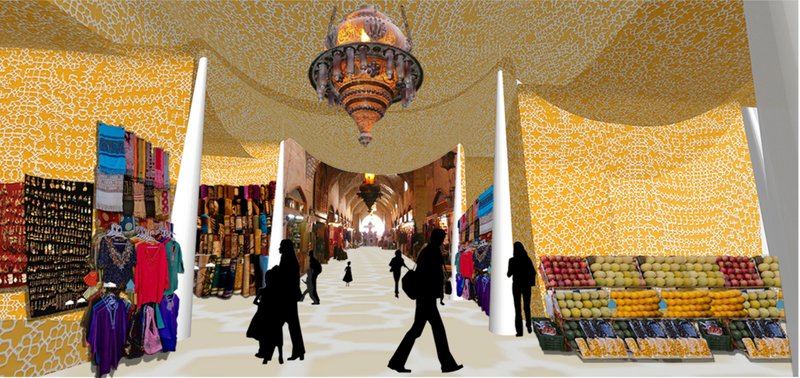
One of the most distinctive elements of the proposal is its use of textile-based structures, a direct reference to Syria’s heritage of weaving, pattern-making, and craftsmanship.
Functions of the Textile System
- Environmental Control: Creates shade, controls wind, and reduces heat during summer months.
- Spatial Flexibility: Textiles can be expanded, overlapped, or condensed depending on the scale of events.
- Cultural Identity: Patterns echo Aleppo’s visual heritage, restoring familiarity and belonging.
- Lightness and Transparency: Allows public gatherings to feel open, breathable, and inclusive.
These airy structures mediate between interior and exterior, between old and new, between memory and transformation.
A Space for Debate, Identity, and Reconstruction
The central public building is envisioned as a hub of civic life—a place where respectful public debate can occur and where Syrians can reconnect with one another and with their city. The architecture recognizes the equality of all people, offering neutral ground for discussion, celebration, and shared experience.
Its flexibility supports:
- Massive public events
- Hybrid indoor-outdoor gatherings
- Souk-inspired small spaces
- Cultural performances, markets, and festivals
As Aleppo moves into a new era, this space becomes a catalyst for social cohesion. By enabling citizens to express themselves, remember their past, and shape their own future, the project invests in long-term community empowerment.
Rebuilding Public Life Through Everyday Spaces
The project extends beyond large-scale architecture. It focuses on the elasticity of spaces that define Syrian domestic and civic life—from small courtyards to expansive event plazas.
By restoring these spaces, the project aims to:
- Rebuild routines disrupted by war.
- Strengthen connections between private homes and public squares.
- Allow neighborhoods to regain a sense of place.
- Reinforce memories tied to landscapes, smells, colors, and textures.
The design revives the multisensory qualities of Aleppo—not only its structures but also its atmosphere.
Light, Climate, and Biodynamic Qualities
Textile canopies and flexible shading systems enhance environmental comfort:
- Filtering sunlight naturally.
- Creating gradations of shade.
- Reducing heat radiation during peak summer.
- Allowing breezes to circulate.
The result is a breathable architectural environment deeply suited to Aleppo’s climate and cultural patterns of outdoor living.
Toward a Gathered, Resilient, Reunified Aleppo
The House, The Urban Fabric is more than a reconstruction project—it is a vision for healing. By grounding the future of Aleppo in its traditional spatial intelligence, the proposal merges memory with innovation, honoring the footprints of the past while opening pathways toward a resilient, unified future.
Through urban reconstruction architecture, Tatiana P, fabian3412, and Arkiworks offer a roadmap where architecture becomes a tool of reconciliation—where rebuilt streets, markets, and courtyards become places of gathering, identity, and hope once again.



Popular Articles
Popular articles from the community

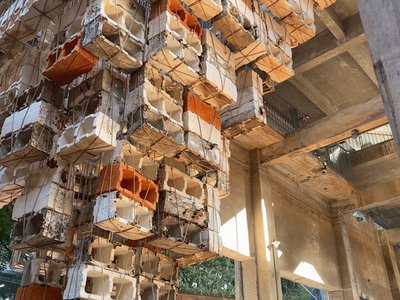
Inverted Architecture Installation by Studio Link-Arc: Exploring the Intersection of Architecture and Living Organisms
Inverted Architecture Installation by Studio Link-Arc blends mycelium, sustainability, inverted design, ecological cycles, and urban adaptive architecture in Shenzhen.


The Ken Roberts Memorial Delineation Competition (Krob)
As the most senior architectural drawing competition currently in operation anywhere in the world, it draws hundreds of entries each year, awarding the very best submissions in a series of medium-based categories.
Atelier Macri Concept Store Interior Design by CASE-REAL
Atelier Macri store features a "ko" counter, walnut wood details, cork displays, blending retail, gallery, and seamless customer experiences.
Alton Cliff House: A Harmonious Retreat by f2a Architecture in Lake Country, Canada
Alton Cliff House blends corten steel, prefabrication, and sustainable design, creating a luxurious, energy-efficient retreat perched on Canadian cliffs.

Similar Reads
You might also enjoy these articles

Digital Façade Design for our cities’ urban fronts
Prima Facie - Result Story
Protecting avian biodiversity: Bird observatories to help spread awareness & save rare bird species.
Results for ‘Fly’ - Landscape design competition out now
Connecting with nature: Forest interpretation center in Australia's Wollemi National Park
‘Asatti’ - Landscape design competition - Result story





Comments (0)
Please login or sign up to add comments
No comments yet. Be the first to comment!