

The story of Mad Hatter Sanctuary
Design Statement

The term ‘Closet’ often portrays a mixed or an extensive meaning depending on the state of usage. Over the period of human existence, we’ve often used metaphors to announce something that’s visible to the eye but remains intangible. The term ‘Closet’ falls in such category. The following is an initial conceptual study on the various interpretations of ‘Closets’ and its meaning within the realm of intimacy.
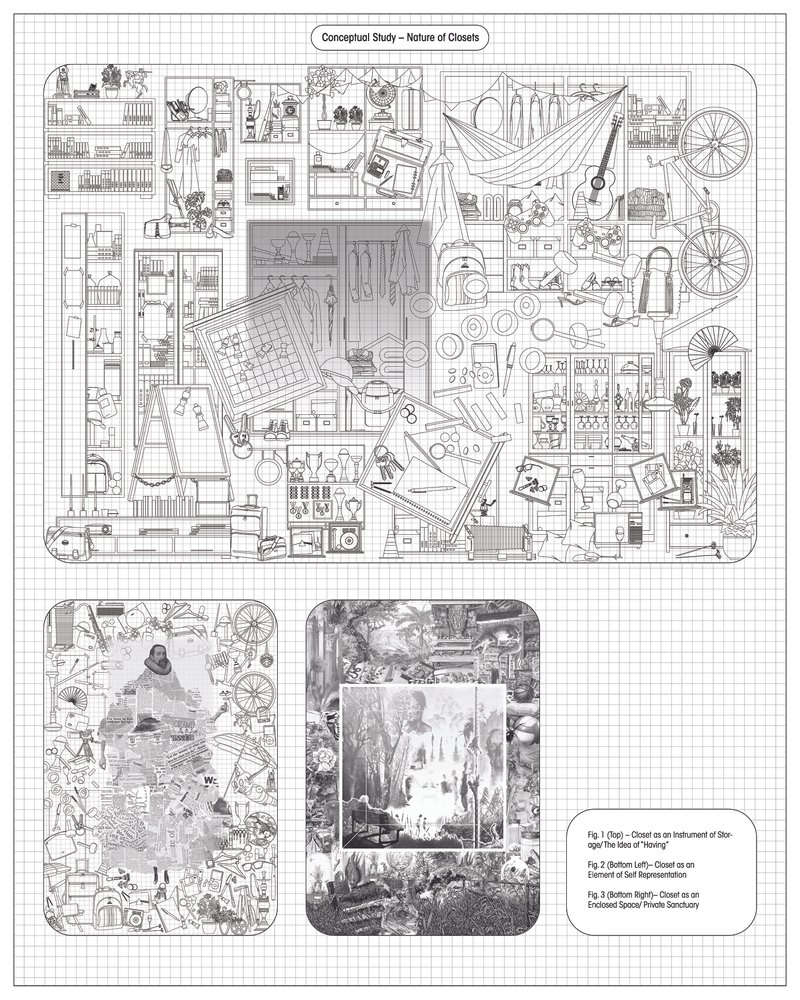
Closet as an Instrument of Storage/ The Idea of “Having” (fig. 1) – Human beings love to collect/purchase things that would suit their lifestyles better, but where would you store the belongings that are not supposed to be on the display? Or how would you keep you room tidy? The interpretation of closet in such a meaning is purely observational and subjective and while the number of objects keep on increasing, we’re often left to find ourselves in the midst of a culture which metonyms accumulation of wealth in terms of material acquisition.
Closet as an Element of Self Representation (fig. 2) – The clothes we wear, the books we read, or the things we store, collectively offers a form of self-representation which is often unsaid. The idea takes inspiration from the queer phrase, “coming out of the closets”, which was initiated in the 60’s and later broadcasted into our lives to promote the acceptance of various sexual orientations.
Closet as an Enclosed Space/ Private Sanctuary (fig. 3) – Between the 14th and 19th century, the term ‘closet’ offered an inhabitable room where one could resort to in the moments to experience solitude. The room often hosted personal objects of private life and thus would be described as a place for retreat, prayer, study or speculate or in other words, it would serve as a “Private Sanctuary”.
Mad Hatter’s Condition
Chapter 7 in Alice in Wonderland, we’re introduced to a peculiar hat maker (also one of the best in the Wonderland), the Mad Hatter. He’s shown as to enjoying tea with his friends and constantly ask riddles which have no meaning to them. But the entire nature of the riddles does provide us with some sense of inner workings of the Mad Hatter.
Apparently, the Mad Hatter is found guilty by the Queen of Hearts for murdering time and thus punished to have a tea party all the time. So, his condition of entrapment in time creates this problem of existentialism with his surroundings. If a person is trapped in time or in other words time remains still for a person, the question of his existence rises not within his own mind but also with his surroundings as well. To exist is to experience time in all its nature.
The Mad Hatter’s personal approach to this condition lies in his constant expression of meaningless riddles (or meaningful). They seem to portray his sense of entrapment and his lack of existence, and his constant agony of perpetual Tea-Time raises this case of designing a closet which would allow him to exist in another world, in dreams or in daydreams.
Design Proposal
The proposal aims to create an event of ‘whiteness’ which would allow the Mad Hatter to reverie and escape his state of capital punishment.
The idea is taken from the initial ‘Closet’ study where its portrayed as an inhabitable room or a ‘Private Sanctuary’. As the existence of the Mad Hatter is called into question, a potential solution aims to sympathize with his condition of non-existence and provides a space to speculate or daydream.
A series of translucent cardboard sheets are assembled on a suspended ceiling structure from which spaces are hollowed out to provide areas for sitting, sleeping, and contemplating. The use of translucent cardboard sheet provides us with an opportunity of play between privacy and transparency while blending with the surrounding as well.
By creating this sort of layered closet, the appearance tries to focus on the negative spaces left within a closet which is a metonym for hiding inside these closets. I remember when I was a kid, I would often hide inside a closet or a wardrobe and escape to the magical world of daydreaming.



Popular Articles
Popular articles from the community

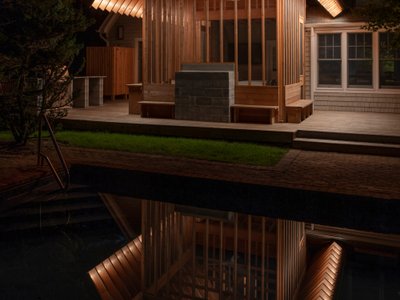
BLDUS Turns a 250-Square-Foot Screened Porch into a Pine Forest Temple in East Hampton
A gabled cedar pavilion mimics the rhythm of surrounding pines, anchoring a 1990s wooded home to its hollow in Long Island.

Johnston Architects Reimagines the Methow Valley Hay Barn as a Small-Town Library in Winthrop
A 7,300-square-foot timber library channels the region's agrarian vernacular to serve a rural Washington community of 400 year-round residents.

VEIVE Architects Builds a Mountain Hostel That Disappears into a Hangzhou Hillside
On the Huihang Ancient Trail in Xiangjian Village, a shelter of wood, steel, and rammed earth roots itself in the rural landscape.
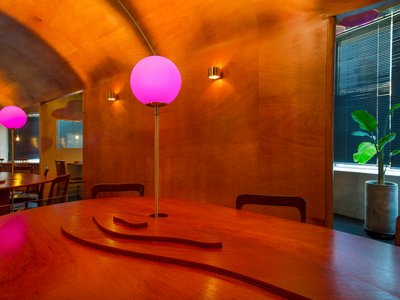
Indiesalon Carves a Plywood Cave into a Seoul Bistro's Second Floor
Munhwa Bistro's second Seongsu branch wraps diners in a laminated timber vault laced with colored light and mirror illusions.


Similar Reads
You might also enjoy these articles

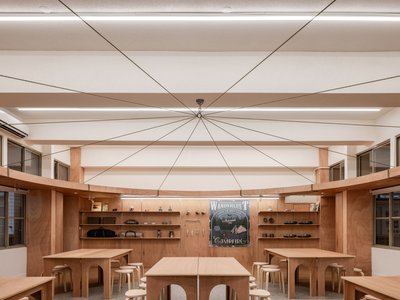
317studio Turns an 87 m² Classroom into a Forest Clearing for Scouts in New Taipei City
A rope canopy, student-made specimens, and campfire geometry replace rows of desks in this Scouting classroom in Xizhi District.
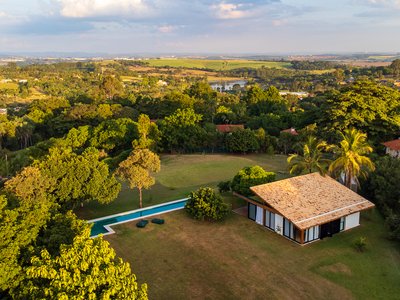
24 7 Arquitetura Builds a Timber Pavilion as a Family's First Act on a 5,000 m² Brazilian Plot
In Jaguariúna, a prefabricated glulam house nestles among mature trees as the opening move of a larger residential masterplan.
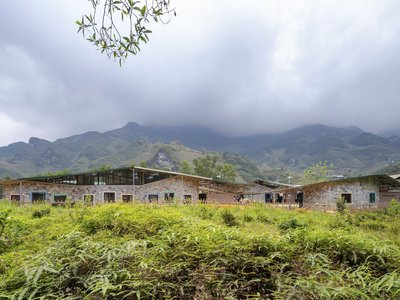
1+1>2 Architects Build a School from 900 Blocks of Hmong Stone on Vietnam's Rocky Plateau
On a barren valley in Ha Giang province, a community quarried its own stone to raise a kindergarten and primary school rooted in Hmong identity.
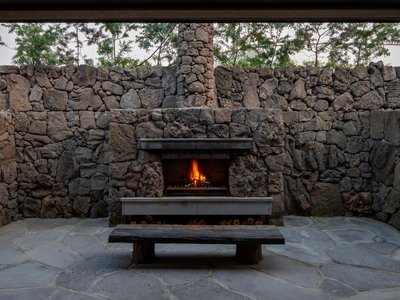
100A Associates Builds a Volcanic Stone Retreat on Jeju Island Rooted in Ritual and Restraint
Watarstay [Wa:Tar] in Bongseong-ri channels Jeju's basalt, reed, and hemp into a 150 m² hospitality space shaped by contemplation.


Explore Product Design Competitions
Discover active competitions in this discipline




The Global Benchmark for Architecture Dissertation Awards

Design challenge to equip cities with modern furniture


Packaging challenge - Design meets sustainability
Comments (0)
Please login or sign up to add comments
No comments yet. Be the first to comment!