

The Unplugged City: Twin Towers That Float Above Urban Limits
A pair of interconnected vertical structures reimagine high-density living through radial planning, shared infrastructure, and sky-bound urbanism.


What if the next city didn't sprawl outward but lifted off entirely? The Unplugged City proposes exactly that: two floating hybrid towers, cylindrical and interconnected, rising above the urban plane to form a self-sufficient vertical settlement. The project refuses the conventional tower typology of stacked, isolated floors. Instead, it treats the pair of structures as a single architectural ecosystem, weaving residential, commercial, and public programs into a continuous spatial matrix held together by shared circulation, communal terraces, and renewable energy systems.
Designed by Rabah Saoud, Aseel Mohammad Mansour, and Nasma Yasir Abdulhaleem, the project was submitted as an Institutional Excellence Award entry in the Hybrid Futures '19 - Work x Fly competition. The brief asked designers to confront the future of work and mobility, and this team responded with a provocation: a city that unplugs from the ground altogether, challenging how we define occupancy, density, and urban territory when land itself is no longer the starting condition.
Twin Cylinders, Gridded Skins, Spiraling Crowns
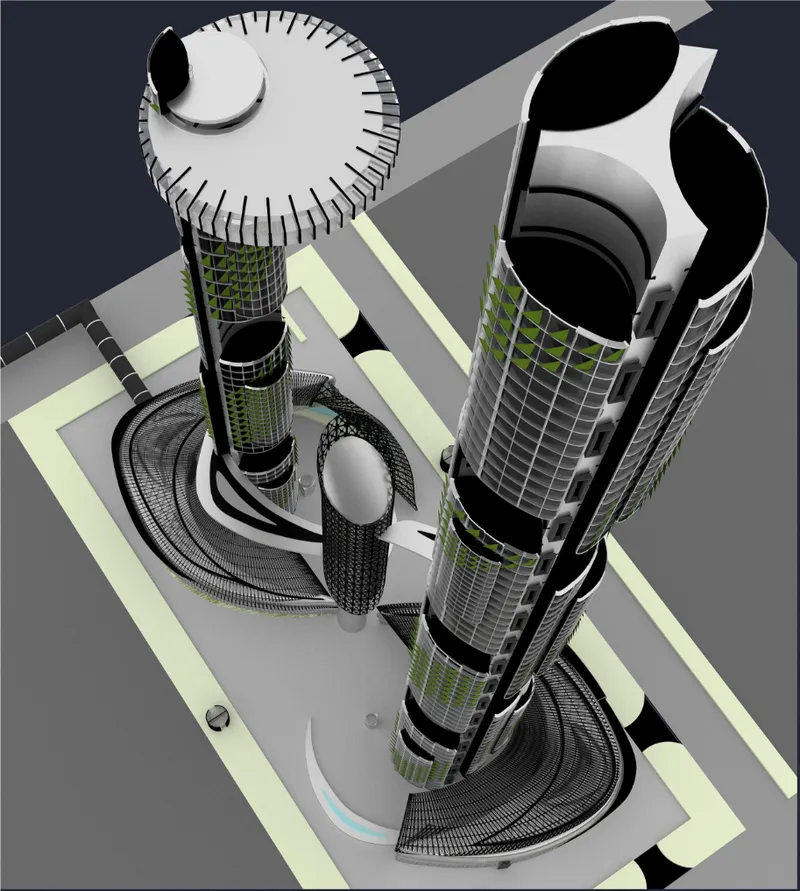
The axonometric drawing reveals the core formal logic: two cylindrical towers, each wrapped in a gridded facade that suggests a modular, repeatable structural system. The volumes are topped with spiraling disc-shaped roofs that appear to peel away from the body of each tower, creating canopied terraces at the upper levels. The grid does double duty. It is both structural armature and environmental filter, regulating light and air across the full height of each tower. The spiral crowns are more than sculptural flourishes; they signal the project's commitment to layered, continuous surfaces rather than flat terminations, hinting at the helical circulation that organizes movement within.
Capsule Interiors and the Hybrid Workspace
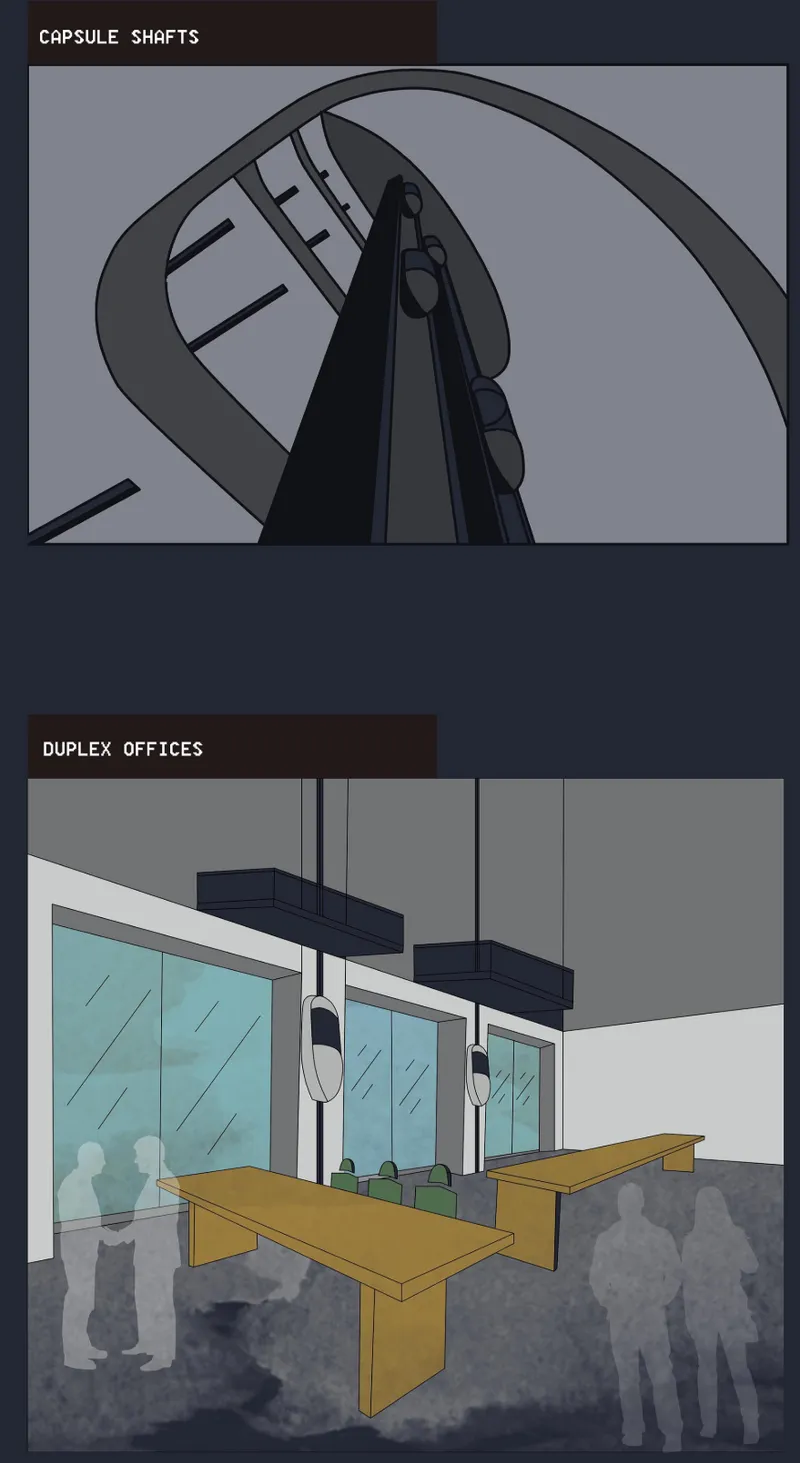
Step inside and the scale shifts dramatically. The interior rendering shows a curving capsule shaft, its walls bending around a duplex office volume fitted with yellow benches and populated with figures at work and in conversation. The space reads as neither pure office nor pure lounge. It occupies that productive middle ground the competition brief was chasing: a place where work and social life are not separated by floors or walls but coexist within a single, smoothly contoured enclosure. The curvature of the capsule shell eliminates hard corners, producing a sense of continuous flow that mirrors the tower's cylindrical exterior.
Sectional Logic: Vertical Circulation as Urban Infrastructure
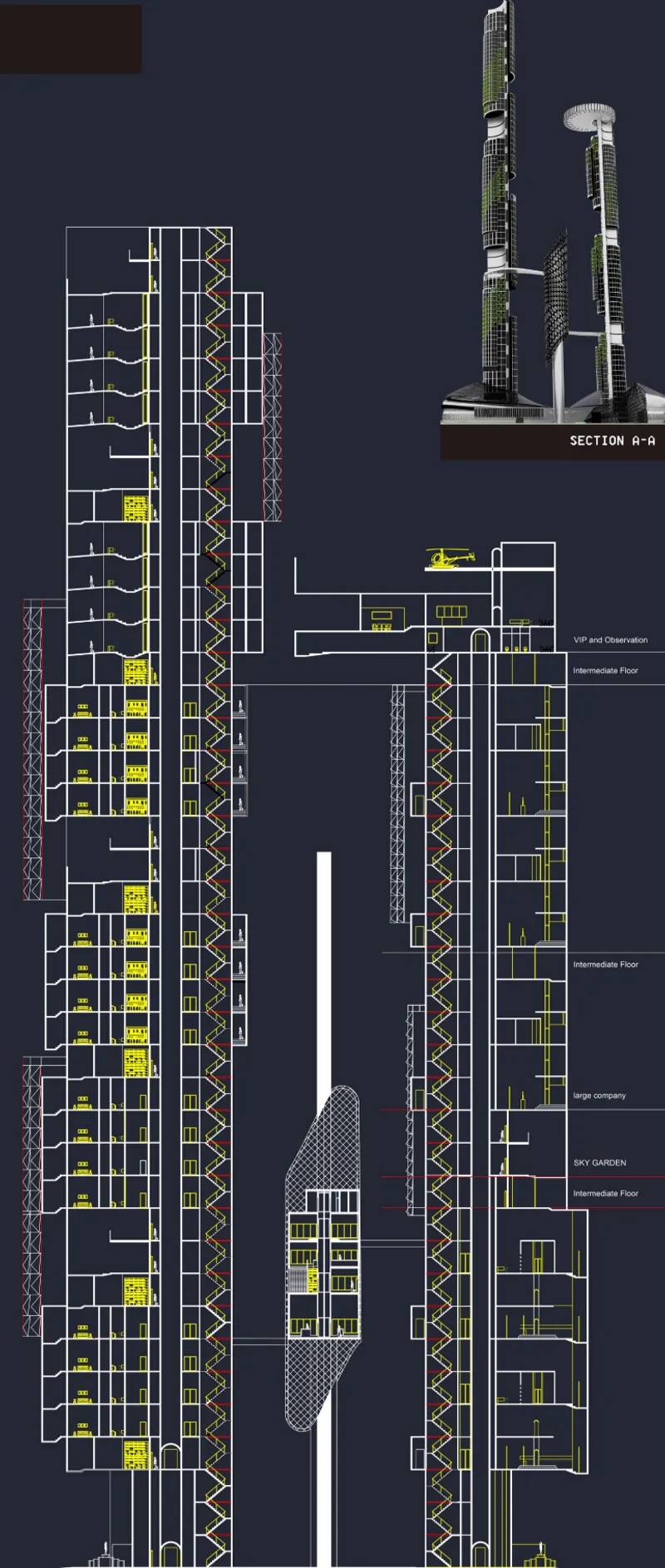
The section drawings cut through both towers simultaneously, exposing the vertical circulation cores and the distribution of program across height. Yellow-highlighted spaces mark zones of communal activity, public interface, or energy infrastructure, punctuating the residential and office floors at regular intervals. What becomes clear in section is that these towers are not simply stacked floor plates. The circulation system links programs vertically the way streets link buildings horizontally. Elevators, ramps, and connecting bridges form a three-dimensional infrastructure network, turning movement itself into an urban experience rather than a utilitarian transfer between levels.
Radial Plans: Organizing Life Around the Core
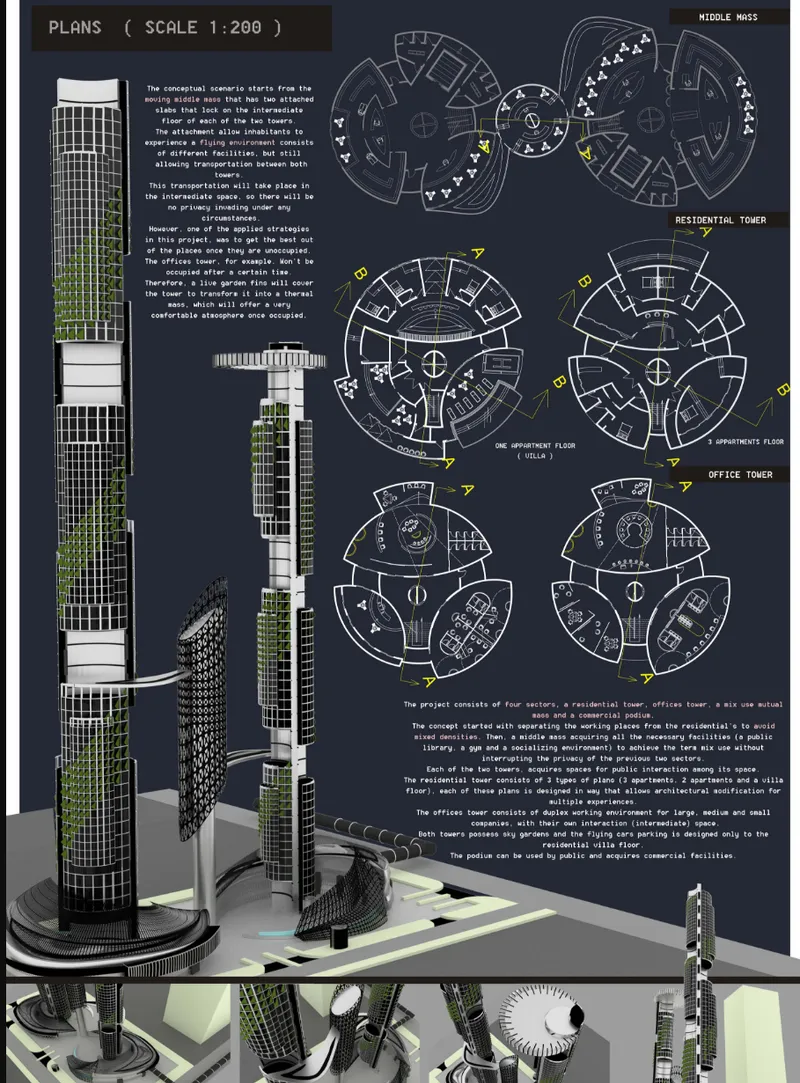
The plan drawings at multiple levels show how each tower's circular footprint is subdivided through radial room divisions. One tower is organized for residential use, the other for office and mixed-use functions, but both share the same geometric discipline: rooms fan outward from a central core like slices of a wheel. This radial logic maximizes perimeter exposure, ensuring that every unit or workspace touches the facade and receives natural light and ventilation. It also creates a legible spatial hierarchy, from the dense, serviced core to the inhabited periphery, that users can navigate intuitively regardless of which level they occupy.
The Full Vision: Sketches, Diagrams, and Green Terraces
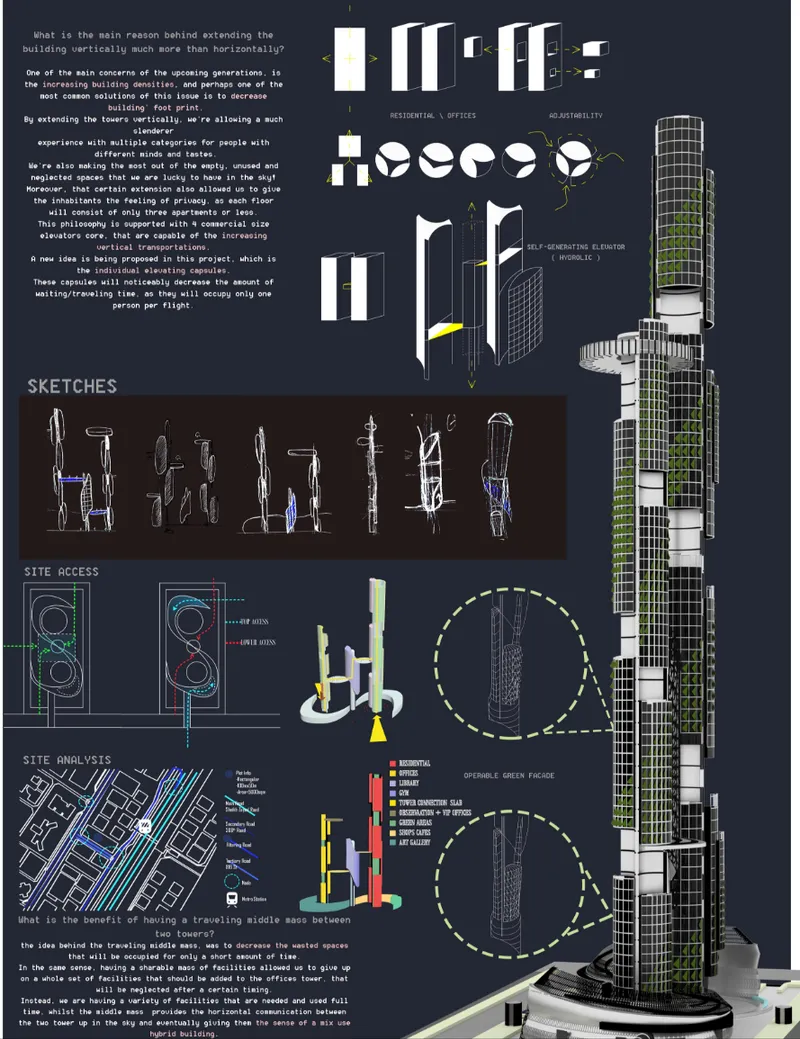
The presentation board assembles the full design narrative: early sketches, analytical diagrams, site plans, and an elevation of the double-helix tower configuration complete with green terraces stepping up the facade. Seen together, these drawings make the case that the project is not merely speculative sculpture but a rigorously developed proposition. The green terraces introduce planted surfaces at regular intervals, reinforcing the project's sustainability ambitions and softening the otherwise hard geometry of the gridded cylinders. The double-helix reading of the tower pair, visible in elevation, suggests that the two structures are not just neighbors but are genetically intertwined, each one incomplete without the other.
Why This Project Matters
The Unplugged City operates at the intersection of provocation and plausibility. Its floating premise is deliberately extreme, but the spatial systems underneath it, radial planning, continuous vertical circulation, hybridized programs, renewable energy integration, are grounded in real architectural problems. The project's strength lies in treating two towers not as independent objects but as halves of a single urban organism, sharing infrastructure and identity in a way that most twin-tower developments never attempt.
For a competition that asked designers to reimagine work and mobility, this entry delivers a clear answer: dissolve the boundaries between living, working, and moving by embedding all three into a single vertical structure that operates on its own terms. It is a reminder that density does not have to mean congestion, and that altitude, when paired with intelligent spatial organization, can offer a kind of freedom that horizontal cities struggle to provide.
View the Full Project
About the Designers
Designers: Rabah Saoud, Aseel Mohammad Mansour, Nasma Yasir Abdulhaleem
Enter a Design Competition on uni.xyz
uni.xyz runs architecture and design competitions year-round that reward proposals with spatial conviction and real site intelligence.
Project credits: The Unplugged City by Rabah Saoud, Aseel Mohammad Mansour, Nasma Yasir Abdulhaleem Hybrid Futures '19 - Work x Fly (uni.xyz).


Popular Articles
Popular articles from the community


GROUP A Strips a 1969 Rotterdam Harbor Headquarters to Its Frame and Wraps It in Timber Louvers
In Rotterdam's M4H harbor district, Ferro Offices reuses a 1969 frame, adds one timber storey and reaches BREEAM-NL Outstanding.

Juan García Correa, John González and Claudia Rueda Sink a Circular Amphitheater into a Manizales Engineering Building
On the La Nubia campus in Manizales, Colombia, the S1 Building folds labs and offices into a hillside of ramped lawns that double as a campus route.

Architekt Andreas Gruber Scatters 23 Dark Timber Chalets Across a South Tyrolean Forest Edge
In Molini di Tures, Amonti Chalets breaks a resort into a hamlet of gabled timber houses, with parking, storage and services pushed into the slope.

David Macias Steps a Doorless Stone and Plaster House Down a Tropical Colombian Hillside
In the humid hills of Colombia, Threshold House replaces the front door with an open void and terraces its 850 m² down the slope instead of fighting it.

Similar Reads
You might also enjoy these articles


Vereda Arquitetos Renovates a 40-Square-Meter Apartment Inside Niemeyer's Copan Building
A compact unit in São Paulo's most iconic residential tower gets a material overhaul that pairs exposed concrete with bold blue Formica.

Shakur's House: Exposed Brick as an Interior Organiser in a 168 m² Mashhad Residence
Brick moves indoors in this Mashhad residence, where masonry walls, glass partitions and teal planes sequence a compact home without closing it off.

Day and Night Park: A Time-Based Urban Newsstand in Beijing
A temporary urban newsstand in Beijing blending travel, light, and reading through poetic colors, compact form, and community-focused design.

Modernist Patio Renovation in El Masnou, Barcelona by Oliver Segura Arquitectura + Cebrià Arquitectura
Modernist patio renovation blending tradition and innovation with a movable pool, leveled floors, and Catalan materials in El Masnou.

Explore Future City Competitions
Discover active competitions in this discipline

Challenge to design a shop stop sunk in the city

Render competition to represent the city as a machine

Design challenge to equip cities with modern furniture
Comments (0)
Please login or sign up to add comments
No comments yet. Be the first to comment!