
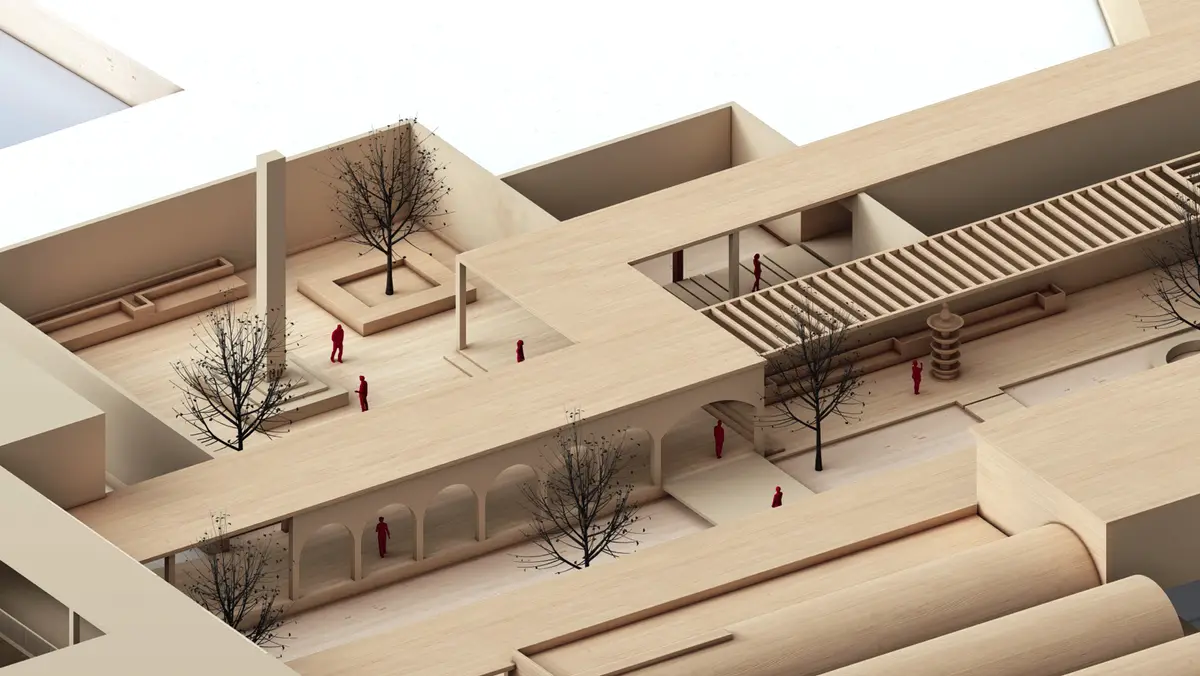
Thripooram
An Immersive Cultural Experience Center: Celebrating Thrissur Pooram

Architectural Concerns
Thrissur, often hailed as the cultural capital of Kerala, is a city where festivals, rituals, and traditions shape collective identity. At the heart of this cultural fabric lies the Thrissur Pooram, a festival that has transcended centuries to become not only a religious celebration but also a spectacle of music, procession, and performance. Known as the “Pooram of all Poorams,” it embodies the collective rhythm of the city, temples, artisans, musicians, elephants, fireworks, and above all, people uniting in a shared cultural moment. However, in recent years, the grandeur of the Pooram has faced mounting challenges. Issues of pollution, overcrowding, animal welfare concerns, and the growing commercialization of rituals threaten to diminish the authenticity of the festival. Unless carefully preserved and interpreted, the cultural richness of Pooram risks being reduced to a spectacle detached from its heritage roots.
Parallel to this concern is Thrissur’s struggle with cultural tourism. Despite its strong identity, tourism statistics indicate that Thrissur lags behind other districts such as Ernakulam and Thiruvananthapuram. Visitors arrive in large numbers during the Pooram season but have little reason to remain engaged with the city throughout the year. This highlights a gap in infrastructure, spaces that can extend cultural experiences beyond festival days, provide interpretation for visitors, and celebrate Thrissur’s unique identity consistently. Without such spaces, the city’s cultural narrative is left fragmented, limiting its potential for tourism-driven economic growth.
Another concern is the lack of platforms for artisans, craftsmen, and local communities who sustain the Pooram through their skills and traditions. Anachamayam artisans, percussionists, and ritual specialists are vital to the Pooram but often remain on the periphery, without opportunities for year-round engagement or recognition. As younger generations drift away from traditional practices, the transmission of skills becomes uncertain. Architecture, in this context, must act as a cultural instrument, preserving intangible traditions, enabling new forms of engagement, and offering economic sustenance to those who keep the festival alive.
The Immersive Cultural Center emerges from these concerns as a proactive response. By reinterpreting Thrissur Pooram through an architectural lens, the project seeks to safeguard its essence, engage the public in a year-round cultural journey, and create new platforms where heritage, tourism, and community support converge.
Architectural and Conceptual Strategies
The design of the Thripooram Immersive Cultural Experience Center is conceived as a cultural ecosystem, weaving together heritage preservation, economic sustenance, and participatory engagement. Central to its strategy is the creation of a narrative journey, translating the rituals and sequences of Thrissur Pooram into spatial experiences. The program includes an immersive cultural center, craft studios, workshop spaces, a souvenir market, and an open amphitheater, supported by interactive elements such as digital installations, projection mapping, and VR exhibits. This blend of physical and digital experiences ensures that visitors not only witness but also engage with the cultural layers of Pooram.
The project adopts a spatial narrative approach. Four major thematic zones—History of Thrissur Pooram, Pooram Preparations, Pre-Pooram Rituals, and Pooram Day—guide visitors through the evolving story of the festival. This progression mirrors the anticipation, rhythm, and climax of Pooram, making the architecture itself a storytelling device. Alongside, mental mapping techniques, inspired by processional routes and pause points of the Pooram, are integrated into the spatial planning, ensuring the journey resonates with cultural memory.
The Panchabhootha concept (Earth, Water, Fire, Air, Space) anchors the project symbolically and climatically. Laterite and terracotta reflect the element of Earth, while water courts and reflective surfaces represent purification and rhythm. Fire is evoked through dramatic lighting that recalls fireworks, Air through open courtyards and ventilated spaces, and Space through vast gathering halls that replicate the collective energy of Pooram. In this way, the building embodies cultural symbolism while addressing environmental responsiveness.
The strategy extends beyond the building. A narrative street introduces visitors to Thrissur’s story even before they enter the center. Inspired by the annapalla mathil of Vadakkumnathan Temple, the compound wall is designed with glow-in-the-dark elements, creating a symbolic threshold between the city and the cultural world inside. This street is animated with an open library, public art spaces, and pavilions, reinforcing community participation. Upon exiting the building, visitors are taken to a landscaped area inspired by Thekkinkadu Maidan, with trees, seating areas, and temporary exhibition spaces that reflect the spirit of Thrissur’s gathering ground. Additionally, the relocation of the Golden Market near the road ensures that visitors are connected to a vibrant marketplace, echoing the temporary stalls and shopping experiences of Thrissur Pooram. This extension of the program outside the building ensures continuity between architectural space and urban life, transforming the project into a holistic cultural corridor.
Architectural Language
The architectural language of the Thripooram Immersive Cultural Center reflects a deliberate balance between tradition and modernity, memory and innovation. Rather than imitating historic forms, the design interprets the cultural spirit of Thrissur Pooram through abstracted architectural expressions that are sensory, symbolic, and experiential. Spatial sequencing mirrors the crescendo of the festival, moving from smaller, intimate storytelling spaces to expansive gathering courts that resonate with the collective celebration of Pooram Day.
Material expression grounds the architecture in its context. Locally available laterite and terracotta dominate, imparting an earthy, tactile quality that connects to Thrissur’s heritage. Timber detailing and stone textures evoke temple architecture, while glass, tensile canopies, and modern projection surfaces introduce contemporary layers. This juxtaposition reflects the dual ambition of preserving tradition while making it accessible to modern audiences. The surfaces of walls and installations are treated as narrative canvases, embedding cultural motifs and symbolic patterns that allow spaces to resonate visually even when unoccupied.
Light and sound are critical elements of the architectural language. Daylight filters through perforated walls to create rhythmic shadow patterns reminiscent of temple courtyards, while dynamic illumination animates night-time spaces, echoing the Pooram’s fireworks and lamp-lit rituals. Acoustic design enhances the auditory experience, immersing visitors in the layered sounds of percussion ensembles. Sensory dimensions of smell and touch are also engaged—incense, flowers, and textured surfaces create a multi-sensory recall of festival moments.
The external spaces further extend this narrative. The narrative street, glowing with motifs inspired by Vadakkumnathan’s annapalla mathil, sets the tone for cultural storytelling. The landscape zone, modeled after Thekkinkadu Maidan, offers shaded courts, tree groves, and exhibition spaces that recreate Thrissur’s vibrant public realm. The relocation of the Golden Market connects the project with economic activity, reinforcing the idea that culture and commerce have always coexisted during Pooram. These interventions ensure that the project is not confined to a building but resonates as part of the urban experience.
Sustainability is seamlessly integrated into the architectural language. Passive cooling through courtyards, rainwater harvesting, cross-ventilation, and the use of local materials align with ecological wisdom. Thus, the architecture embodies both cultural symbolism and environmental responsibility. In essence, the Thripooram Experience Center becomes an immersive narrative in itself—an architectural interpretation of Thrissur Pooram that is celebratory yet contemplative, local yet global, ephemeral yet enduring.

Popular Articles
Popular articles from the community

Tsunami Convergenics: Turning Catastrophic Ocean Forces into Underwater Housing Infrastructure
A speculative underwater settlement off the coast of Onagawa, Japan, treats tsunamis and typhoons as energy sources rather than threats.

The Amber Palace Opera: A Geological Fiction Surfaces on Tallinn's Baltic Waterfront
Pierre Brillard reimagines a Baltic legend as a public landscape, opera house, and waterfront promenade rooted in Tallinn's coastal identity.
Faces of the Soviet Avant-Garde: Turning Moscow's Street Names into an Open-Air Museum
A network of sculptural installations across a Moscow residential district transforms forgotten architect names into spatial encounters with cultural memor
Opera by the Sea Estonia: Three Shells Dissolving Architecture into Tallinn's Coastline
A winning opera house proposal replaces monumental form with interconnected shells that blur the boundary between building, park and Baltic Sea.

Similar Reads
You might also enjoy these articles
The Rhythm of Seasons
A Farmers' Market Connecting Nature and the City

More Than a Building-Designing a Living System
More Than a Building-Designing a Living System
Base Beyond
DESERT COMPOUND ARID: TOURISM OF ABSENCE AND ABUNDANCE


Comments (0)
Please login or sign up to add comments
No comments yet. Be the first to comment!