
Tintim Atrae: 3D-Printed Earth Housing for 30 Families in Northern Ghana
A modular settlement in Bolgatanga uses earth-based 3D printing and passive cooling strategies rooted in Ghanaian vernacular architecture.


What if the oldest building material on earth could solve one of its most pressing contemporary crises? Tintim Atrae takes that question seriously. Sited in the semi-arid climate of Bolgatanga in northern Ghana, the project proposes a 30-family housing settlement constructed almost entirely from locally sourced soil and clay, deposited layer by layer through earth-based 3D printing. The result is a dense, courtyard-oriented community that reads as both ancient and radically new: traditional Ghanaian spatial patterns rendered through digital fabrication.
Designed by Kacper Magiera and published on uni.xyz, Tintim Atrae positions itself against the tide of industrial materials that dominate contemporary construction across West Africa. Instead of importing concrete and steel, the project extracts earth on site, prints structural walls from it, and repurposes the excavated voids as rainwater harvesting tanks or geothermal temperature regulators. It is a circular logic applied to the most fundamental act of building: shaping ground into shelter.
Clustered Volumes and Planted Courtyards
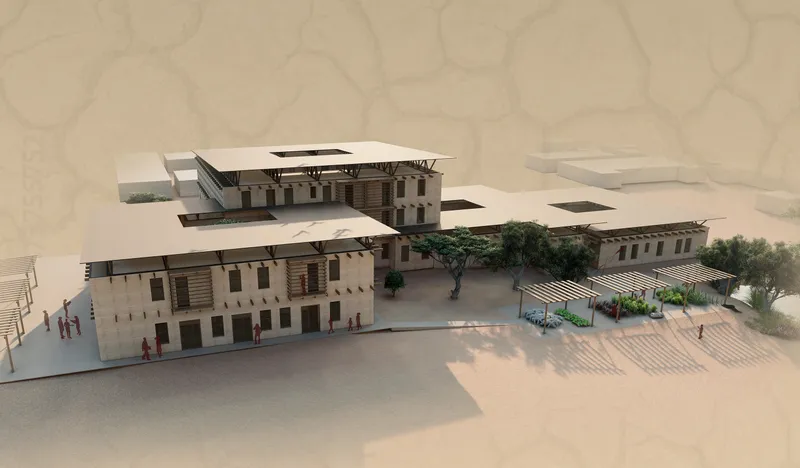
The physical model reveals the settlement's organizational DNA: flat-roofed volumes clustered around shared courtyards planted with trees and low vegetation. This layout echoes the social and spatial logic of rural Ghanaian settlements, where community life happens in the interstitial spaces between buildings rather than within them. The modular arrangement allows for scalability; units can be added or reconfigured as families grow or new residents arrive.
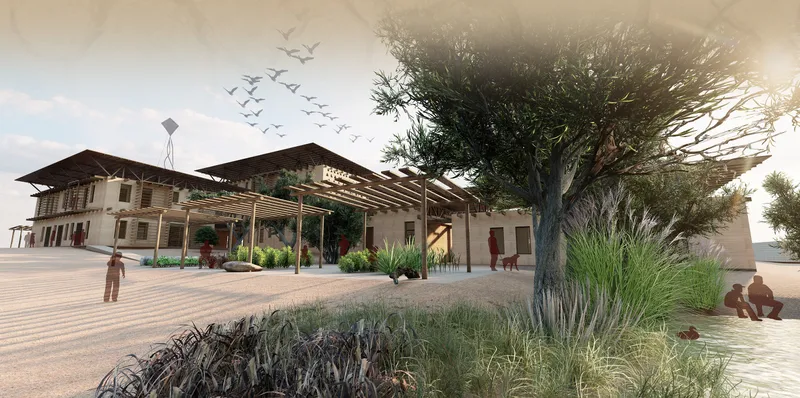
The rendered exterior view confirms that the architecture maintains a low, grounded profile against the landscape. Timber pergolas extend from the earth walls to shade thresholds and transition zones between indoor and outdoor space. A large tree anchors the foreground, a reminder that the project's planting strategy is not cosmetic. Trees provide shade, reduce ambient temperature, and anchor the loose laterite soil against wind erosion, all critical functions in a region where the dry season is long and unforgiving.
A Second Skin for Passive Cooling
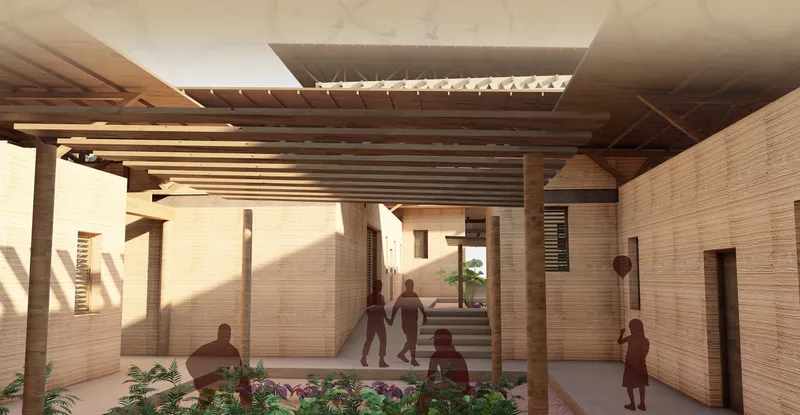
Thermal comfort drives the section. The design deploys a "second-skin" strategy: an outer wall layer that shields the inner living spaces from direct sunlight while permitting airflow through the gap between them. The covered courtyard passageway shown here demonstrates how this works at the ground level. Exposed timber beams cast rhythmic shadows across rammed earth walls, while planted beds at the base of the walls introduce evaporative cooling. The shaded arcade is both circulation spine and climate device.
Above, raised roof structures enable stack ventilation, drawing hot air upward and releasing it through clerestory vents. The orientation and pitch of each roof element were calibrated against prevailing wind patterns and solar angles specific to Bolgatanga. No mechanical cooling is used. The result is a building that breathes through its own geometry, a critical advantage in a region where energy access is unreliable and electricity costs can consume a significant share of household income.
Light, Air, and a Tree Growing Through the Atrium
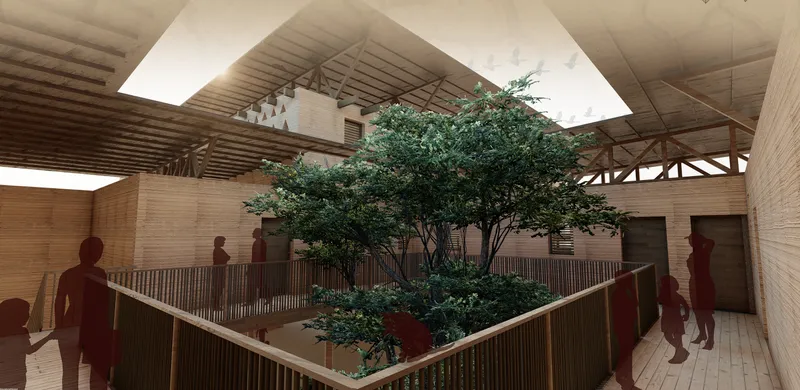
The interior atrium is perhaps the project's most compelling spatial moment. A tree rises through the center of the volume, its canopy reaching toward skylights that wash the surrounding timber railings in diffused light. This is not decorative planting; the tree functions as a biological cooling element, its transpiration lowering the air temperature within the atrium and its canopy filtering harsh overhead sun. The skylight geometry is tuned to admit daylight without the solar gain that would overheat the space.
Timber railings on upper levels suggest a multi-story section, with dwellings or shared spaces opening onto the atrium from above. The vertical organization creates a social gradient: public life at the ground plane, domestic life above, and the tree as a shared vertical axis connecting them. It is a spatial arrangement with clear precedent in Sahelian and West African courtyard typologies, reinterpreted here with contemporary structural means.
Kente Patterns as Solar Screens
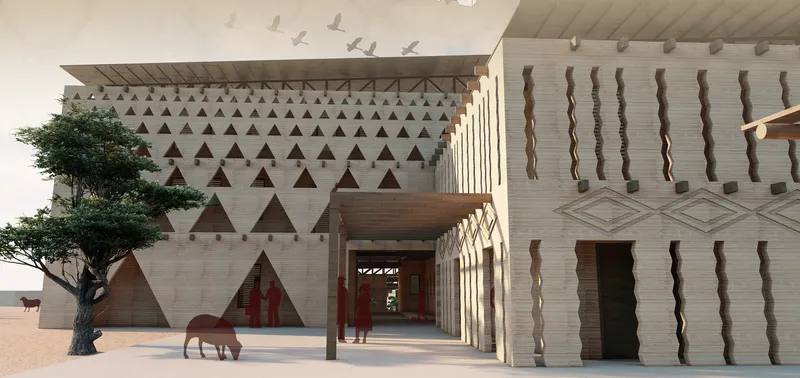
The courtyard facade reveals the project's most explicit cultural gesture: triangular wall panels derived from traditional Kente textile motifs. These are not ornamental appliqué. The patterned panels function as solar screens, regulating the intensity and angle of light entering the spaces behind them while maintaining ventilation through their perforations. Beside them, wavy timber sculptures and a tree complete the courtyard scene, with a grazing animal grounding the image in the everyday reality of rural Bolgatanga.
This fusion of performance and identity is where Tintim Atrae distinguishes itself from generic sustainable housing prototypes. The Kente-derived patterns encode cultural meaning into the building envelope itself, making the facade legible to residents as something that belongs to them. When architecture operates simultaneously as climate mediator and cultural marker, it earns the kind of collective ownership that no top-down housing programme can manufacture.
Why This Project Matters
Ghana's population growth and rapid urbanization demand housing solutions that are affordable, scalable, and climatically appropriate. Tintim Atrae addresses all three by returning to earth as a primary material and pairing it with 3D printing technology that reduces construction time, labor costs, and carbon emissions. The excavated soil becomes the building; the excavation itself becomes infrastructure. That circularity, combined with passive cooling strategies that eliminate dependence on mechanical systems, makes this a genuinely regenerative proposition rather than merely a low-impact one.
What elevates the project beyond technical competence is its refusal to treat sustainability and cultural identity as separate concerns. Kacper Magiera's design demonstrates that vernacular spatial patterns, traditional motifs, and advanced fabrication can coexist without contradiction. For a continent where housing shortages are measured in the tens of millions, prototypes like Tintim Atrae point toward a future where the answer is already beneath our feet.
View the Full Project
About the Designers
Designer: Kacper Magiera
Enter a Design Competition on uni.xyz
uni.xyz runs architecture and design competitions year-round that reward proposals with spatial conviction and real site intelligence.
Project credits: Tintim Atrae by Kacper Magiera.



Popular Articles
Popular articles from the community


Conexión: Biophilic Design Reimagines High-Rise Living in Hong Kong
Conexión reimagines high-rise living in Hong Kong through biophilic design, green facades, shared spaces, daylight, water and nature within.

Play: Fragments of Their World
Familiar architecture becomes modular playground design, creating safe spaces where displaced children can learn, connect, imagine and play.

The Earth Pod: 3D Printed Homes for Resilient Refugee Communities
The Earth Pod reimagines refugee housing through 3D printed homes made from clay, combining resilience, self-sufficiency, and rapid shelter.

Lunar Spiral: Space Architecture Shaped by the Mathematics of the Universe
Lunar Spiral reimagines space architecture through Fibonacci geometry, lunar regolith, levitating habitats, and self-sustaining Moon living.


Similar Reads
You might also enjoy these articles

Day and Night Park: A Time-Based Urban Newsstand in Beijing
A temporary urban newsstand in Beijing blending travel, light, and reading through poetic colors, compact form, and community-focused design.

Modernist Patio Renovation in El Masnou, Barcelona by Oliver Segura Arquitectura + Cebrià Arquitectura
Modernist patio renovation blending tradition and innovation with a movable pool, leveled floors, and Catalan materials in El Masnou.

Alto Residencial Coop: Cooperative Housing Development in Santiago de Compostela by Carbajo Barrios Arquitectos
A linear cooperative housing complex blending white volumes and perforated metal façades, enhancing community living, natural light, privacy, and urban integration.

Vil Genis School by BPA ARCHITECTURE – Massy, France
Vil Genis School in Massy, France, features sustainable design, south-facing classrooms, community integration, accessible spaces, and modern educational architecture.

Comments (0)
Please login or sign up to add comments
No comments yet. Be the first to comment!