

Vicente House / MASA Arquitectos: Adaptive, Sustainable, and Resilient Small-Scale Living
Vicente House by MASA Arquitectos is a compact, adaptable wooden home blending sustainability, flexible design, and DIY construction with natural surroundings.


Located in a lush natural setting, Vicente House, designed by MASA Arquitectos in 2021, exemplifies how architecture can respond to uncertainty, adapt to changing needs, and empower its inhabitants. This compact 40 m² wooden home showcases innovative spatial design, resourcefulness, and sustainability while embracing minimalism and flexibility.


Architecture Born from Challenge
The story behind Vicente House begins during the pandemic, a period that challenged conventional ideas of balance, stability, and domestic life. For a small family facing job loss and financial constraints, maintaining traditional housing became untenable. Rather than succumb to circumstances, the family embraced DIY construction and hands-on learning, training themselves in woodworking and basic construction. This journey reflects resilience, adaptability, and the creative potential of architecture responding to human necessity.


Design Concept: Flexibility and Economy
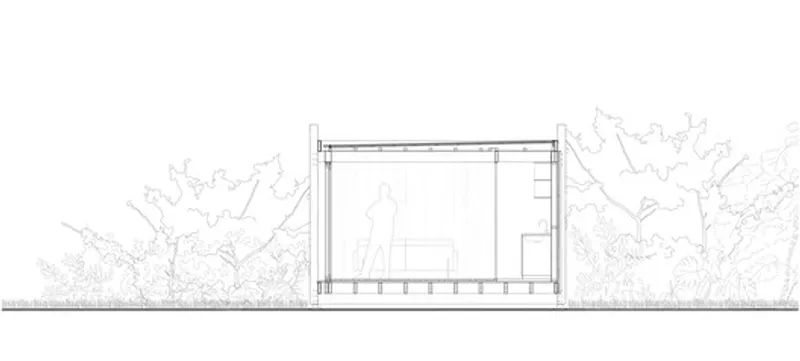
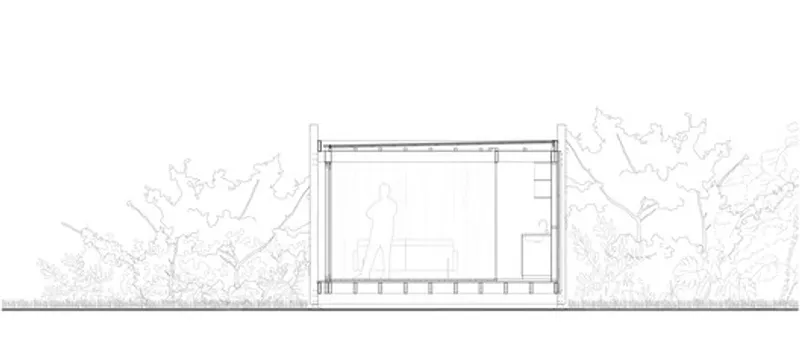
With a limited budget, the architects prioritized fast execution, adaptability, and long-term usability. The structural system consists of a series of intertwined wooden porticos connected by longitudinal beams, forming a rigorous yet versatile spatial grid. This approach allows a single open space to be partitioned as needed, offering maximum functionality for living, sleeping, and work.
Service areas such as the kitchen, bathroom, and storage closets are ingeniously integrated behind a series of folding wooden doors, transforming walls into habitable surfaces. This system allows for seamless spatial adjustments, ensuring that Vicente House can evolve alongside its occupants’ changing lifestyle requirements.


Materiality and Sustainability
Constructed primarily of locally sourced wood, Vicente House emphasizes natural materials that harmonize with the surrounding landscape. The lightweight timber structure not only minimizes environmental impact but also allows for rapid assembly and potential relocation or expansion. The project embodies principles of sustainable design, resource efficiency, and small-scale architecture.

Spatial Experience and Connection with Nature
Despite its compact size, Vicente House feels expansive due to its careful spatial planning and connection to the environment. Large openings, abundant natural light, and views of greenery create a sense of openness and tranquility, blurring the boundary between interior and exterior. Every element, from the folding doors to the structural grid, supports a living experience that is adaptive, flexible, and human-centered.
Significance in Contemporary Architecture
Vicente House is more than a small family home; it is a case study in resilience, adaptability, and sustainable living. It demonstrates how architectural design can empower inhabitants, respond to socio-economic challenges, and provide a framework for future adaptability. Its innovative use of timber, folding walls, and modular spatial planning offers lessons for architects, urban planners, and small-scale housing projects worldwide.

All the photographs are works of Leonardo Finotti


Popular Articles
Popular articles from the community


David Ortega Stacks a Two-Story Mexico City Penthouse Around a Steel Stair and a Pergola-Shaded Roof Terrace
In Colonia Roma, a 300 m² penthouse uses oak joinery, a planted steel stair and a slatted roof pergola to make a new-build apartment feel like a house.


Opera on the Sea: Driftwood Logic Shapes a Timber Opera House on Estonia's Coast
Trevor Orgill's opera house translates the entangled drift of floating timber into a civic building where wood, water, and music converge.

Cube Design Draws an Ecological Corridor Between Two Shenzhen Hills with the Nankai Building
Beside Shenzhen's container docks, the Nankai Building pairs stacked balconies with a climbing green screen to connect two hillsides across its height.

FCC Arquitectura Expands a Portuguese Granite House with a Board-Marked Concrete Wing
In Portugal, JV House pairs a cleaned-up whitewashed and granite dwelling with a timber-shuttered concrete extension, courtyards and a garden pool.

Similar Reads
You might also enjoy these articles


Hodi-Mandai Geram
Project Function: Preservation and revitalization of the Intangible heritage and socio-spatial identity of the Hodi by Housing, Cultural Memory Center, Sacred Grove, landscape, local tourism economy


Olio Towers: A Mid-Rise for Performers That Fuses Housing, Rehearsal, and Stage
Located blocks from Houston's Theater District, this modular tower stacks living units around a central performance atrium.

Oasis: Modular Green Housing Carved into Dhaka's Urban Fabric
A shortlisted Plugin Housing entry reclaims unauthorized settlements in Dhaka with stepped concrete volumes, green roofs, and ventilation-driven design.

Black Hole: A Floating Megastructure for the Post-Physical Era
Emiliano Mazzarotto envisions a spherical, self-scaling arena where e-sports, digital hotels, and holographic stadiums replace traditional public space.

Explore Tiny House Competitions
Discover active competitions in this discipline

Challenge to reimagine the Iron Throne

Photograph architecture without architects

Illustrate the lost glory of Angkor Wat - Render Challenge

Design challenge to reuse E-waste
Comments (0)
Please login or sign up to add comments
No comments yet. Be the first to comment!