
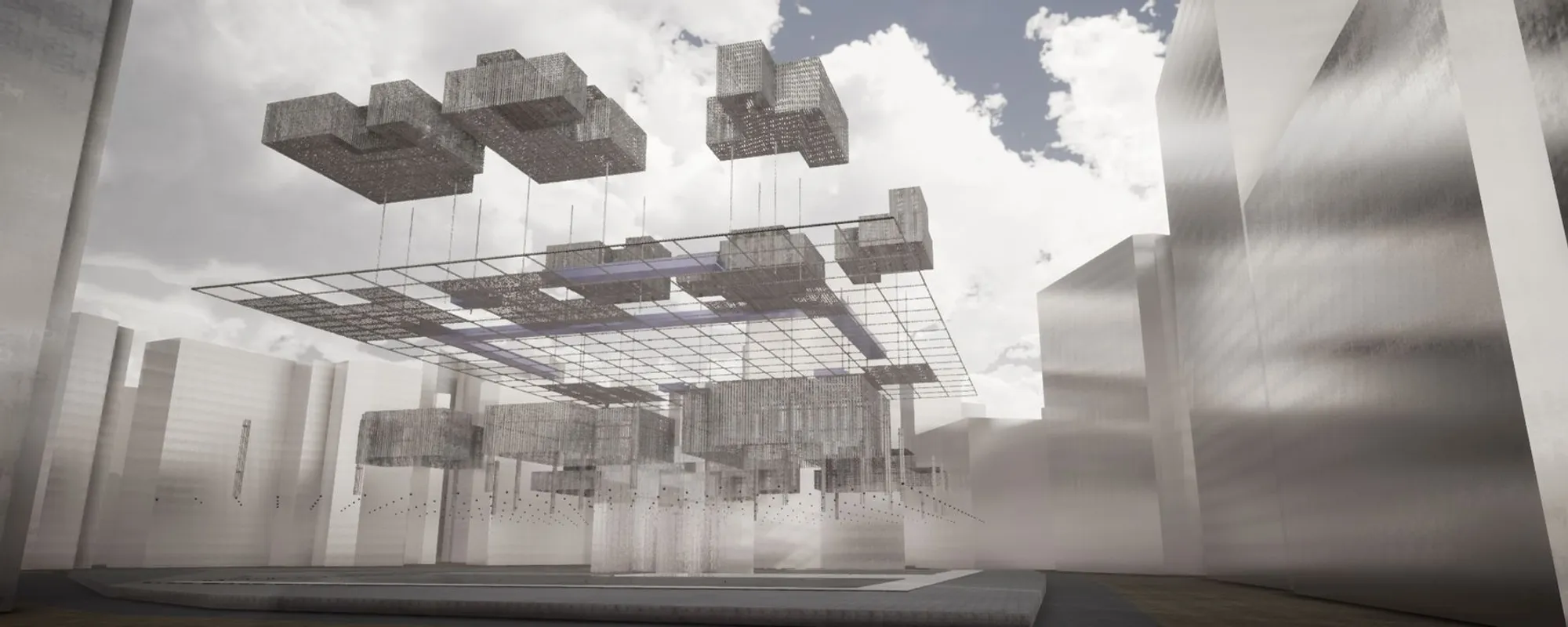
Wall E-ducation: A Rail-Based Modular System for the 2050 Workspace
A reconfigurable vertical infrastructure merges education zones, machine labs, and transit nodes into a living urban platform.


What if the building itself could teach? Not through signage or wayfinding, but through its very structure: floors that rise to become lecture halls, walls that slide to reveal machine laboratories, an architecture so deeply entangled with its programme that reconfiguration becomes a form of pedagogy. Wall E-ducation proposes exactly this. It is a vertical and horizontal rail-based infrastructure where architectural elements move, stack, and reassemble to match the shifting demands of a society learning to coexist with automation and AI.
Designed by Mert Özdemir and Adır Rumet Birtane, this shortlisted entry for the Breaking Work – Singularity competition takes on a deceptively simple question: how should we design workspaces for a future where routine tasks belong to machines and humans must cultivate higher-level cognitive and collaborative skills? Their answer is not a fixed building but a living infrastructure, set within a dense urban grid and designed to transform underutilized city zones into active nodes of learning and invention.
A Sunken Plaza as Urban Interface
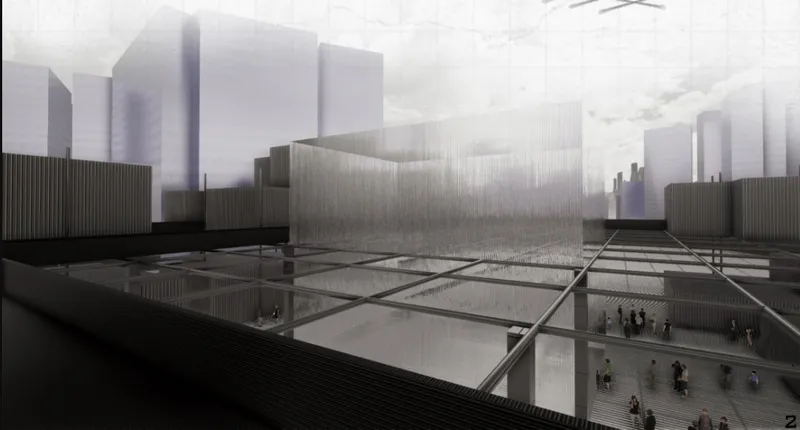

The aerial rendering reveals the project's primary point of contact with the city: a sunken public plaza punctuated by glass skylights that draw daylight deep into the infrastructure below. Figures move through a misty urban context, suggesting a threshold between the familiar density of the street and the speculative interior world beneath. The plaza is not ornamental; it is a connective tissue linking areas of high city flow to the educational and machine programmes housed within the system.
Adjacent axonometric diagrams unpack the logic behind this spatial generosity. Four distinct layout scenarios illustrate how the same structural framework accommodates different configurations of machine factories, educational nodes, public entrances, and passageways. Circulation paths are colour-coded to distinguish between human movement, programmatic zones, and robotic transit. The drawings make a compelling case: this is architecture designed not for a single use but for a lifespan of continuous adaptation.
Transformable Floor Plates and the Knowledge Matrix

From above, the recessed plaza reads as a gridded field, its pavement pattern echoing the modular logic of the system beneath. Surrounding towers recede into fog, reinforcing the project's ambition to operate as an infrastructural layer woven into the urban fabric rather than a standalone object competing for skyline attention. The design deploys transformable floor plates and lecture platforms that rise, descend, or shift along the rail system. Each architectural unit functions as a responsive node within a larger matrix of knowledge transfer, from education modules to invention labs.
Upper levels are programmed as feeding zones and multifunctional lecture spaces, while lower modules integrate public circulation, city connectivity, and technology interface zones. The hierarchy is legible but not rigid. Because every component can be relocated along the rail infrastructure, the vertical section of the building is as fluid as its plan. The result is a structure that can be reprogrammed to match shifting societal, technological, or pedagogical needs without demolition or major renovation.
Steel Canopy and the Ground Plane of Human-Machine Dialogue

At the covered plaza level, a steel frame canopy filters diffused light across a gathering space where pedestrians congregate. The scale is generous but not overwhelming, calibrated to encourage informal interaction and observation. It is here that the project's thesis becomes most tangible: humans and machines are not positioned in competition but in dialogue. The architecture mediates, training people to navigate the world of AI, automation, and robotic systems by making those systems visible, accessible, and spatially integrated into everyday urban life.
The canopy itself performs structurally and symbolically. Its exposed steel members reference industrial fabrication while sheltering a decidedly post-industrial programme. Cooperation replaces labour. The building becomes an instructor, its modular adaptability a constant reminder that the spaces we inhabit can and should evolve as quickly as the technologies they house.
Why This Project Matters
Most speculative proposals about the future of work default to sleek renders of open-plan offices with slightly more robots. Wall E-ducation pushes further by questioning the permanence of the building itself. Its rail-based modular system treats spatial configuration as a variable, not a constant. That philosophical shift, from fixed architecture to programmable infrastructure, is where the project's real contribution lies. It suggests that the 2050 workspace will be defined less by what it looks like at any given moment and more by how readily it can become something else.
Özdemir and Birtane have produced a proposal that takes the competition brief seriously without taking itself too seriously. The four-scenario framework is rigorous enough to demonstrate systemic thinking, while the atmospheric renderings ground the concept in a recognizable urban reality of fog, concrete, and pedestrian movement. For a shortlisted entry in a competition about singularity and the future of labour, this is a measured and intelligent response: architecture not as a monument to progress but as an open platform for adaptation.
View the Full Project
About the Designers
Designers: Mert Özdemir, Adır Rumet BİRTANE
Enter a Design Competition on uni.xyz
uni.xyz runs architecture and design competitions year-round that reward proposals with spatial conviction and real site intelligence.
Project credits: Wall E-DUCATION by Mert Özdemir, Adır Rumet BİRTANE Breaking Work – Singularity (uni.xyz).




Popular Articles
Popular articles from the community


The Earth Pod: 3D Printed Homes for Resilient Refugee Communities
The Earth Pod reimagines refugee housing through 3D printed homes made from clay, combining resilience, self-sufficiency, and rapid shelter.
AL-JANNAH: Sustainable Architecture and Permaculture for Afghan Widows
AL-JANNAH uses sustainable architecture and permaculture to create resilient oasis of housing, learning, work and renewal for Afghan widows.
Pangolin Can Help Mining: Biomimicry Architecture for an Asteroid Mining Habitat
Pangolin Can Help Mining explores biomimicry architecture through a modular 3D-printed habitat designed for asteroid mining and future life.

FAMM Arquitectura Organizes Ten Villas Around Courtyards and Jungle in Nosara, Costa Rica
El Molino pairs two elongated volumes with deep overhangs and timber louvers to build a compact coastal community five minutes from the beach.

Similar Reads
You might also enjoy these articles

Day and Night Park: A Time-Based Urban Newsstand in Beijing
A temporary urban newsstand in Beijing blending travel, light, and reading through poetic colors, compact form, and community-focused design.

Modernist Patio Renovation in El Masnou, Barcelona by Oliver Segura Arquitectura + Cebrià Arquitectura
Modernist patio renovation blending tradition and innovation with a movable pool, leveled floors, and Catalan materials in El Masnou.

Alto Residencial Coop: Cooperative Housing Development in Santiago de Compostela by Carbajo Barrios Arquitectos
A linear cooperative housing complex blending white volumes and perforated metal façades, enhancing community living, natural light, privacy, and urban integration.
Vil Genis School by BPA ARCHITECTURE – Massy, France
Vil Genis School in Massy, France, features sustainable design, south-facing classrooms, community integration, accessible spaces, and modern educational architecture.

Explore Educational Building Competitions
Discover active competitions in this discipline



The Global Benchmark for Architecture Dissertation Awards


Challenge to design public laboratory
Comments (0)
Please login or sign up to add comments
No comments yet. Be the first to comment!