

obermoser + partner architekten Turns a 1906 Swarovski Polishing Workshop in Wattens into Felt-Boxed Offices
In Wattens, Tyrol, a 1906 Swarovski factory keeps its raw shell while glass walls and felt retreat boxes turn polishing halls into start-up offices.


The former Swarovski Werk 2 compound in Wattens, Tyrol, reads less like a factory and more like a small town: a cluster of production halls that once handled the cutting and polishing behind a global crystal brand. Since late 2015, part of it has housed Werkstätte Wattens, a founders' and start-up centre run by a public/private partnership between Daniel Swarovski KG and the market town. Demand outran the first conversion of Buildings 6 and 7, completed in 2017 and 2018 with Architekt Hanno Schlögl. So in 2019 obermoser + partner architekten returned for a second extension in Buildings 5 and 6.
What makes this phase worth your attention is not a dramatic gesture. It is a refusal to make one. Building 6 dates from 1906, and the architects kept its floors, walls and ceiling structure largely as found. They then dropped in a small set of new pieces: glass walls, felt-clad boxes and long light beams. These elements never pretend to be original. The project turns on that contrast between a raw inherited shell and furniture-scale insertions, and on the bet that a start-up office needs acoustic comfort and clear zoning more than it needs a finished interior.
A Palazzo Front for a Factory
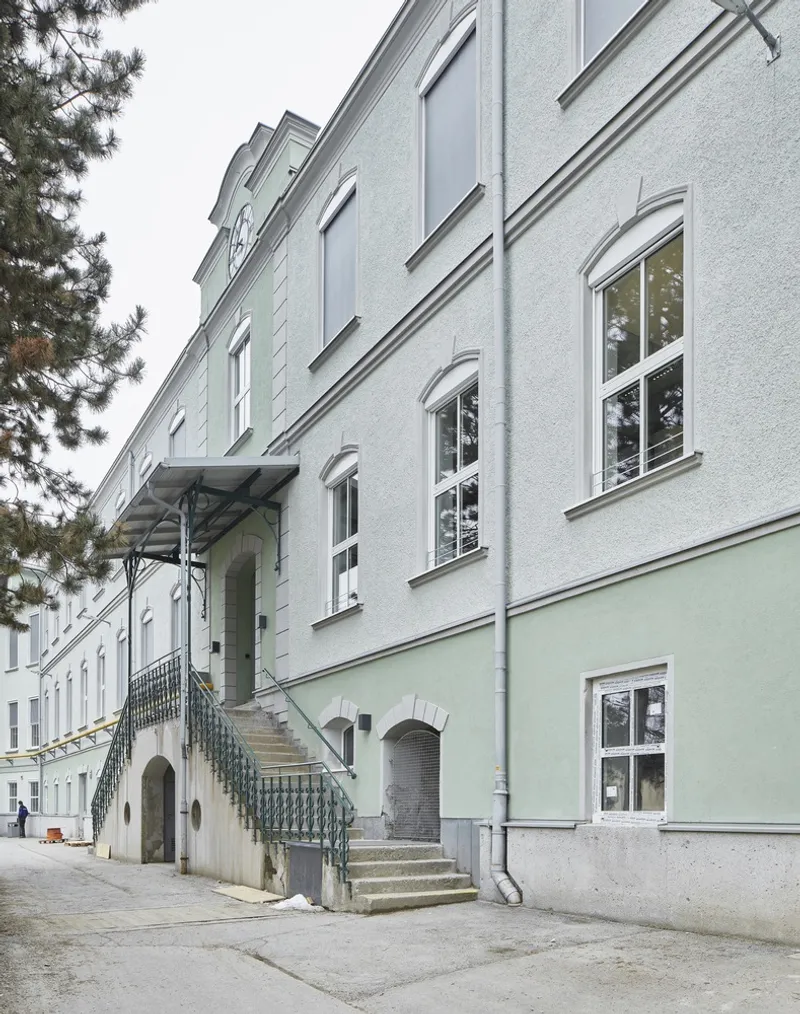
Building 6 belongs to the moment when industrial architecture still borrowed civic manners. Its pale green plaster, arched windows and external stair with green railings give it an almost palazzo-like front. That is a useful reminder that the compound was built to be seen as well as worked in. The architects left this face alone, and they were right to. Its dignity does the branding work that a new signage scheme never could.
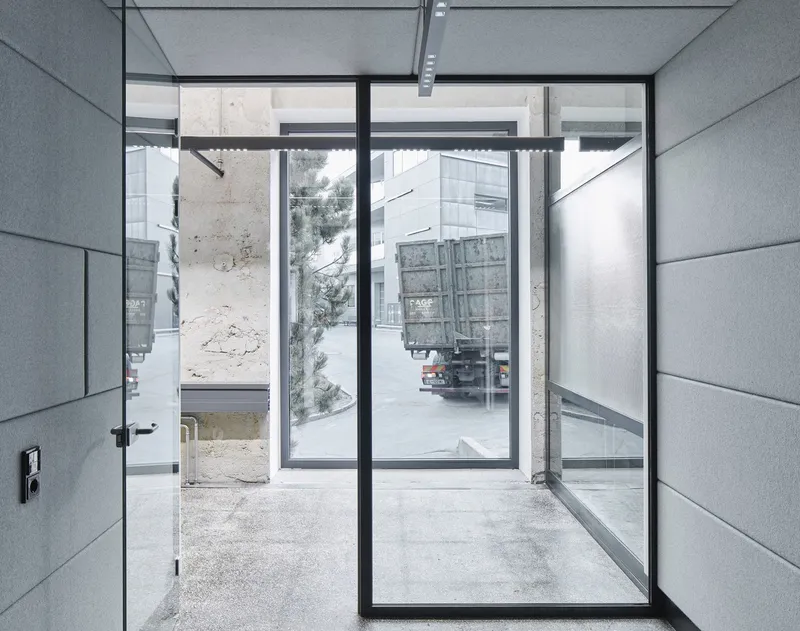
The new entrance vestibule is the first hint of what happens inside. It is a glass box lined with grey acoustic panels, and it frames the working yard outside, parked dump truck included. We like that it does not tidy the context away. The centre sits in an active industrial landscape, and the threshold admits it.
Leaving the Shell Raw
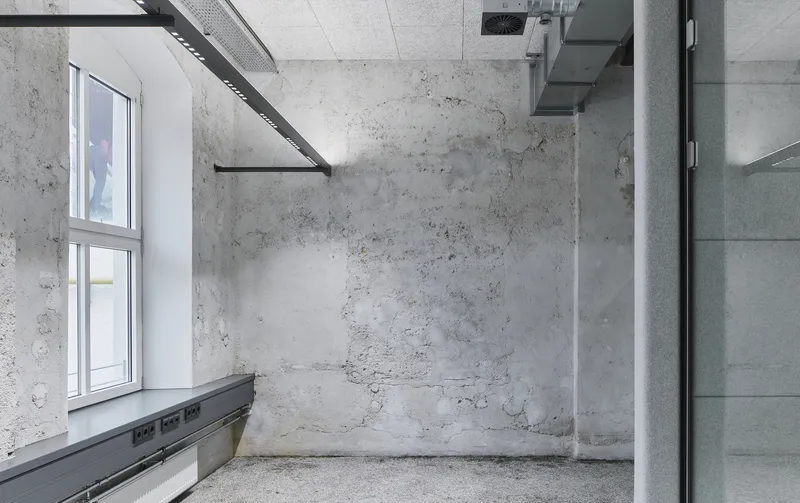
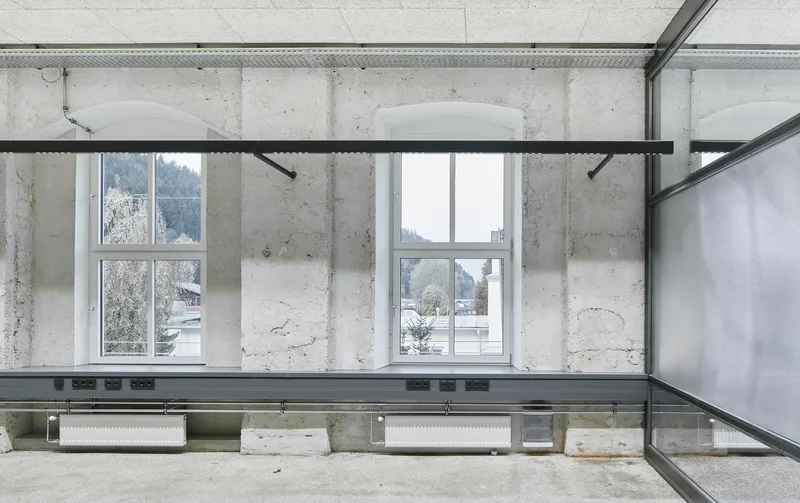
The most confident decision here is what was not done. Weathered concrete walls keep their stains and patches. The arched window openings stay unaltered, and the grey sills now carry sockets and sit above radiators. That is the only concession to office life at the perimeter. A suspended black light track runs past this surface without touching it, which makes the separation between old and new legible at the scale of a single cable.
The approach is cheaper and more honest than restoration, and it carries a quiet argument about authenticity. A building's history lives in its marks, not in a repainted version of its former self. If you have ever walked through a heritage conversion polished into anonymity, you will see the difference immediately.
Glass and Felt in the Former Polishing Rooms
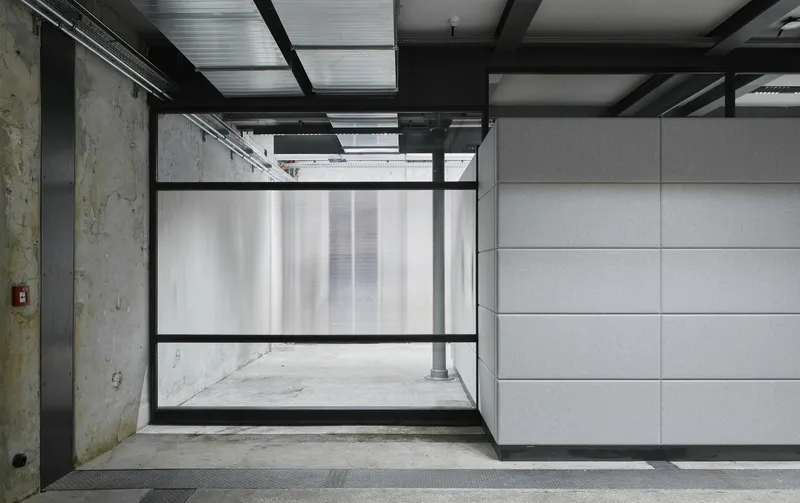
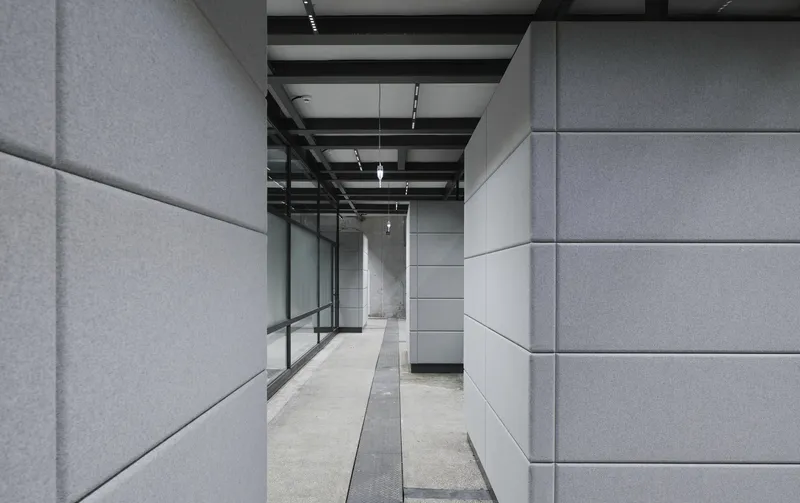
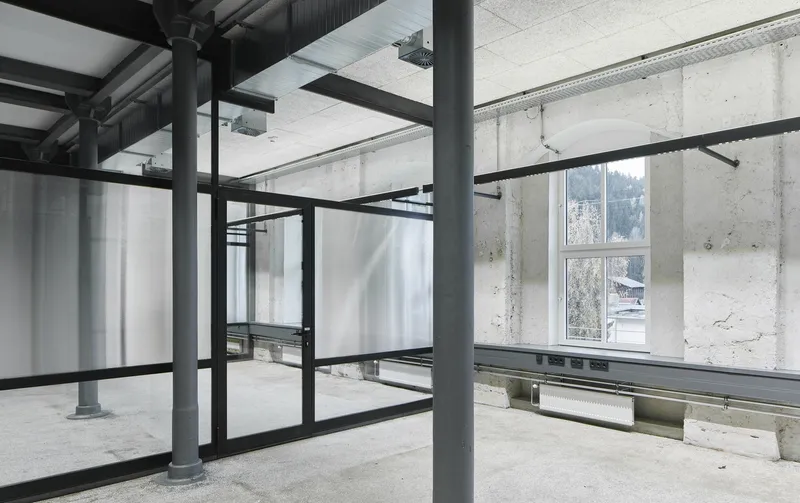
In the Building 6 polishing workshops, a central internal stair once led to four workrooms. Now, glass walls in black steel frames divide the floor into office units. Each unit gets its own retreat box, clad in felt on both sides, so the box absorbs sound inside and out. The palette here is a cool range of greys, set against concrete, cast columns and steel ceiling beams.
The narrow passages between the felt volumes are the most interesting spatial moments on this level. A metal floor grate leads you between soft grey walls toward a glazed partition. Hard industrial ground meets the muffled surfaces of the new insertions, and the corridor feels deliberately compressed before opening into the units. The translucent and clear glazing keeps views running through to the windows and the wooded hillside beyond. Each unit stays private without becoming a cell.
A White Hall on the Second Floor
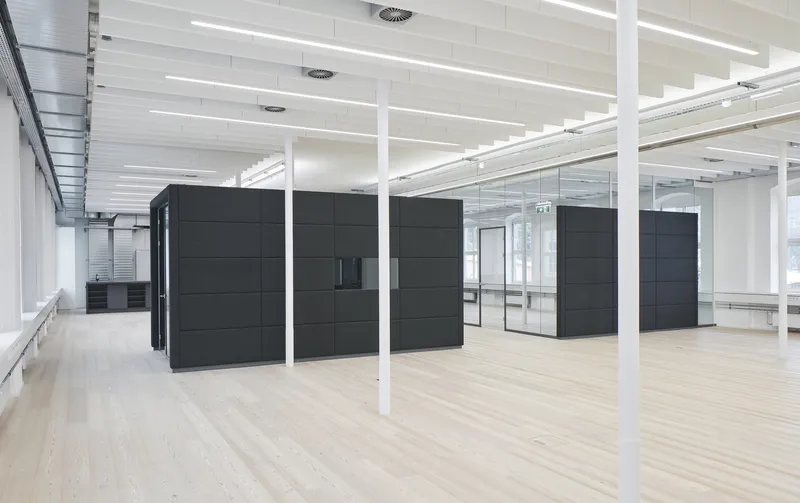
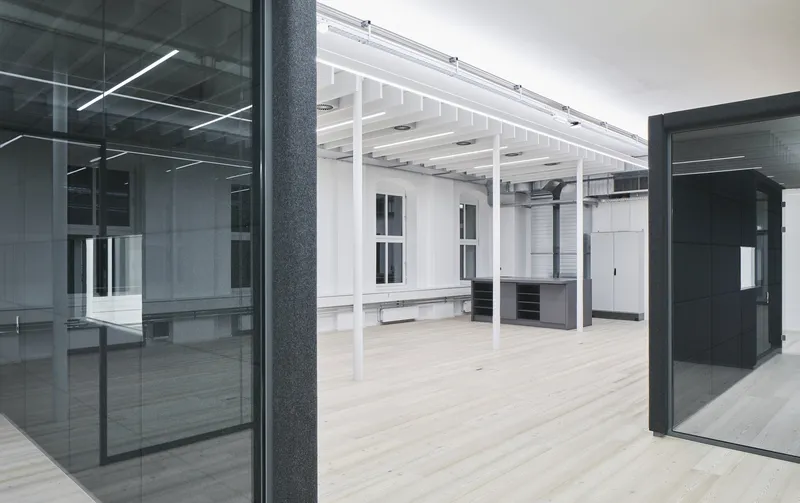
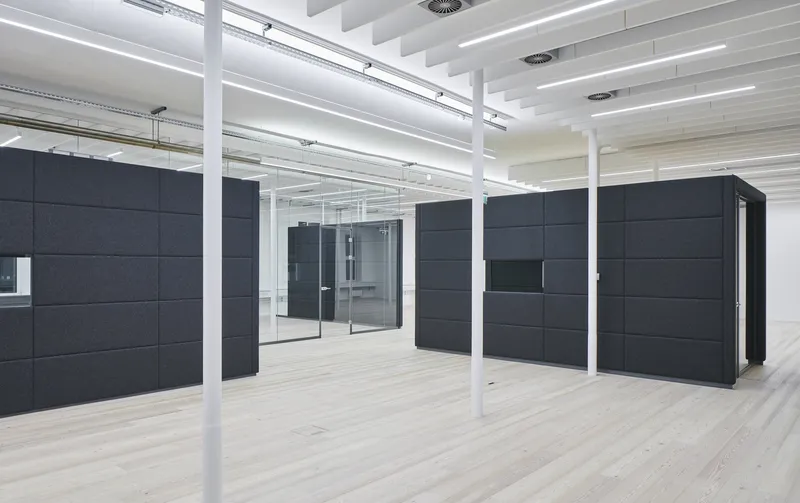
The second-floor polishing hall shifts register entirely. The walls, ceiling and slender columns are painted white, and a new larch floor runs across the full open plan. Here the inherited structure becomes a bright, even field rather than a textured backdrop. Daylight from the tall windows reaches deep into the room, and ribbed ceiling baffles help control sound in what would otherwise be a reverberant volume.
Two black felt boxes are the only significant objects in the hall. They split the open plan into zones for different uses without walls. One zone works like a call centre and is closed off by a full-height glass wall. This is a lean way to plan an office: put the acoustic and functional load into two pieces of furniture-architecture, and leave everything else flexible for tenants whose needs will keep changing.
Two light beams run the full length of the room, with fittings on both sides providing direct and indirect light. A few more were threaded into the existing ceiling structure. Their linear rhythm echoes the column grid. Lighting specialist Bartenbach kept the fixtures from competing with the baffles or the structure.
The Box as Room
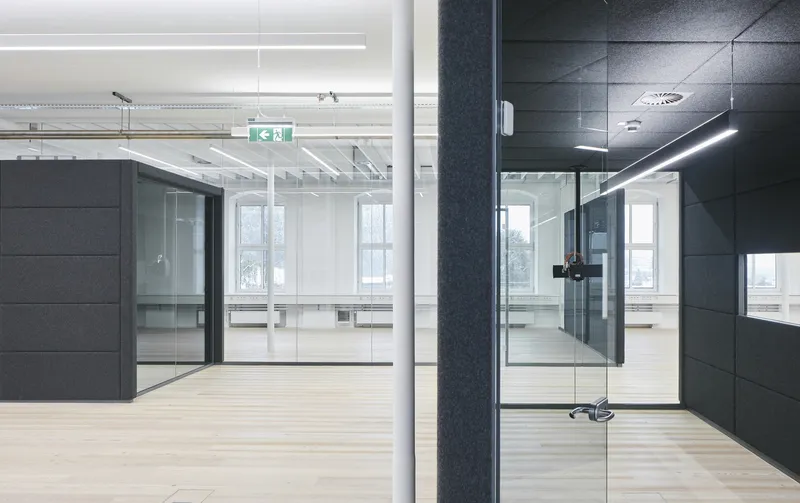
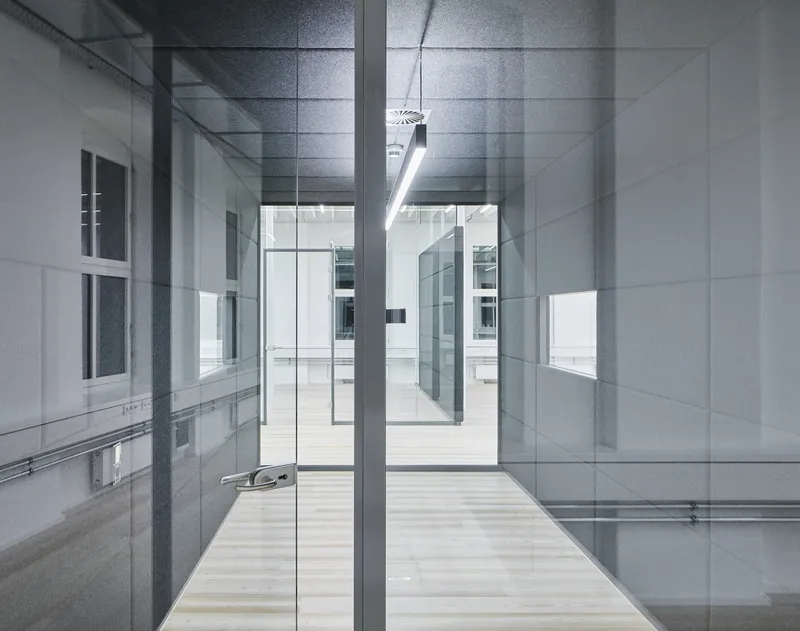
Up close, the charcoal felt boxes reveal how much work they do. Glass doors keep them from reading as closed volumes, so a meeting inside stays visible from the open floor. Looking out from one, the felt lining frames the pale larch and the linear pendant beyond. It is a small room that behaves like a piece of acoustic equipment.
Compare this with the first extension, where the boxes were lined in oak and finished outside in white polished varnish. That was a more refined object. Felt on both faces is rougher, more practical and better suited to dense shared work. The move from oak to felt suggests the architects learned what tenants actually needed from the first phase: quiet, more than polish.
Why This Project Matters
Much adaptive reuse still treats an old building as a costume, a set of brick walls wrapped around a generic fit-out. Wattens works the other way. The structure and its 1906 room layout remain the organising logic, and the new elements are kept few, freestanding and reversible. That makes the second extension less an interior design project than a strategy, one that can absorb another phase, another tenant mix or another use without unpicking what came before.
It also shows how a regional economy can recycle its own industrial core rather than building incubators on greenfield sites. A wheelchair ramp, storage and showers for all occupants sound unglamorous, yet they are what turn a heritage hall into a working workplace. For anyone facing a disused factory and a tight brief, this is a useful model: uncover the space, keep the marks and put the budget where people actually feel it.
Wattens Workshops Second Extension (Werkstätte Wattens) by obermoser + partner architekten, Wattens, Tyrol, Austria, 2019. Photography by David Schreyer.
About the Studio
Share Your Own Work on uni.xyz
If projects like this are the kind of work you want to make, uni.xyz is a place to publish your own, find collaborators, and enter design competitions.


Popular Articles
Popular articles from the community


Opera by the Sea Estonia: Three Shells Dissolving Architecture into Tallinn's Coastline
A winning opera house proposal replaces monumental form with interconnected shells that blur the boundary between building, park and Baltic Sea.
Temporary Home for Dogs: A Reversed Zoo Rethinks Animal Shelter Architecture
In Bucharest, a sinuous corridor and freed landscape flip the logic of containment, designing a shelter that works to make itself unnecessary.

Extended Shell: Retrofitting Kolkata's Balconies as Living Urban Thresholds
A modular retrofit system recovers the social and environmental intelligence of Kolkata's historic verandas for contemporary Park Street residents.

Cloaked Colonization: A Mobile Underwater Habitat That Moves Like a Fish
Micah Abaya's shortlisted EHC Pacific entry reimagines ocean settlement as a dispersed network of self-sustaining architectural organisms.

Similar Reads
You might also enjoy these articles

Bamboo Housing Challenge 2026: Design Affordable, Sustainable Homes Using Bamboo
An international design competition by Bamboo U and IBUKU inviting architects and designers to reimagine affordable housing using bamboo — with the winning design built full-scale in Bali.

Computational Design & Education: Beegraphy Design Awards Introduces 7th Category (Featuring Jiyun's Innovative Approach)
Dive into Beegraphy’s 7th Design Awards category, where computational design meets education to create immersive, interactive learning tools, inspired by Jiyun’s work.
From Parametric Lighting to Urban Furniture: Join the 2nd Workshop in Beegraphy’s Computational Design Series
Dive into Cutting-Edge Design Techniques and Practical Applications with Industry Experts

Last Call: Unleash Your Architectural Genius in SHAK's Kindergarten Design Competition
Urgent call for architects to join SHAK's kindergarten design competition before the looming deadline

Explore Blocs Competitions
Discover active competitions in this discipline

Challenge to reimagine the Iron Throne

Photograph architecture without architects

Illustrate the lost glory of Angkor Wat - Render Challenge

Design challenge to reuse E-waste
Comments (0)
Please login or sign up to add comments
No comments yet. Be the first to comment!