

CTA | Creative Architects Designs Triangular Floating Shelters for Vietnam's Flood-Ravaged Communities
A timber-louvered triangular shelter rises on concrete pontoons to keep Vietnamese families safe and together when floodwaters come.


In 2025, Vietnam endured 17 consecutive storms. Twenty-two of the country's 34 provinces were battered by flooding, displacing families and destroying homes built close to rivers and coastlines. The question of how to live with water, rather than simply against it, is no longer theoretical in this part of the world. It is a matter of survival. CTA | Creative Architects responded with the Floating House, a modular triangular shelter designed to rise with floodwaters on a buoyant concrete platform, keeping occupants dry, together, and close to their livelihoods.
What makes this project genuinely interesting is its refusal to treat disaster architecture as a temporary afterthought. The Floating House is not a tent or a shipping container repurposed in an emergency. It is a permanent dwelling with a clear spatial hierarchy, timber louvers that manage ventilation and light, and a footprint compact enough to sit in a vegetable garden during the dry season and float among boats during the wet. The triangular form is not stylistic posturing: it sheds rain efficiently, resists lateral wind loads, and minimizes material use. CTA has designed something that functions in two radically different conditions, on land and on water, without compromise in either.
Living on Two Planes
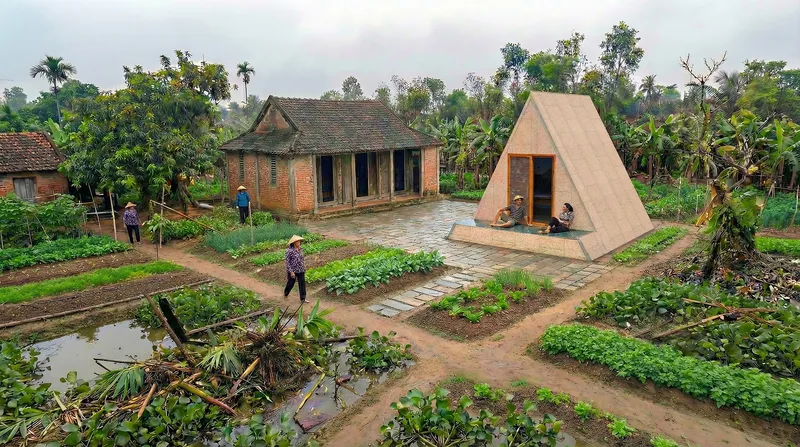

The dual identity of the Floating House is immediately legible. In the dry season, the shelter sits on its concrete base amid vegetable plots and traditional houses, looking almost like a garden folly or a modest workshop. The surrounding landscape is thoroughly domestic: fruit trees, fences, packed-earth paths. Then the water comes. The same structure detaches from the ground plane and floats, its triangular silhouette now rising above a field of river traffic and submerged rooftops. The concrete pontoon serves as both foundation and hull, a single element performing two roles that are usually incompatible.
CTA's decision to use a concrete base rather than a lighter material reflects local construction knowledge. Concrete is familiar, repairable with local labor, and heavy enough to keep the shelter stable when afloat. The trade-off in buoyancy is managed by the hollow pontoon geometry, which displaces enough water to support the timber superstructure above.
When the Flood Comes

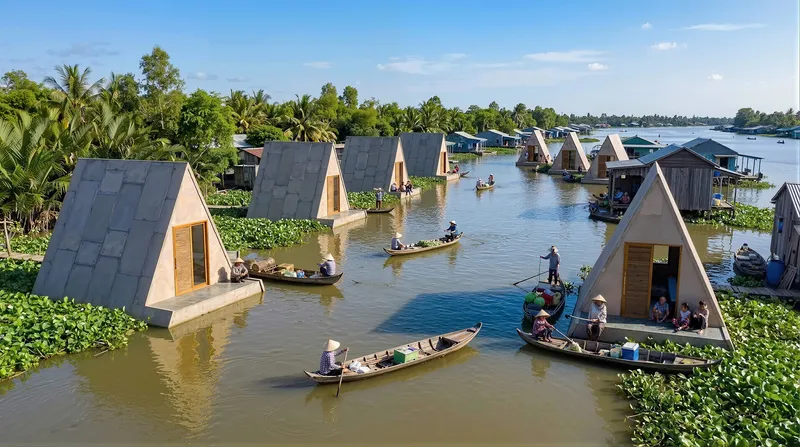
The most arresting images of this project are the ones where the water has already risen. Triangular shelters float among partially submerged houses, palm trees breaking the surface like reeds. Boats weave between the structures. What could read as a scene of devastation instead reads as a kind of adapted normalcy: people are still together, still sheltered, still navigating their landscape. The Floating House does not prevent disaster. It makes disaster survivable, and that distinction matters.
The dispersed pattern of the shelters across the river suggests a deployment strategy rather than a single-site installation. CTA appears to have conceived the Floating House as a unit that can be multiplied and distributed across vulnerable settlements, each one anchored to its family's plot in dry months and released to float when the water demands it. The aerial views confirm this: the triangular forms dot the waterscape like a fleet of small vessels, unified by geometry but independent in operation.
Timber Louvers and the Triangular Frame
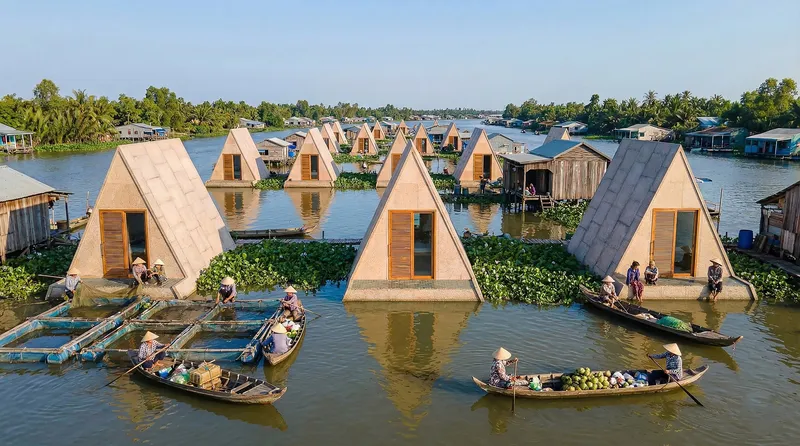

Up close, the material palette is restrained and purposeful. Timber louvers wrap the upper triangular volume, filtering sunlight and encouraging cross-ventilation in Vietnam's humid climate. The louvers also provide a degree of privacy without sealing the interior from the outside, an important quality in a shelter that may need to function as a home for days or weeks during extended flooding. The wood is left natural, aging into the same tonal range as the traditional stilt houses and fishing boats nearby.
Along the wooden walkways of the river settlement, the shelters read as an extension of the existing built fabric rather than an alien insertion. CTA has clearly studied the vernacular context, and the triangular profile, while sharper and more geometric than the pitched roofs around it, shares a family resemblance with the gabled forms of rural Vietnamese housing. It belongs without mimicking.
Plans and Drawings

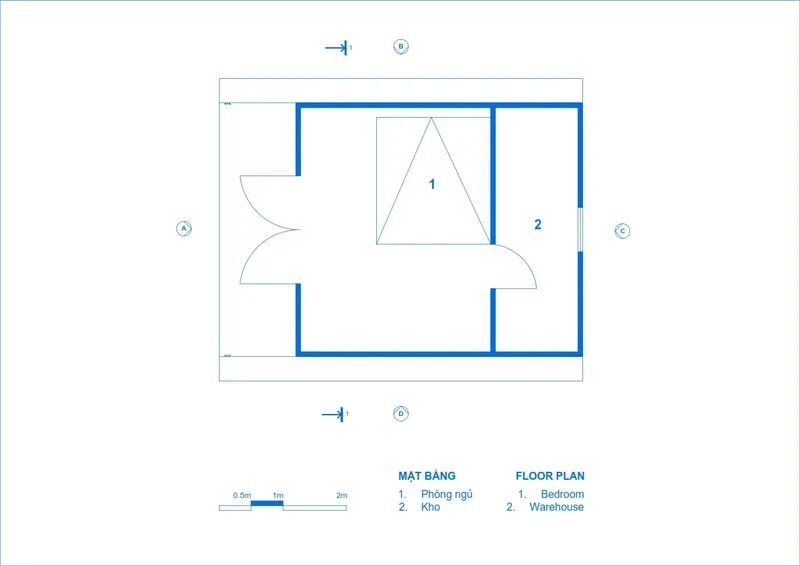

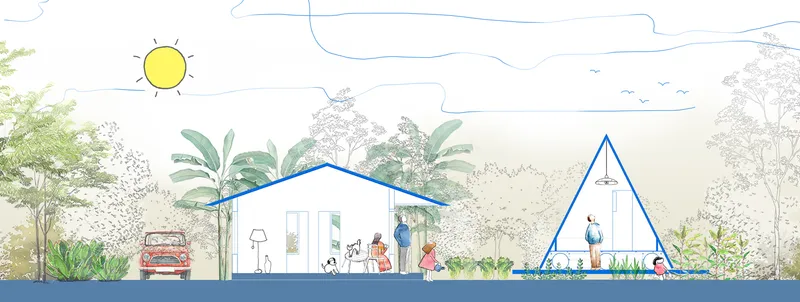
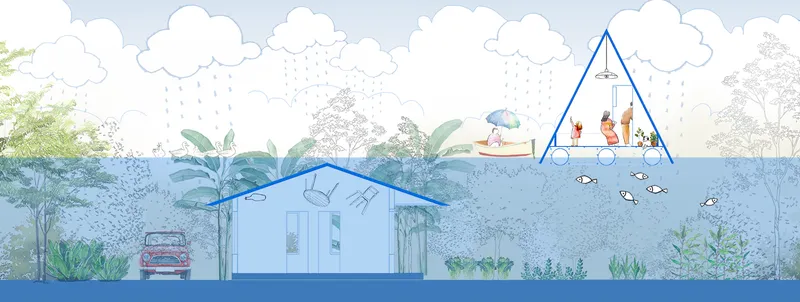
The plan drawings reveal a compact but considered interior arrangement. A triangular bedroom occupies the upper volume, while a rectangular warehouse or storage zone sits at the base, separated by curved partition walls that soften the geometry and allow flexible use. The site plan shows the shelter nestled within an orchard, confirming that the dry-season footprint is designed to integrate with agricultural land rather than consume it.
The sections are the most revealing drawings. One shows the shelter in fair weather: a gabled dwelling beside the triangular frame, figures standing at ease, trees in full canopy. The companion section shows the same structures partially submerged, rain clouds overhead, people sheltering inside the raised volume. The contrast is stark and intentional. CTA is not illustrating a building. They are illustrating a scenario, and the architecture's performance within it. The message is clear: this structure was designed for the worst day, not the best one.
Why This Project Matters
Climate adaptation in architecture often falls into two traps. Either it produces speculative renderings of floating cities that will never be built, or it delivers emergency shelters so utilitarian that they strip their occupants of dignity. The Floating House avoids both. It is buildable now, with local materials and local labor, at a scale that matches the communities it serves. And it is genuinely designed, not just engineered: the louvers, the proportions, the relationship to the garden and the river all suggest an architect who cares about how it feels to live inside this thing, not just whether it floats.
CTA | Creative Architects has produced a project that takes Vietnam's flood crisis seriously without resorting to spectacle. The Floating House is quiet, repeatable, and grounded in the reality of rural settlement patterns. It does not promise to solve the climate emergency. It promises that when the next storm comes, families will have a place to be together, above the waterline, with a roof that holds. In a year of 17 storms, that promise is worth more than most buildings deliver.
Floating House, by CTA | Creative Architects, Vietnam, 2025.
About the Studio
Share Your Own Work on uni.xyz
If projects like this are the kind of work you want to make, uni.xyz is a place to publish your own, find collaborators, and enter design competitions.


Popular Articles
Popular articles from the community


David Ortega Stacks a Two-Story Mexico City Penthouse Around a Steel Stair and a Pergola-Shaded Roof Terrace
In Colonia Roma, a 300 m² penthouse uses oak joinery, a planted steel stair and a slatted roof pergola to make a new-build apartment feel like a house.

Jaramillo Van Sluys Arquitectura and Urbanismo Turn a Demolished Registry Lot in Quito into an Orchard Plaza
In Quito's Centro Histórico, a 2,800 m² plaza exposes the San Agustín convent wall and redraws its lost Augustinian orchard in volcanic stone.

Juan García Correa, John González and Claudia Rueda Sink a Circular Amphitheater into a Manizales Engineering Building
On the La Nubia campus in Manizales, Colombia, the S1 Building folds labs and offices into a hillside of ramped lawns that double as a campus route.

LT2A and OPEN Architectes Thread a Brick and Glass High School Through a Wooded Belgian Campus
In Braine-l'Alleud, a 3,000 m² wing for Collège Cardinal Mercier pairs pale brick with a glazed colonnade, deferring to a small chapel and a dense wood.

Similar Reads
You might also enjoy these articles


LAVA Architecten Gives Vocational Education a Sawtooth-Roofed Face on a Mechelen School Campus
In Mechelen, Belgium, a 2,053 m² STEM school on a 6×6 m grid turns workshops and classrooms into rooms that can be rearranged as teaching changes.

KEMA Studio Turns a Derelict Marvila Attic into a 60 m² Lighthouse Apartment Above Lisbon
In Lisbon's Marvila district, a rebuilt roof, four skylights and two plywood volumes turn an unlivable attic into a bright home facing the Tagus.

Pixel Gardens: One Repeated Module Stacked Into a Terraced Social Housing Tower for Famagusta
Salem Bader's shortlisted housing tower builds a vertical neighbourhood from one repeated module, offsetting units to carve terraces, light and air.

Bao Huynh Watercolor Atelier: A Serene Art Retreat in Hội An
Bao Huynh Watercolor Atelier in Hội An blends multifunctional art spaces, sustainable design, local materials, and family-friendly living in a serene environment.

Explore Container House Competitions
Discover active competitions in this discipline

Comments (0)
Please login or sign up to add comments
No comments yet. Be the first to comment!