

1-1 Architects Builds a Nagoya House and Office from Decades of Stockpiled Timber
A 69-square-meter tower in dense residential Nagoya transforms surplus lumber into a home and workplace for a construction company.


In Nagoya, a construction company with a 50-year history had a problem that was, in its own way, a kind of wealth. Two warehouses sat nearby, packed with timber: surplus stock ordered in bulk by the previous generation, a carpenter by trade, and reclaimed lumber pulled from demolition jobs over the years. The wood was too good to throw away, too plentiful to ignore, and had no clear purpose. 1-1 Architects turned that surplus into the substance of a new building, a combined residence and office that treats material reuse not as a constraint but as the generative logic of the entire project.
House & Office SH is a narrow, 69-square-meter tower wedged into a dense low-rise neighborhood. Its white exterior is restrained and almost anonymous from the street, a polite neighbor among older houses. But behind the full-height glazing, the building's interior reads as a sectional celebration of timber framing, diagonal bracing, and vertically connected space. The structural members are not hidden; they are the architecture. Thick diagonal braces crisscross through every level, organizing circulation, framing views, and turning what could have been a cramped vertical tube into something spatially generous. The project won prizes at both the 57th Chubu Architecture Award and the 36th Aichi Housing Award, and the recognition is well deserved.
A White Tower in a Tight Neighborhood
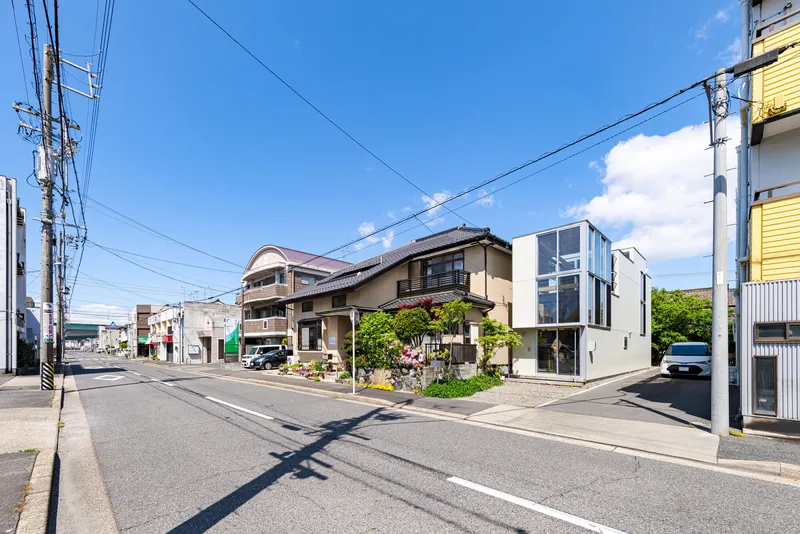
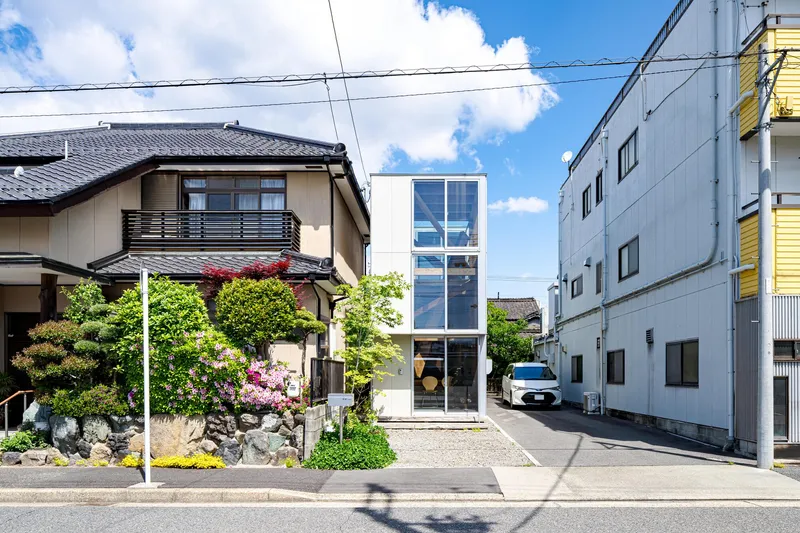
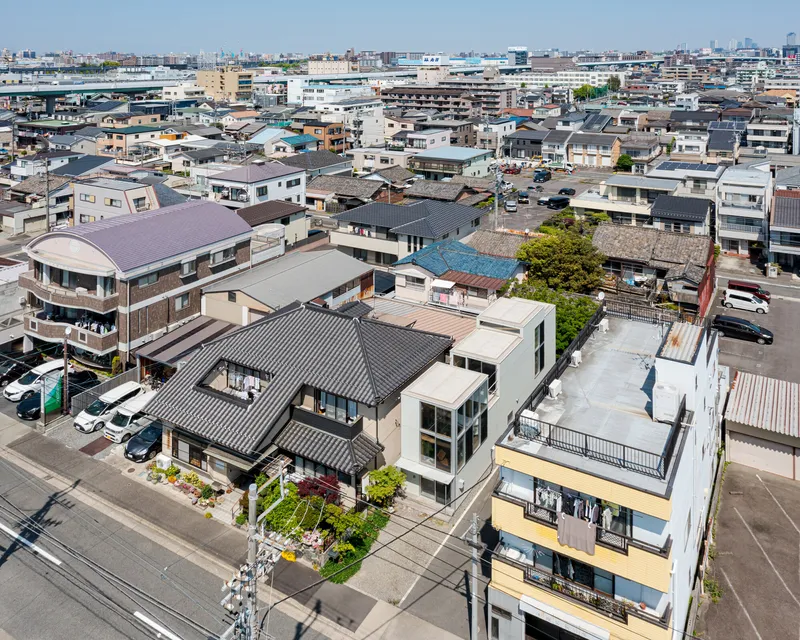
From the air or the street, House & Office SH registers as a crisp white box slotted into the grain of a typical Nagoya residential block. The massing is modest. It sits between traditional houses, under a web of power lines, and makes no attempt at monumental presence. Instead, it earns its distinction through proportion and transparency. The facade is narrow, the footprint minimal, and the building rises just high enough to clear its neighbors' rooflines.
The restraint of the exterior is strategic. In a neighborhood where every lot is tight and every meter of frontage matters, the white shell acts as a neutral frame for the expressive timber structure visible through the glass. At dusk, the building becomes a lantern, its internal skeleton glowing against the surrounding fabric.
The Facade as a Display Case for Structure
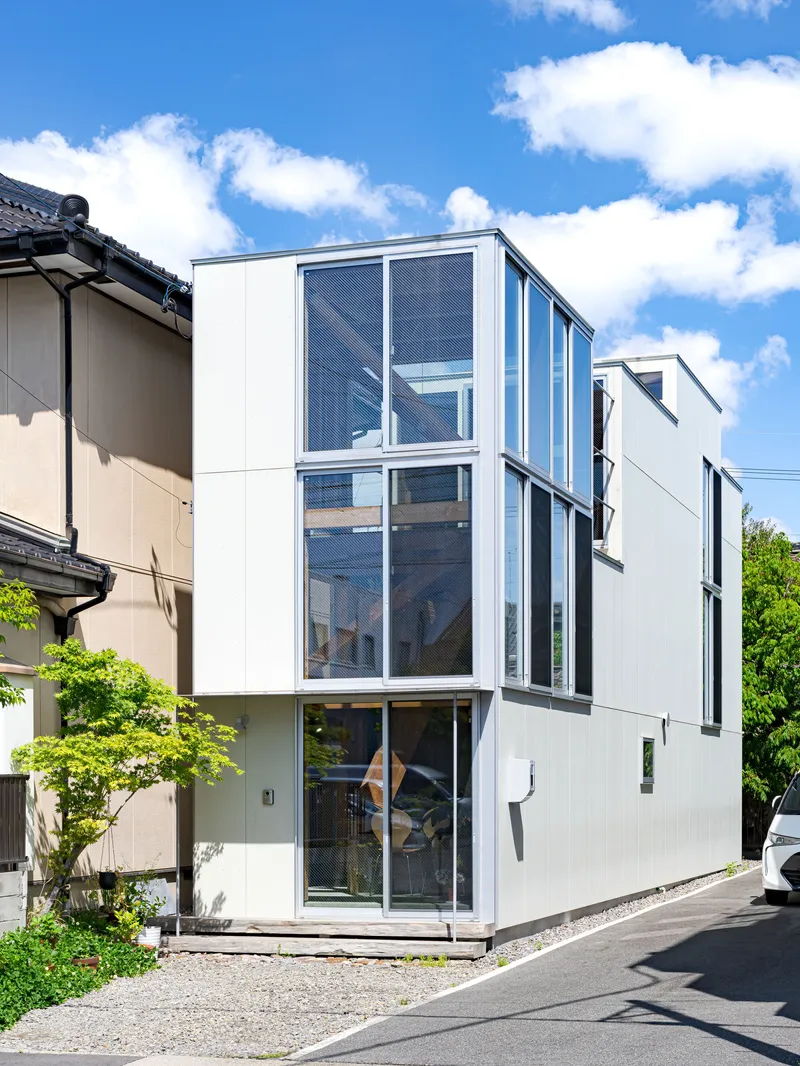
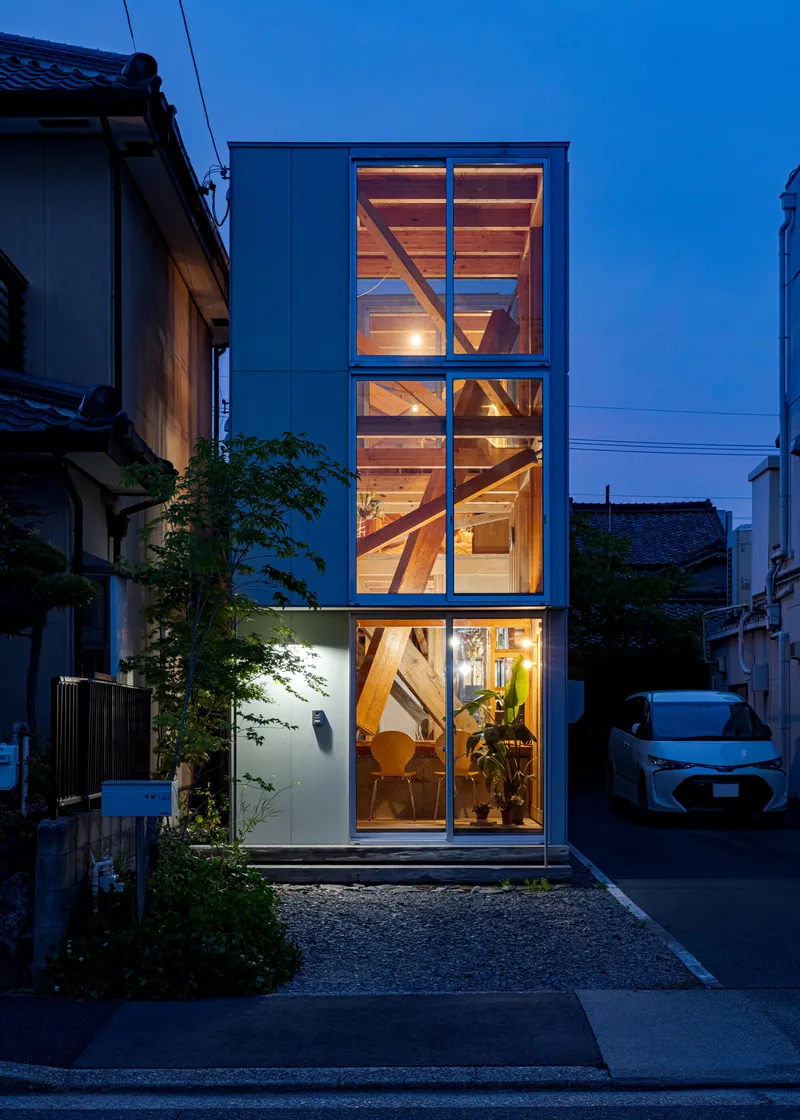
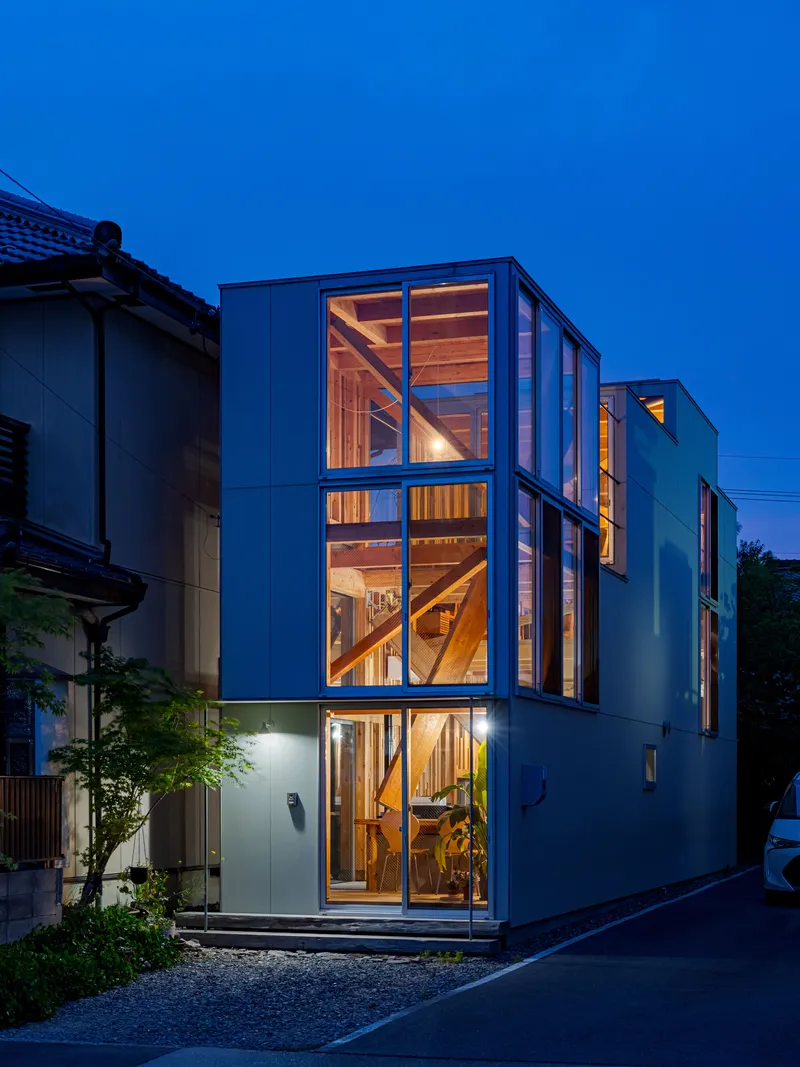
The street-facing elevation stacks three full-height glazed bays that expose the diagonal timber staircase behind. During the day, the metal screens and white framing give the facade a composed, layered quality. At twilight, the relationship inverts: the timber skeleton, lit from within, becomes the primary image, and the white walls recede. The building performs differently depending on the hour, oscillating between opacity and exposure.
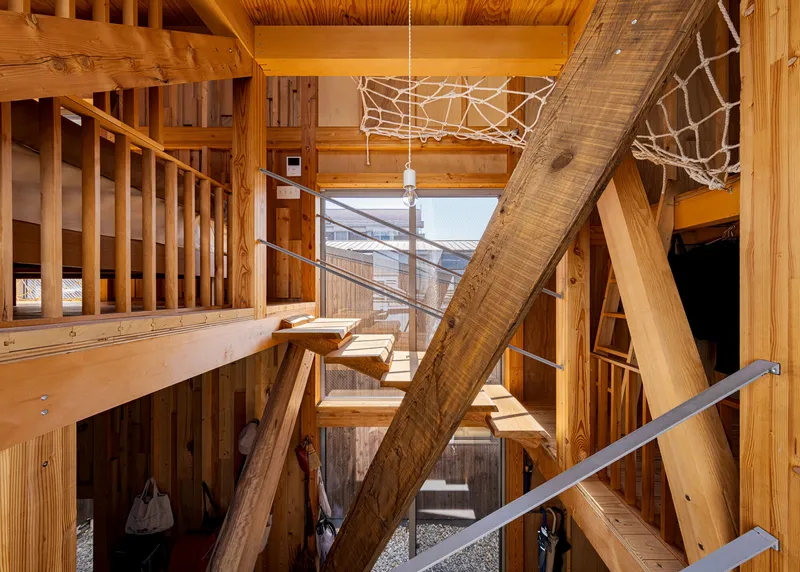
The decision to make the circulation core visible from the street is telling. In most narrow houses, the stair is a compromise, tucked away to maximize plan area. Here, it becomes the public face of the building. The diagonal braces that stiffen the structure also define the stair geometry, so the engineering and the architecture are legible in the same gesture.
Diagonal Bracing as Spatial Framework
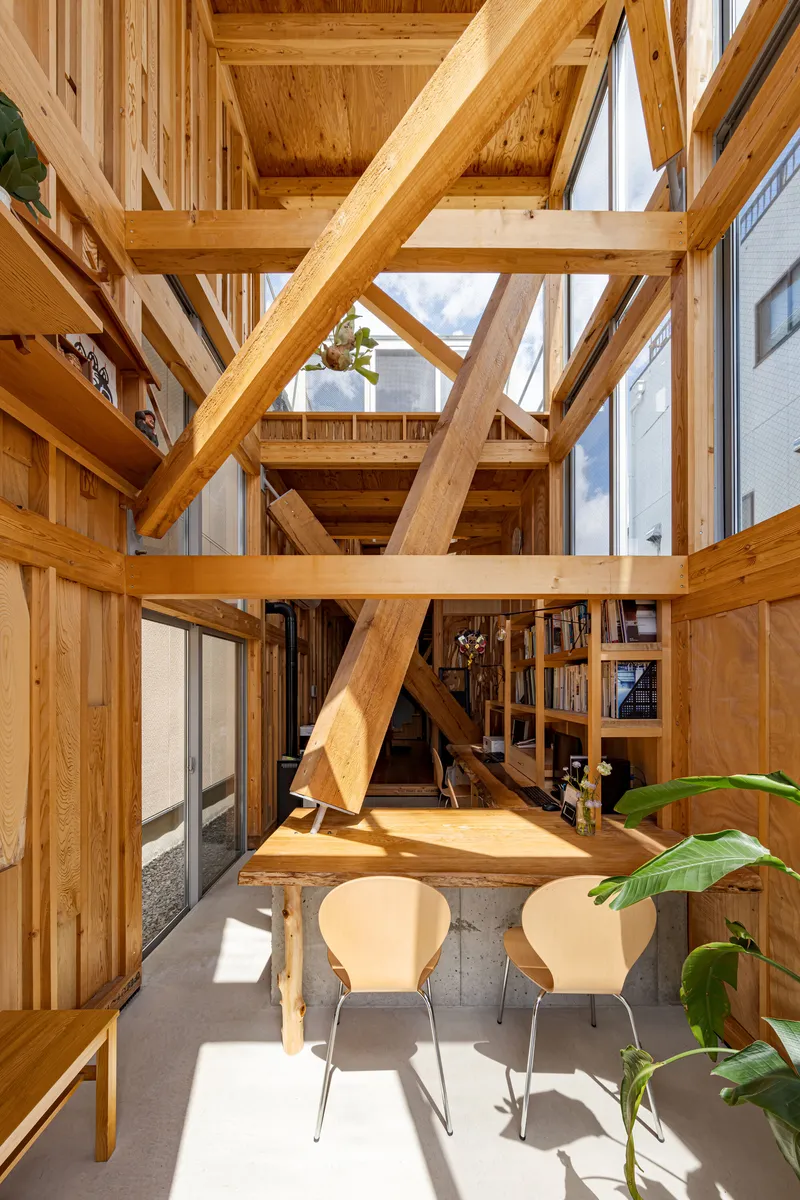
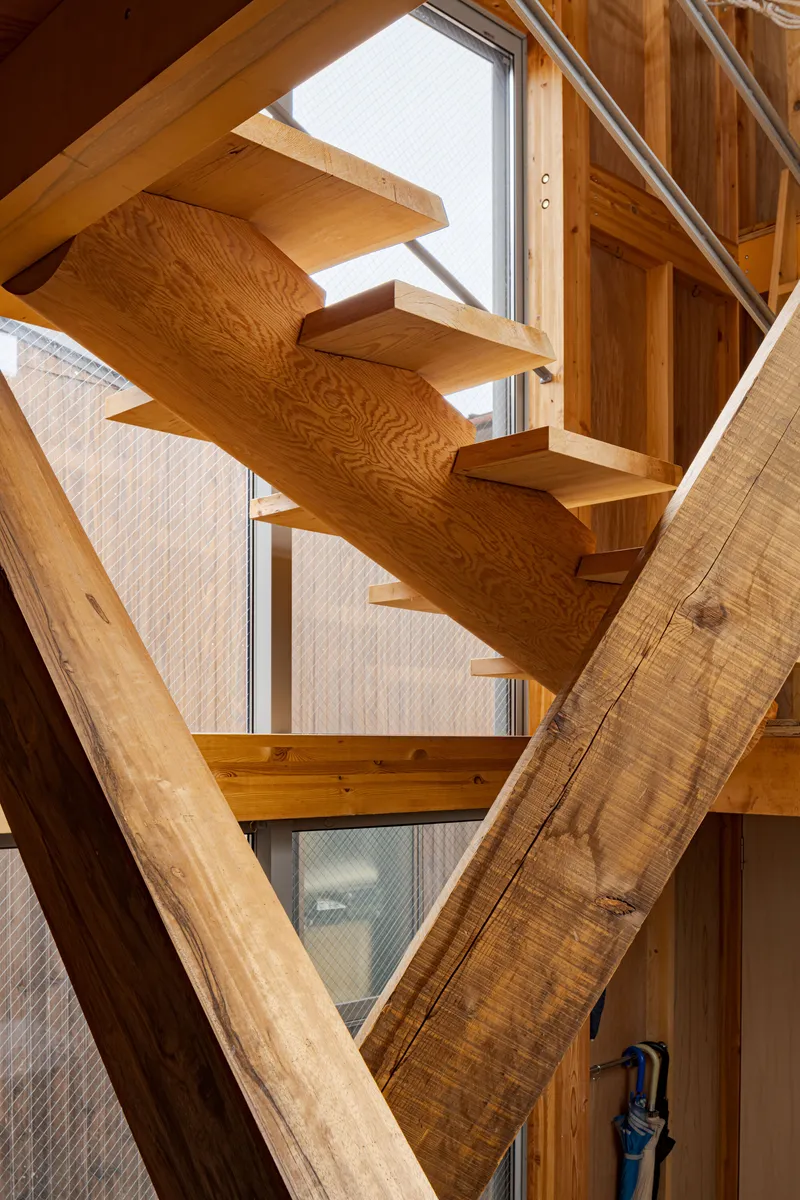
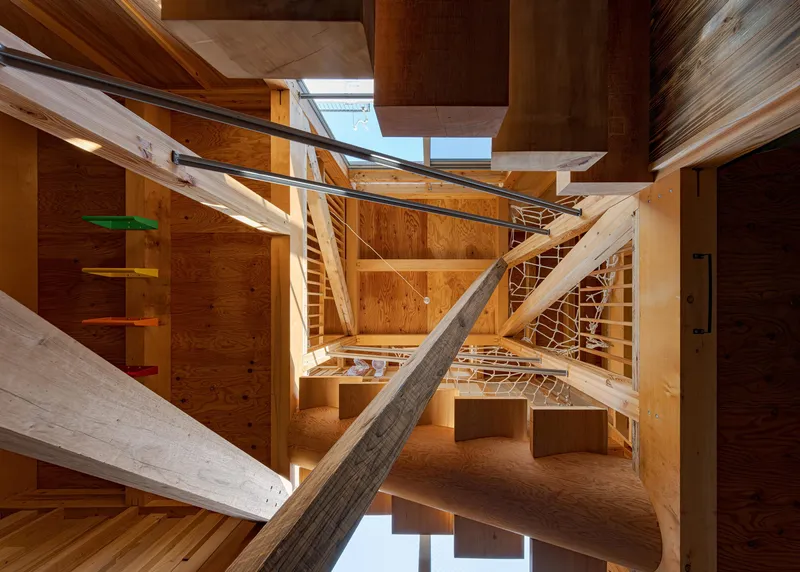
The thick diagonal braces that run through the section do far more than resist lateral loads. They partition space without enclosing it, define the zigzag path of the staircase, and create frames within frames at every level. Sunlight catches their surfaces and throws sharp shadows across plywood ceilings and polished concrete floors. The effect is kinetic: as you move vertically through the building, the braces shift in and out of alignment, constantly recomposing the view.
For a building of only 69 square meters, this structural expressiveness is crucial. The braces give the eye something to track, introduce rhythm and depth, and prevent the narrow plan from feeling like a corridor. They are thick enough to have material presence, to suggest the weight of the stockpiled timber they were cut from, and rough enough to retain the character of wood that has lived a previous life.
Living Vertically: The Central Void
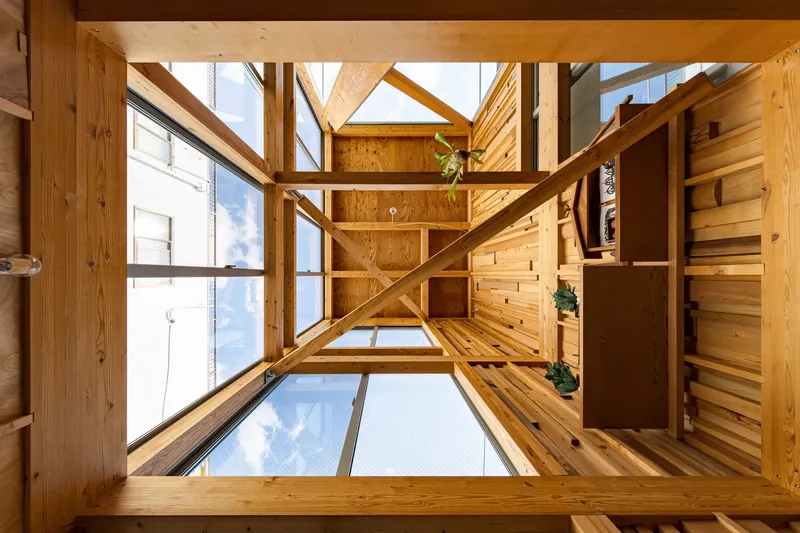
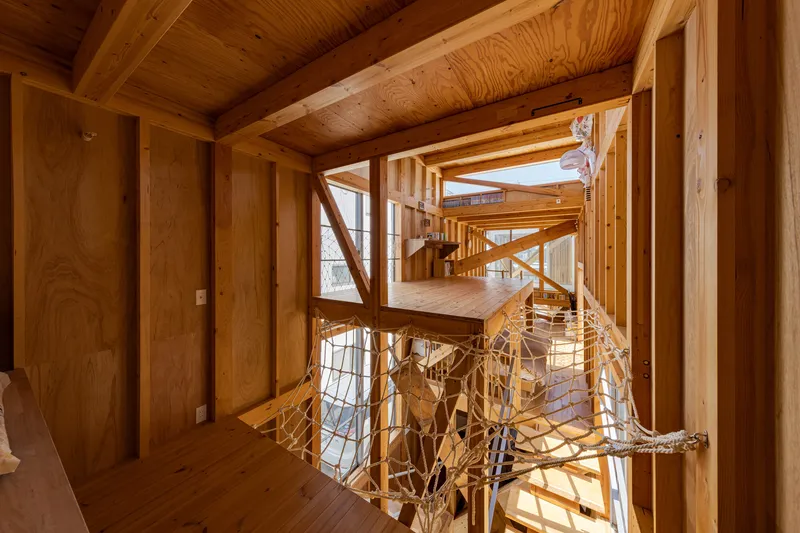
The building's section is organized around a continuous vertical void that links all levels visually and physically. Glass floor panels allow light to pass downward; rope net balustrades and timber bridges make the void feel inhabited rather than purely circulatory. Looking up from the ground floor, the layered timber framing and overhead skylights compose an almost geological image, like looking into the cross-section of a log.
Rope netting and hammocks strung across the open spaces are not decorative afterthoughts. They soften the hard geometry of the braces and invite a looser, more playful occupation of the vertical dimension. A child can lie in a hammock and look down through multiple levels; a resident on the ground floor can hear activity above. The void connects the office function on lower levels to the domestic life above, maintaining porosity between the two programs without collapsing them into one.
Timber Variety as Interior Texture
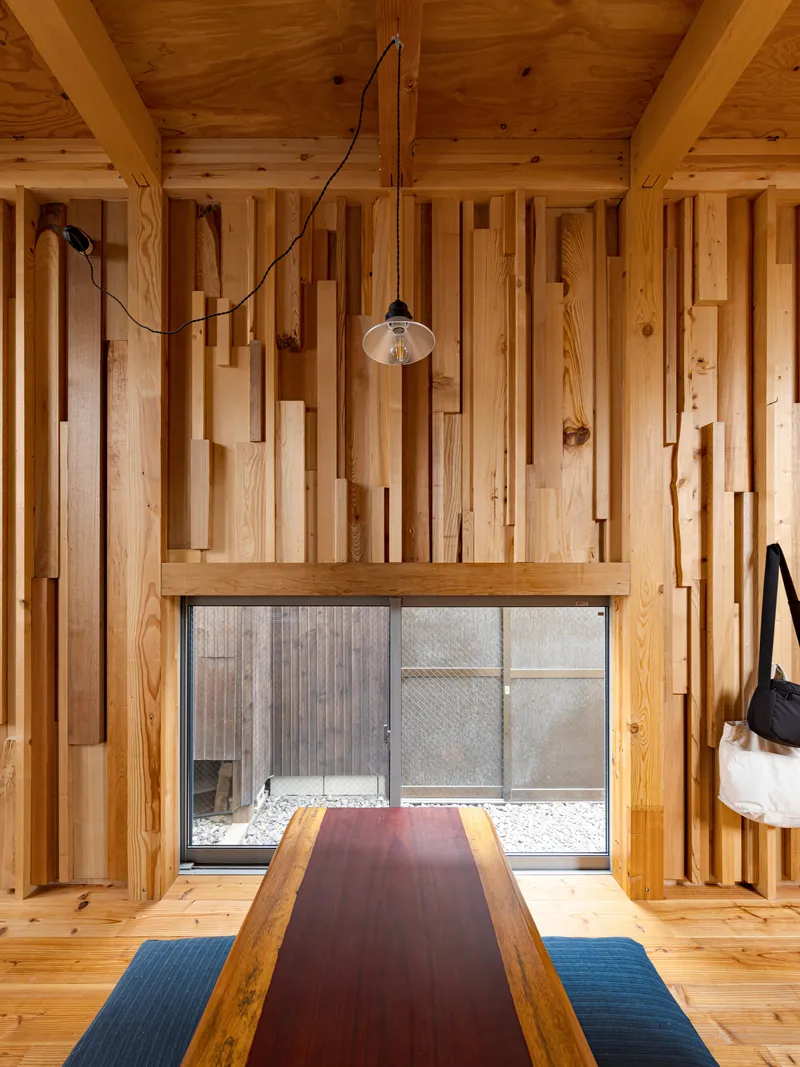
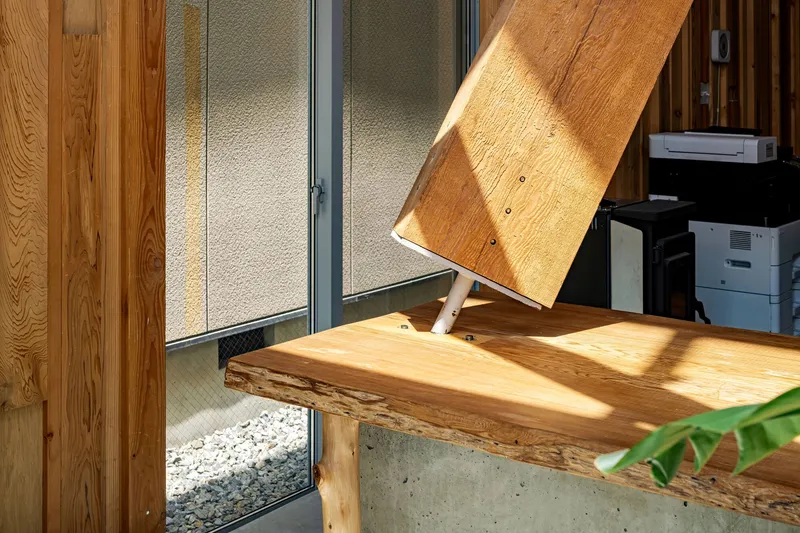
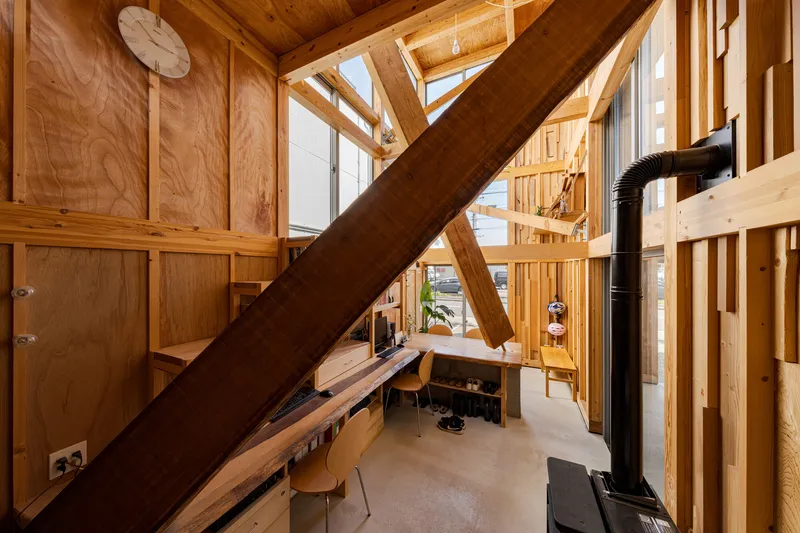
Because the timber comes from varied sources, ordered over decades and salvaged from different demolition sites, it carries a visible range of species, grain, tone, and patina. The variegated wall cladding in the interior rooms is a catalog of this material history. No two boards match. The effect is warm without being precious, and it sidesteps the uniformity that characterizes most new timber construction.
A live-edge shelf cantilevered from a concrete base, a simple pendant lamp over a two-tone table, a black metal stove beside a low desk: the details are unpretentious and honest. The interiors feel like a workshop that has been refined into a home. That is, in a sense, exactly what happened. The construction company's own stored material and craft knowledge produced the building they now inhabit.
Work and Domestic Space Interwoven
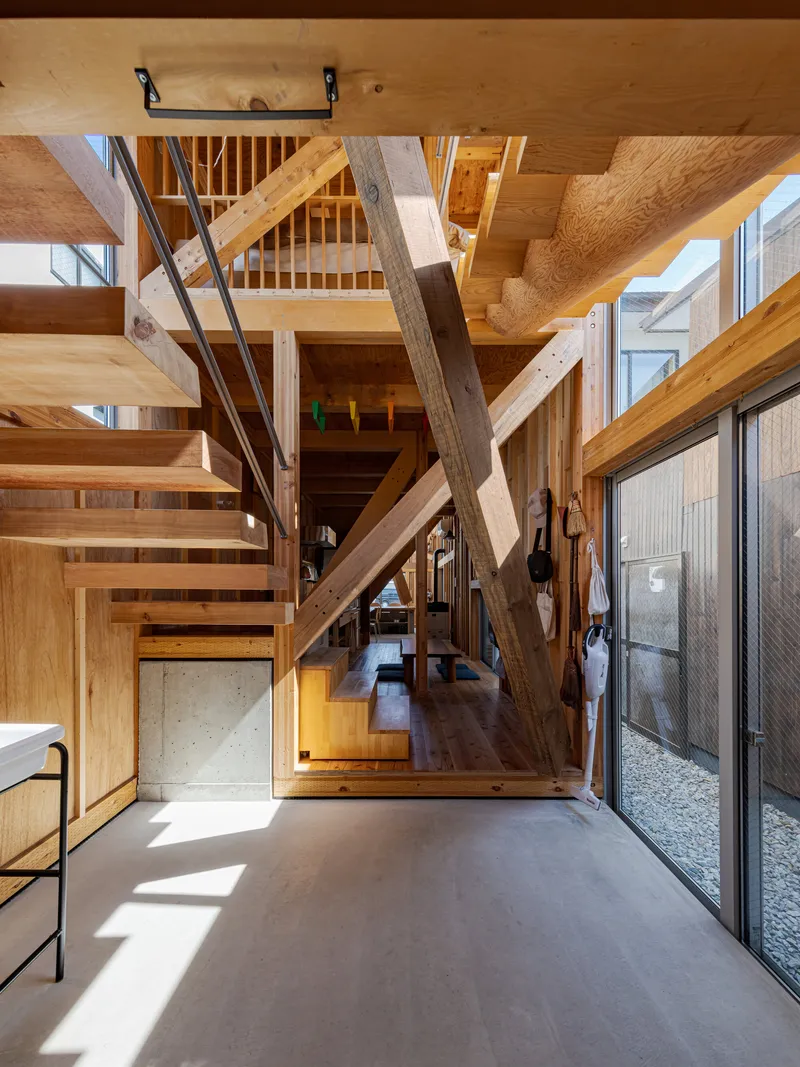
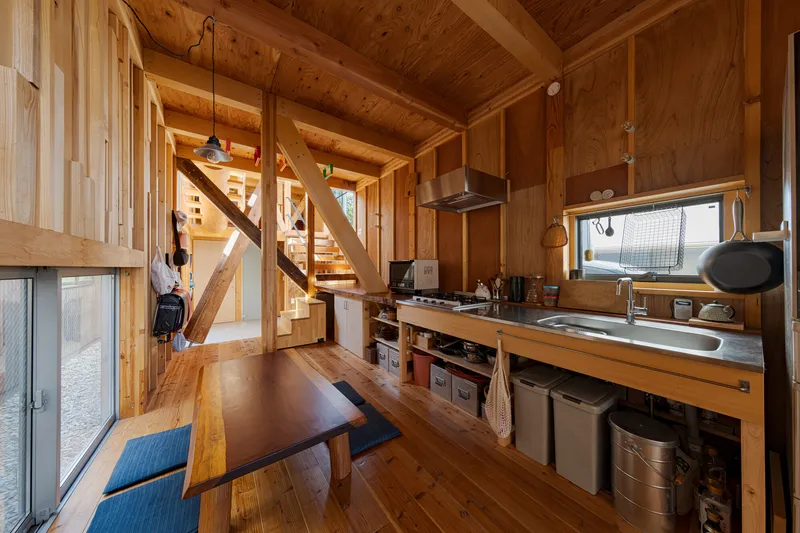
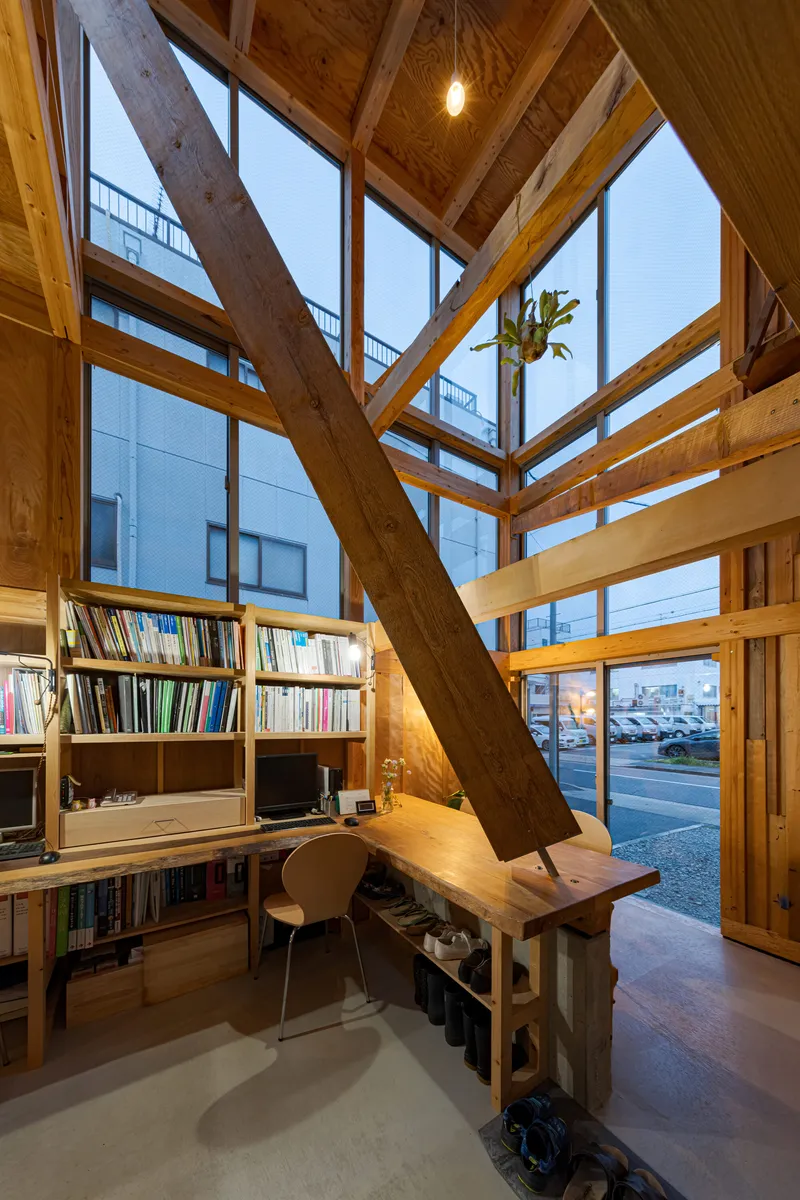
The ground level, with its polished concrete floor and open entry, reads as office. Above, the kitchen with its timber countertop and the book-lined work areas suggest domestic life, but the boundary is soft. Diagonal braces pass through both programs indifferently. The staircase, visible through every level, stitches work and living together rather than separating them with a corridor and a locked door.
At dusk, the bookshelves and desk surfaces glow behind full-height glazing, projecting an image of productive inhabitation to the street. For a small construction company, this transparency is also a form of advertising: the craft of the building is the business card.
Upper Levels: Light, Air, and Rest
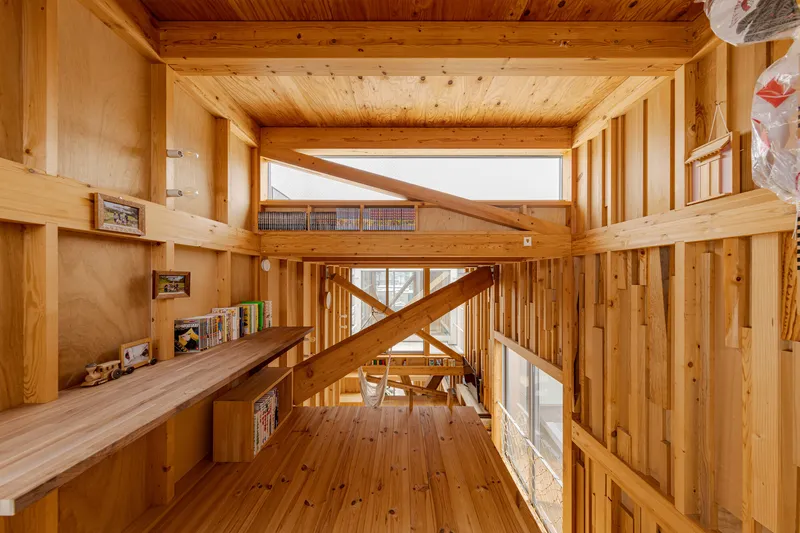
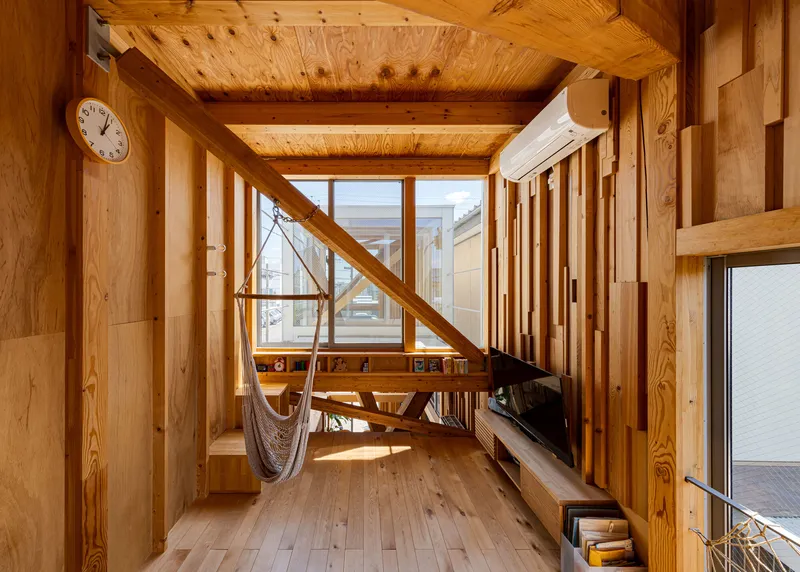
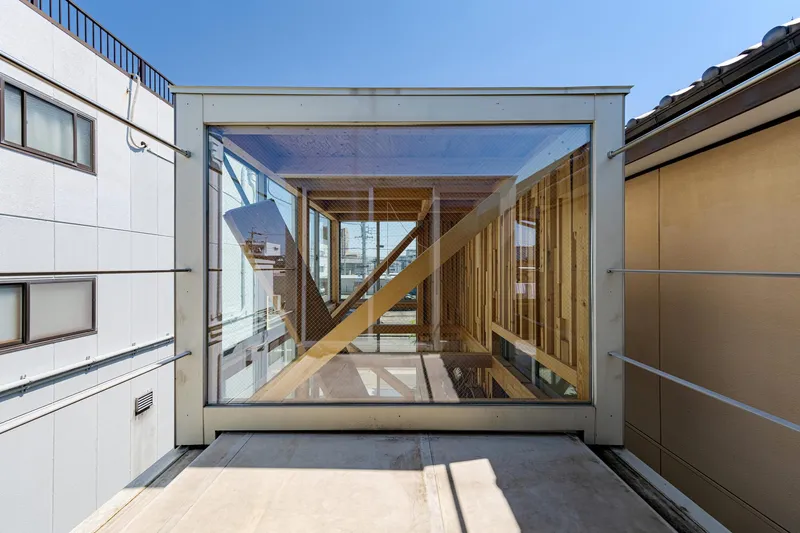
As you climb, the building becomes progressively lighter. Upper-level rooms receive clerestory light and open onto a small rooftop courtyard enclosed by white walls and a glass-walled stair enclosure. A hammock hangs between exposed beams. The study space overlooks the dining area below through the open void, maintaining spatial continuity even at the building's most private elevation.
The rooftop courtyard is a small but important release valve. In a lot this tight, with neighbors this close, it provides a private patch of sky. The glass staircase enclosure on the roof acts as a lantern, pulling daylight deep into the section and marking the building's summit from outside.
Plans and Drawings
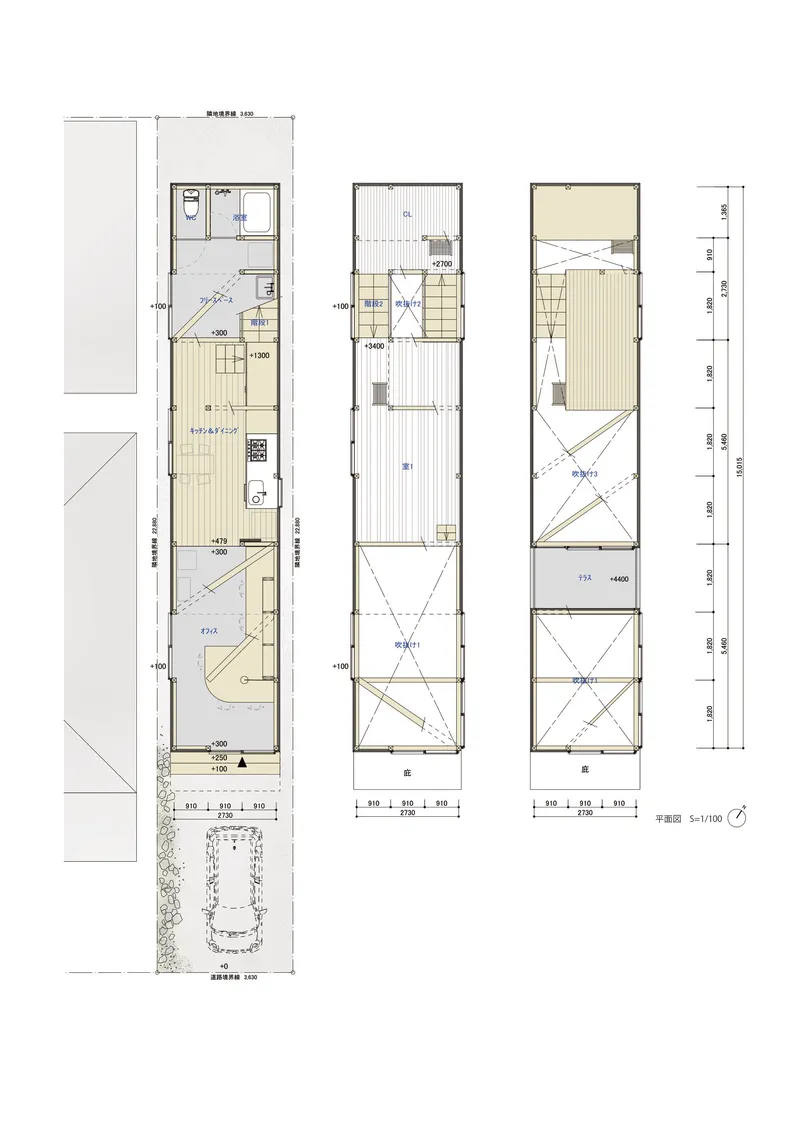
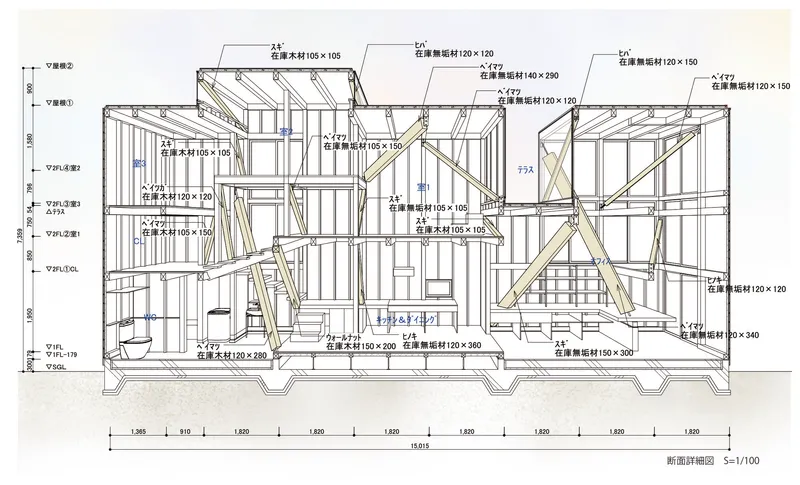
The floor plan drawing reveals the narrow linear footprint and the diagonal stair geometry that defines every level. The section is where the project's logic is most legible: the timber frame structure, with its cross-bracing running continuously through the building's height, creates a visual lattice that unifies the multiple floor levels. Each half-level shift in the stair opens a different spatial relationship to the void, confirming that the building was designed in section first and plan second.
Why This Project Matters
House & Office SH takes a familiar problem in Japanese construction culture, the accumulation of surplus and salvaged timber with no clear use, and turns it into a design premise. The building does not sentimentalize reuse or treat it as a sustainability badge. Instead, it absorbs the material variety of its sources into an expressive structural system that is simultaneously pragmatic and atmospheric. The diagonal bracing that gives the building its visual identity is also the most efficient way to stiffen a narrow timber tower on a small lot. Form, structure, and material ethics converge.
At 69 square meters, the project is a lesson in doing more with less. The vertical section, the continuous void, the rope nets and hammocks, the glass floors: all of these devices expand the perceived volume far beyond the plan area. For a construction company that has spent half a century building for others, this is a fitting headquarters. The building is an argument, made in wood, that craft and resourcefulness still matter.
House & Office SH by 1-1 Architects, Nagoya, Japan. 69 m², completed 2023. Photography by Takashi Uemura.
About the Studio
1-1 Architects
Official website of 1-1 Architects, one of the studios behind this project.
1-1arch.comShare Your Own Work on uni.xyz
If projects like this are the kind of work you want to make, uni.xyz is a place to publish your own, find collaborators, and enter design competitions.


Popular Articles
Popular articles from the community

Extended Shell: Retrofitting Kolkata's Balconies as Living Urban Thresholds
A modular retrofit system recovers the social and environmental intelligence of Kolkata's historic verandas for contemporary Park Street residents.

Faces of the Soviet Avant-Garde: Turning Moscow's Street Names into an Open-Air Museum
A network of sculptural installations across a Moscow residential district transforms forgotten architect names into spatial encounters with cultural memor

The Amber Palace Opera: A Geological Fiction Surfaces on Tallinn's Baltic Waterfront
Pierre Brillard reimagines a Baltic legend as a public landscape, opera house, and waterfront promenade rooted in Tallinn's coastal identity.

Opera by the Sea Estonia: Three Shells Dissolving Architecture into Tallinn's Coastline
A winning opera house proposal replaces monumental form with interconnected shells that blur the boundary between building, park and Baltic Sea.

Similar Reads
You might also enjoy these articles

Pixel Gardens: One Repeated Module Stacked Into a Terraced Social Housing Tower for Famagusta
Salem Bader's shortlisted housing tower builds a vertical neighbourhood from one repeated module, offsetting units to carve terraces, light and air.

Bao Huynh Watercolor Atelier: A Serene Art Retreat in Hội An
Bao Huynh Watercolor Atelier in Hội An blends multifunctional art spaces, sustainable design, local materials, and family-friendly living in a serene environment.

Atelier Macri Concept Store Interior Design by CASE-REAL
Atelier Macri store features a "ko" counter, walnut wood details, cork displays, blending retail, gallery, and seamless customer experiences.

Manuel Vargas Izquierdo Stadium and High-Performance Sports Center: Architectural Excellence in Jalpa de Méndez
The Manuel Vargas Izquierdo Stadium blends sustainable design, inclusive sports facilities, and cultural-inspired architecture, revitalizing Jalpa de Méndez’s public spaces.


Comments (0)
Please login or sign up to add comments
No comments yet. Be the first to comment!