

Westerpunt Observation Tower by studio MOTO: A Seamless Connection Between Land and Sea
Westerpunt Observation by studio MOTO in De Panne, Belgium, harmonizes dunes, sea, and promenade with concrete design, offering dynamic coastal views.


Located in De Panne, Belgium, the Westerpunt Observation Tower, designed by studio MOTO, is a striking example of contemporary public architecture and urban design. Completed in 2024, this 200 m² structure offers visitors an immersive experience that harmonizes with the surrounding coastal landscape, including the dunes, beach, and promenade connecting Belgium and France.
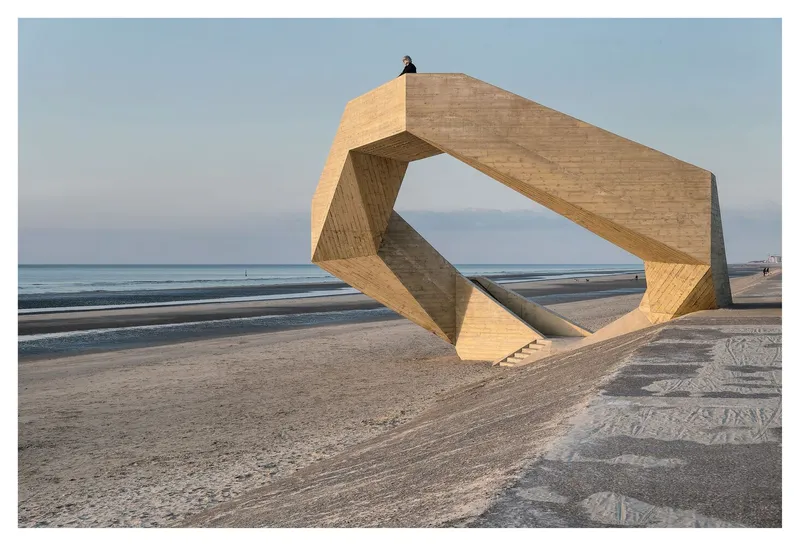
Context, Integrating Nature and Human Experience
From the outset, studio MOTO recognized the sensitivity of the site. The location is where multiple elements converge: the sea with its tides, sandy beaches, dunes, and the bustling promenade. Birds and walkers share the space, alongside natural and man-made materials: water, sand, and concrete. The design goal was to create a structure that enhances these elements without overwhelming them. The result is a permanent yet unobtrusive observation point, seamlessly integrated into the environment, offering a meaningful and intuitive visitor experience.

Connecting the Landscape
Strategically positioned on the slope of the promenade, the observation tower extends the walking experience along the coastline. Visitors ascending the structure remain connected to the promenade and beach, creating a continuous journey. The tower functions as a link between land and sea, bridging natural and urban landscapes.

Unique Positioning and Dynamic Experience
The view from Westerpunt is exceptional due to the large nature reserve and open dunes that characterize De Panne. The tower’s design respects this landscape through its scale, height, shape, color, and materials, enhancing the town’s unique coastal identity. Its dynamic form transforms the traditionally linear promenade walk into a looped, spatial experience, with staircases offering shifting perspectives of the dunes, beach, and sea. At high tide, parts of the structure interact with the water, further blending nature with human experience.

Landmark Identity
The tower’s nearly ring-shaped form gives it a distinctive presence on the promenade’s slope. Despite its modest scale, it stands out as a photogenic landmark, attracting visitors and serving as a destination point. Transparency within the structure frames the surroundings, acting as a lens that encourages exploration from different vantage points, whether approaching from De Panne or Dunkirk.

Symbolism and Journey
Inspired by the Confucian quote, “The journey is the destination,” the observation tower emphasizes movement rather than arrival. Visitors experience the structure as a resting point along the walk, seamlessly integrating it into the promenade. Its circular form symbolizes the connection between humans and nature, as well as the cultural link between Belgium and France.
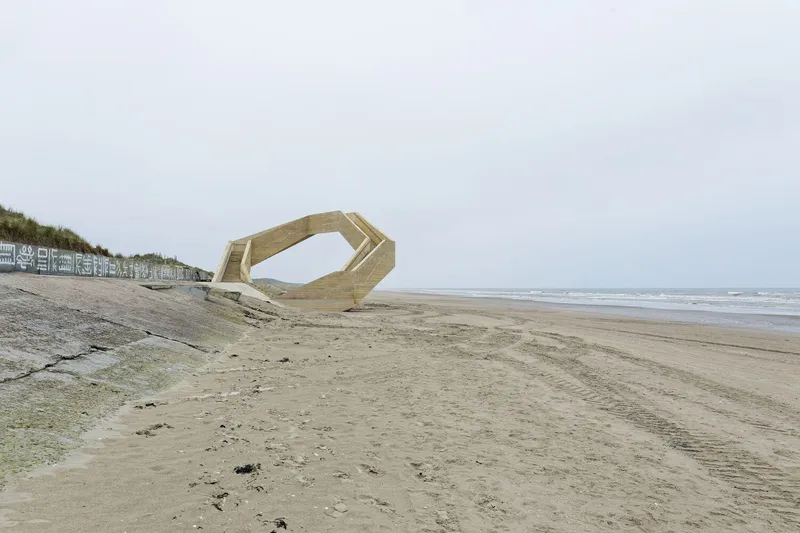
Sustainable Materials and Resilience
Constructed entirely of concrete, the tower is robust enough to withstand the harsh coastal climate while maintaining minimal maintenance needs. The material complements the surrounding promenade and allows for the potential expansion of dunes beneath the structure, ensuring it can stand independently while remaining harmonious with the environment.

Architectural Plan and Functionality
The structure’s plan is an elongated pentagon, with equal stair segments connected at 108° angles. Each landing acts as a resting point, providing unique views of the landscape. These stair segments also serve as the structural pillars, allowing the tower to cantilever over the beach and sea. An additional bench on the east side offers visitors a contemplative spot to enjoy the scenery through the structure. In this design, form, function, and structure are unified, creating a seamless and immersive experience.
Westerpunt Observation by studio MOTO exemplifies sensitive coastal architecture, enhancing the Belgian seaside experience while respecting nature and offering visitors an unforgettable landscape perspective.


All photographs are works of
Michiel Hendryckx, Pink Appartment, studio MOTO


Popular Articles
Popular articles from the community


longwave studio Reorganizes a 112 m² Tainan Apartment Around the Daily Routines of a Family and Two Cats
In Tainan, Taiwan, birch plywood, rust-red furniture and a freestanding plaster wall link arrival, storage, work and family life in one apartment.

Jaramillo Van Sluys Arquitectura and Urbanismo Turn a Demolished Registry Lot in Quito into an Orchard Plaza
In Quito's Centro Histórico, a 2,800 m² plaza exposes the San Agustín convent wall and redraws its lost Augustinian orchard in volcanic stone.

Cube Design Draws an Ecological Corridor Between Two Shenzhen Hills with the Nankai Building
Beside Shenzhen's container docks, the Nankai Building pairs stacked balconies with a climbing green screen to connect two hillsides across its height.

David Macias Steps a Doorless Stone and Plaster House Down a Tropical Colombian Hillside
In the humid hills of Colombia, Threshold House replaces the front door with an open void and terraces its 850 m² down the slope instead of fighting it.

Similar Reads
You might also enjoy these articles

Gil Mello Arquitetura Tilts a Single Roof Toward the Waterfalls on a Plateau Above Aiuruoca, Brazil
In Aiuruoca, Minas Gerais, a 200 m² house of local labor and reclaimed poles pairs a low valley veranda with a tall mountain one.

U.GA Architects Wraps an Oval Rooftop Pool in Curved Board-Formed Concrete on Busan's Jeollidan-gil
In Busan's Jeonpo-dong, a 454 m² mixed-use block stacks a neighborhood facility, guest rooms and an oval rooftop pool inside spiraling concrete walls.

Felipe Hess Arquitetos Turns a Blind Stone Wall to the Street and Opens a Brazilian House onto a Courtyard and Canal
A canal-front house in Brazil hides behind painted stone and planting, then opens to an olive-tree courtyard, a reed-ceilinged porch and a curving pool.
David Macias Steps a Doorless Stone and Plaster House Down a Tropical Colombian Hillside
In the humid hills of Colombia, Threshold House replaces the front door with an open void and terraces its 850 m² down the slope instead of fighting it.

Explore Public Architecture Competitions
Discover active competitions in this discipline

Challenge to reimagine the Iron Throne

Photograph architecture without architects

Illustrate the lost glory of Angkor Wat - Render Challenge

Design challenge to reuse E-waste
Comments (0)
Please login or sign up to add comments
No comments yet. Be the first to comment!