
Heatherwick Studio Grows a Terraced Urban Forest in Xi'an's New Central Business District
A multilevel commercial district in Xi'an layers arching bronze columns, planted terraces, and sunken plazas into a landscape-like civic center.

Xi'an is a city that has reinvented itself many times over. As the eastern terminus of the Silk Road and China's ancient imperial capital, it carries an almost overwhelming weight of history. So when Heatherwick Studio was tasked with designing the Xi'an Central Cultural Business District, the brief was never simply about retail square footage or office floor plates. It was about building a new center of gravity for a city already saturated with them.
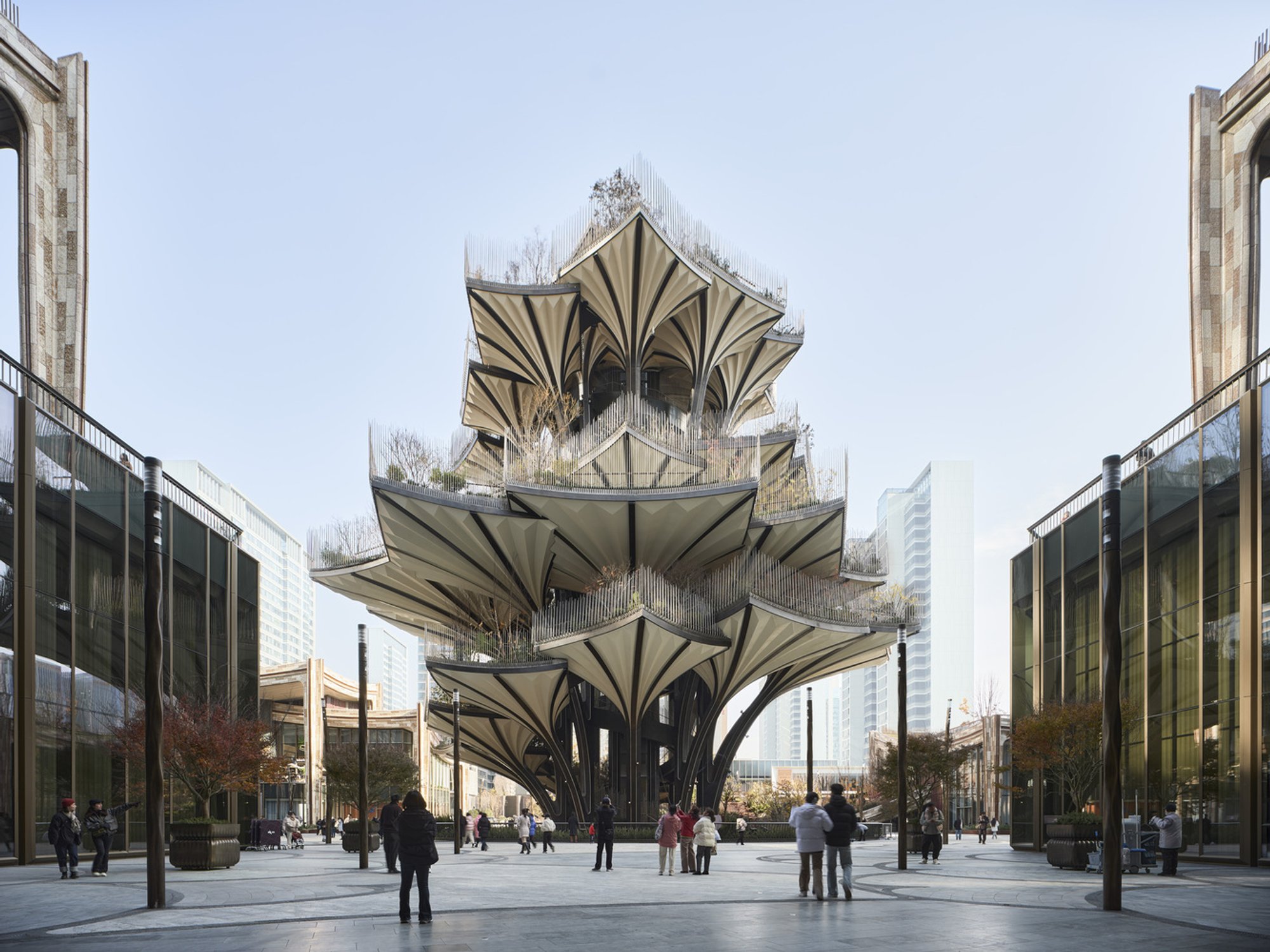
What the studio delivered is less a building than a constructed topography. The CCBD takes the logic of a terraced hillside and transplants it into the commercial core, stacking planted levels under radiating arched columns that read simultaneously as structural ribs and canopies. The result is a project that refuses to separate landscape from architecture, treating every horizontal surface as an opportunity for planting and every vertical element as a chance to frame a view. It is ambitious, occasionally excessive, and genuinely unlike anything else operating at this scale in Chinese urbanism.
A Landscape You Can Walk Through and Over
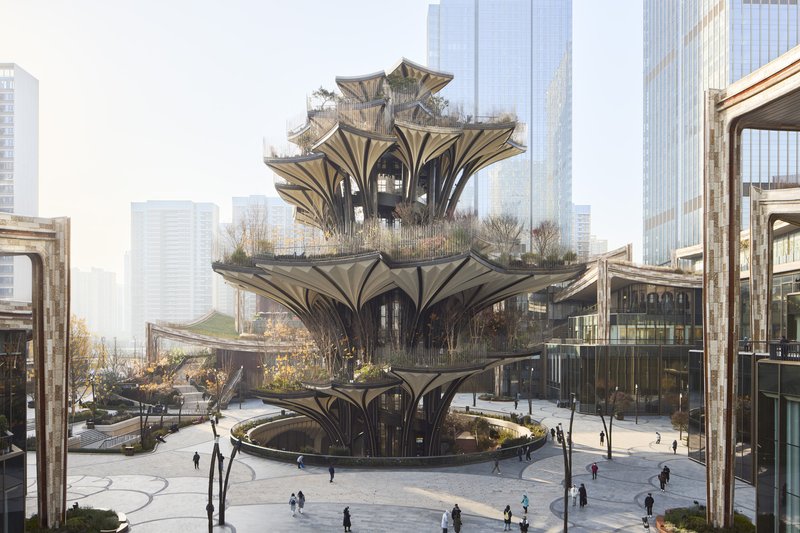
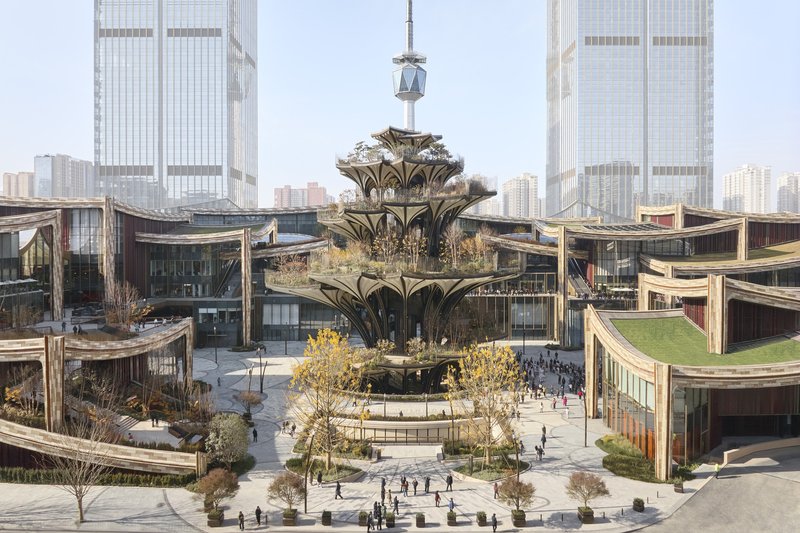
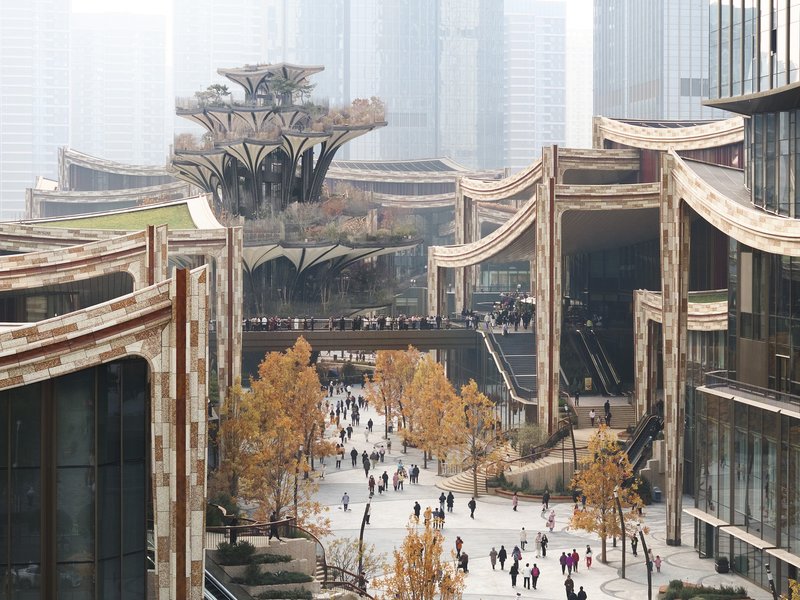
The central conceit of the project is its terraced massing, which rises from a public plaza in stepped layers, each one fringed with planting. Seen from the air, the geometry is concentric and organic, with curved rooflines that ripple outward from a central vertical element. At ground level, the experience is more intimate: you are walking beneath overhanging gardens, looking up through layers of foliage and bronze-toned structure.
The decision to treat the entire building envelope as a continuous landscape means there is no single "front" to the complex. Pedestrians approach from sunken plazas, elevated bridges, and rooftop promenades. The hierarchy is deliberately flattened, so that arriving on foot from street level feels no less considered than descending from an upper terrace. That is a rare quality in a large commercial development, where the VIP entrance and the service road usually tell you everything about who the building is really for.
Arching Columns as Both Structure and Ornament
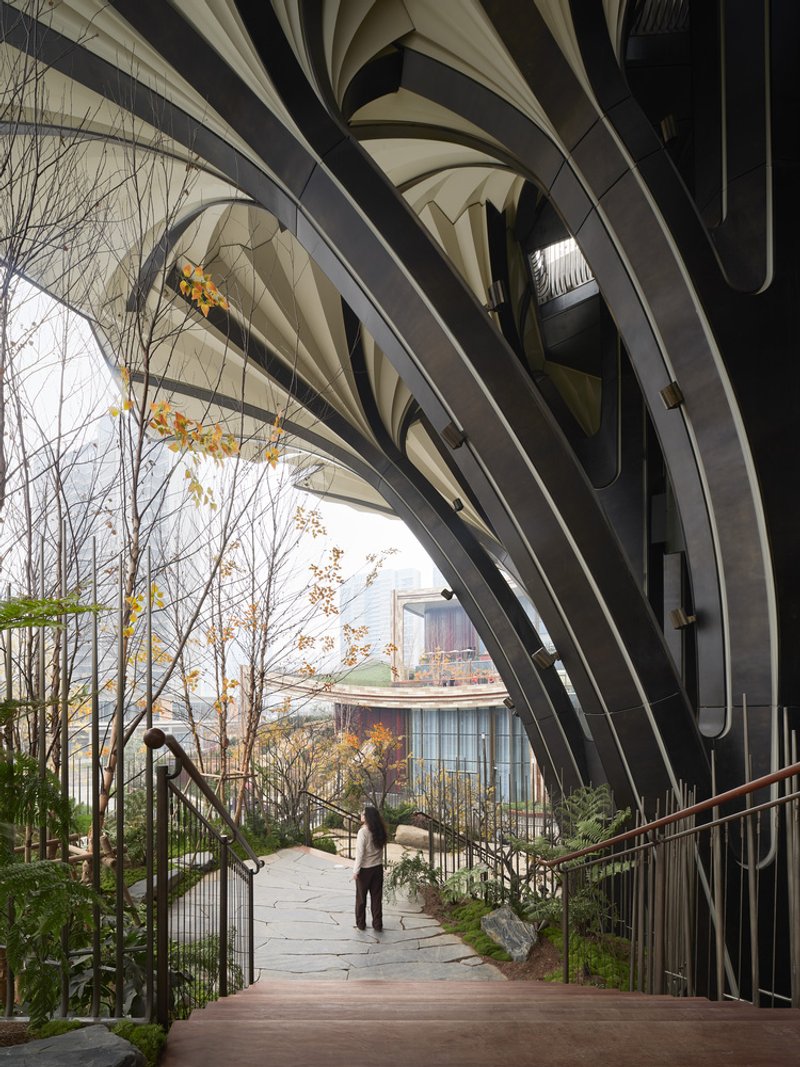
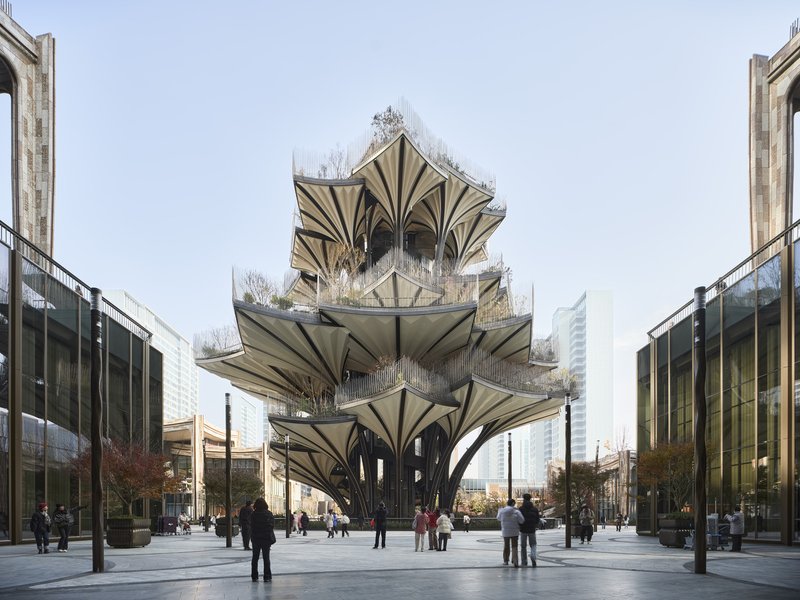
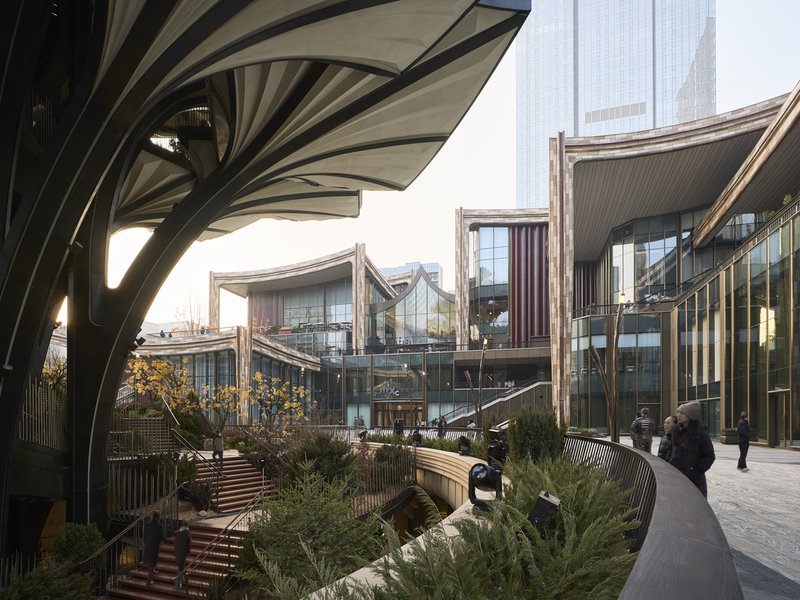
The defining visual motif is the fan-shaped column: a structural member that spreads at its top into a series of radiating ribs, like a palm frond or an opening hand. These columns do real work, supporting cantilevered terraces and shading the walkways below. But they also operate as ornament in the oldest sense of the word, giving the complex a rhythmic verticality that keeps it from reading as a simple stack of trays.
The bronze finish on these elements is calibrated to shift tone depending on the light. Under Xi'an's frequent haze, the columns take on a muted warmth; in direct sun they catch and throw light in a way that gives the facade depth. It is a material choice that rewards patience, and it ties the complex visually to the earthen tones of the surrounding Guanzhong Plain rather than to the reflective glass towers that dominate most Chinese CBDs.
Sunken Courts and Rooftop Groves
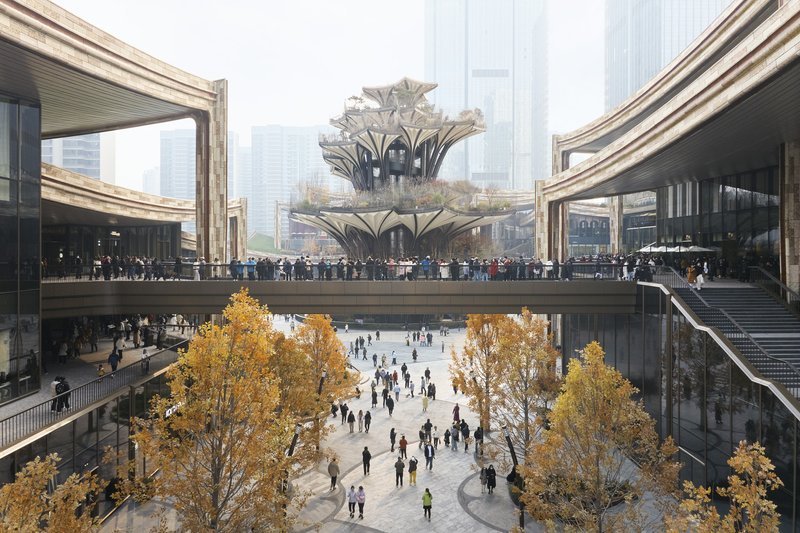
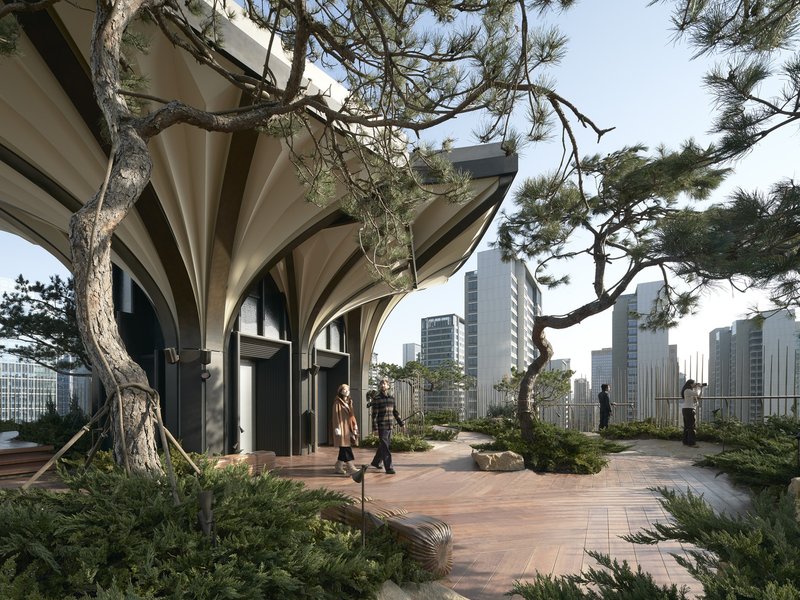
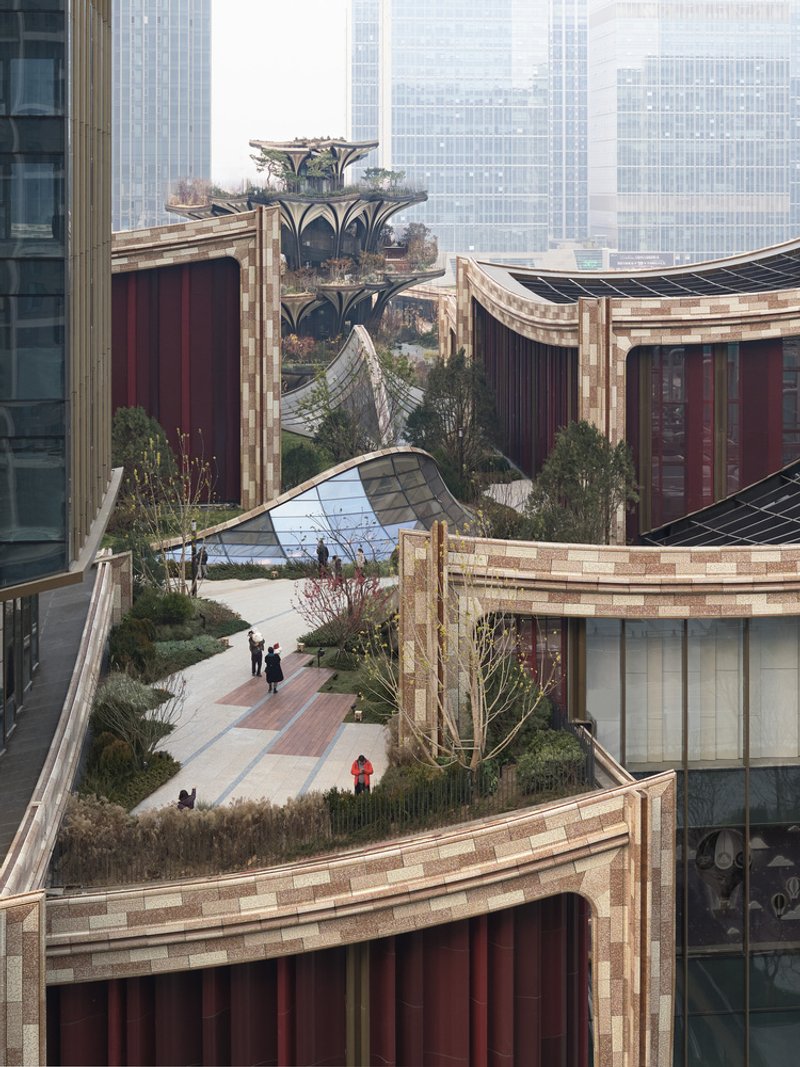
Two scales of public space coexist here. Below grade, sunken plazas lined with mature autumn trees create sheltered rooms open to the sky, framed by elevated walkways and the terraced mass of the building. These are genuinely pleasant urban rooms, shielded from wind and noise, with a sense of enclosure that recalls traditional Chinese courtyard logic more than it does Western sunken retail concourses.
Above, the rooftops are treated as a continuous park system. Curved concrete canopies shade paved pathways that wind between pine trees and planted beds, turning the building's upper surfaces into a public amenity rather than a mechanical penthouse. The juxtaposition of the two levels is the project's strongest spatial move: you descend into shade and intimacy, then ascend into openness and panorama, all within a few minutes of walking.
Interior Volumes and Light
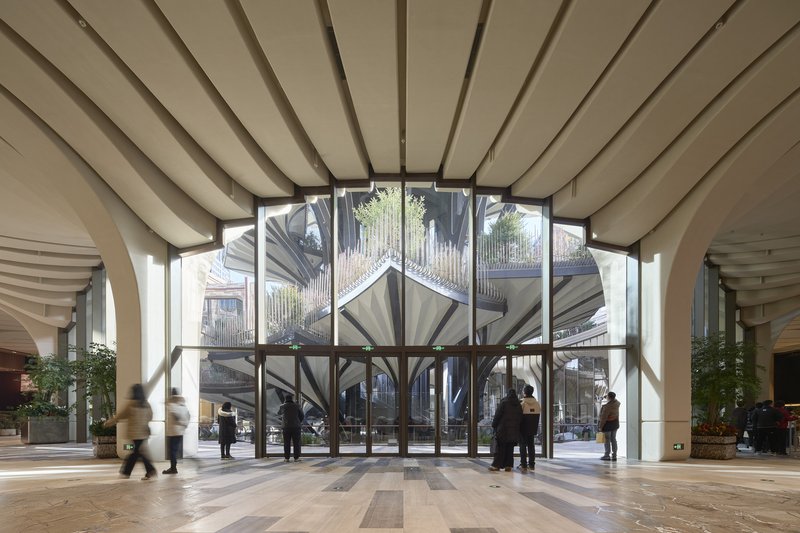
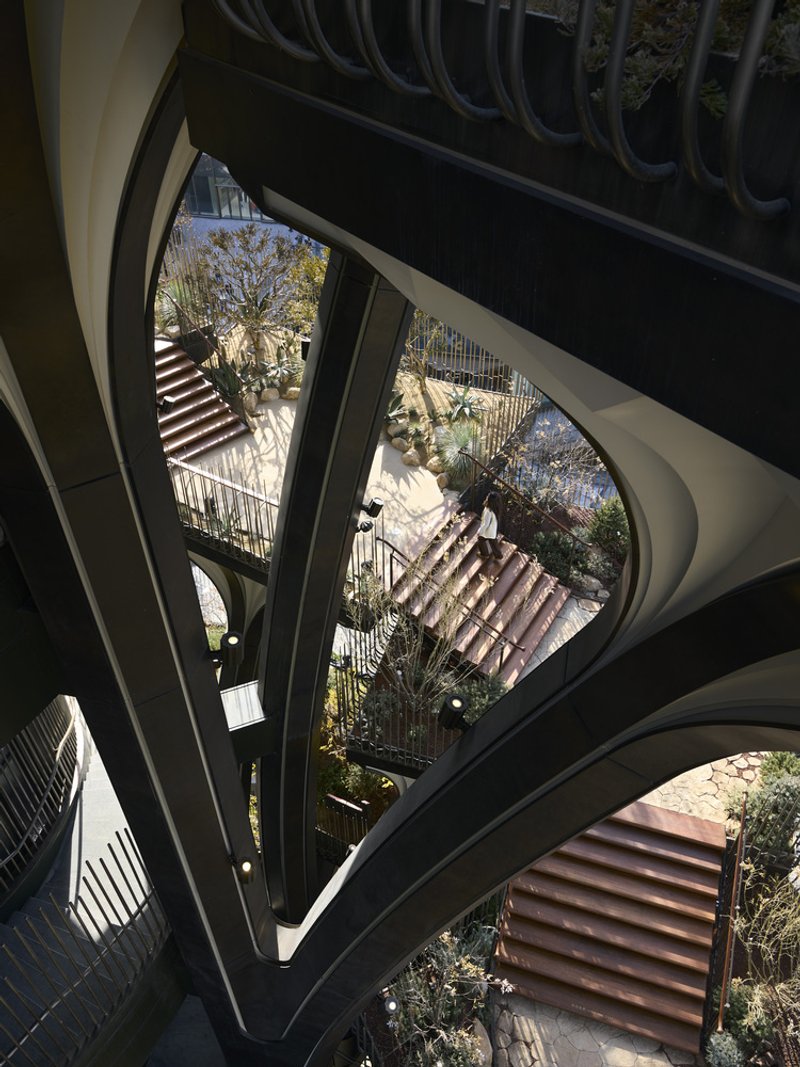
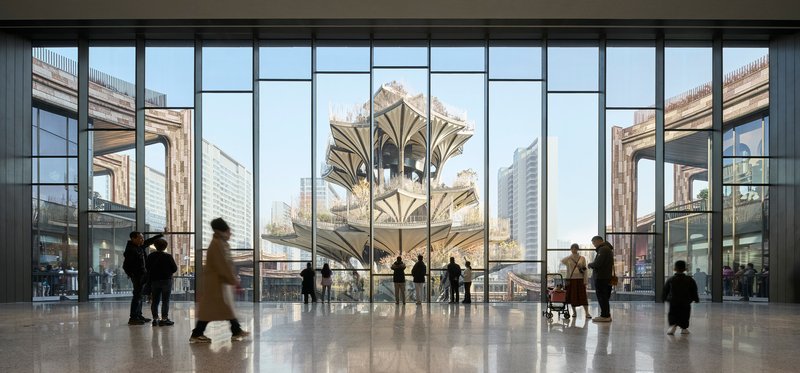
The interiors continue the theme of porosity. Full-height glazing wraps the concourse levels, erasing the boundary between inside and outside and allowing views deep into the terraced structure from within. The entrance lobbies are handled with a ribbed cream ceiling treatment that feels lighter and more restrained than the exuberance of the exterior, offering a moment of compression before the spatial release of the atrium beyond.
The triangular atrium voids are perhaps the most photographed feature, and for good reason. Looking down through planted terraces and crisscrossing staircases in dappled sunlight, you get a sense of the project's real ambition: to collapse the distance between indoor commerce and outdoor ecology. Whether it achieves that collapse or merely stages it is an open question, but the spatial effect is undeniable.
Surface and Texture at Close Range
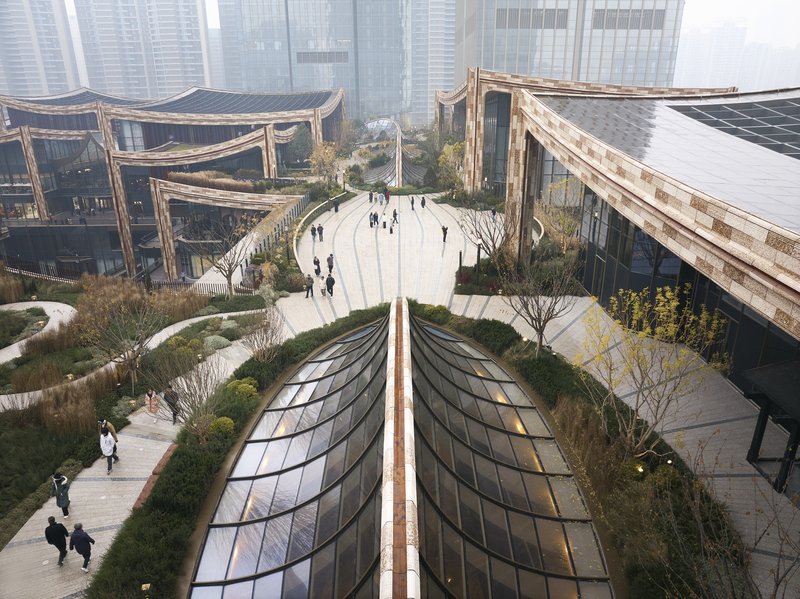
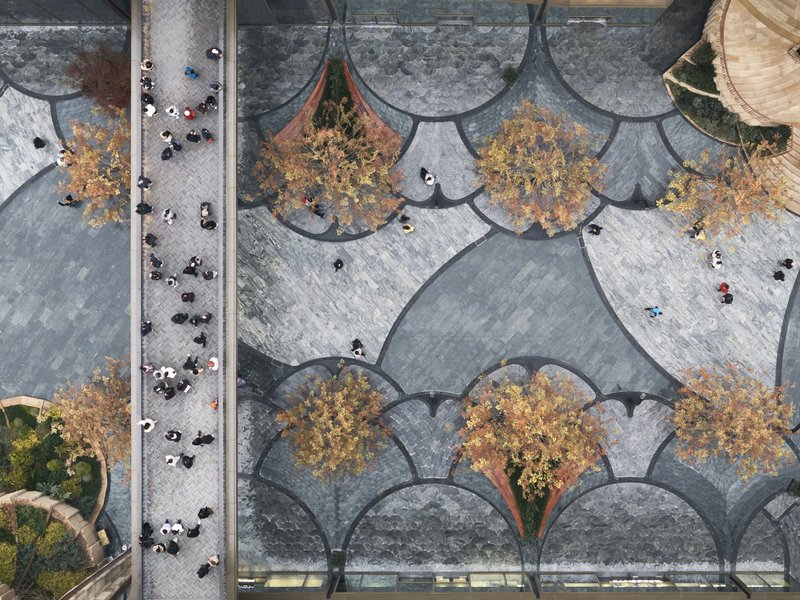
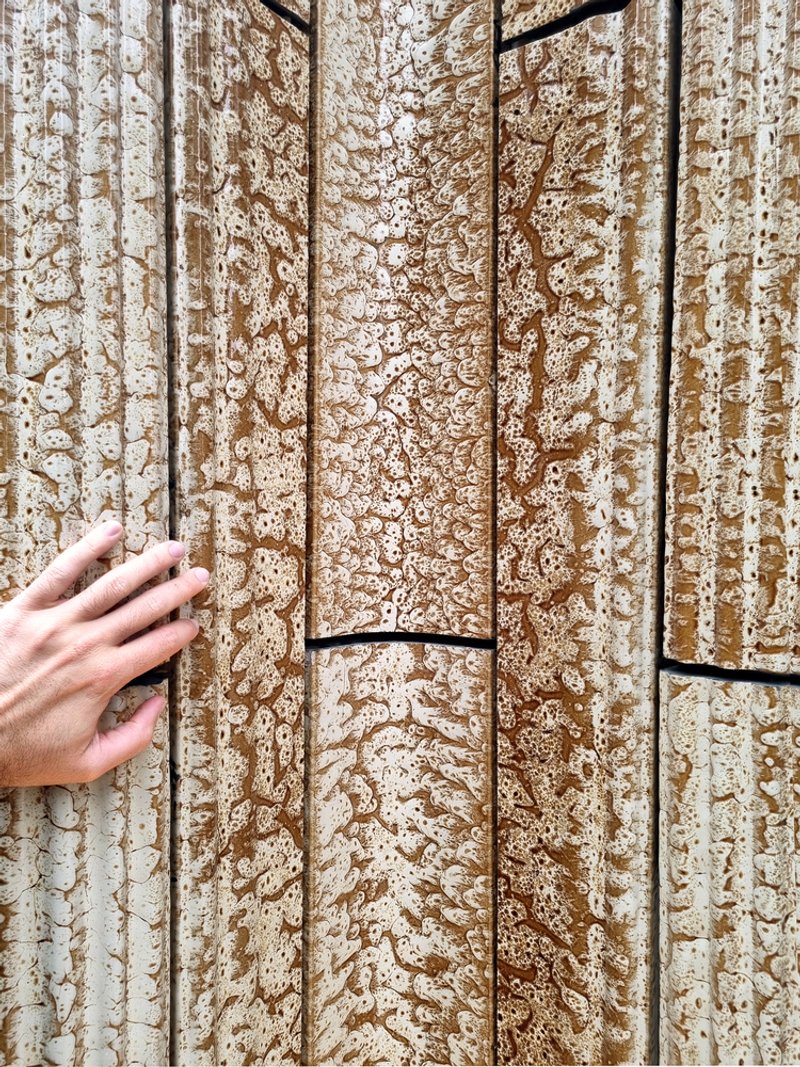
Large projects often fall apart at the detail scale. The CCBD holds up better than most. Curved glass skylight domes sit flush within the paved plaza, their geometry echoing the organic rooflines above. The stone paving on the ground plane is laid in a petal-shaped pattern with planted tree wells, a detail that reads clearly from above but also registers underfoot. And the hempcrete wall panels, visible in close-up with their rough, tactile surface, introduce a material honesty that counterbalances the high-finish bronze of the columns.
These are not incidental decisions. They signal a project that has been resolved across scales, from the urban silhouette down to the hand touching a wall. That kind of consistency is difficult to maintain through the long arc of a commercial development, and it speaks to the studio's insistence on controlling material specification through construction.
Plans and Drawings
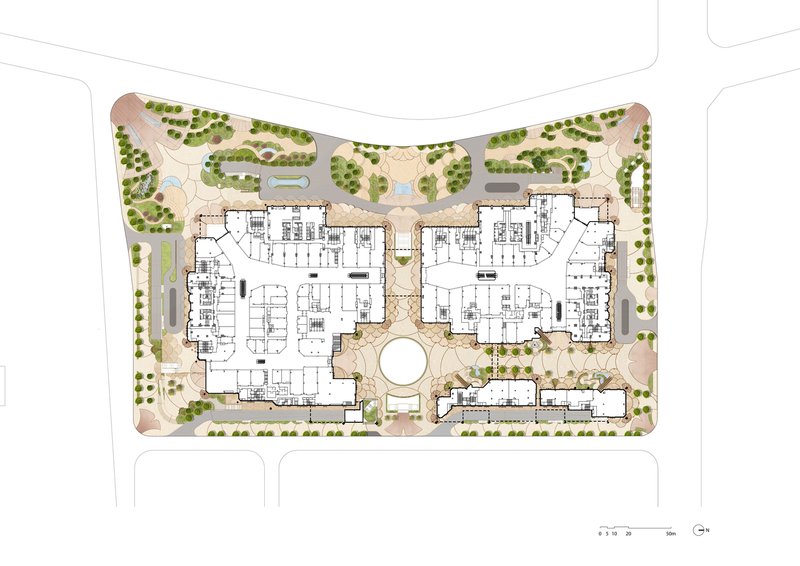
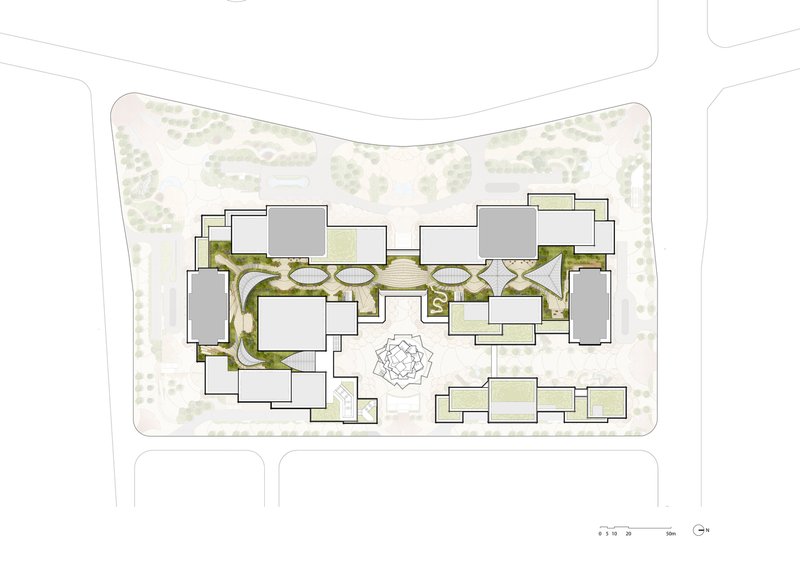
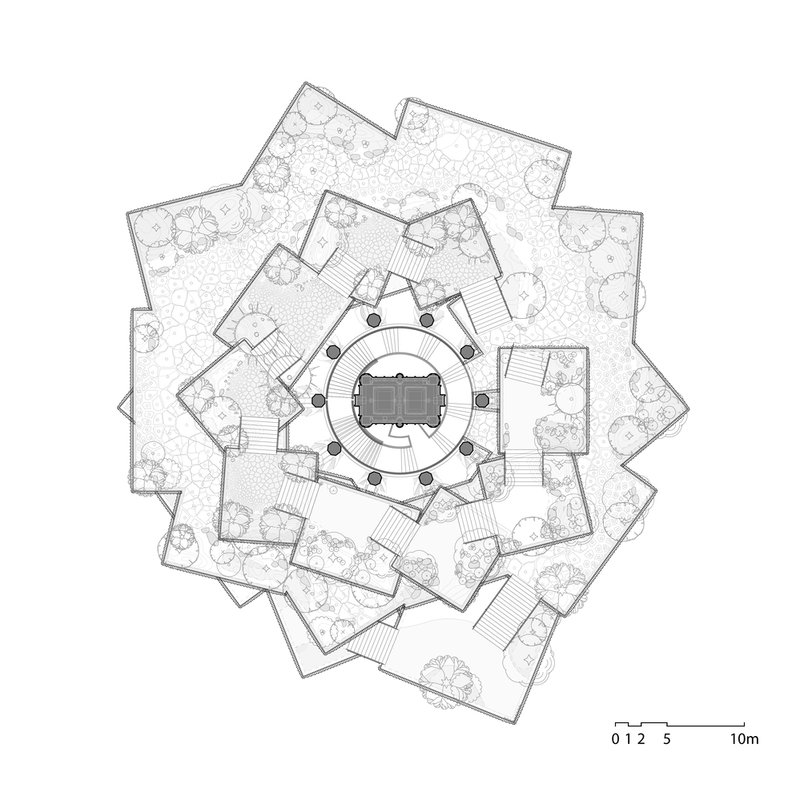
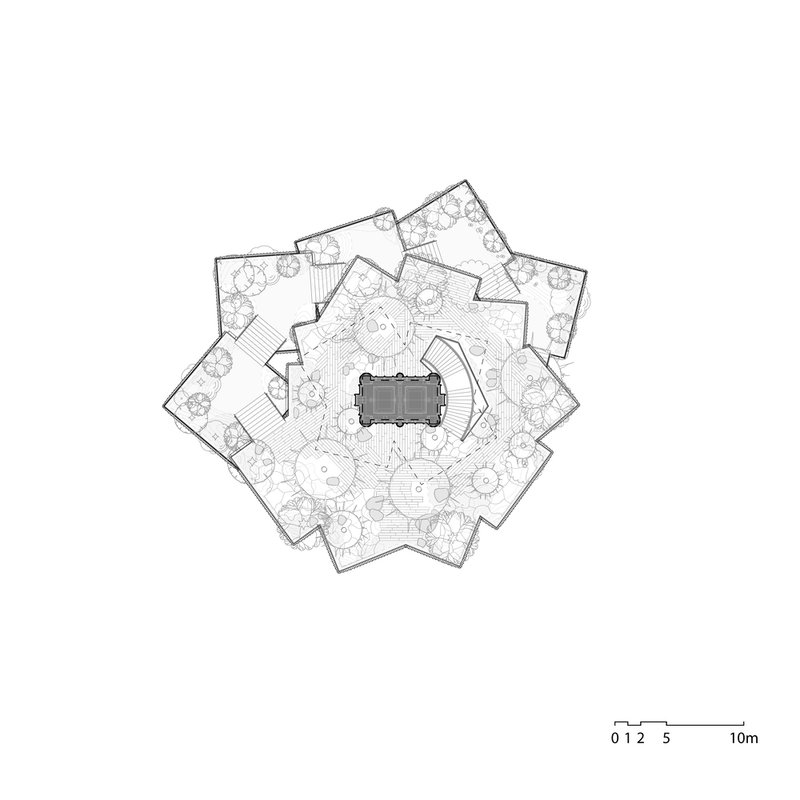
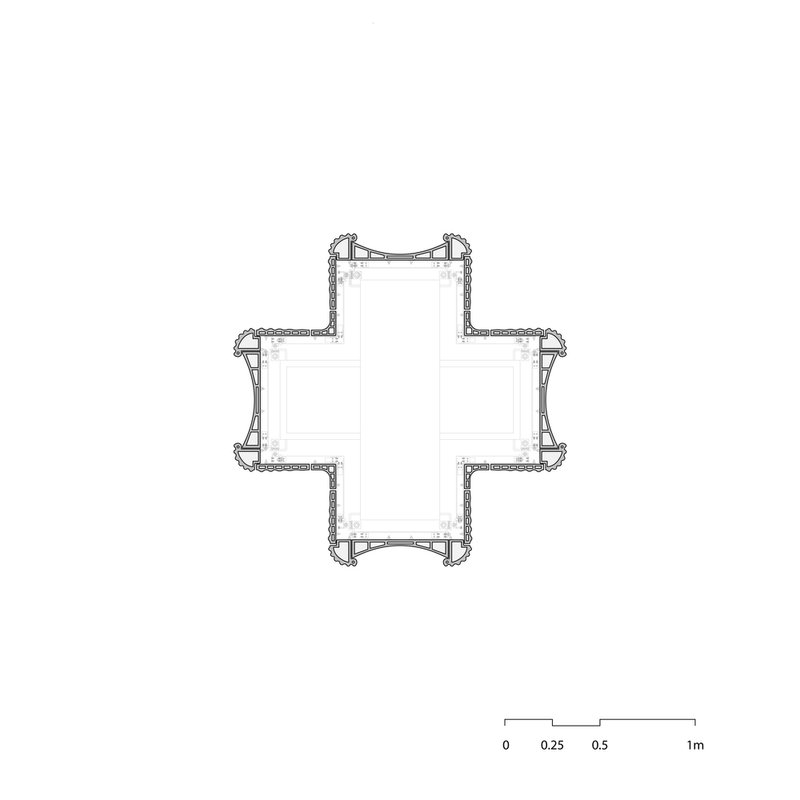
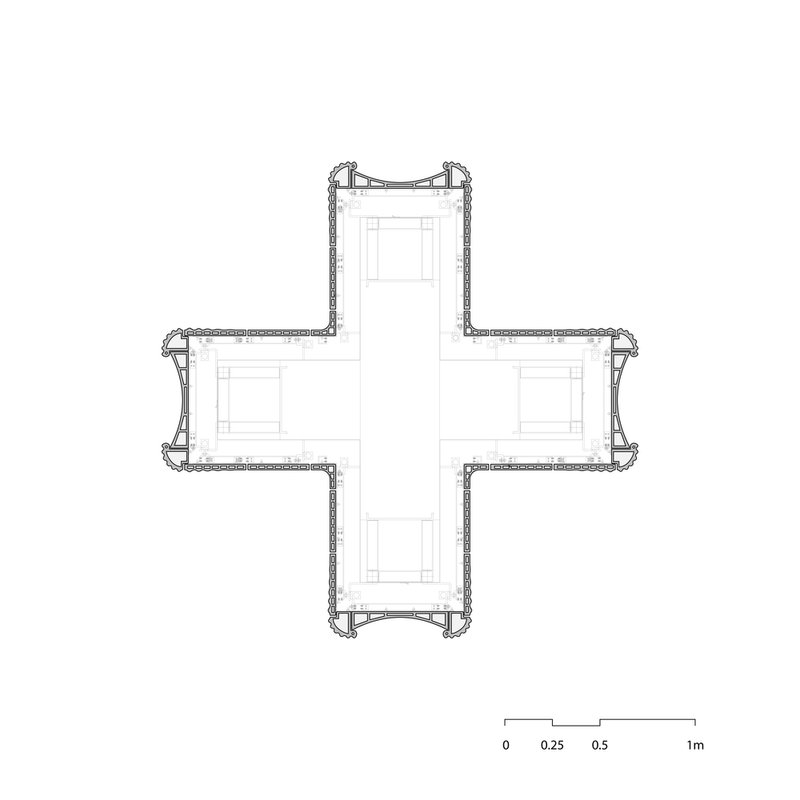
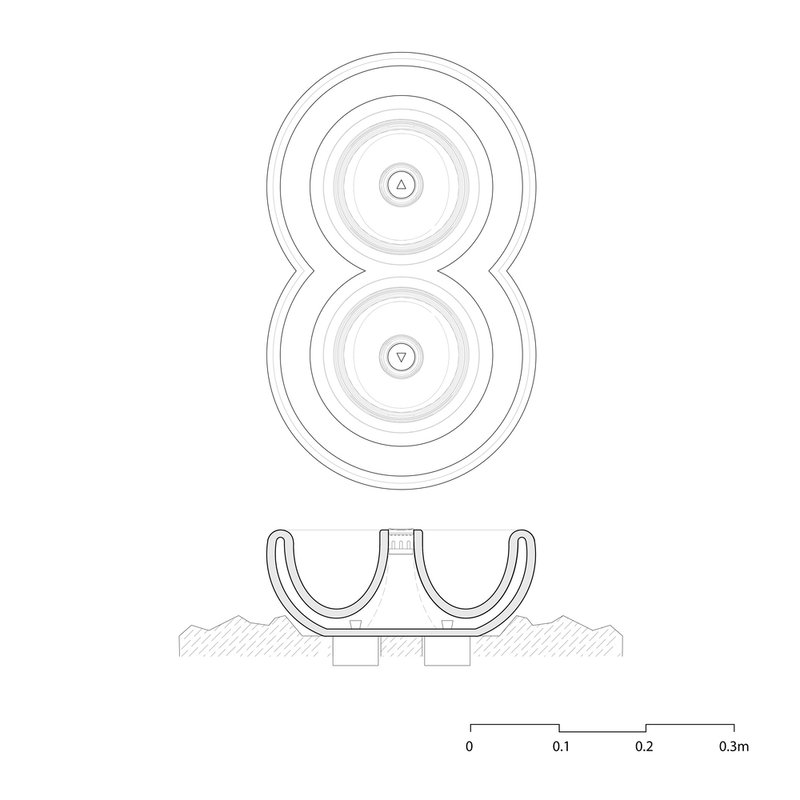
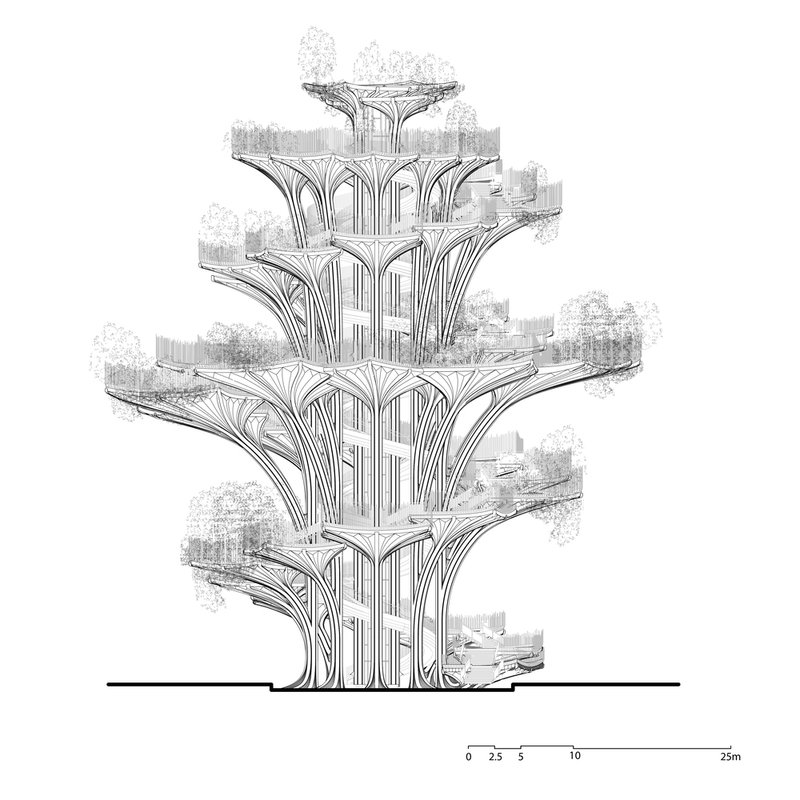
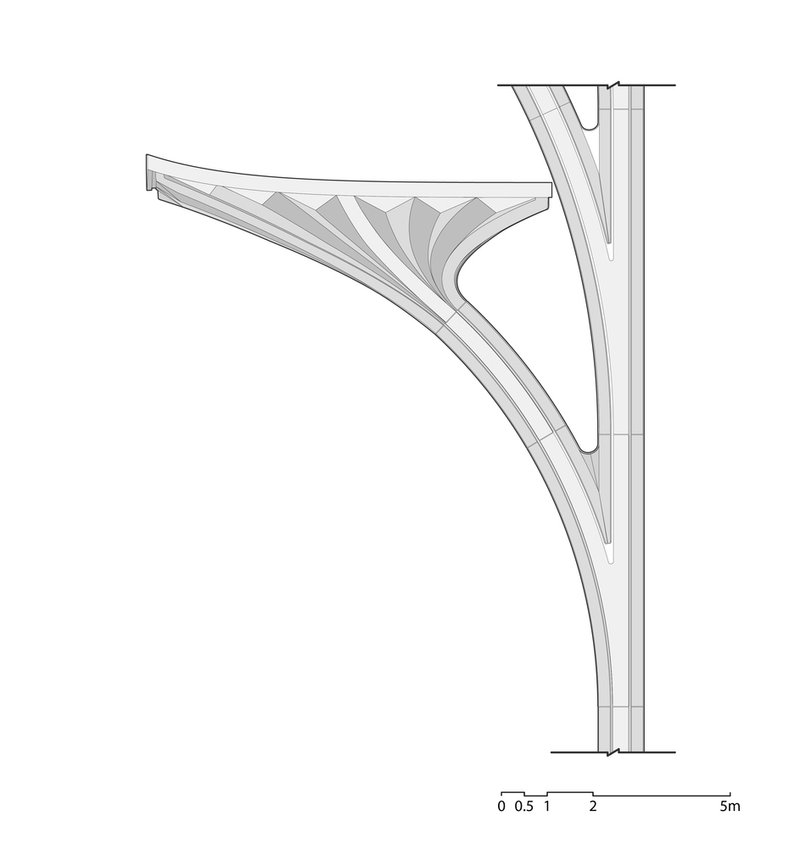
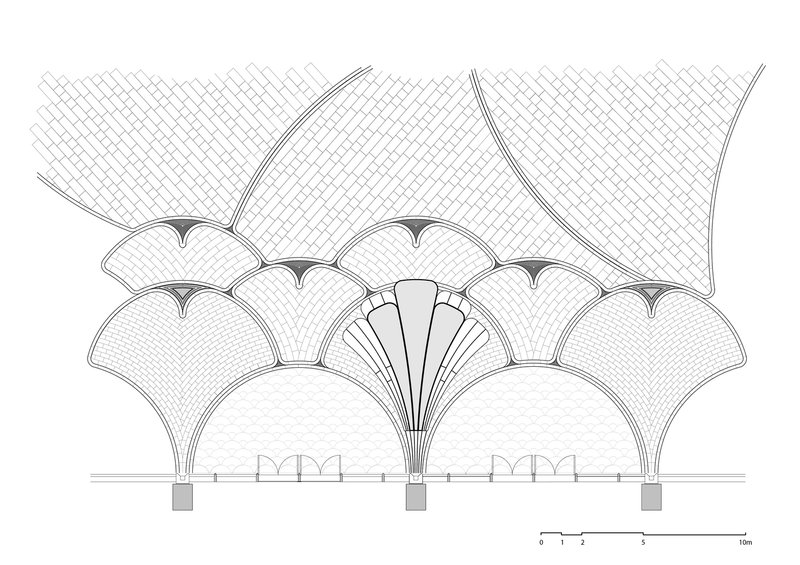
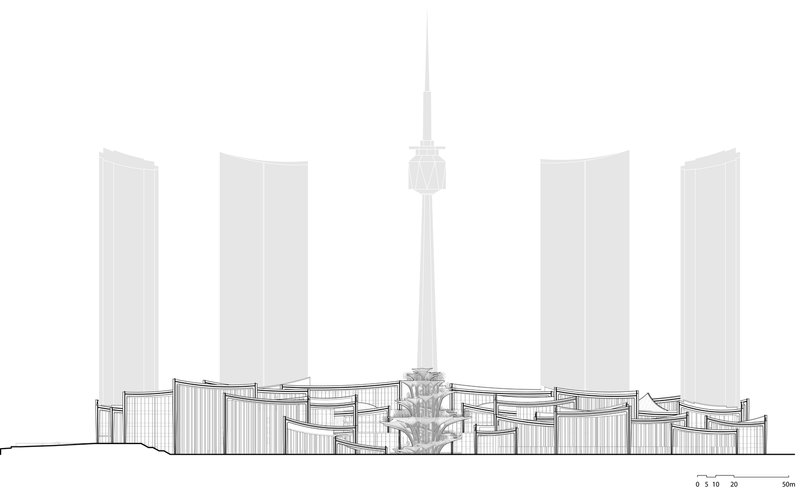
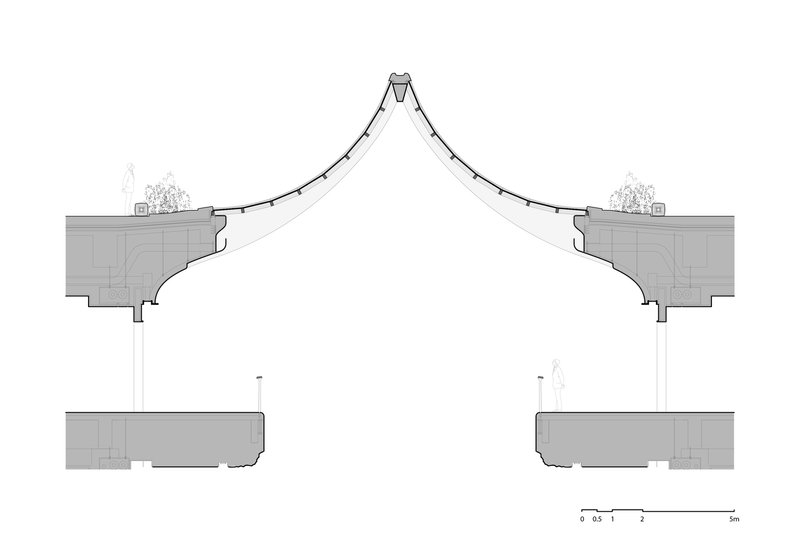
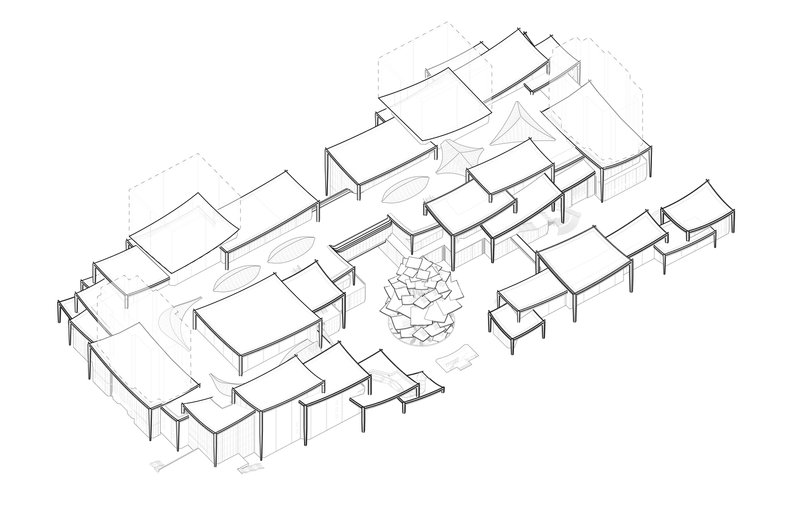
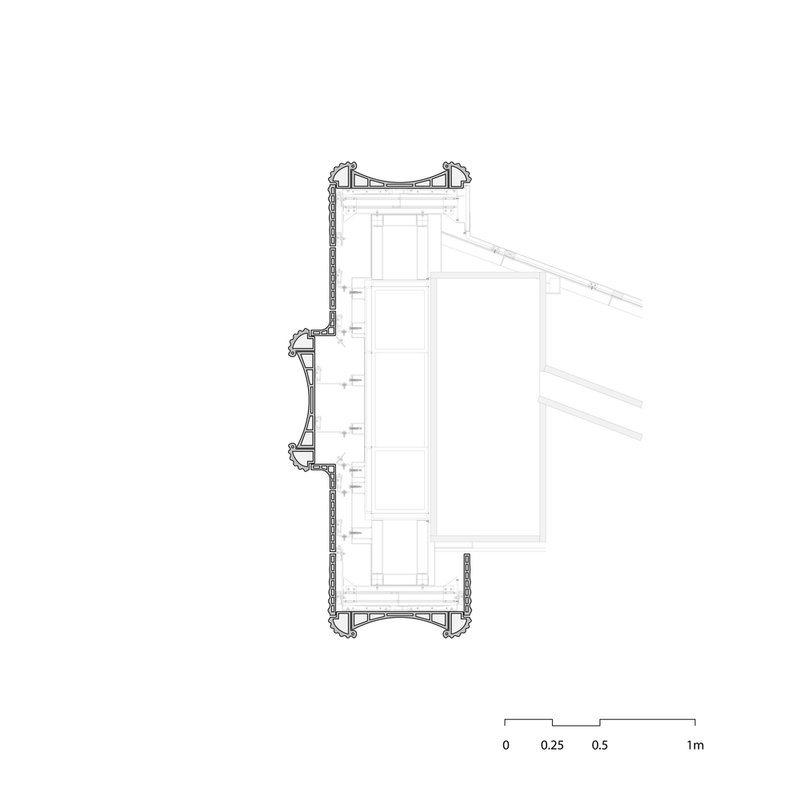
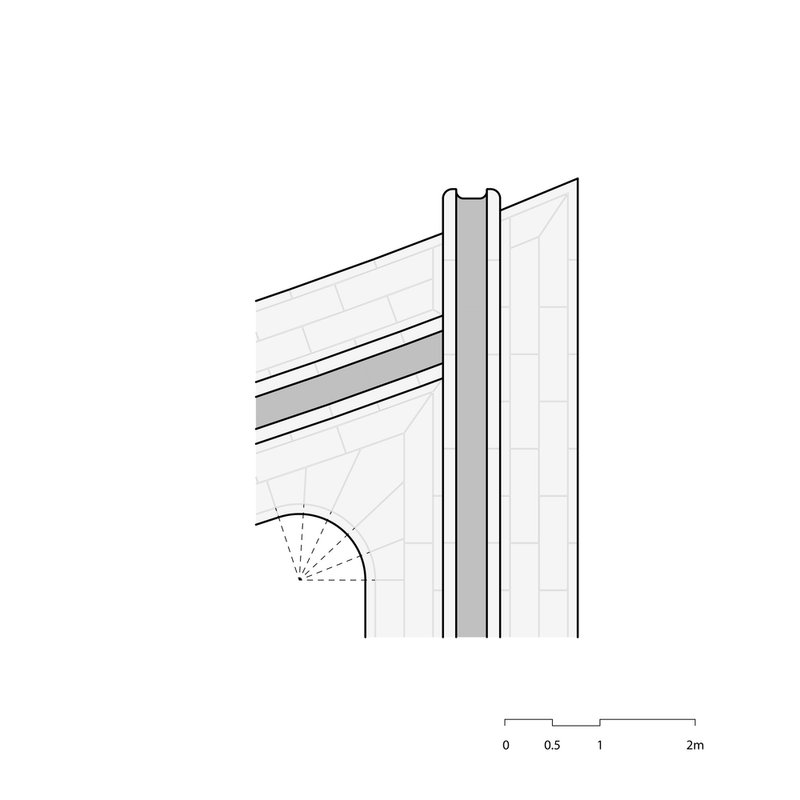
The drawings reveal what the photographs suggest but cannot confirm: a pinwheel arrangement of volumes radiating from circular cores, with cruciform and cross-shaped configurations providing structural and circulatory clarity beneath the organic exterior. The sectional drawings are the most revealing. Branching columns spread their loads through radiating ribs, while scalloped vaulted arches and cable-supported roof structures create the canopy effects visible in the photos. The axonometric of the modular pavilions shows how the apparent complexity of the massing is generated from a relatively disciplined kit of parts, repeated and rotated around central courtyards.
The site plans confirm the project's commitment to landscape as infrastructure. Building footprints are set within dense tree clusters, water features, and geometric gardens connected by curved pathways. There is no leftover space here. Every gap between buildings is treated as program, not residue. The elevation drawing, showing low-rise volumes flanked by tall towers and a central spire, gives a sense of the skyline composition that is hard to grasp at ground level, where the terracing dominates the visual field.
Why This Project Matters
The Xi'an CCBD matters because it offers a credible alternative to the glass-and-steel default of Chinese commercial urbanism. By treating every surface as landscape and every column as spatial event, Heatherwick Studio has produced a project that people actually want to walk through, not just past. That is a low bar in theory but a remarkably high one in practice, given the scale and commercial pressures at play.
Whether the planting will mature, whether the public terraces will remain genuinely public, and whether the material palette will weather gracefully are all questions that only time can answer. But as a proposition, the project is serious and specific: urbanism does not have to choose between density and delight, between commercial viability and civic generosity. Xi'an, a city that has been negotiating that balance for over two millennia, is a fitting place to test the argument.
Xi'an Central Cultural Business District (CCBD) by Heatherwick Studio, Xi'an, China. Photography by Yanqing Zhu and Luis Sacristan Murga.
About the Studio
Share Your Own Work on uni.xyz
If projects like this are the kind of work you want to make, uni.xyz is a place to publish your own, find collaborators, and enter design competitions.



Popular Articles
Popular articles from the community

Kawasaki Olympic Sports Center: Sports Complex Architecture Rooted in Community, Tradition, and Movement
Kawasaki Olympic Sports Center reimagines sports complex architecture as a civic park where tradition, training, and community meet locally.
Shinkō Komyuniti: Public Space Architecture Reimagining Sport, Culture and Community in Tokyo
Shinkō Komyuniti transforms sports spectatorship into public space architecture that reconnects play, culture, community and Tokyo life now.
Community Library in Girona: A Replicable Model for Inclusive Library Architecture
A modular community library in Girona transforms learning, culture, and climate-responsive design into a shared civic network for all users.

DIM Architecture Studio Revives the Iranian Courtyard Inside a Mashhad Apartment Building
A 2,500-square-meter mid-rise infill project reinterprets the traditional hashti and central courtyard within the dense urban fabric of Mashhad, Iran.
Similar Reads
You might also enjoy these articles

Hodi-Mandai Geram
Project Function: Preservation and revitalization of the Intangible heritage and socio-spatial identity of the Hodi by Housing, Cultural Memory Center, Sacred Grove, landscape, local tourism economy

Olio Towers: A Mid-Rise for Performers That Fuses Housing, Rehearsal, and Stage
Located blocks from Houston's Theater District, this modular tower stacks living units around a central performance atrium.
Oasis: Modular Green Housing Carved into Dhaka's Urban Fabric
A shortlisted Plugin Housing entry reclaims unauthorized settlements in Dhaka with stepped concrete volumes, green roofs, and ventilation-driven design.

Black Hole: A Floating Megastructure for the Post-Physical Era
Emiliano Mazzarotto envisions a spherical, self-scaling arena where e-sports, digital hotels, and holographic stadiums replace traditional public space.

Explore Architecture Competitions
Discover active competitions in this discipline




The International Standard for Design Portfolios


The Global Benchmark for Architecture Dissertation Awards


The Global Benchmark for Graduation Excellence


Challenge to reimagine the Iron Throne
Comments (0)
Please login or sign up to add comments
No comments yet. Be the first to comment!