

Yano Aoyama Architecture Design Builds a Brick Office Complex on a Japanese Shipyard Waterfront
A horizontally layered headquarters in Marugame reorganizes work, dining, and community life along an industrial harbor edge.


Shipyards are landscapes of raw utility: cranes, dry docks, steel plate, and an atmosphere that prizes function above all else. When Yano Aoyama Architecture Design was asked to build a new headquarters for Imabari Shipbuilding's Marugame site, the brief was less about creating a trophy building and more about fundamentally rethinking how hundreds of employees occupy their working day. The resulting 8,489 square meter office complex, completed in 2025, hugs the ground in a series of long, brick-clad volumes that defer to the harbor cranes behind them while asserting a quiet civic dignity that the industrial waterfront previously lacked.
What makes this project genuinely interesting is its refusal to treat the corporate office as a single sealed container. Architects Yano Toshihiro and Aoyama Eriko fragmented the program into distinct pavilion-like volumes connected by covered outdoor corridors, canopy structures, and planted interstices. The effect is closer to a small campus than a single building: you move between zones of concentration, collaboration, and rest as if passing through the streets of a compact town. That strategy, executed in warm brick, timber soffits, and a disciplined palette of industrial finishes, gives the complex a character that is simultaneously robust enough for its shipyard context and welcoming enough for the people who spend their days inside it.
An Industrial Facade with Civic Ambition


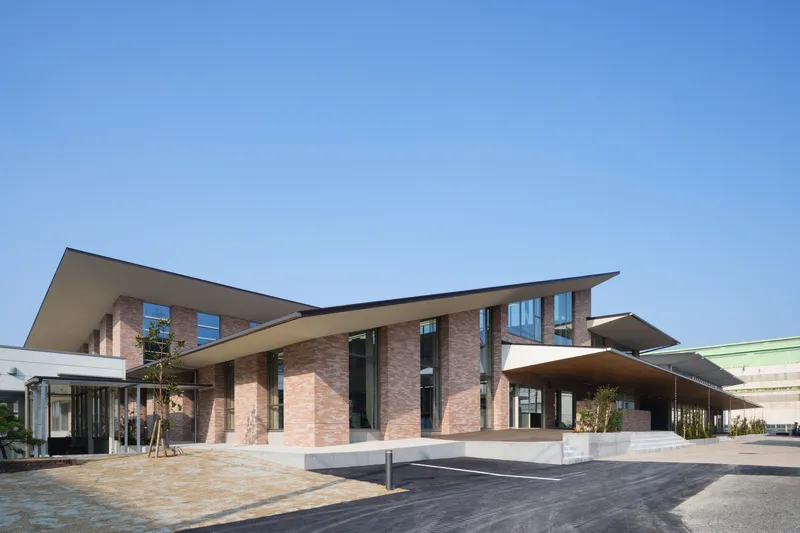
The street elevation reads as a horizontal composition of stacked brick bands, deep cantilevered roof slabs, and vertical sunshades that modulate the long facade without breaking it into arbitrary segments. From the sidewalk, the building feels grounded and approachable. Pedestrians enter through a clearly legible opening in the wall plane, with planted beds and young trees softening the threshold between public road and corporate territory.
What the architects get right here is scale. At only one to two stories, the complex never tries to compete with the port cranes that punctuate the skyline behind it. Instead it occupies its footprint with confidence, using the brickwork's tonal warmth and the deep shadow lines of its overhangs to create a facade that rewards close attention. The layered cantilevers give each elevation a sense of section, as though the building is showing you how it is assembled.
Covered Thresholds and Outdoor Corridors


Between the solid volumes, the architects carved generous covered walkways that function as decompression zones. Timber plank ceilings run overhead, skylights puncture the canopy to let in controlled daylight, and planted beds with colorful seating line the textured concrete floors. These are not mere circulation corridors; they are social spaces in their own right, places where a brief walk between the cafeteria and the office becomes an encounter with fresh air and greenery.
The move is practical as well as atmospheric. Marugame sits on the Seto Inland Sea coast where summers are hot and humid. Providing shaded outdoor routes between program zones means employees can move around the campus without being fully exposed to the elements. The timber soffits and brick columns give these thresholds a material warmth that ties them back to the main building volumes rather than treating them as afterthoughts.
Layered Workspaces Over Two Stories

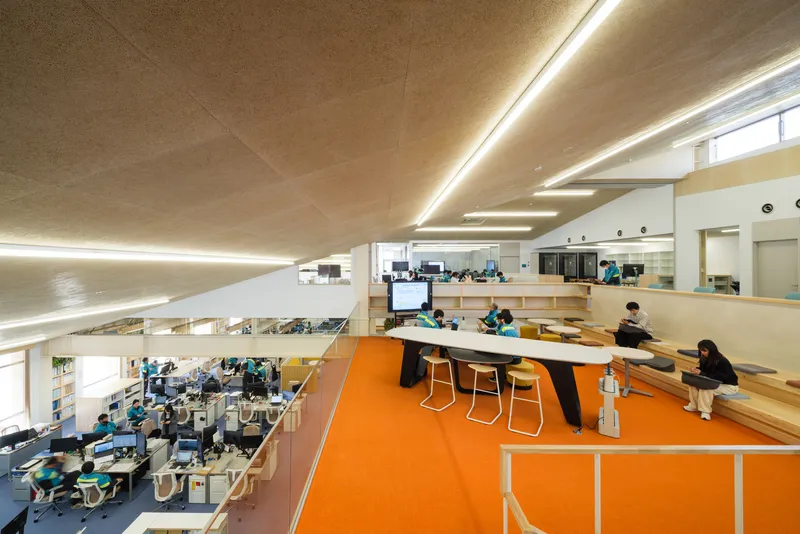
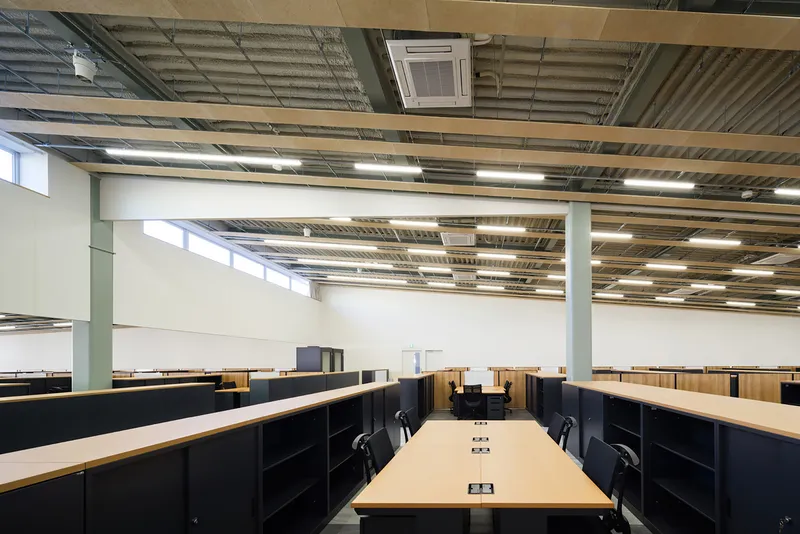
The office interiors are organized around a straightforward idea: give people variety. Open-plan desks occupy the main floor plates, but mezzanine levels, tiered seating zones, and enclosed classrooms are threaded through the section so that no one is trapped at a single desk type all day. The double-height spaces with their orange floor graphics and stepped platforms create a visual energy that prevents the large floor areas from feeling like warehouses.
Material choices are deliberately tough. Exposed corrugated metal ceilings, linear lighting tracks, plywood panels, and blue carpet tiles give the interiors an industrial legibility that mirrors the shipyard outside. Nothing here pretends to be a tech startup lounge. The finishes are honest, durable, and appropriate for a company that builds enormous vessels. That consistency between interior atmosphere and corporate identity is something many headquarters projects fumble.
Mezzanines and Informal Gathering Zones
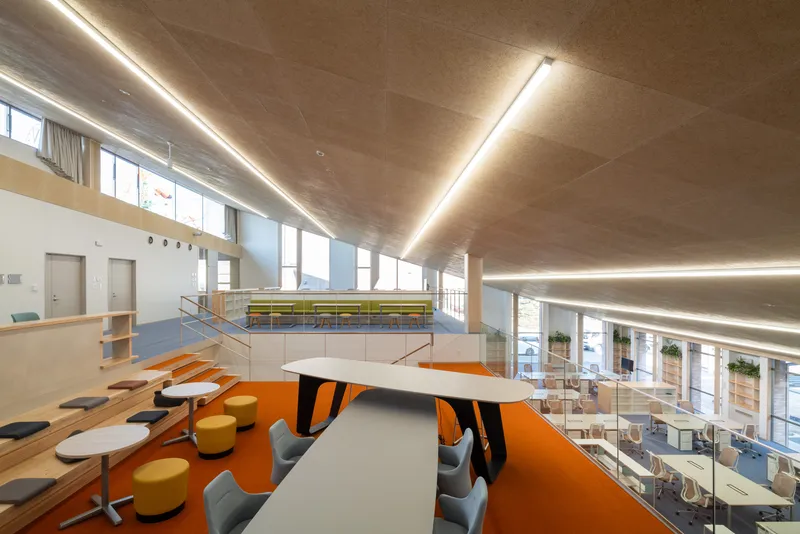


The mezzanine levels deserve their own mention. Tiered benches with orange carpet look down into the workspaces below, functioning as both casual meeting areas and spectator seating for presentations. Elsewhere, informal lounges use green carpet, pink curved seating, and timber-framed windows to create pockets of domesticity within the larger industrial shell. These interstitial spaces are where the building's social life will actually happen: the chance conversation, the impromptu brainstorm, the five-minute break that becomes a twenty-minute discussion.
Warm uplighting along the tiered steps and floor-to-ceiling glazing in the gathering areas ensure these zones feel inviting after dark, when the office transitions from daytime productivity to evening events or overtime work. The architects clearly thought about the building as a place that serves the full arc of the working day, not just the nine-to-five core.
Dining and Communal Life


The cafeteria and dining areas receive as much design attention as the offices themselves. Teal upholstered banquettes, hand-painted murals, hanging plants, and multicolored seating arrangements turn the canteen into something that feels closer to a neighborhood restaurant than a corporate feeding hall. The exposed ceiling ducts and cassette air conditioners are left visible, consistent with the building's ethos of structural honesty, but the furnishing palette softens the space enough that people will actually want to linger.
Potted plants line the tables in at least one dining zone, blurring the boundary between workspace and cafeteria. That porosity is the point. By refusing to segregate programs into hermetically sealed rooms, the architects encourage a campus-wide culture of movement and overlap. You eat lunch next to someone from a different department. You grab coffee in a space that doubles as a study lounge. The architecture does not enforce these encounters, but it makes them likely.
Night and Dusk on the Waterfront
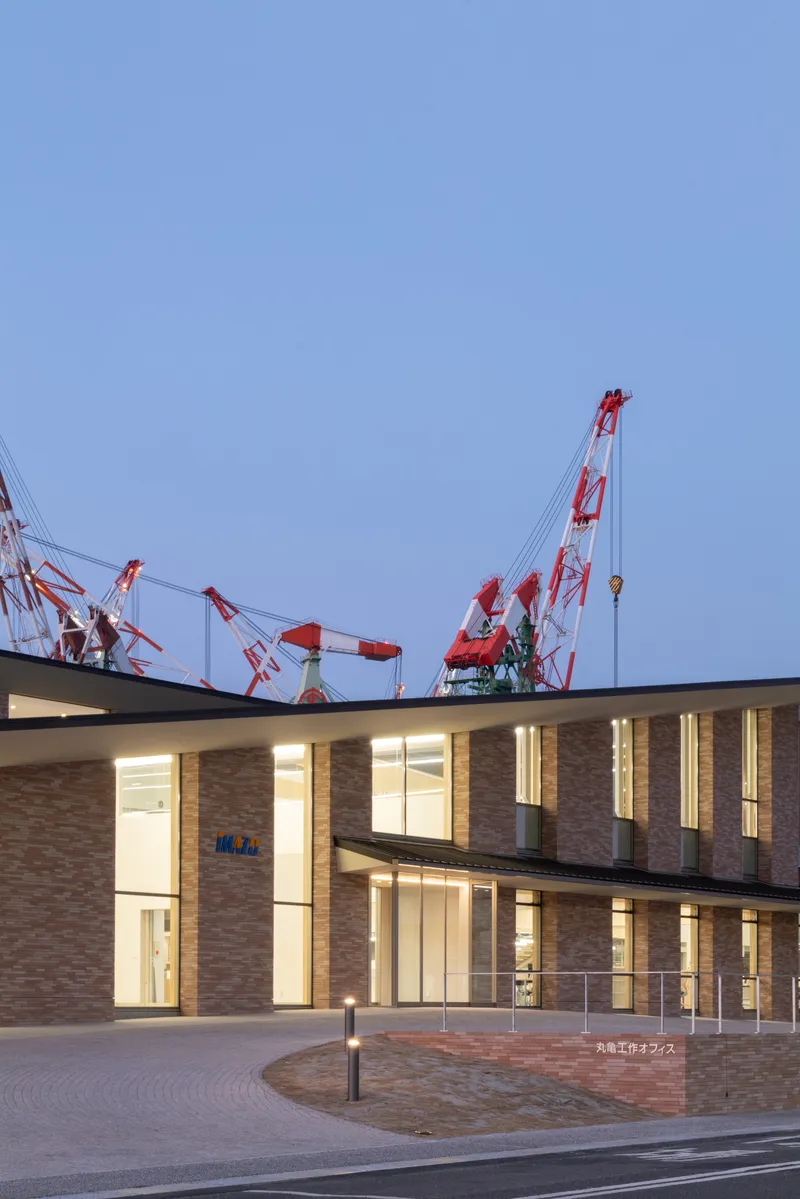
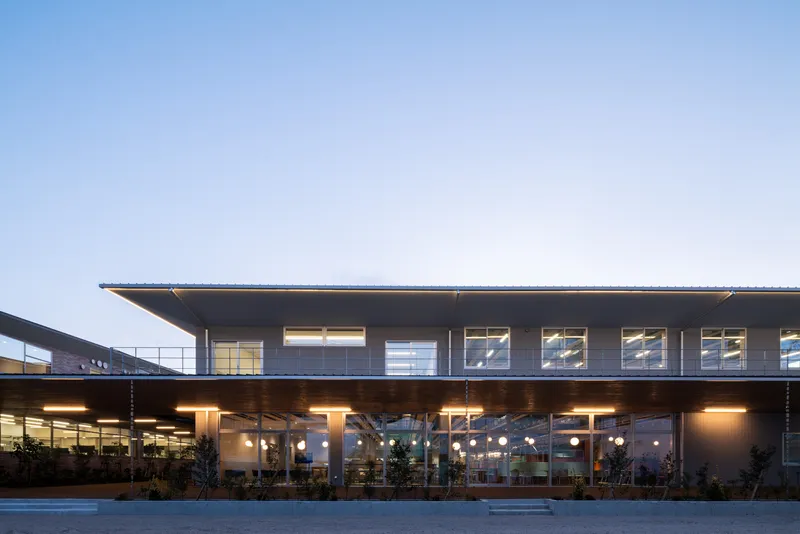

At dusk the building reveals a second character. The floor-to-ceiling glazing of the two-story volumes glows against the darkening sky, and the cantilevered upper floors hover above recessed colonnades lit by globe pendant lights. The shipyard cranes, silhouetted in deep blue, provide a backdrop that no landscape architect could manufacture. The building's low, spread form reads as a band of warm light running along the harbor edge, a signal of habitation in an otherwise utilitarian landscape.
The night photographs show how the pleated metal ceilings and exposed steel structure of the canopy zones pick up artificial light in ways that the daytime images do not fully communicate. There is a drama to these in-between spaces after hours that elevates them beyond simple covered walkways. They become lantern-like passages, architectural events in their own right.
Plans and Drawings


The floor plans confirm what the photographs suggest: the building is organized as a series of color-coded zones for canteen, lounge, open office, and circulation, distributed across a ground floor and a first floor that adds lecture rooms, office booths, and even a prayer room. The section drawing reveals a long linear structure with a steeply sloped roof rising from left to right, a geometry that is barely perceptible from ground level but gives the interior volumes a subtle spatial gradient.
The axonometric diagram of the roof assembly is particularly revealing. It shows the building as a set of split volumes connected by a membrane structure, clarifying how the covered outdoor corridors function as structural and programmatic joints between pavilions. Meanwhile, a detail drawing comparing standard and integrated pile-column foundation connections speaks to the pragmatic engineering required when building on industrial waterfront land. These are not decorative gestures; they are solutions born from site-specific constraints.
Why This Project Matters
Corporate headquarters in industrial settings too often fall into one of two traps: either they ignore their context entirely and drop a glass box onto a gravel lot, or they resign themselves to utilitarian mediocrity. The Imabari Shipbuilding Marugame Office avoids both. Its brick-clad, low-slung volumes are materially and formally at home beside port cranes and warehouse sheds, yet its covered corridors, planted interstices, and carefully considered interior landscapes elevate everyday work life in ways that a standard office building simply does not.
Yano Toshihiro and Aoyama Eriko have demonstrated that treating a large corporate brief as a campus problem, rather than a single-envelope problem, yields richer results. The fragmented plan creates outdoor rooms, the mezzanines create internal views, and the material honesty of exposed structure and tough finishes gives the whole complex an integrity that would be lost under plasterboard and suspended ceilings. For a company that builds ships, a building that shows its bones feels exactly right.
Imabari Shipbuilding Marugame Office by Yano Aoyama Architecture Design (lead architects Yano Toshihiro and Aoyama Eriko). Marugame, Japan. 8,489 m². Completed 2025. Photography by Nishikawa Masao.
About the Studio
Share Your Own Work on uni.xyz
If projects like this are the kind of work you want to make, uni.xyz is a place to publish your own, find collaborators, and enter design competitions.


Popular Articles
Popular articles from the community


Tsunami Convergenics: Turning Catastrophic Ocean Forces into Underwater Housing Infrastructure
A speculative underwater settlement off the coast of Onagawa, Japan, treats tsunamis and typhoons as energy sources rather than threats.

Manzana Morphosis: Stretching Barcelona's Grid into a Living Landscape for 2050
A radical reworking of the Eixample manzana turns density into a tool for generous public space, vertical ecology, and environmental performance.

Singing Woman: Contemporary Architecture Inspired by Estonia’s Voice and the Sea
Singing Woman turns Estonia’s song culture into flowing opera house architecture, blending public life, landscape, sea, and national memory.

Temporary Home for Dogs: A Reversed Zoo Rethinks Animal Shelter Architecture
In Bucharest, a sinuous corridor and freed landscape flip the logic of containment, designing a shelter that works to make itself unnecessary.

Similar Reads
You might also enjoy these articles

Bao Huynh Watercolor Atelier: A Serene Art Retreat in Hội An
Bao Huynh Watercolor Atelier in Hội An blends multifunctional art spaces, sustainable design, local materials, and family-friendly living in a serene environment.

Atelier Macri Concept Store Interior Design by CASE-REAL
Atelier Macri store features a "ko" counter, walnut wood details, cork displays, blending retail, gallery, and seamless customer experiences.

Manuel Vargas Izquierdo Stadium and High-Performance Sports Center: Architectural Excellence in Jalpa de Méndez
The Manuel Vargas Izquierdo Stadium blends sustainable design, inclusive sports facilities, and cultural-inspired architecture, revitalizing Jalpa de Méndez’s public spaces.

KAKR Buluh Awar Hall: Revitalizing Community and Ecology Through Bamboo Architecture
Community built bamboo hall revitalizes Buluh Awar village, empowering youth, restoring ecology, celebrating vernacular craftsmanship through sustainable architecture and culture.


Comments (0)
Please login or sign up to add comments
No comments yet. Be the first to comment!