

YH2 Architecture Stacks Two Wooden Blocks on a Rocky Outcrop Above Lake Memphremagog
A 3,750-square-foot lakeside house in Quebec arranges cedar and brick volumes like a child's building blocks across a sloped clearing.


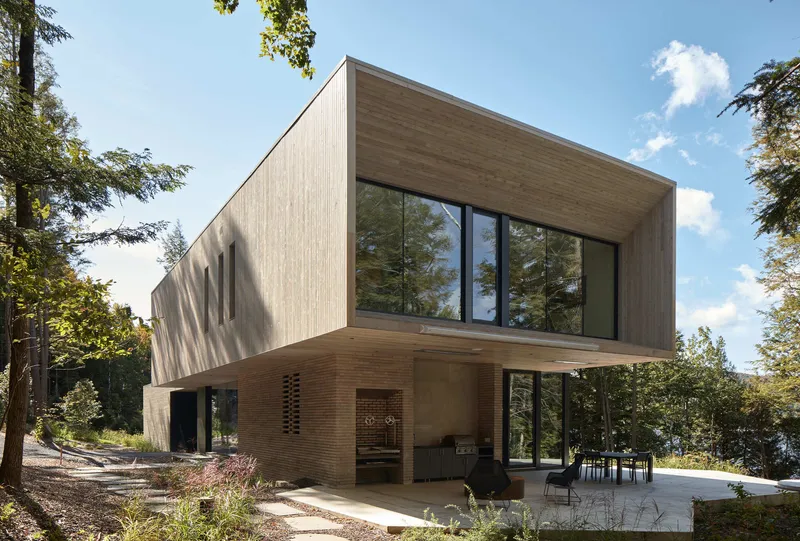
There is a particular kind of restraint that only works when the site does most of the talking. On a rocky, pine-covered outcrop above Lake Memphremagog in Quebec's Eastern Townships, YH2 Architecture (Yiacouvakis Hamelin architectes) placed two rectangular volumes, one on top of the other, rotated just enough to create sheltered terraces, overhangs, and a double-height interior where they overlap. The move is deceptively simple: stack two blocks, offset them, and let the resulting gaps do all the spatial work.
What makes the project genuinely compelling is how it reads the topography. Rather than flatten the site or fight gravity with retaining walls, the lower block spans a natural gully like a bridge between two plateaux, allowing stormwater to drain through as it always has. The house, a garage clearing, and a concrete swimming pool terrace are then distributed across three successive clearings that follow the natural slope down to the lakeshore. It is landscape strategy disguised as architecture, or perhaps the reverse.
Two Volumes, Two Characters
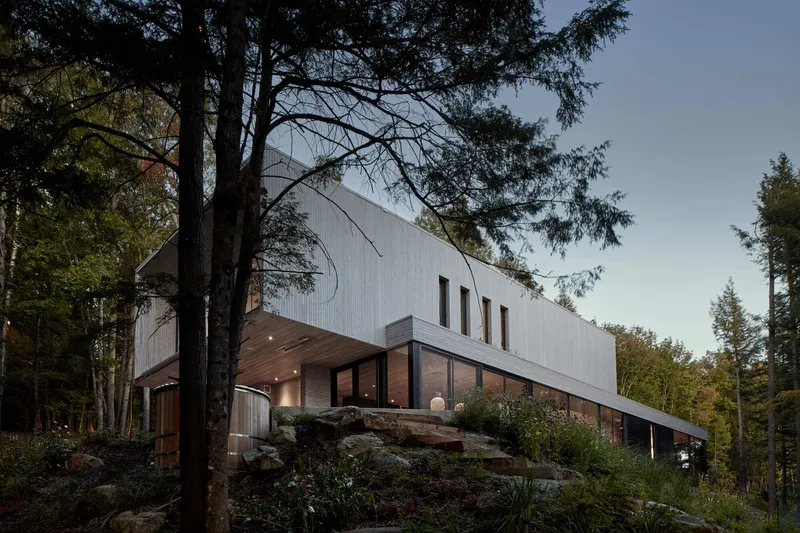
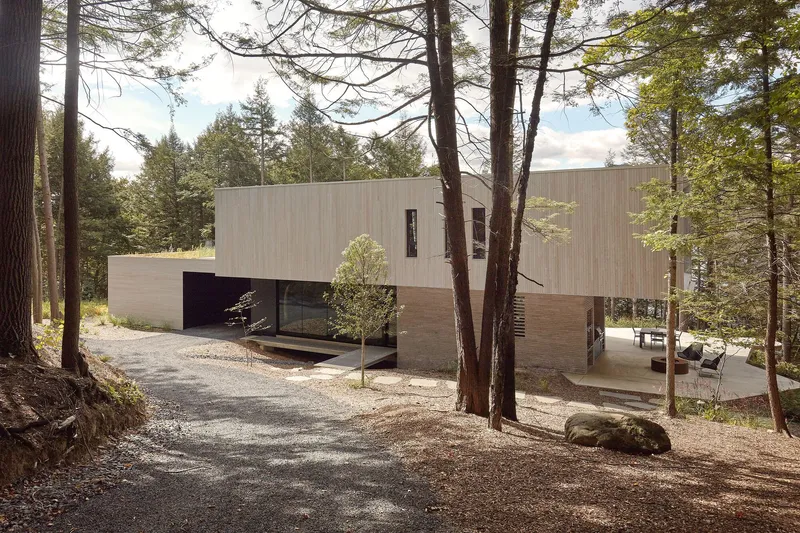
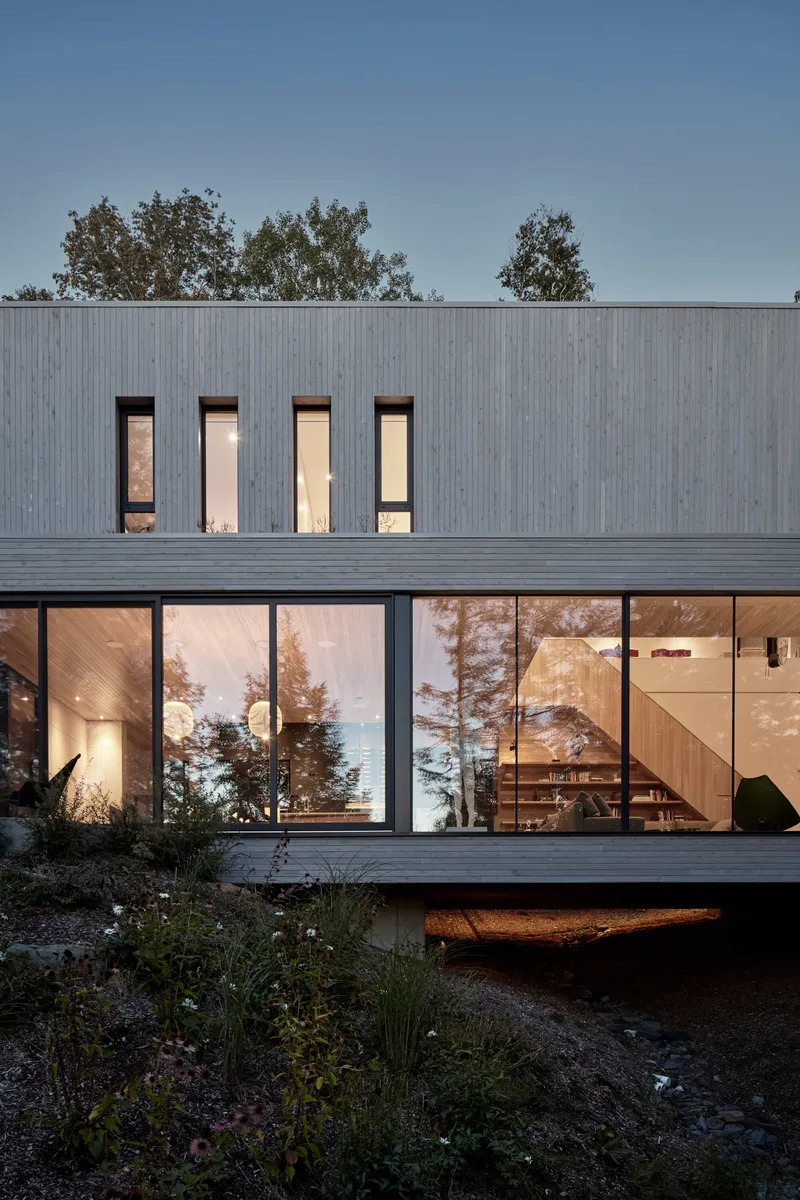
The upper block is clad in white cedar planks and punctured by slim vertical openings that give it a solid, almost monolithic presence against the sky. The lower volume takes the opposite approach: expansive horizontal glazing wraps its corners, dissolving the ground floor into the surrounding forest. The contrast is deliberate. One block is introverted and protective; the other is open and immersive. At dusk, the lower level glows behind its glass walls while the cedar box above disappears into the treeline.
The cantilever of the upper volume over the lower one on two sides is the structural gesture that generates everything else: a covered terrace at the entry, a rooftop patio on the lower block, and deep shadow lines that change character through the day. Arriscraft brick, black anodized aluminum panels, and concrete appear alongside the cedar, each material zoned to a specific condition rather than mixed decoratively.
The Double-Height Overlap
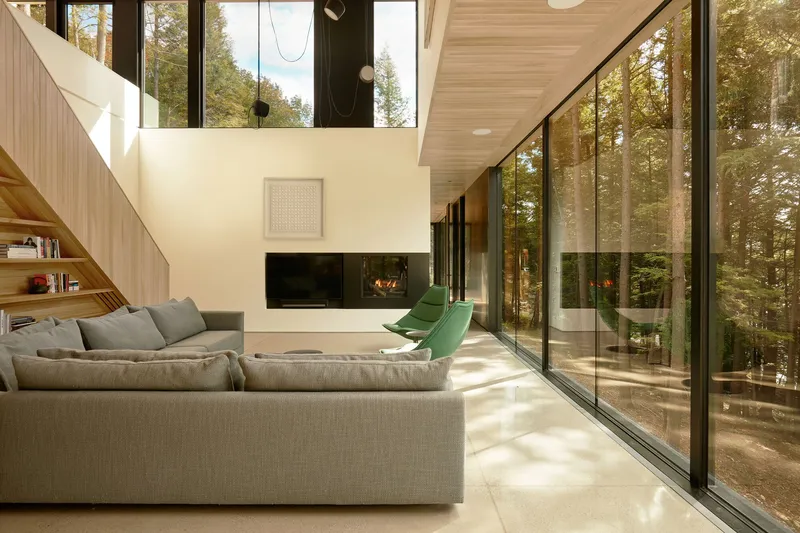
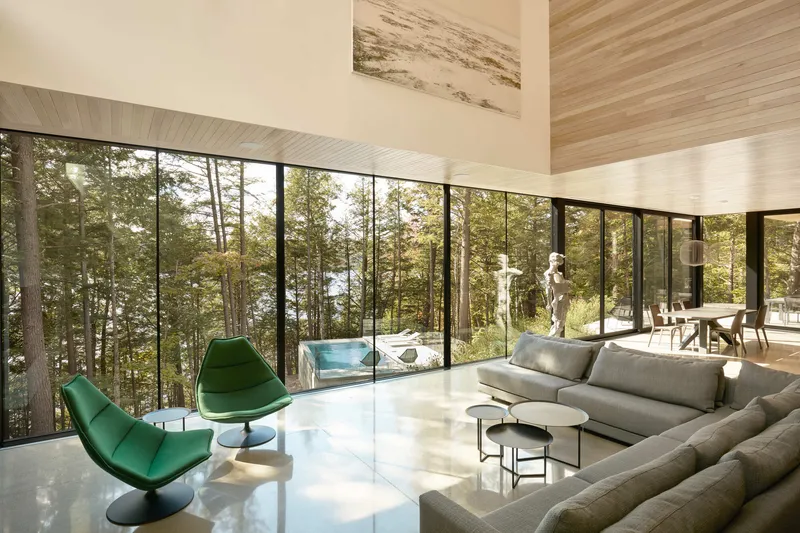
Where the two volumes overlap on the south side, the house opens up to a double-height living room flooded with natural light. Floor-to-ceiling glazing faces the forest, turning the room into something closer to a covered clearing than a conventional interior. A mezzanine office sits above, benefiting from the same light shaft. It is the spatial payoff for the offset: a vertical void that connects the house's two registers and anchors the plan emotionally.
Polished concrete flooring by Béton Prestige and engineered wood flooring by Eurolegno run continuously through the ground level, reinforcing the idea that interior and exterior share the same material logic. The green lounge chairs placed near the corner glazing feel almost incidental, like furniture left on a forest deck.
Thresholds and Courtyards
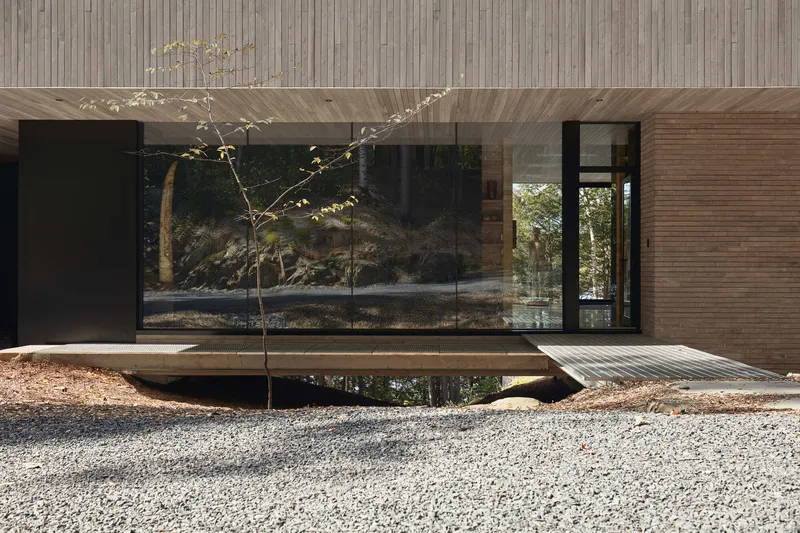
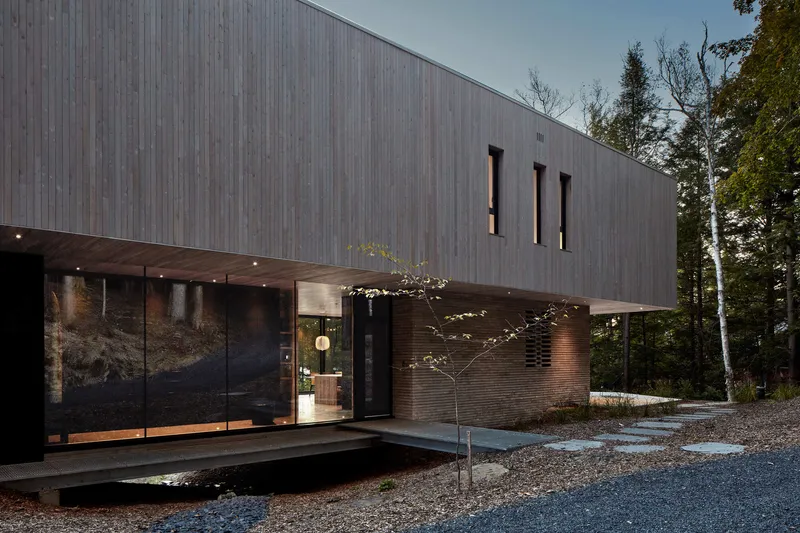
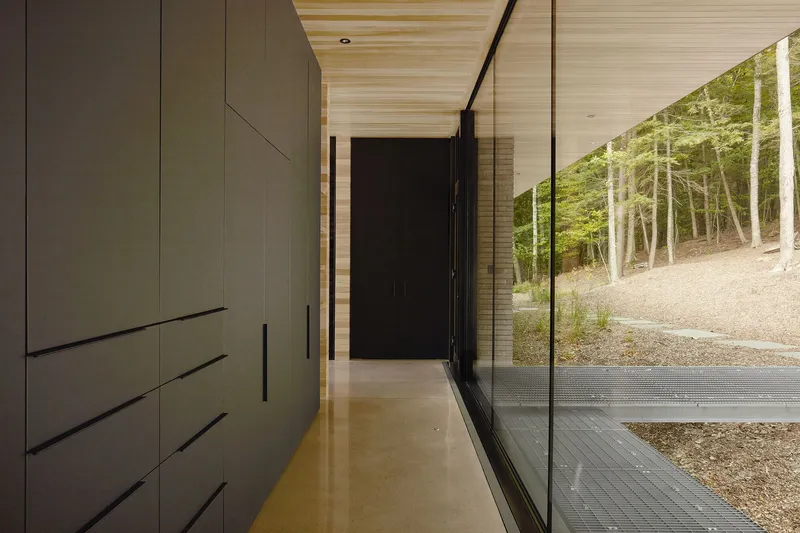
The approach to the house is choreographed carefully. A gravel courtyard with a single sapling emerging from a reflecting pool marks the entry, an almost ceremonial pause before you step inside. The covered terrace beneath the cantilevered upper block provides shelter without formality, its brick accent wall a warm counterpoint to the cedar above. Entry hallways are lined with floor-to-ceiling storage on one side and frameless glass on the other, so you are always oriented toward the woods even when moving through the house's thickest walls.
YH2 uses the same materials inside and out to blur the boundary between built and unbuilt. The timber ceiling of the glass-walled corridor feels continuous with the forest canopy beyond. It is a well-worn trick, but the execution here is rigorous enough to land.
Living Between the Trees
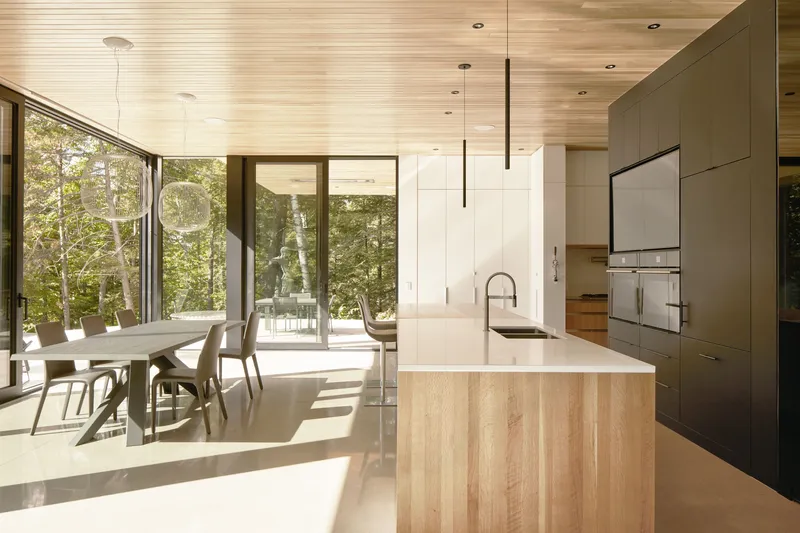
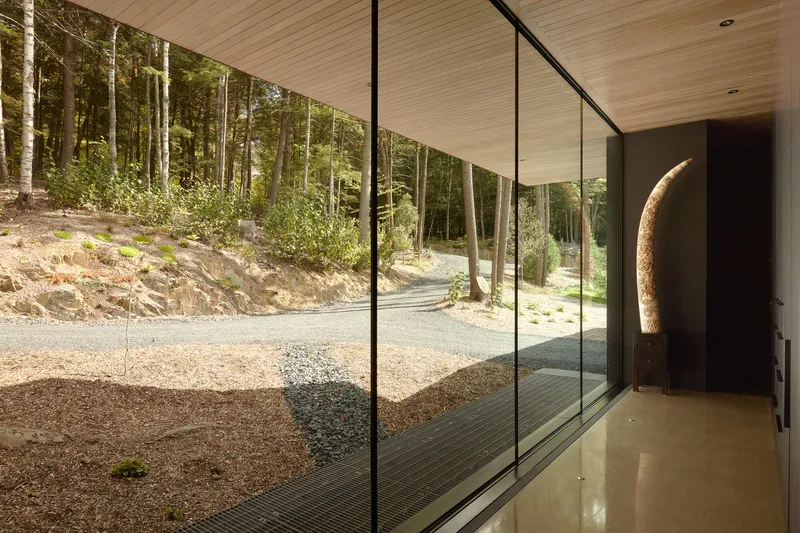
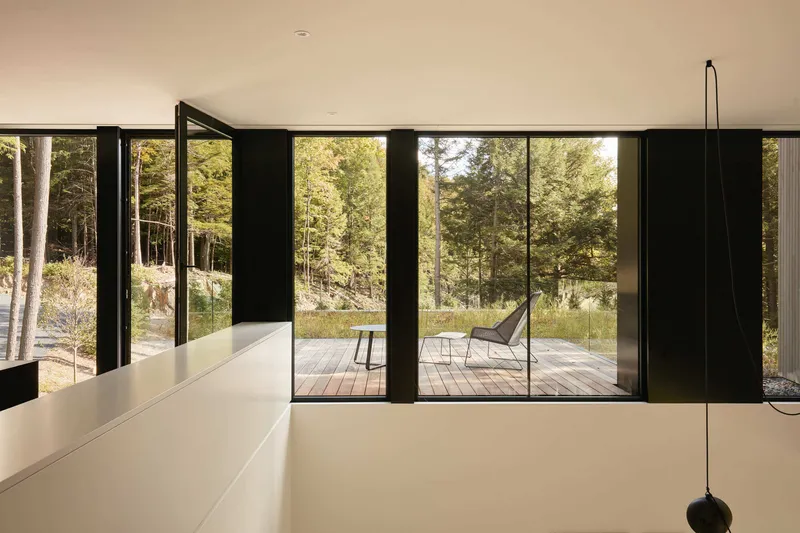
The open kitchen and dining area occupy the lower block, organized around a timber island and oriented toward full-height glazing that opens to a forest terrace. The aluminum window frames by Alumilex are slender enough to almost vanish, so the glass reads as a single membrane between cooking and landscape. Sliding doors on the upper level open onto a timber deck suspended among the trees, a private retreat that feels disconnected from the rest of the house.
Deep encadrements at the upper volume's openings are not decorative. They admit zenithal light in winter, when the sun is low, and provide solar protection in summer, when overheating is the risk. The passive strategy is modest but well-calibrated to Quebec's severe seasonal swings.
Landscape as Program
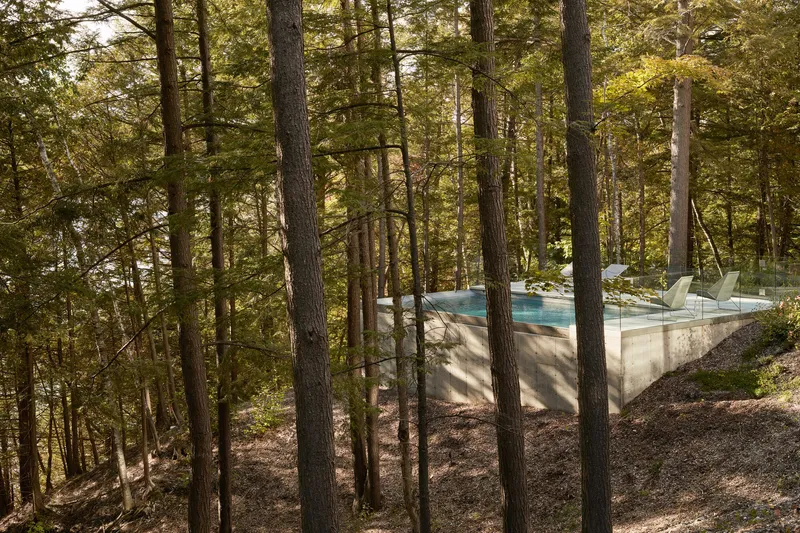
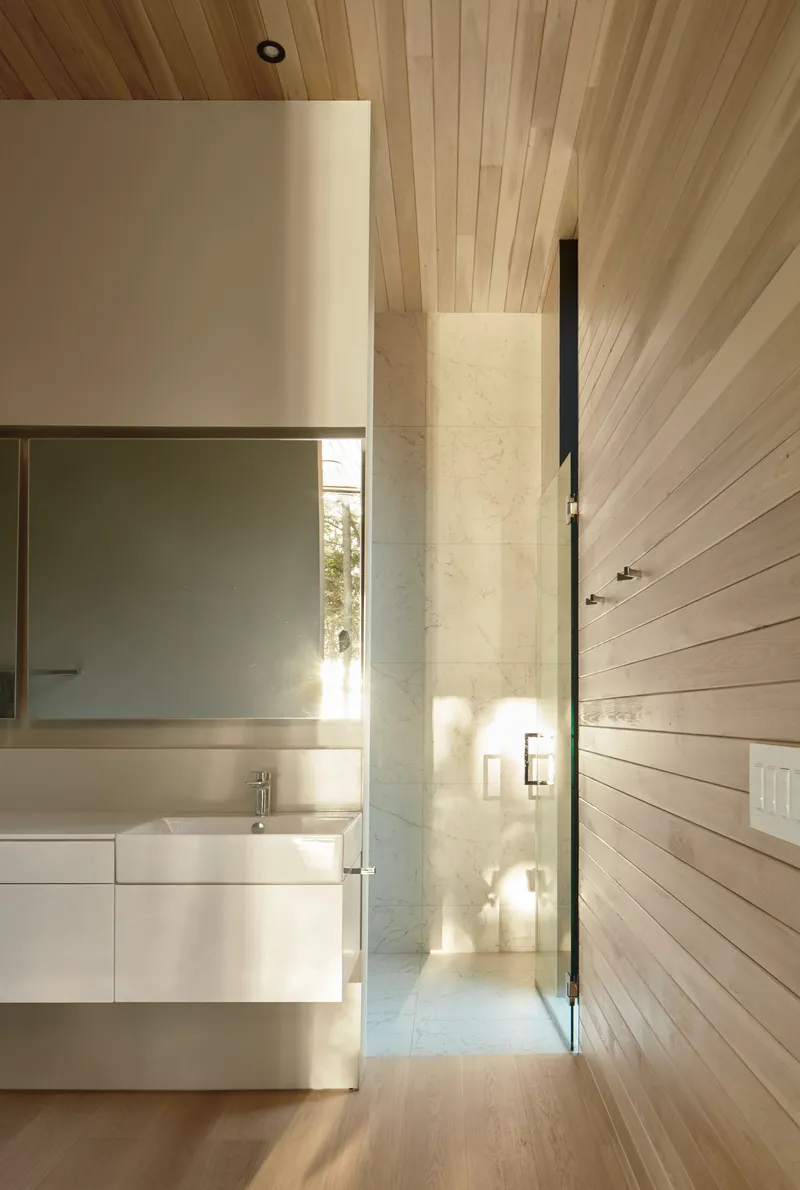
The concrete swimming pool terrace, designed by landscape architect Louis Dubuc, sits on the third clearing closest to the lakeshore, visible through the vertical trunks of the surrounding pines. It is positioned as an independent event, not an appendage of the house. You walk to it through the forest, which transforms a thirty-meter commute into an experience. The narrow glazed slot in the bathroom vanity captures a similar effect at a smaller scale: a sliver of sunlight and trees framed by the thinnest possible opening.
The decision to treat the site as a sequence of clearings rather than a single building pad is probably the project's smartest move. Each clearing has a purpose, garage, house, pool, and the forest between them is left intact. Infrastructure follows the slope rather than reshaping it, a respectful posture that also happens to produce better spatial variety than any open floor plan could.
Plans and Drawings
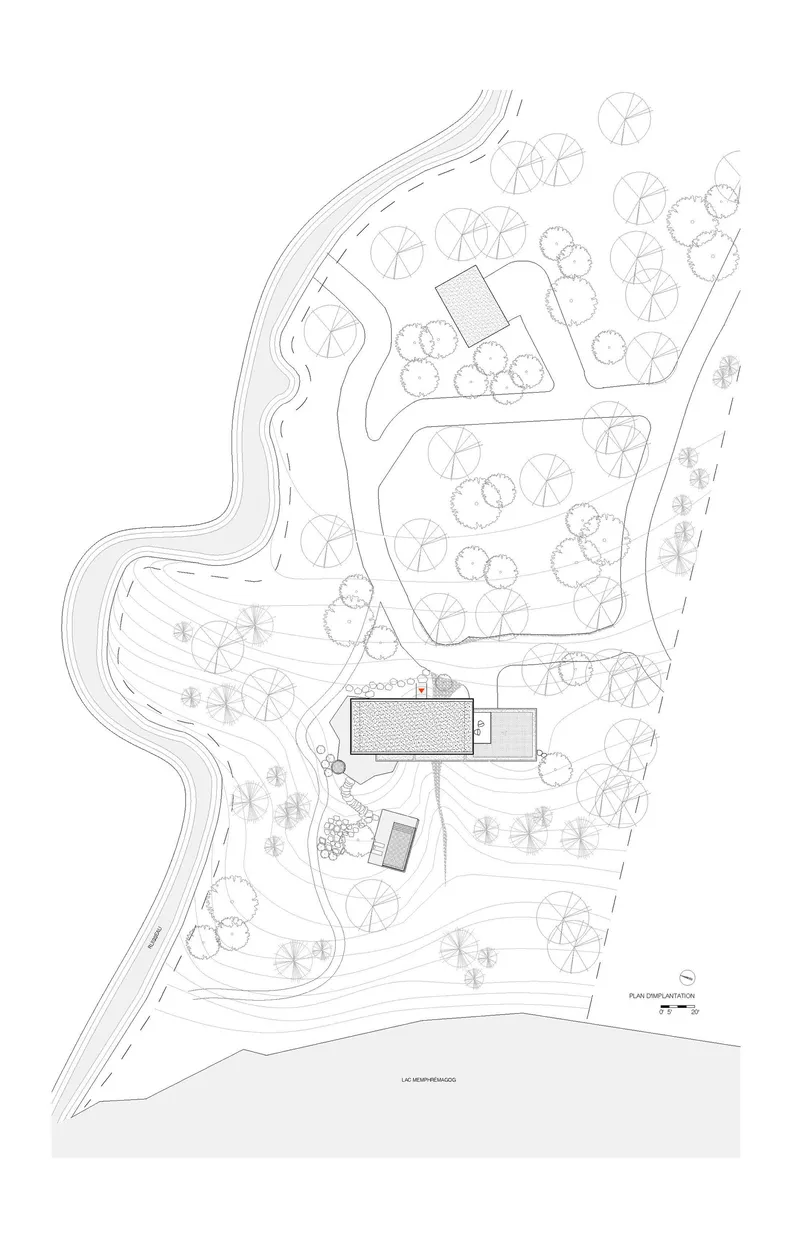
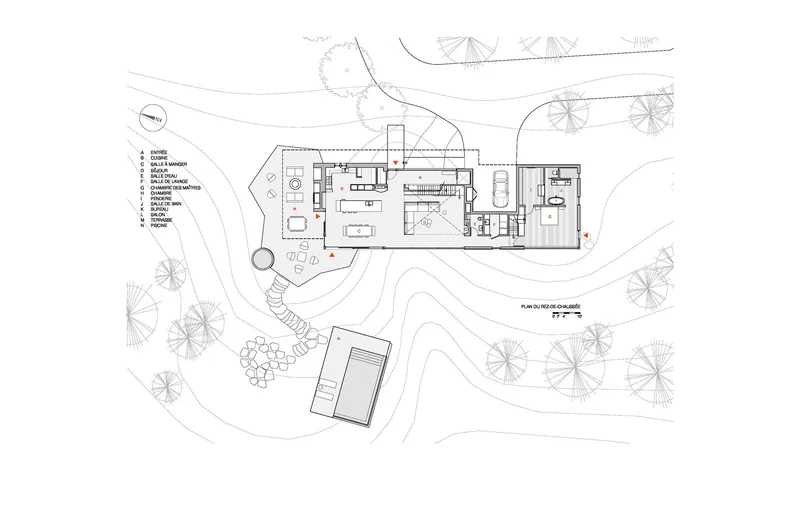
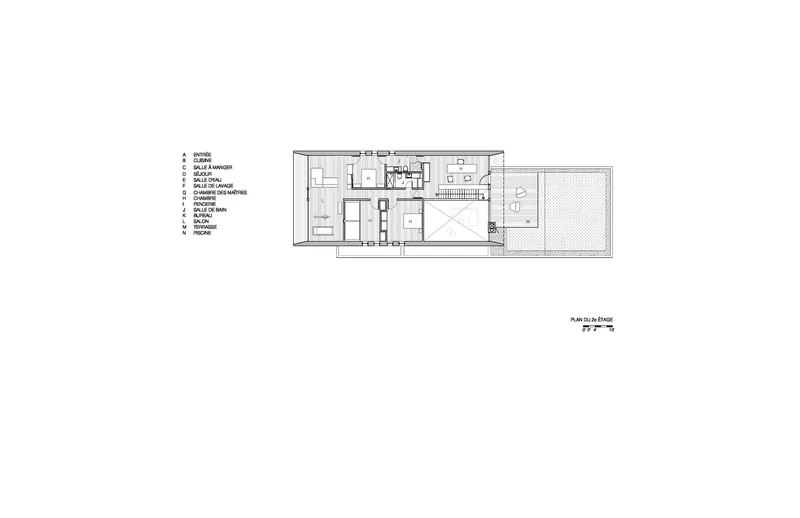
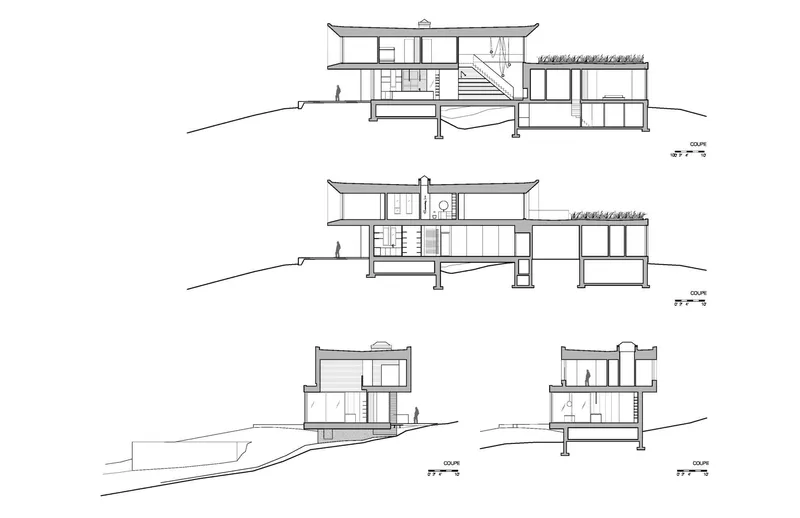
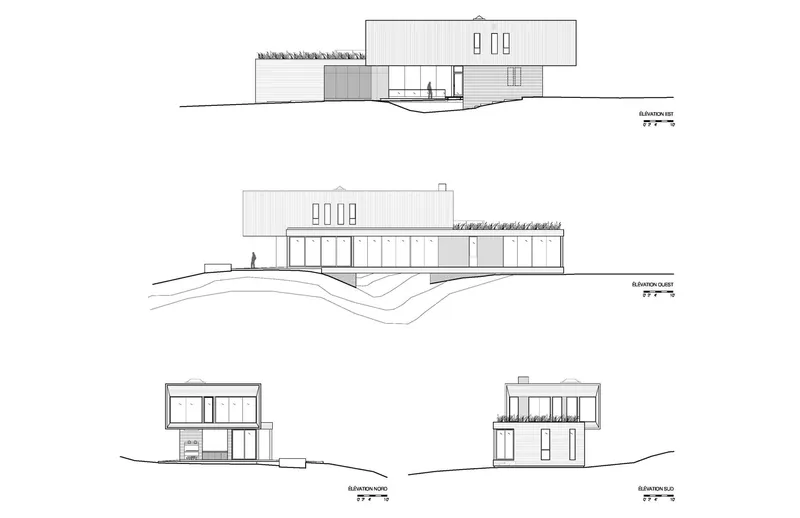
The site plans reveal the logic that the photographs only hint at: three distinct clearings connected by the natural grade, with the house placed precisely where the gully creates a natural bridge condition. The upper floor plan shows bedrooms and bathrooms bookended by terraces, giving each end of the block an outdoor room. Sections confirm the split-level relationship between the two volumes, with timber columns and exposed structure supporting the cantilever. The elevations make clear just how much character the vertical cedar cladding gives the upper block, its slim window slots reading as incisions rather than openings.
Why This Project Matters
Stacking two boxes is not a novel proposition. What YH2 demonstrates here is that the real design happens in the offset: the gaps, overhangs, and voids generated when two simple geometries are rotated and shifted against each other. Every usable outdoor space, every moment of double-height drama, every sheltered threshold is a byproduct of that offset. The architecture is in the gap, not the solid.
Wooden Blocks also offers a quiet lesson in site ethics. By distributing the program across clearings and bridging a gully instead of filling it, the project avoids the kind of brute-force earthmoving that disfigures so many lakefront properties. The house sits in its landscape rather than on it, and the distinction matters. For a 3,750-square-foot residence, that kind of restraint is both rare and worth studying.
Wooden Blocks by YH2 Architecture (Yiacouvakis Hamelin architectes). Lac Memphrémagog, Canada. 3,750 sq ft. Completed 2020. Structural engineer: GénieX. Constructor: Finition de l'Estrie. Landscape architect: Louis Dubuc. Photography by Maxime Brouillet.
About the Studio
Share Your Own Work on uni.xyz
If projects like this are the kind of work you want to make, uni.xyz is a place to publish your own, find collaborators, and enter design competitions.


Popular Articles
Popular articles from the community


GROUP A Strips a 1969 Rotterdam Harbor Headquarters to Its Frame and Wraps It in Timber Louvers
In Rotterdam's M4H harbor district, Ferro Offices reuses a 1969 frame, adds one timber storey and reaches BREEAM-NL Outstanding.

U.GA Architects Wraps an Oval Rooftop Pool in Curved Board-Formed Concrete on Busan's Jeollidan-gil
In Busan's Jeonpo-dong, a 454 m² mixed-use block stacks a neighborhood facility, guest rooms and an oval rooftop pool inside spiraling concrete walls.

Cube Design Draws an Ecological Corridor Between Two Shenzhen Hills with the Nankai Building
Beside Shenzhen's container docks, the Nankai Building pairs stacked balconies with a climbing green screen to connect two hillsides across its height.

Jaramillo Van Sluys Arquitectura and Urbanismo Turn a Demolished Registry Lot in Quito into an Orchard Plaza
In Quito's Centro Histórico, a 2,800 m² plaza exposes the San Agustín convent wall and redraws its lost Augustinian orchard in volcanic stone.

Similar Reads
You might also enjoy these articles


LAVA Architecten Gives Vocational Education a Sawtooth-Roofed Face on a Mechelen School Campus
In Mechelen, Belgium, a 2,053 m² STEM school on a 6×6 m grid turns workshops and classrooms into rooms that can be rearranged as teaching changes.

KEMA Studio Turns a Derelict Marvila Attic into a 60 m² Lighthouse Apartment Above Lisbon
In Lisbon's Marvila district, a rebuilt roof, four skylights and two plywood volumes turn an unlivable attic into a bright home facing the Tagus.

Pixel Gardens: One Repeated Module Stacked Into a Terraced Social Housing Tower for Famagusta
Salem Bader's shortlisted housing tower builds a vertical neighbourhood from one repeated module, offsetting units to carve terraces, light and air.

Bao Huynh Watercolor Atelier: A Serene Art Retreat in Hội An
Bao Huynh Watercolor Atelier in Hội An blends multifunctional art spaces, sustainable design, local materials, and family-friendly living in a serene environment.

Explore Blocs Competitions
Discover active competitions in this discipline

Challenge to design a barrier free sports center

Challenge to design an outdoor ice-rink and park
Comments (0)
Please login or sign up to add comments
No comments yet. Be the first to comment!