
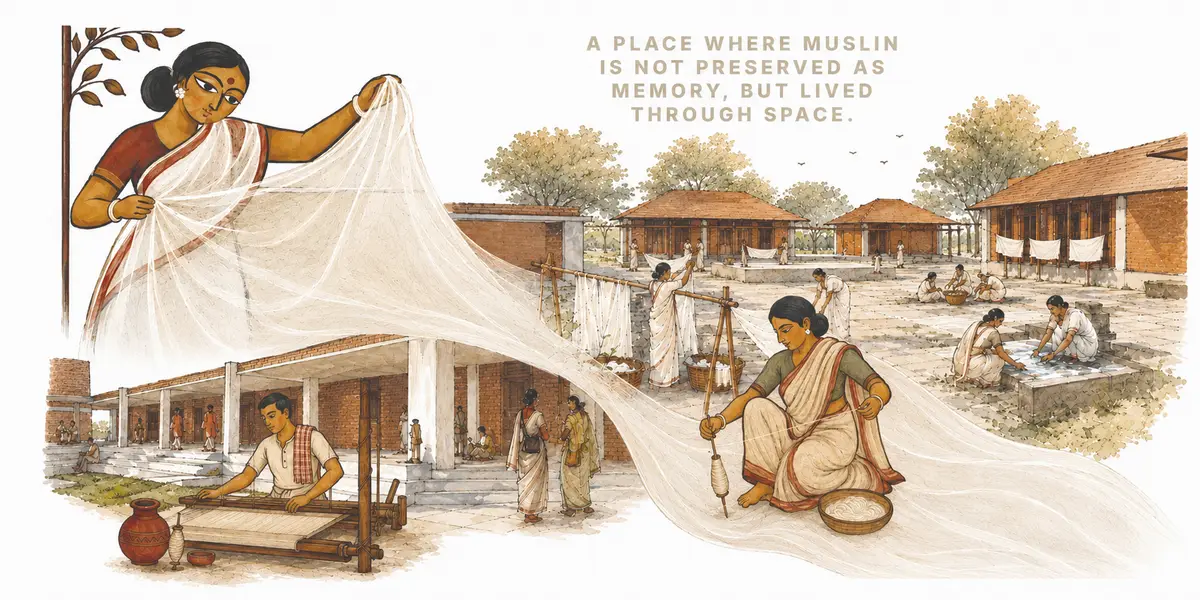
Calibrated Revival Weaving Heritage Through Spatial Continuity
Rooted in the heritage of Dhaka Muslin, the project transforms traditional weaving environments into a contemporary space for making, learning, and cultural continuity: where heritage is experienced, practiced, and carried forward through everyday life.
Project Media
Calibrated Revival Weaving Heritage Through Spatial Continuity
This sheet introduces the historical, cultural, and environmental context of the Muslin Research and Training Institute. Tracing the journey of Dhaka Muslin from its heritage and revival to contemporary safeguarding frameworks and site conditions, it establishes the foundation for reimagining muslin as a living cultural practice shaped through place, climate, and community.
From Homestead to Institute
This sheet establishes the architectural direction of the project through the research question and the study of traditional muslin weaving homesteads. By understanding their spatial relationships, environmental qualities, and role in knowledge transfer, the project explores their reinterpretation within a contemporary institutional setting.
Strategies of Transformation
Derived from site observations and research insights, the design framework transforms environmental, cultural, and functional considerations into spatial strategies that support muslin production, learning, and living heritage.
The Spatial Narrative of Muslin
The masterplan translates the spatial logic of traditional muslin weaving into a contemporary institutional landscape. Organized through courtyards, production sequences, and interconnected public and private zones, the layout supports environmental comfort, knowledge transfer, and everyday cultural engagement.
Constructing Microclimates
Sections reveal how environmental and spatial strategies work together to support muslin production. Through courtyards, layered openings, passive airflow, and material response, the architecture creates comfortable and climate-responsive environments for making and learning.
Spaces Woven in Air and Memory
The institute reinterprets the spatial qualities of traditional muslin weaving through courtyards, layered thresholds, and climate-responsive environments. Together, these spaces create an immersive experience where making, learning, and heritage continue through everyday life.
A Place Where Muslin Lives
Once woven into the identity of Bengal, muslin returns as a living heritage: where craft, climate, and community are brought together through architecture.

Project Score
Project Team (1)


Project Owner
PUBLISHED ON 29th June 2026

Explore Reclaiming Heritage Competitions
Discover active competitions in this discipline


Challenge to reimagine the Iron Throne

Photograph architecture without architects

Illustrate the lost glory of Angkor Wat - Render Challenge

Design challenge to reuse E-waste
Similar Projects
Discover related projects you might like




Comments (5)
Please login or sign up to add comments
Well done! Keep up the excellent work!
Thank you so much. I really appreciate the feedback and encouragement. I’ll definitely keep pushing the work further.
A thoughtful and well-researched thesis that successfully turns textile heritage into a living spatial experience. Further development of the architectural expression could make the strong cultural and climatic ideas even more distinctive
Thank you so much for the thoughtful feedback. I’m still exploring how to make the architectural expression more appropriate to the cultural and climatic ideas behind the project. I really appreciate your point, and I’d genuinely welcome any further suggestions or criticism as I continue working on it.
Thank you for your thoughtful response. I’m glad the feedback was useful. Your intention to further develop the relationship between the architectural expression, cultural context, and climate is a valuable direction. I encourage you to continue exploring this through your design process and to let the project itself demonstrate that connection clearly. Wishing you the best with the further development of your thesis.