
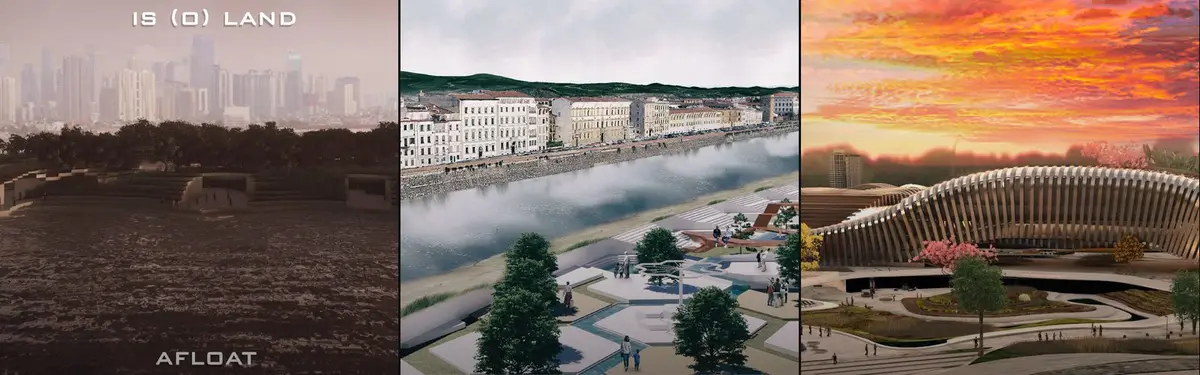


Landscape Urbanism
FLDIntegration of landscape design with urban planning to reshape cities through ecological and social systems.
Landscape urbanism is a theory of urban design that treats landscape, rather than buildings, as the medium that organises the city. It reads a city as a horizontal field of ecological, hydrological and infrastructural systems that keep changing over time, and it designs those systems first. The idea took shape in the 1990s through figures such as Charles Waldheim and James Corner, and it later gave the world projects like Freshkills Park in New York.
What is landscape urbanism?
At its core, landscape urbanism argues that the structure of a city can be drawn from its ground: its watersheds, soils, slopes, transport corridors and leftover industrial land. Wikipedia's summary of the field describes it as a theory holding that the city is made of interconnected and ecologically rich horizontal field conditions rather than an arrangement of objects and buildings, and notes that it values performance over pure appearance. Instead of placing a park inside a finished plan, the landscape urbanist uses landscape to decide where the plan goes.
That is the main difference from landscape design, which usually works at the scale of a garden, plaza or park and shapes how a place looks and feels. It also differs from conventional landscape architecture practice in its ambition: the subject is the whole urban region, including highways, landfills, rivers and logistics land. Charles Waldheim, now the John E. Irving Professor of Landscape Architecture at the Harvard Graduate School of Design, is described by his publisher as one of the field's pioneers. The publisher's description of his 2016 book Landscape as Urbanism: A General Theory puts the claim plainly: landscape has recently emerged as a model and medium for the city.
Landscape urbanism sits close to ecological urbanism and to urban ecology, but it is a design discipline first. Its products are plans, phasing strategies and new ground, not scientific inventories. It is also distinct from New Urbanism, the movement that favours traditional streets and blocks, and the two schools have long been at odds over density and urban form.
A short history of landscape urbanism
The roots run back to the nineteenth century, when landscape architecture was invented as a profession to reconcile the industrial city with its ecological and social conditions. Waldheim's history traces the idea further, from the Renaissance through the twentieth century, and through designers ranging from Ludwig Hilberseimer to Adriaan Geuze. In this reading, landscape urbanism emerged in the late twentieth century to fill a void at the heart of the contemporary urban project, as planning drifted toward social science and urban design toward neotraditional town models.
The phrase itself appears in the mid 1990s. According to the Wikipedia entry on landscape urbanism, Peter Connolly used it at RMIT in Melbourne in 1994, and the first major event under the name was a Graham Foundation conference in Chicago in April 1997, with speakers including Waldheim, Mohsen Mostafavi, James Corner and Adriaan Geuze of West 8. The same entry lists Bernard Tschumi's Parc de la Villette in Paris among the movement's notable projects, alongside later American work.
Built precedent arrived in Europe first. In Germany's Ruhr valley, Latz + Partner won an international competition to convert the Thyssen blast furnace plant at Meiderich into Landschaftspark Duisburg-Nord, a 200 hectare park designed and realised between 1990 and 2002. The furnaces, bunkers and rail lines stayed. Planting, water and paths were threaded through them.
"The idea was to integrate, shape, develop and interlink the existing patterns that were formed by its previous industrial use, and to find a new interpretation with a new syntax."
Latz + Partner, project text for Landschaftspark Duisburg-Nord

In the United States the decisive projects came after 2000. Field Operations, the practice led by James Corner, began work in 2001 on Freshkills Park on Staten Island, a master plan for a former landfill of more than 2,200 acres that is being built in phases through 2036. In Manhattan, a disused elevated freight line became the High Line, designed by James Corner Field Operations with Diller Scofidio + Renfro and planting designer Piet Oudolf, whose first section opened in 2009.
Key principles of landscape urbanism
James Corner's essay "Terra Fluxus", published in The Landscape Urbanism Reader (2006), is often used as a checklist. The four themes it names are process over time, horizontality, adaptable working methods and the imaginary. In practice they translate into the five working principles below.
Design for process, not a finished picture
A landscape urbanist plan sets up conditions and lets them develop: soils mature, woodland closes, water cuts new channels. Phasing is part of the design. Freshkills will take decades to complete, and its early phases were pilot projects that opened the site to the public while the rest kept changing.

The Hills of Shanghai applies the idea to an unlikely programme. The team reads a cemetery as a growing system that develops over time and becomes part of the urban fabric and an ecological hotspot.
Treat the ground as a continuous, horizontal field
Horizontality means working with surfaces that run across property lines, roads and building footprints. The ground plane carries movement, drainage and planting at once. Some members push the idea upward: Elevated Landscapes by Bob Borson explores arraying the ground plane vertically, so that a stack of ground experiences rises into the air.

Let infrastructure and ecology share the same plan
Highways, pipes, landfills and floodways are not hidden behind planting. They become the framework for it. Field Operations describes Freshkills in exactly those terms.
"Transforming the world's largest landfill into a vast public landscape where ecology, infrastructure, and recreation converge."

Reclaim waste and residual land
Post-industrial sites, quarries, rail yards and dumps are the classic territory of landscape urbanism, because they are large, cheap and already part of urban infrastructure. Keeping traces of their history, as at Duisburg, is usually cheaper and more legible than erasing them.
Use landscape to structure where the city grows
The most ambitious principle is planning by landscape: reading catchments, slopes and flood plains first and placing streets and buildings second. This is where the theory meets green infrastructure and climate adaptation, and where several uni.xyz members have done their most rigorous work.
Landscape urbanism on uni.xyz
The topic on uni.xyz gathers competition entries, student theses and editorial features that use landscape as the organising system of a city or district. A few stand out.
Farmscape, by Sadaf Khan, Rafia, Syed Saif and Khalifa Sampad, received an Honorable Mention in the Urban Meal Mine competition and, with 498 likes, is the most liked project in this topic. Its form is drawn from the traditional farmland pattern of London, and its programmes, zoning and infrastructure are submerged beneath a landscape that covers most of the site.

Landfill to Landform_A Story of Transformation, by Sanskriti Jindal, Manali Jamgaonkar and Linda Elsa Baby, won a People's Choice Award at UnIATA '20. It takes on the Ghazipur Landfill in New Delhi, a site whose height has been compared in the news to the Qutub Minar and the Taj Mahal, and argues that such decommissioned landfills need a permanent solution. It is a direct counterpart to Freshkills, set in an Indian city.

City Fields_Wrapped Up, by Marina Mihailovic, Kristina Verušeski and Jelena Z, also earned an Honorable Mention in Urban Meal Mine. It folds fields, workshops, hubs, public space and markets into one productive ecosystem, and its statement reads almost like a definition of the field.
"General idea is based on immersion of the landscape principles into an urban context."
Marina Mihailovic, Kristina Verušeski and Jelena Z, project statement for City Fields_Wrapped Up
Fore^t De Poche, by Sehr Gupta and Anita Stankova, won a People's Choice Award at Elevate 2019. The pocket forest is a self-sufficient walkway module that creates its own microclimate and produces its own electricity, a small piece of ecological infrastructure meant to raise awareness of pollution.
The journals go deeper. Machine Made Landscapes follows Karan Anand's proposal for the Betthalasuru White Rocks Quarry near Bengaluru, a limestone quarry closed in 2008 and spread over roughly 152 acres. Rather than backfilling the pits, the project keeps the cliffs, plateaus and flooded basins as the raw material of a public ecological park.

Terrain Anamorphosis, by Zoi Niki Eleftheriadi and Antonia Gerogianni, works on the Kifisos River in Athens beside a closed steam-electric power station. It lets controlled water passages erode the ground into terraces and basins, accepting the river's engineered corridor as part of the landscape. URBANSCAPE: symbiosis by Sujata Hazarika brings the same thinking to street scale in Guwahati, where bamboo bus shelters, parklets and benches double as a network of stormwater micro-systems along Rajgarh Road.
Challenges and future directions
Landscape urbanism has drawn sustained criticism. The same Wikipedia entry summarises the main charges: the idea is loosely defined, its showcase projects can be expensive and aimed at elite patrons, and its parks may contribute to rising land values and the displacement of lower-income residents. Critics have also argued that the movement borrows the language of ecology without fully merging with urban ecology, which led Frederick Steiner to propose a "landscape ecological urbanism".
There are practical limits too. Process-led parks need long-term budgets and management, and a phased master plan can stall when politics change. Large reclamation sites carry contamination and engineering risks that a drawing can underplay.

The likely future lies in climate adaptation, where landscape is already infrastructure. Rohit Raj's thesis Structuring the Urban Form with Natural Systems shows the direction: it maps catchments, slopes and runoff near Shimla and then distributes urban functions by their water demand, so that supply can move by gravity rather than by pump. Work like this answers the critics by tying the landscape to measurable urban needs.
Landscape urbanism for students and designers
Landscape urbanism suits thesis work because it starts with research that students can do themselves: mapping a watershed, a landfill, a dead rail line or a flood plain. Strong thesis angles include reclaiming a quarry or landfill on a city edge, planning a hill town by its catchments, turning a buried river back into a public corridor, or using street furniture as distributed drainage. Keep the time dimension visible in your drawings: show the site at opening, after ten years and after thirty.
Design competitions are a good place to test these ideas at speed, and many of the projects above began that way. Browse open briefs on uni.xyz competitions, and read across to the neighbouring topics of landscape design, green infrastructure and urban ecology linked above.
Frequently asked questions
What is landscape urbanism in simple terms?
It is an approach to urban design that uses landscape systems, such as water, soil, vegetation and infrastructure corridors, to organise a city, instead of starting with buildings. The landscape is planned first and the urban form follows it.
How is landscape urbanism different from landscape design?
Landscape design shapes specific places such as gardens, plazas and parks. Landscape urbanism works at the scale of districts and regions and treats landscape as the structure of urban growth, often on post-industrial or infrastructural land.
Who are the key figures in landscape urbanism?
Charles Waldheim, James Corner of Field Operations, Mohsen Mostafavi and Adriaan Geuze of West 8 all spoke at the 1997 Chicago conference that launched the term. In Europe, Latz + Partner's Landschaftspark Duisburg-Nord is one of its key built precedents.
What are famous examples of landscape urbanism?
Frequently cited examples include Parc de la Villette in Paris, Landschaftspark Duisburg-Nord in Germany, Freshkills Park on Staten Island and the High Line in Manhattan.
Is landscape urbanism the same as ecological urbanism?
They overlap but are not the same. Ecological urbanism places more weight on scientific ecology and social systems, while landscape urbanism is rooted in design practice and in landscape as a medium of urban order.
References and further reading
- Landscape urbanism, Wikipedia
- Landscape as Urbanism: A General Theory, by Charles Waldheim, Princeton University Press via Project MUSE
- Charles Waldheim, faculty profile, Harvard Graduate School of Design
- Landschaftspark Duisburg-Nord, Latz + Partner
- Freshkills Park, Field Operations
- High Line history, Friends of the High Line


Popular projects
View all 81 projects


Latest journals
View all 81 journals

Lines of the Land: A Fish Market Sheltered Beneath an Arching Greenway Bridge
An arching vegetated bridge spans an urban fish market in Vietnam, folding terraced field geometry into stalls, seating and lantern-lit lawns.

prOpencity: Treating the Dense City as Open-Source Code That Its Citizens Can Edit
A collage-driven urban experiment that swaps the masterplan for a repeatable loop of listening, prototyping and revising with the people on the street.


Juguemos en el Parque and Alcaldía de Medellín Stitch Climate-Aware Playgrounds into Hillside Barrios
Across Medellín's peripheral neighborhoods, Tejiendo Hogares turns leftover corners into permeable, color-coded play spaces that also manage stormwater.

CAW Arquitectos Stabilizes an Antofagasta Hillside with Planted Terraces and Slatted Timber Shade
In Antofagasta's Las Brisas sector, a 13,500 m² park uses vegetation, stone terraces and timber canopies as living infrastructure on unstable ground.


