
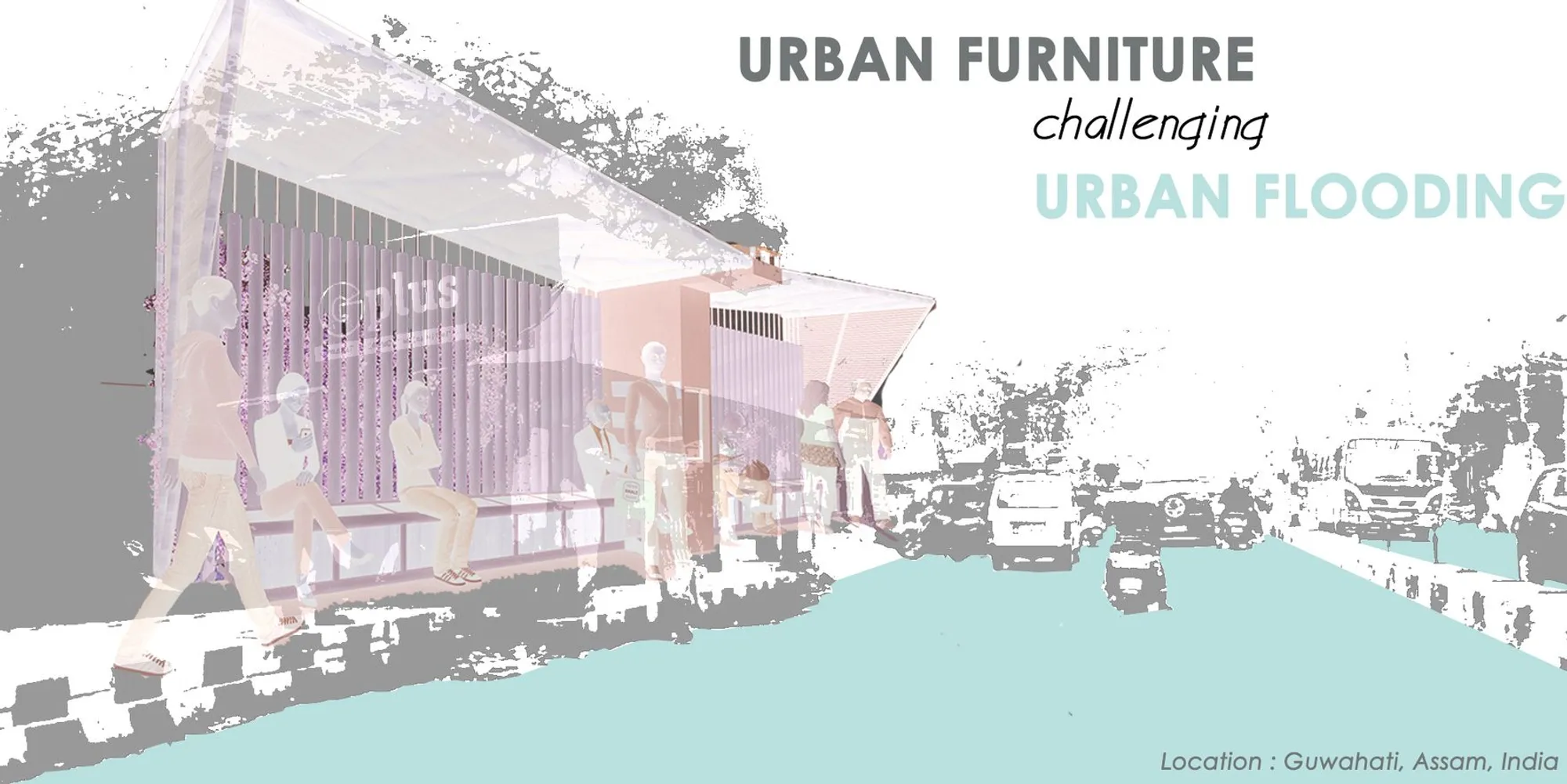
URBANSCAPE: Symbiosis Turns Guwahati's Street Furniture into Flood Infrastructure
Bamboo bus stops, parklets, and modular benches work as ecological micro-systems to absorb monsoon runoff along Rajgarh Road, Guwahati.


What if the bus stop you wait under during a monsoon downpour could actually prevent the street from flooding? In Guwahati, a city where rapid concretization has turned every rainy season into a waterlogging crisis, Sujata Hazarika proposes exactly that: a system of bamboo street furniture that doubles as distributed stormwater infrastructure. Bus shelters harvest rainwater. Parklets absorb runoff through turf and permeable surfaces. Benches grow plants out of their structural cores. Each piece is modest in scale but collectively, they form a network of ecological micro-systems capable of reshaping a street's relationship to water.
The project, titled URBANSCAPE: symbiosis, is sited along Rajgarh Road in Guwahati, Assam, a stretch that captures the core urban condition facing Indian cities today: dense concrete growth, vanishing permeable surfaces, and minimal green intervention. Hazarika's analysis of the site reveals a public realm disconnected from its ecology, where the absence of softscapes and urban shelters intensifies both environmental stress and social isolation during monsoons. The design response is a catalog of modular furniture typologies, all constructed from locally available bamboo, that serve everyday civic functions while quietly performing as flood resilience architecture.
A Bus Shelter That Catches Rain Before It Hits the Street
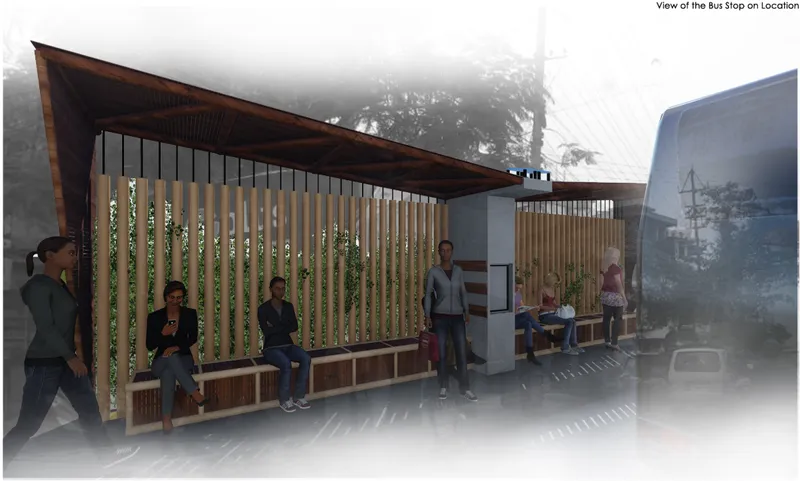

The bus stop module is the most developed typology in the project, and it carries the heaviest conceptual load. An angled bamboo canopy slopes toward integrated rainwater collection pipes, channeling precipitation into storage rather than letting it sheet across asphalt. Vertical timber slats and creeper-covered screens wrap the shelter, creating shaded microenvironments that reduce heat accumulation while protecting commuters and street animals from rain. The section drawing makes the hydraulic logic legible: water hits the roof, travels downslope, and is captured before it reaches the ground plane. The shelter is simultaneously civic furniture, green screen, and water management device.
Inserting Ecology into an Existing Streetscape
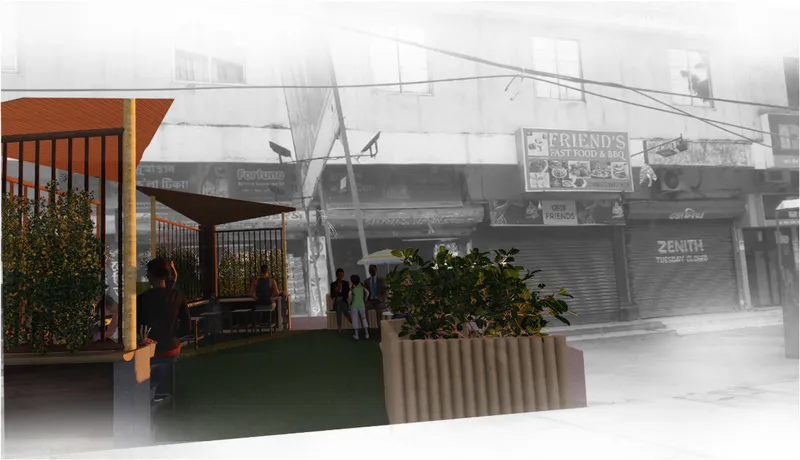
The street view rendering demonstrates something critical about the project's ambition: these interventions are designed to fit within the existing urban fabric of Rajgarh Road, not to require wholesale reconstruction. The planted bus shelter sits between an active roadway and pedestrian zone, occupying the kind of residual infrastructure strip that most cities ignore. It reads as a natural extension of the streetscape rather than an alien object dropped into it. The bamboo framing and living vegetation help the module register as both structure and landscape simultaneously.
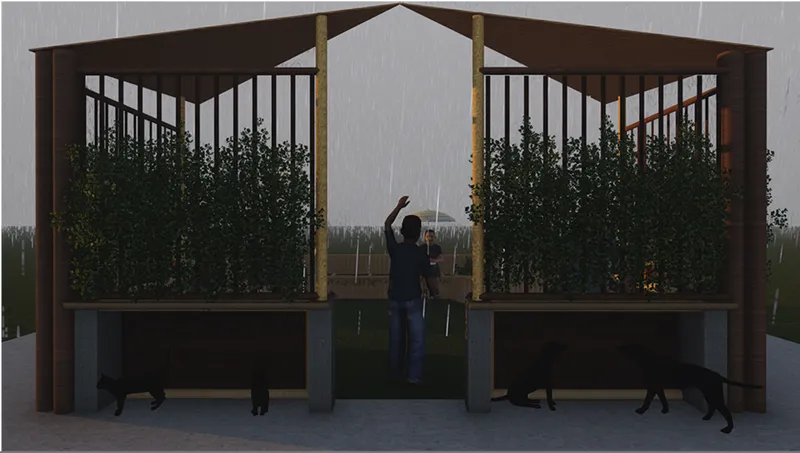
The dusk elevation of two timber-framed modules with hanging planters reveals the design's atmospheric potential. At twilight, the modules glow with integrated solar-powered lighting, transforming from daytime shelters into evening landmarks. The symmetrical composition, with a single figure standing between the structures, emphasizes the human scale of the intervention. These are not monumental gestures; they are quietly insistent pieces of infrastructure that make a street feel habitable during and after the rain.
Three Typologies, One Ecological Strategy
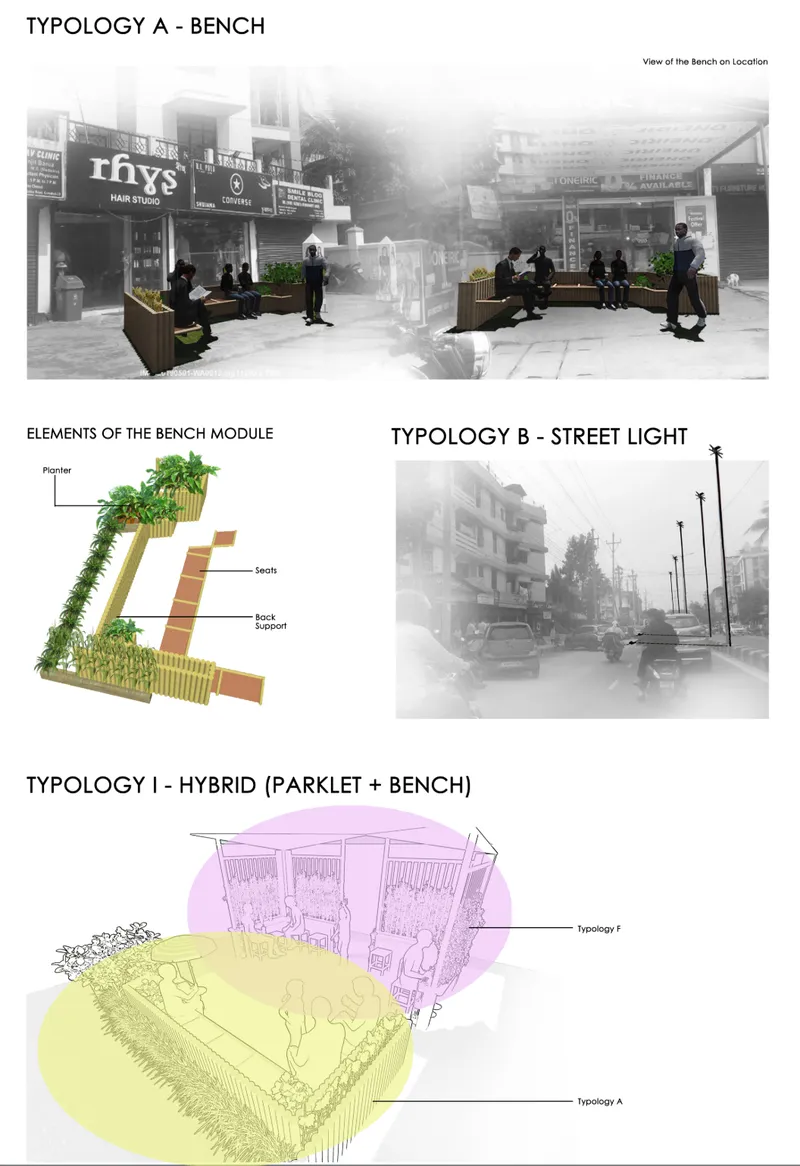
The typology diagram lays out the modular system's full range. Beyond the bus stop, Hazarika proposes parklet modules that convert underused road edges into green pockets featuring turf grass for stormwater absorption, planters, and dedicated animal shelter zones. Bench modules use planters as structural elements, merging greenery with rest zones so that every seat is also a container for vegetation. A hybrid configuration combines parklet and bench functions to foster social engagement alongside ecological continuity. The modularity is the key: each piece can be deployed independently, but the system gains cumulative power as more units populate a corridor.
From Daylight Shelter to Night Beacon
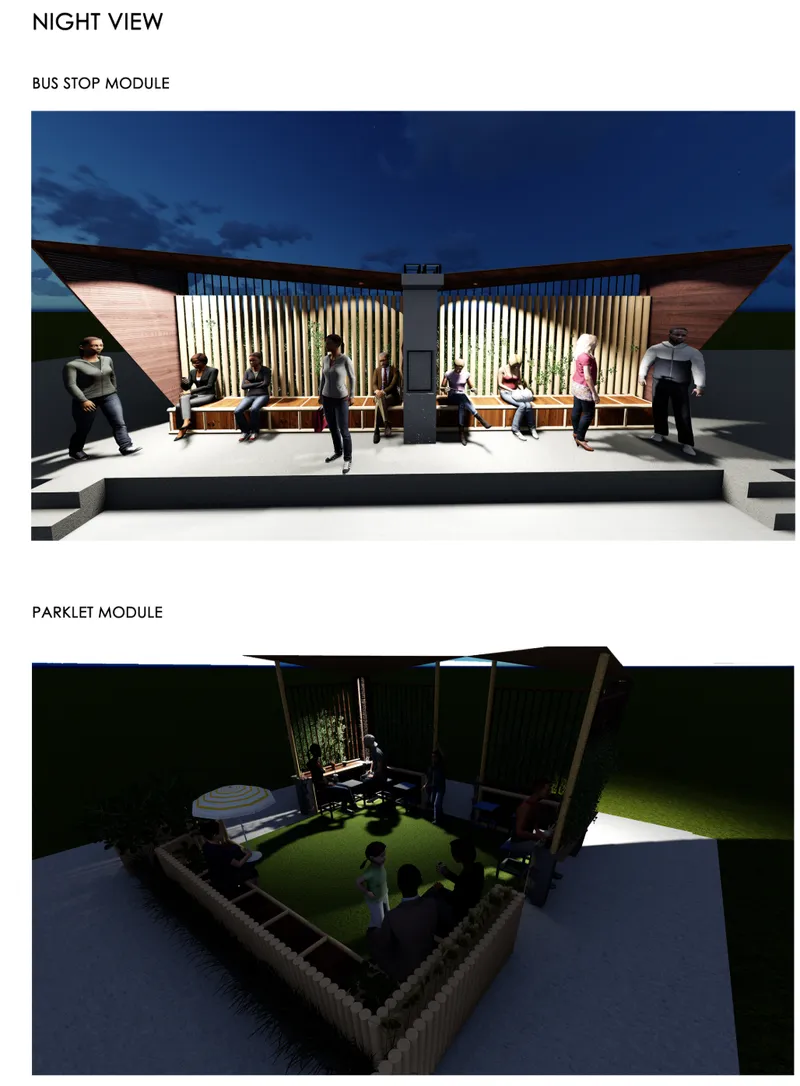
The night model view and top-down parklet plan reveal the project's attention to temporal performance. The illuminated bus stop module, powered by integrated solar panels, maintains its civic presence after dark, offering safe, lit shelter on streets that typically lose their public character at night. The plan view of the parklet module shows the deliberate allocation of ground surface to turf, planting, and seating, making visible the percentage of each module devoted to permeable area versus hardscape. It is a simple ratio, but in a city where permeable surface is disappearing block by block, every square meter of absorption counts.
Why This Project Matters
The most persuasive thing about URBANSCAPE: symbiosis is its refusal to treat urban flooding as a problem requiring massive civil engineering. Hazarika's argument is spatial and material: use locally sourced bamboo, integrate vegetation into everyday furniture, make every surface permeable where possible, and distribute the flood response across hundreds of small interventions rather than concentrating it in a single drain or retention basin. The approach is replicable precisely because it is low-cost, modular, and tied to materials and labor already available in the region.
What elevates the project beyond a furniture catalog is its ecological generosity. Shelter is not only provided for commuters but also for street animals. Plants are not decorative but hydraulic, pulling water through root systems and reducing runoff before it pools on roads. The design positions urban architecture as a living organism, one that absorbs and adapts rather than resists. For Guwahati and the many Indian cities facing similar monsoon pressures, the lesson is clear: resilience does not always require big infrastructure. Sometimes it starts with a bench that knows how to hold water.
View the Full Project
About the Designers
Designer: Sujata Hazarika’s
Enter a Design Competition on uni.xyz
uni.xyz runs architecture and design competitions year-round that reward proposals with spatial conviction and real site intelligence.
Project credits: Urban Furniture challenging Urban Flooding: by Sujata Hazarika’s.



Popular Articles
Popular articles from the community


Co-life: Sustainable Architecture for Age-Friendly Community Living
Co-life reimagines sustainable architecture for seniors through courtyards, rammed earth, shared gardens, and spaces designed for belonging.

Riyadh For All: Intergenerational Urban Design for Active Aging in Rabat
Riyadh For All reimagines urban design in Rabat with intergenerational co-living, adaptive courtyards, and Moroccan cultural exchange today.

Lunar Spiral: Space Architecture Shaped by the Mathematics of the Universe
Lunar Spiral reimagines space architecture through Fibonacci geometry, lunar regolith, levitating habitats, and self-sustaining Moon living.

The Musturak Paradise: Senior Living Architecture for a Connected Future in Temara, Morocco
The Musturak Paradise reimagines senior living architecture in Temara via private homes, social spaces, culture, community, and shared care.


Similar Reads
You might also enjoy these articles
Lunar Spiral: Space Architecture Shaped by the Mathematics of the Universe
Lunar Spiral reimagines space architecture through Fibonacci geometry, lunar regolith, levitating habitats, and self-sustaining Moon living.
The Main Dream: Modular Architecture for Play, Learning, and Community
A modular playground turns recycled plastic into adaptable spaces where refugee children can play, build, learn, and reconnect.

Play: Fragments of Their World
Familiar architecture becomes modular playground design, creating safe spaces where displaced children can learn, connect, imagine and play.

Wadi Rum Observatory: Desert Architecture Designed for the Night Sky
Wadi Rum Observatory turns desert architecture into a quiet instrument for astronomy, hiding research spaces under Jordan's starlit terrain.


Comments (0)
Please login or sign up to add comments
No comments yet. Be the first to comment!