
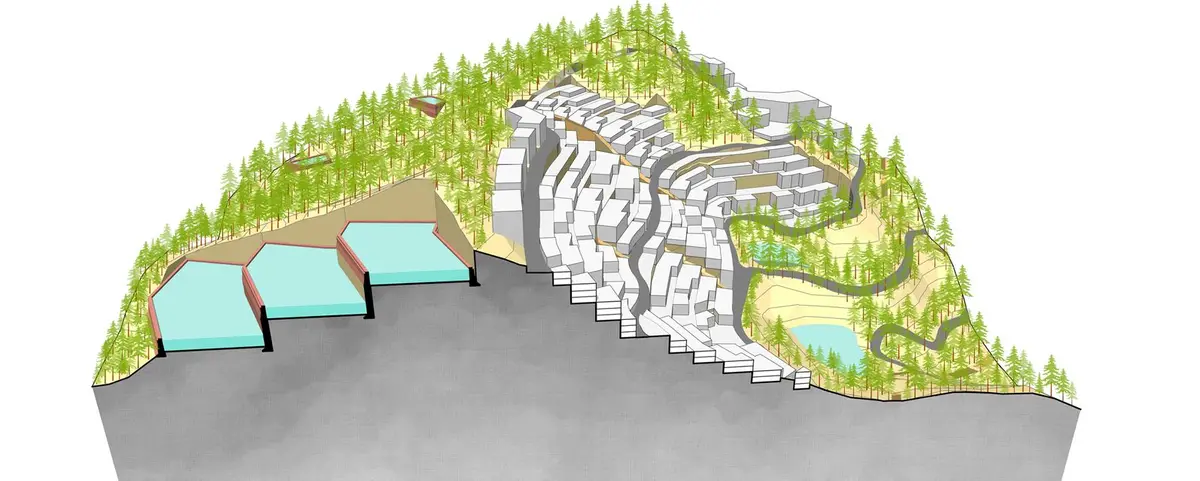
Structuring the Urban Form with Natural Systems: Letting Water Plan Shimla's Next Growth
Rohit Raj's thesis maps catchments, slopes and runoff near Shimla, then places urban functions by water demand so gravity does the work of pumps.


Most hill towns fight their terrain. They cut it, pump water uphill against it, and pave over the channels it carved. This thesis starts from the opposite assumption: in a mountain city, the water already knows where the city should go. Structuring the Urban Form with Natural Systems treats catchments, slope gradients and seasonal runoff as the master plan, and asks the buildings to follow.
Developed as an academic thesis by Rohit Raj, the project is rooted in Shimla, the historic Himalayan settlement that grew along its ridgelines for climate, views and defense, and now strains under pressure on land, water, housing and infrastructure. Raj names the symptoms plainly: scarce and poorly distributed drinking water, building on steep slopes that degrades the environment, dependence on energy-intensive pumping, fragmented growth with no ecological logic, and a housing shortage driven by limited buildable land. Rather than treating these as obstacles to work around, the thesis reframes them as the generators of the design.
Terraces That Step Down With the Water
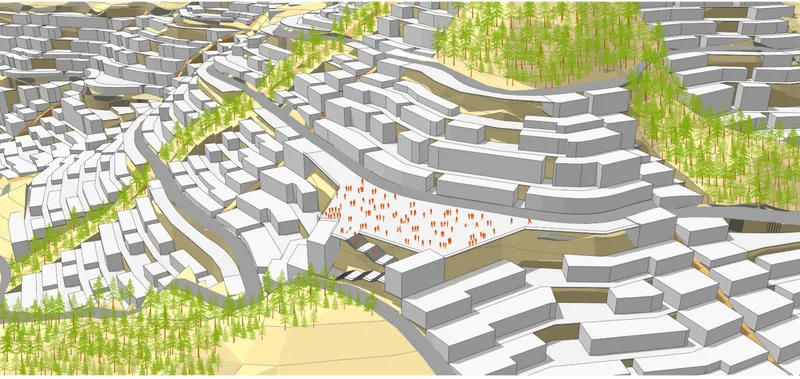
The axonometric shows the core argument in built form: terraced massing that descends a forested slope and gathers at an open plaza, crowded with figures. The movement of the buildings echoes the movement of water, from higher catchment zones toward lower ground. That is not a stylistic gesture. Raj distributes urban functions according to their water demand, so supply can move by gravity rather than by pump, and the stepped section becomes a diagram of how resources flow through the settlement.
Placing the plaza at the bottom of that descent is a smart reading of hill-town life. Public space lands where the slope eases and where people naturally converge, instead of being squeezed onto a ridge already saturated by Shimla's historic core. Development is concentrated on south-facing slopes, following contours rather than a rigid grid, which lets the terraces catch sun while respecting the land's existing grain.
Moving People Vertically Without Carving New Roads
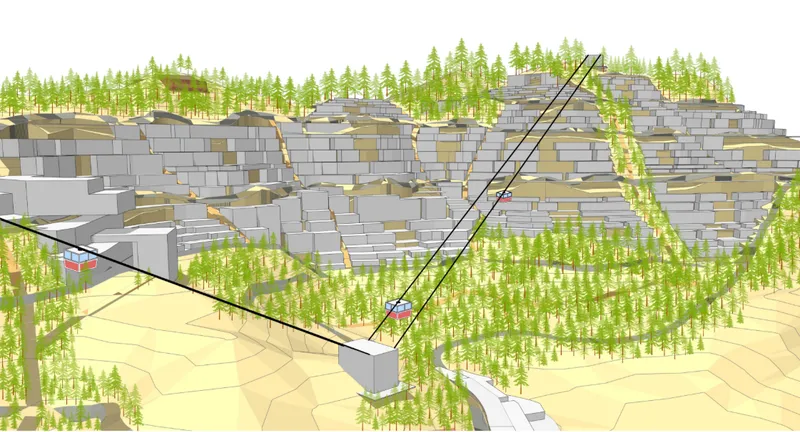
The cable car diagram, with red gondolas rising past stacked terraces and pine trees toward a ridge, addresses a problem every mountain planner faces: vertical distance. In a city where each new road means another cut into a fragile slope, a line in the air reads as a far lighter intervention. The drawing ties the proposal back to the ridge, suggesting a settlement connected to its surroundings rather than an isolated enclave on the hillside.
The trees are given equal weight with the gondolas in this drawing, and that tells you where the priorities lie. Infrastructure here threads through the forest instead of clearing a corridor through it, which is consistent with a thesis that refuses to treat ecology as leftover space.
A Site Defined by What Stays Unbuilt

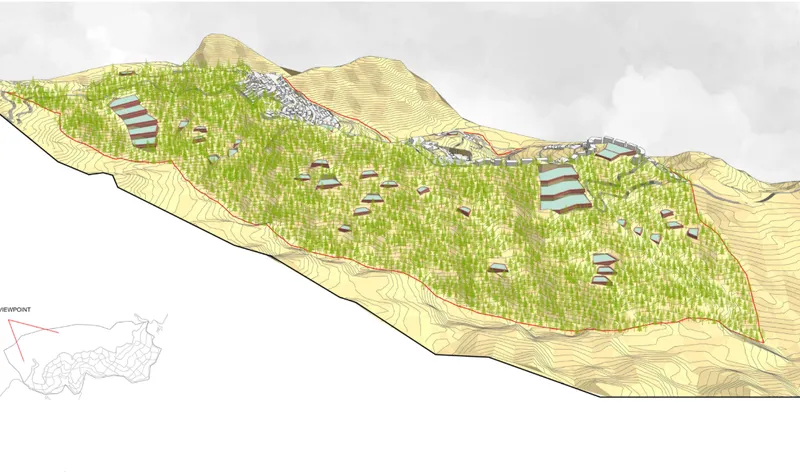
The intervention site sits near Jathia Devi, along the highway connecting Shimla to surrounding regions. Raj arrives there through regional-scale analysis of settlement patterns, transport corridors, forest cover and topography, then delineates the boundary using non-developable forest, water catchment areas, slope suitability, solar orientation and existing access routes. The site model, outlined in red and paired with a key plan and a table of area and water figures, makes this method legible: the plan is quantified, and water is counted as carefully as floor area.
The aerial drawing delivers the most striking statement of the project. A densely wooded slope holds only scattered small pavilions and a few terraced blocks. More than half of the site is preserved as non-developable land, and the image refuses to hide that. Many urban proposals measure success by density; this one measures it by restraint, arguing that sustainable planning in mountain cities must put ecological conservation ahead of built volume.
Why This Project Matters
Indian hill towns are frequently planned with tools borrowed from the plains, and the results show in landslides, dry taps and tanker queues. Raj's thesis offers a transferable alternative: map the watershed first, quantify rainfall and runoff, and let the hydrological structure decide where density, open space and public life belong. Distributing functions by water demand so that gravity handles supply is a modest-sounding idea with large consequences for energy use and resilience.
What makes the work convincing is its discipline. The drawings do not oversell the built proposal; they keep returning to the forest, the slope and the catchment. For a generation of designers who will inherit climate-stressed mountain settlements across the Himalaya and beyond, this is a useful reminder that the best planning move is sometimes the decision not to build, and that the terrain's own logic is a design brief worth reading closely.
View the Full Project
About the Designers
Designer: Rohit Raj
Enter a Design Competition on uni.xyz
uni.xyz runs architecture and design competitions year-round that reward proposals with spatial conviction and real site intelligence.
Project credits: Structuring the Urban Form with Natural Systems by Rohit Raj.


Popular Articles
Popular articles from the community


Tsunami Convergenics: Turning Catastrophic Ocean Forces into Underwater Housing Infrastructure
A speculative underwater settlement off the coast of Onagawa, Japan, treats tsunamis and typhoons as energy sources rather than threats.

Opera on the Sea: Driftwood Logic Shapes a Timber Opera House on Estonia's Coast
Trevor Orgill's opera house translates the entangled drift of floating timber into a civic building where wood, water, and music converge.

Singing Woman: An Opera House That Performs Before the Curtain Rises
Ovidiu Cristian Pavel's conceptual opera house translates Estonia's choral identity into a sculpted waterfront landmark facing the Baltic Sea.

Manzana Morphosis: Stretching Barcelona's Grid into a Living Landscape for 2050
A radical reworking of the Eixample manzana turns density into a tool for generous public space, vertical ecology, and environmental performance.

Similar Reads
You might also enjoy these articles

Healing Façade: A Modular Chapel System That Restores Ethiopia's Sacred Forests
Winner of the Eco-Chapel competition, this circular timber façade collects water from air to rebuild soil and reforest degraded Ethiopian landscapes.
Kaffeebühnen: Where Coffee Shop Architecture Becomes a Civic Stage in Vienna
A linear sequence of timber boxes, transparent shells, and open yards turns the Viennese café tradition into a public performance space.
Eco Chapel: A Modular Forest Pavilion That Grows Like the Landscape It Protects
Hexagonal timber modules weave through existing trees, turning a chapel into a living system for prayer, education, and reforestation.


Urban Forest: A Vertical Ecosystem for 5,000 Workers in Singapore's Changi Business Park
Radially stacked pods and layered green decks turn a 7-acre plot into 47 acres of ecological workspace projected for 2040.

Comments (0)
Please login or sign up to add comments
No comments yet. Be the first to comment!