
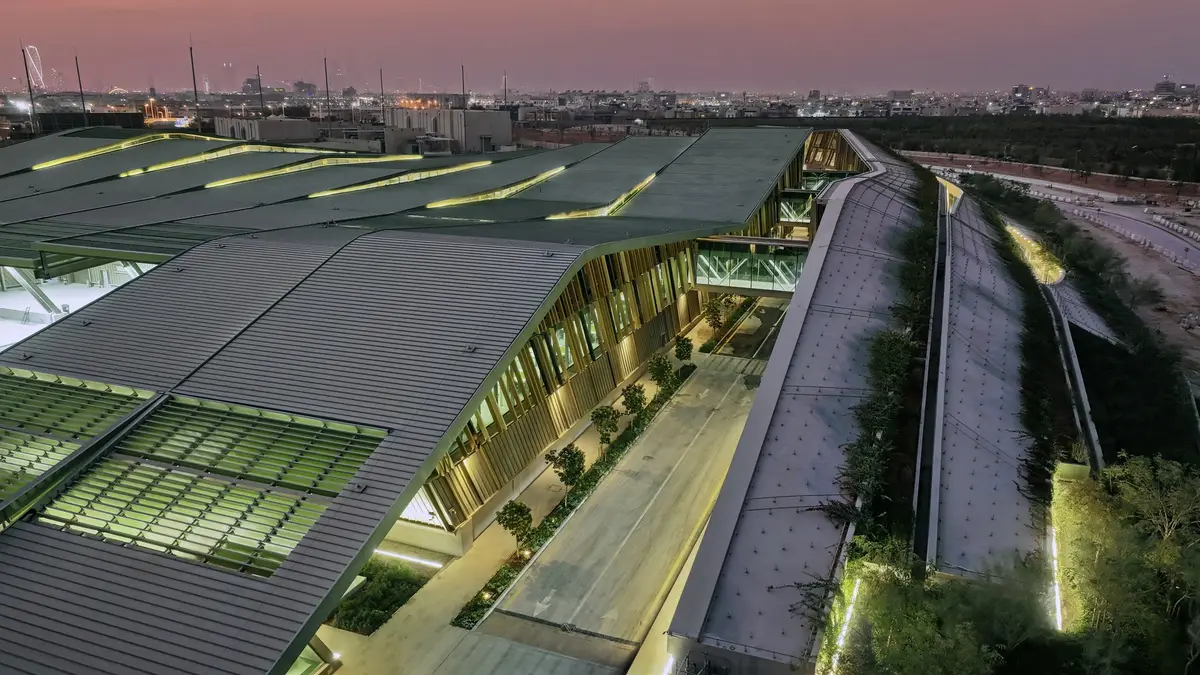
A Park Building That Wants to Be a Landscape
Omrania's Operations & Maintenance Building at King Salman Park dissolves industrial program into Riyadh's largest green infrastructure.


The brief for an operations and maintenance building rarely inspires poetry. It is a program defined by utility: workshops, storage, logistics corridors, staff facilities. At King Salman Park in Riyadh, Omrania took that utilitarian core and wrapped it in an argument about what infrastructure should look like in the 21st century. The result is a 21,312 square meter complex whose undulating green roofs and terraced planting make it almost impossible to distinguish from the park it serves.
What makes the project genuinely interesting is its refusal to treat "blending with the landscape" as mere camouflage. The building is not hidden. It is assertive, angular, and legible as architecture from the plaza level. But from above, and at a distance, it reads as topography. That tension between built object and living surface is the real subject of the design, and Omrania navigates it with conviction.
Roofscape as Terrain

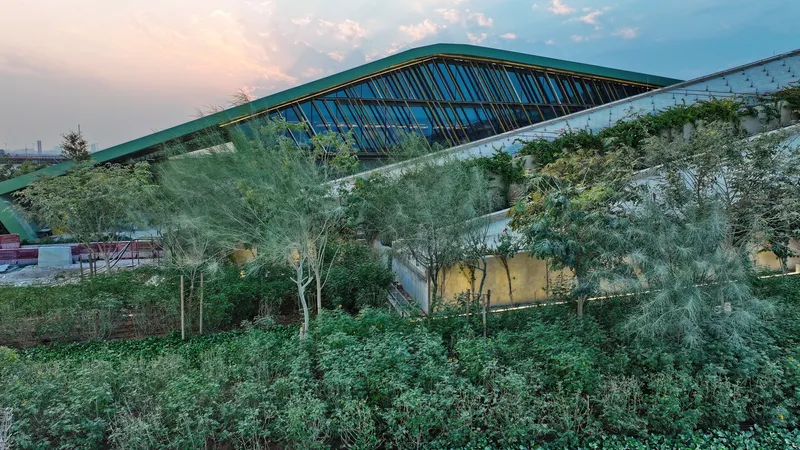
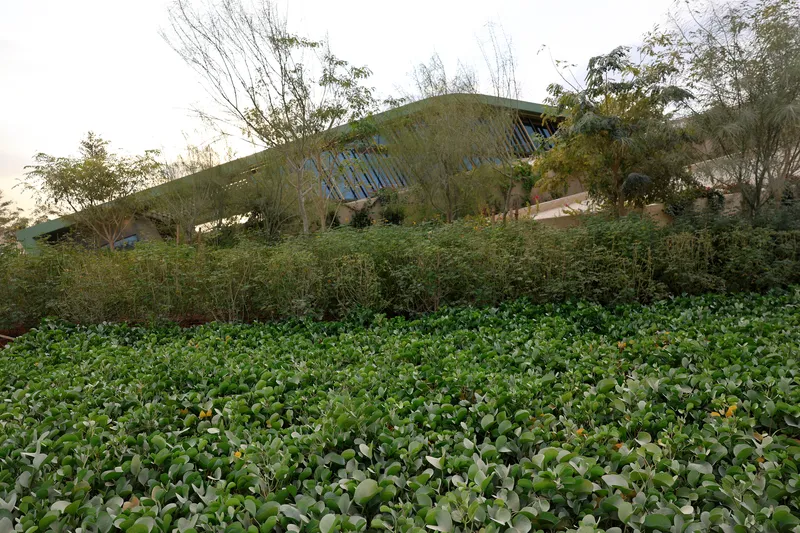
The most immediate gesture is the roof. Clad in green metal panels and integrated with solar arrays, the roofscape rolls in gentle curves that echo dune forms without mimicking them. The slopes are not decorative: they channel rainwater toward planted terraces and create differential heights that allow natural ventilation strategies to function across the deep plan. From the aerial perspective, the building registers as a series of planted ridges emerging from the surrounding groundcover, its built edges softened by dense vegetation that climbs right up to the glazing lines.
Integrated skylights puncture the green surface, pulling daylight deep into the interior where operational staff spend their working hours. It is a straightforward move, but an important one. Maintenance buildings are too often windowless boxes. Here, the roof doubles as both energy generator and light well, justifying its formal ambition with measurable performance.
The Planted Edge
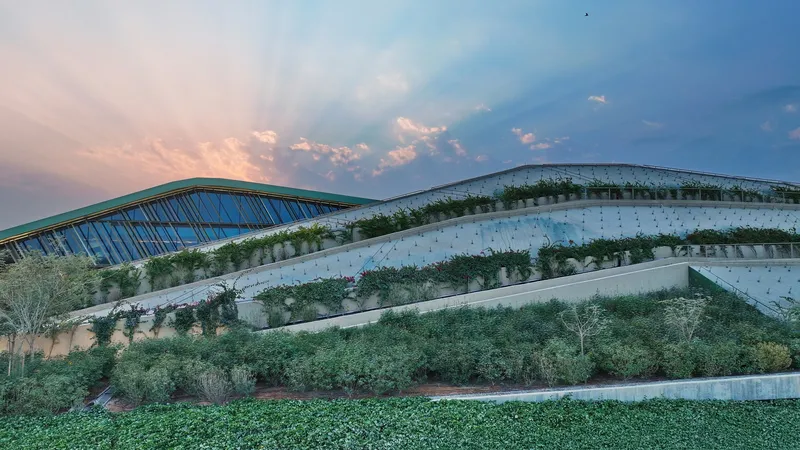
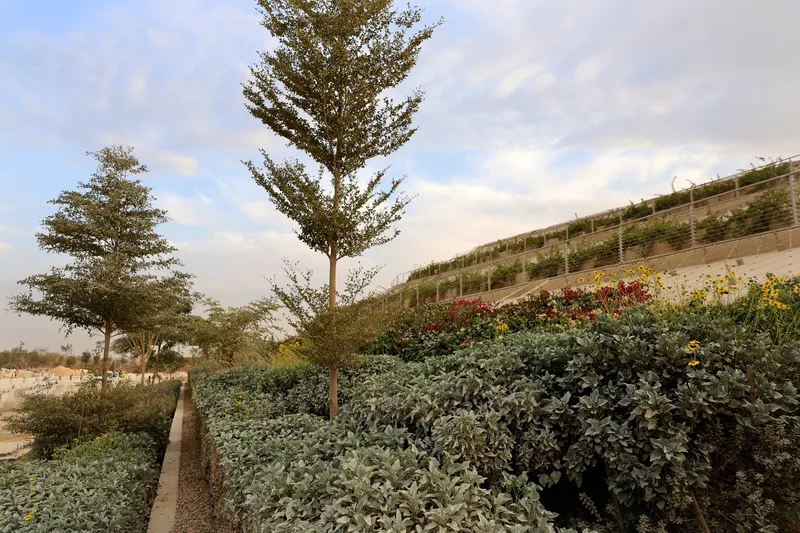
At ground level, the boundary between building and park dissolves into cascading planted terraces. Tiered beds with low shrubs and wildflowers ascend the facade, stepping up alongside gravel paths that could belong to the park's broader landscape design. The planting is not ornamental screening. It is structural to the project's thermal strategy, providing shade to the glazed facades below and reducing the heat island effect that a 21,000 square meter footprint would otherwise produce in Riyadh's climate.
The detail at the roof edge is worth noting: vertical timber louvers mediate between the green metal cladding and the planted beds, creating a layered transition zone rather than a hard line. It is a considered detail that carries the project's larger idea all the way down to its smallest junctions.
Timber, Metal, and the Facade System

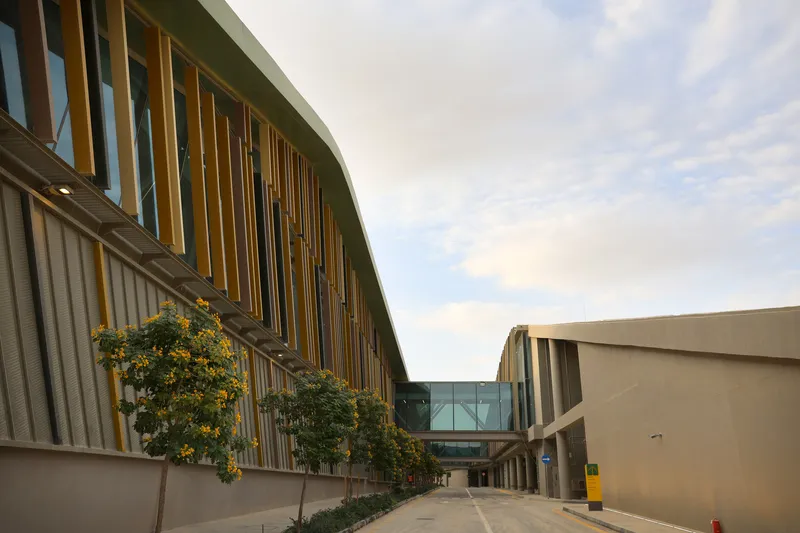
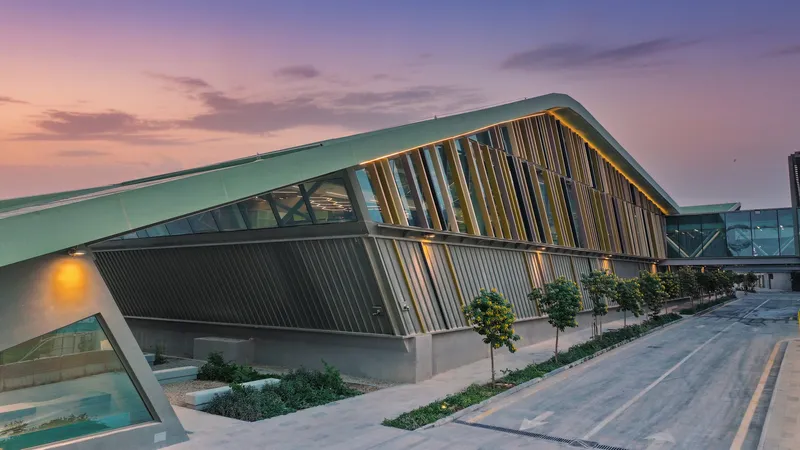
The facades work through a vocabulary of three primary materials: vertical timber fins, corrugated metal cladding, and generous glazing. The timber brise-soleil elements are the most expressive, angling outward at varying pitches to calibrate solar shading across different orientations. They give the building a warm, textured presence that offsets the industrial scale of its volumes.
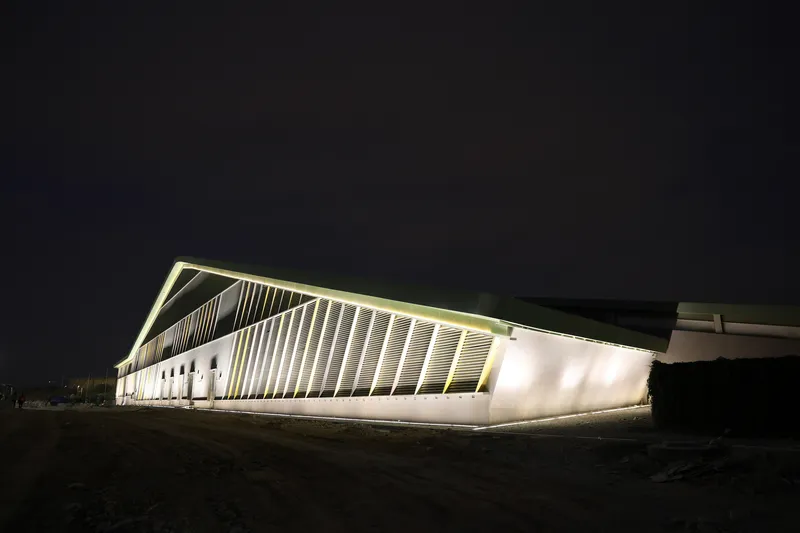
At night, the building transforms. Uplighting along the angular white fin walls and the backlit canopy soffits turn the complex into a lantern, its geometry suddenly sharp against the dark park. The curved facade with its vertical timber screens reads differently again under artificial light, the corrugated metal taking on a reflective quality that amplifies the evening glow. It is a building designed to perform across the full cycle of a desert day.
The Central Plaza and Courtyard


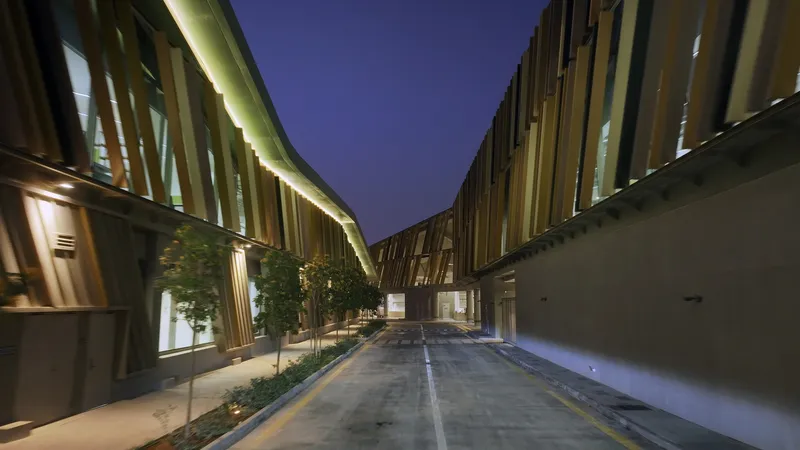
The building is organized around a central plaza that sits between two major volumes, each capped with its own green roof. This open-air spine does the heavy lifting for circulation, orientation, and microclimate. Projecting canopies supported by slender columns shade the paver surface, creating covered outdoor zones for gathering and transition. At night, the illuminated pedestrian passages between vertical metal screen facades become the building's most atmospheric spaces, their planted medians and warm lighting suggesting a quality of environment more commonly associated with cultural programs than maintenance facilities.
Raised planted beds within the courtyards sit beneath cantilevered ribbed ceilings, blurring the threshold between inside and outside. This is a genuine courtyard typology, not just a leftover void between two buildings. It organizes the plan and provides every interior space with a view toward greenery.
Interior Connectors and Bridges

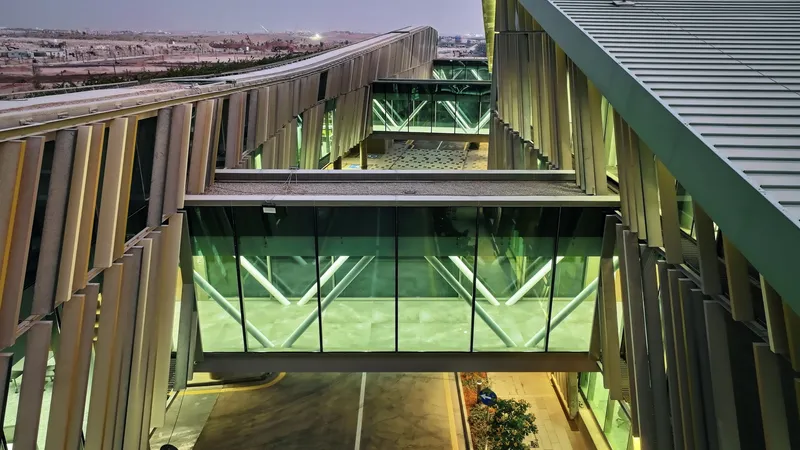
Glazed bridges connect the two primary volumes across the courtyard, and they are among the project's strongest moments. The interior courtyard view reveals angled timber louvers framing the bridge, creating a layered depth that rewards close looking. The bridge itself uses green-tinted geometric glazing that filters light into the passage below, making the connection feel less like a corridor and more like a threshold event.
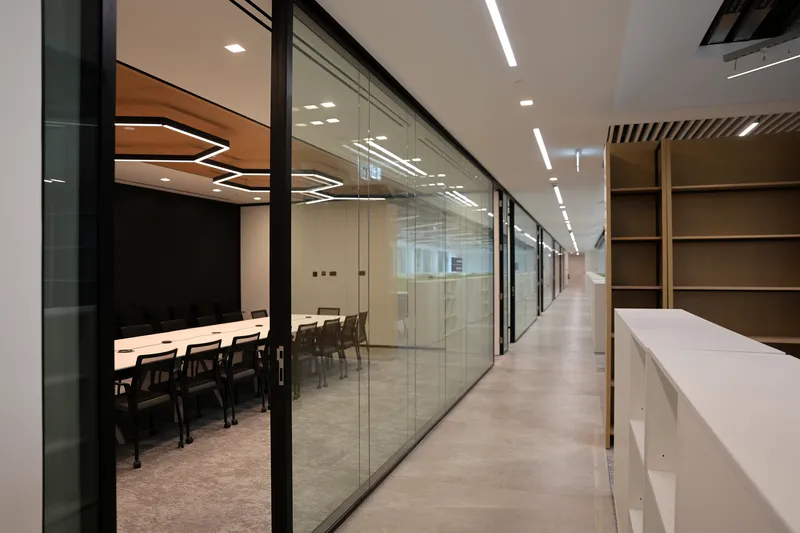
Inside, the circulation spine is lined with glass-walled conference rooms on one side and timber shelving on the other, establishing a rhythm of transparency and warmth. Linear ceiling lights reinforce the directional logic, pulling you along the length of the building with clarity. There is nothing ambiguous about the wayfinding here, which matters in a building where operational efficiency is the primary functional requirement.
Workspaces That Resist the Generic
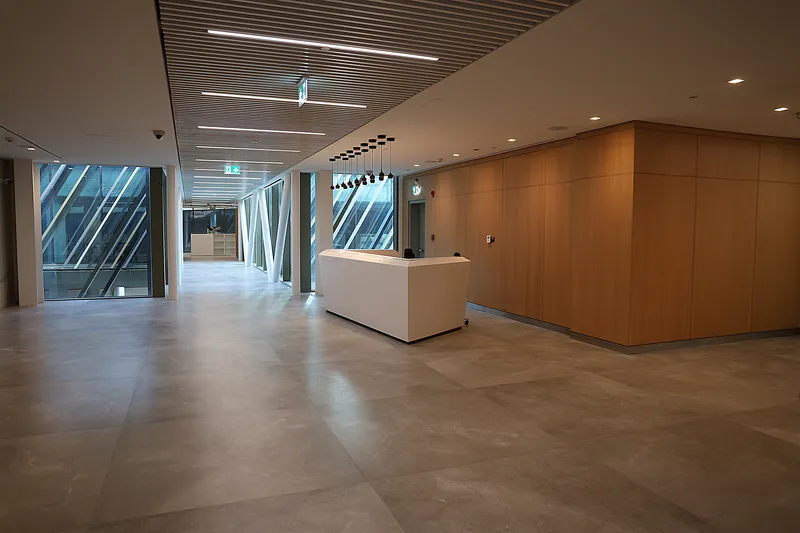
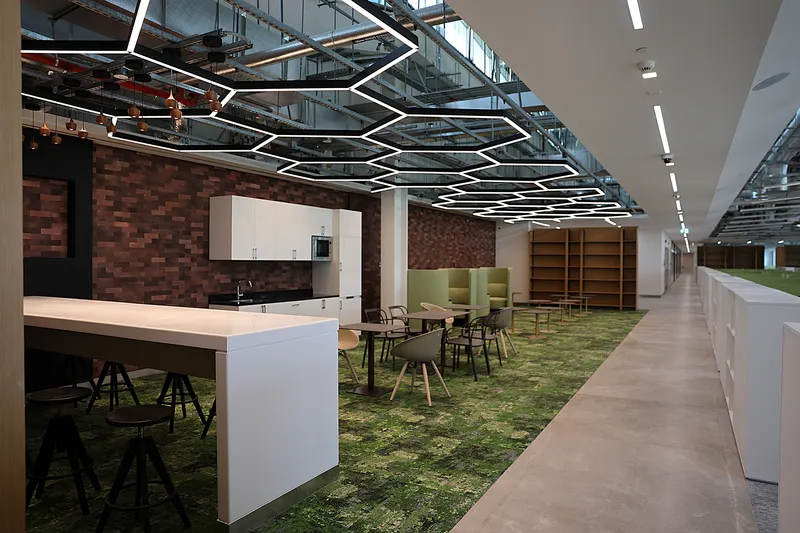
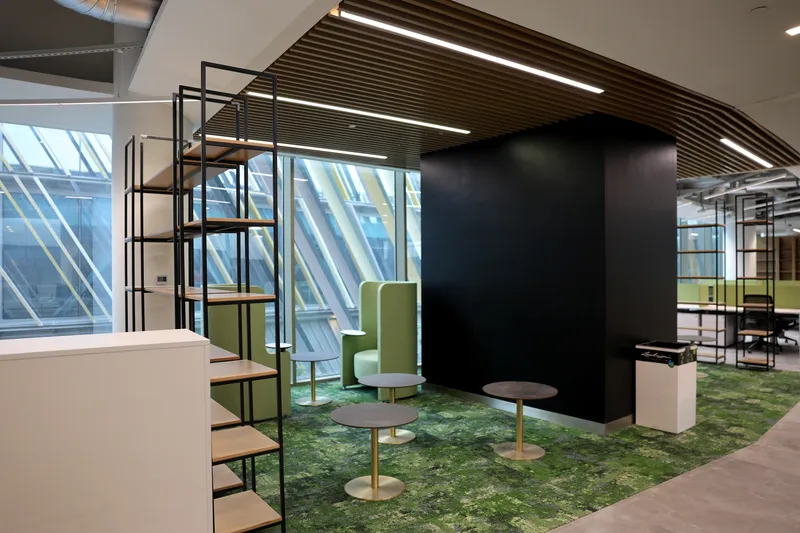
The interiors are where the project could easily have compromised, defaulting to standard-issue office fit-out behind the ambitious exterior. Omrania does not take that route. The reception lobby pairs a clean white desk with slatted timber ceilings and generous glazed facades that frame the evening landscape. Breakout areas feature grass-patterned carpet, white kitchen islands, and geometric lighting that reads as playful without being juvenile. Green upholstered seating pods sit on the same grass carpet beside diagonal-braced glazed walls, creating lounge zones that feel genuinely comfortable.
These are spaces designed for people who work in them every day, not for a single photograph. The material palette is restrained but specific: wood paneling, white surfaces, green accents that echo the exterior planting. It coheres.
Meeting and Conference Spaces
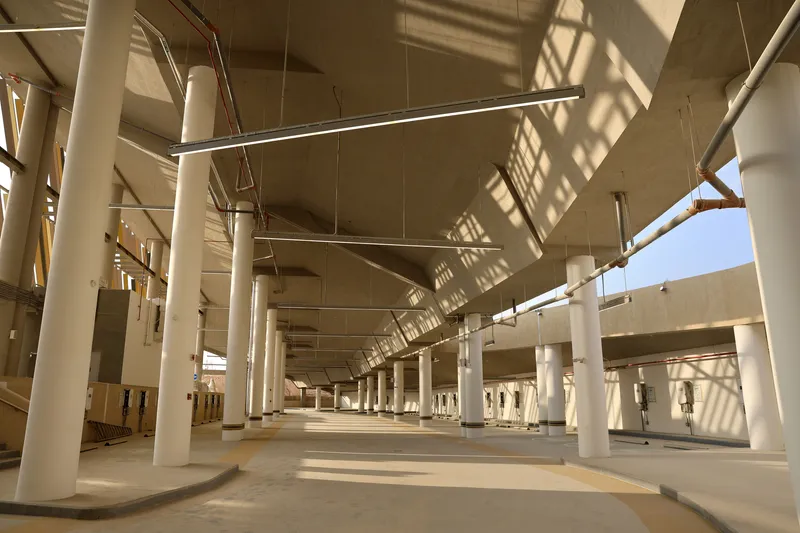
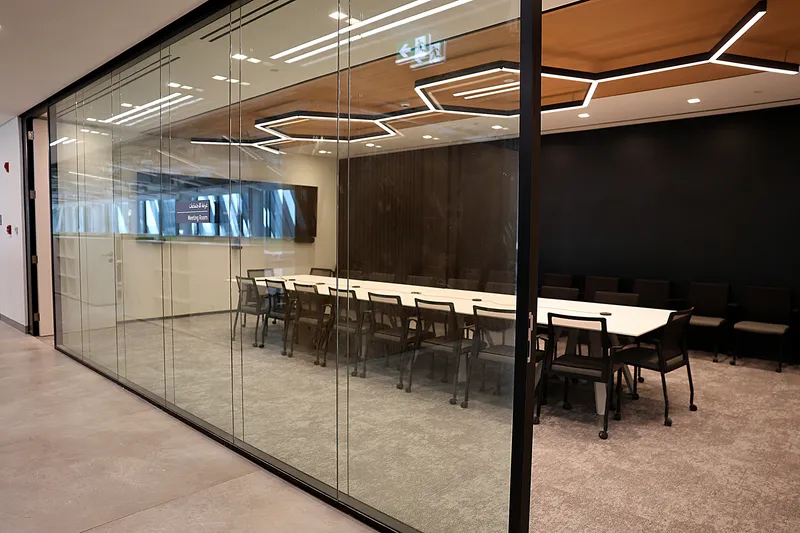
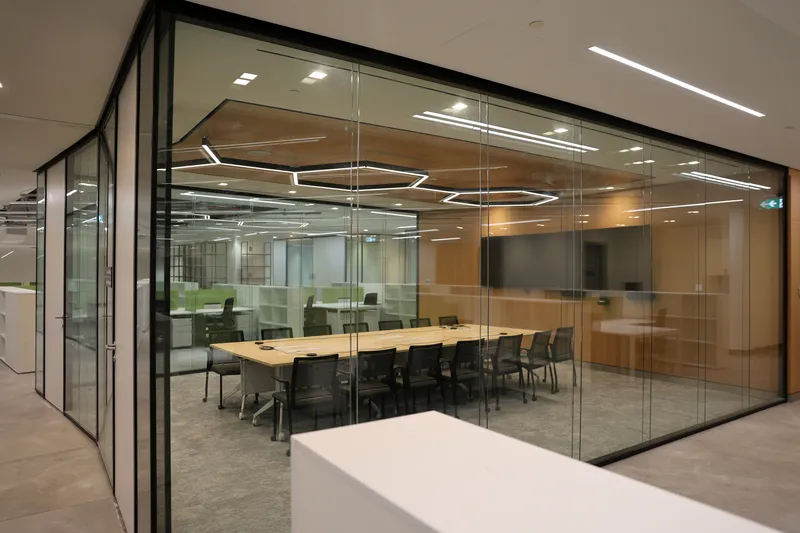
The formal meeting rooms continue the language of transparency and material warmth. Glass-enclosed conference spaces with timber tables and hexagonal pendant fixtures are visible from the main circulation corridors, reinforcing a culture of openness within the operational hierarchy. White cylindrical columns punctuate the larger interior volumes, their solidity anchoring rooms where linear suspended lighting casts sharp, precise shadows across the ceiling panels.
Nothing here is extravagant, but the quality of finish and the attention to lighting design elevate what could have been mundane office space into something with genuine spatial character. The hexagonal ceiling fixtures are a small but telling choice, their geometry echoing the building's larger formal moves without over-determining the interior aesthetic.
Nightscape and Urban Presence
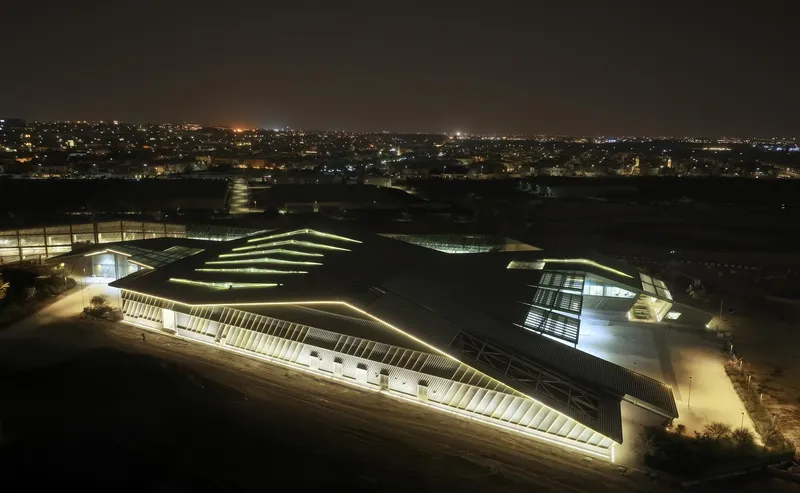
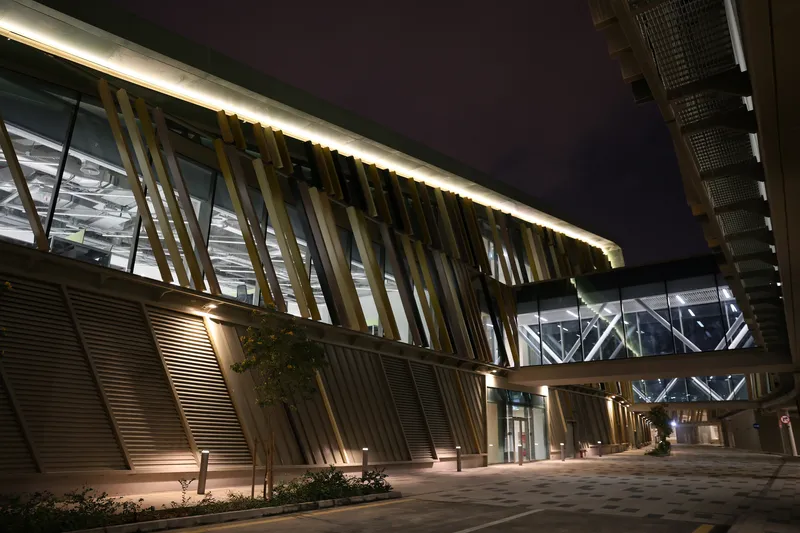
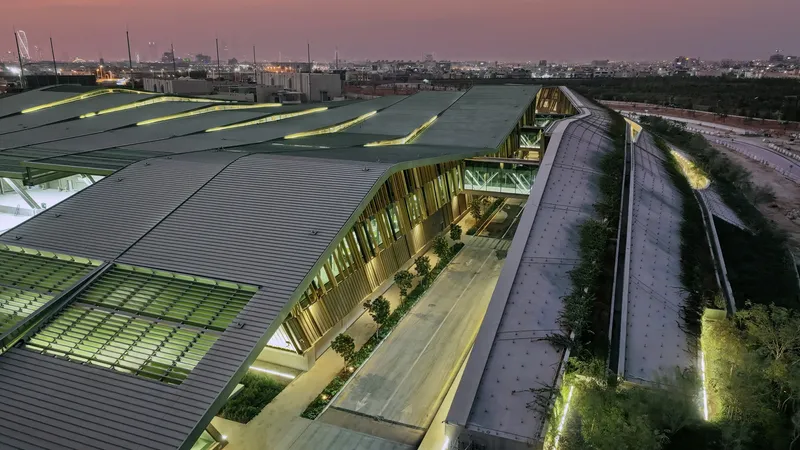
The aerial night views are where the project's dual identity becomes clearest. The terraced green roofs read as dark masses against the illuminated facades, while the distant Riyadh skyline provides a contrasting backdrop of towers and light. The building holds its own at this scale without competing. The entry canopy, with its angled metal fins and backlit soffit, marks the arrival sequence with enough drama to signal a civic threshold rather than a service entrance.
The illuminated central plaza, flanked by its twin green volumes, becomes a gathering space that reads as public even within a restricted operational compound. This is a deliberate choice: to treat the people who maintain the park with the same architectural generosity afforded to its visitors.
Plans and Drawings
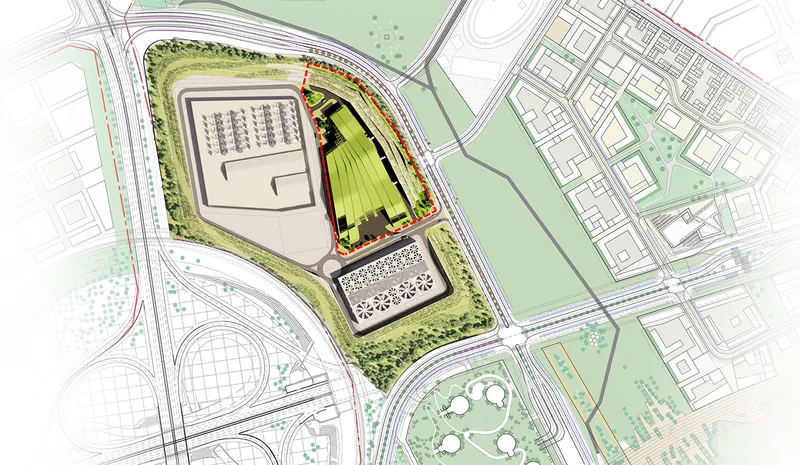
The site plan confirms what the photographs suggest: the building is conceived as a landscape element within the larger park system. Its green roof merges with the surrounding planted grounds, while the plan organization reveals the courtyard logic that structures the interior. The building's relationship to Hub 08 and the northern park edge is clear, positioning operations and maintenance at the threshold between urban Riyadh and the park's green core.
Why This Project Matters
The Operations & Maintenance Building at King Salman Park matters because it refuses the premise that back-of-house architecture should look like back-of-house architecture. In a region where mega-projects often lavish attention on visitor-facing elements while neglecting the buildings that keep everything running, Omrania's approach is a corrective. The workers who maintain one of Riyadh's most significant public spaces deserve a building that treats their daily experience with seriousness, and that is precisely what this project delivers.
It also offers a persuasive model for how industrial-scale buildings can participate in landscape systems rather than simply occupying them. The green roof is not greenwashing. It is a functional component of a thermal, hydrological, and ecological strategy that makes the building measurably better for being integrated into the park's ecology. If the ambition of King Salman Park is to demonstrate that Riyadh can build green infrastructure at metropolitan scale, then its operations building should embody that thesis. It does.
Operations & Maintenance Building at the King Salman Park by Omrania, led by Dr. Rukn Eldeen. Riyadh, Saudi Arabia. 21,312 m². Completed 2025.
About the Studio
Share Your Own Work on uni.xyz
If projects like this are the kind of work you want to make, uni.xyz is a place to publish your own, find collaborators, and enter design competitions.


Popular Articles
Popular articles from the community


Extended Shell: Retrofitting Kolkata's Balconies as Living Urban Thresholds
A modular retrofit system recovers the social and environmental intelligence of Kolkata's historic verandas for contemporary Park Street residents.

Singing Woman: Contemporary Architecture Inspired by Estonia’s Voice and the Sea
Singing Woman turns Estonia’s song culture into flowing opera house architecture, blending public life, landscape, sea, and national memory.

Manzana Morphosis: Stretching Barcelona's Grid into a Living Landscape for 2050
A radical reworking of the Eixample manzana turns density into a tool for generous public space, vertical ecology, and environmental performance.

Opera on the Sea: Driftwood Logic Shapes a Timber Opera House on Estonia's Coast
Trevor Orgill's opera house translates the entangled drift of floating timber into a civic building where wood, water, and music converge.

Similar Reads
You might also enjoy these articles

Bao Huynh Watercolor Atelier: A Serene Art Retreat in Hội An
Bao Huynh Watercolor Atelier in Hội An blends multifunctional art spaces, sustainable design, local materials, and family-friendly living in a serene environment.

Atelier Macri Concept Store Interior Design by CASE-REAL
Atelier Macri store features a "ko" counter, walnut wood details, cork displays, blending retail, gallery, and seamless customer experiences.

Manuel Vargas Izquierdo Stadium and High-Performance Sports Center: Architectural Excellence in Jalpa de Méndez
The Manuel Vargas Izquierdo Stadium blends sustainable design, inclusive sports facilities, and cultural-inspired architecture, revitalizing Jalpa de Méndez’s public spaces.

KAKR Buluh Awar Hall: Revitalizing Community and Ecology Through Bamboo Architecture
Community built bamboo hall revitalizes Buluh Awar village, empowering youth, restoring ecology, celebrating vernacular craftsmanship through sustainable architecture and culture.

Comments (0)
Please login or sign up to add comments
No comments yet. Be the first to comment!