
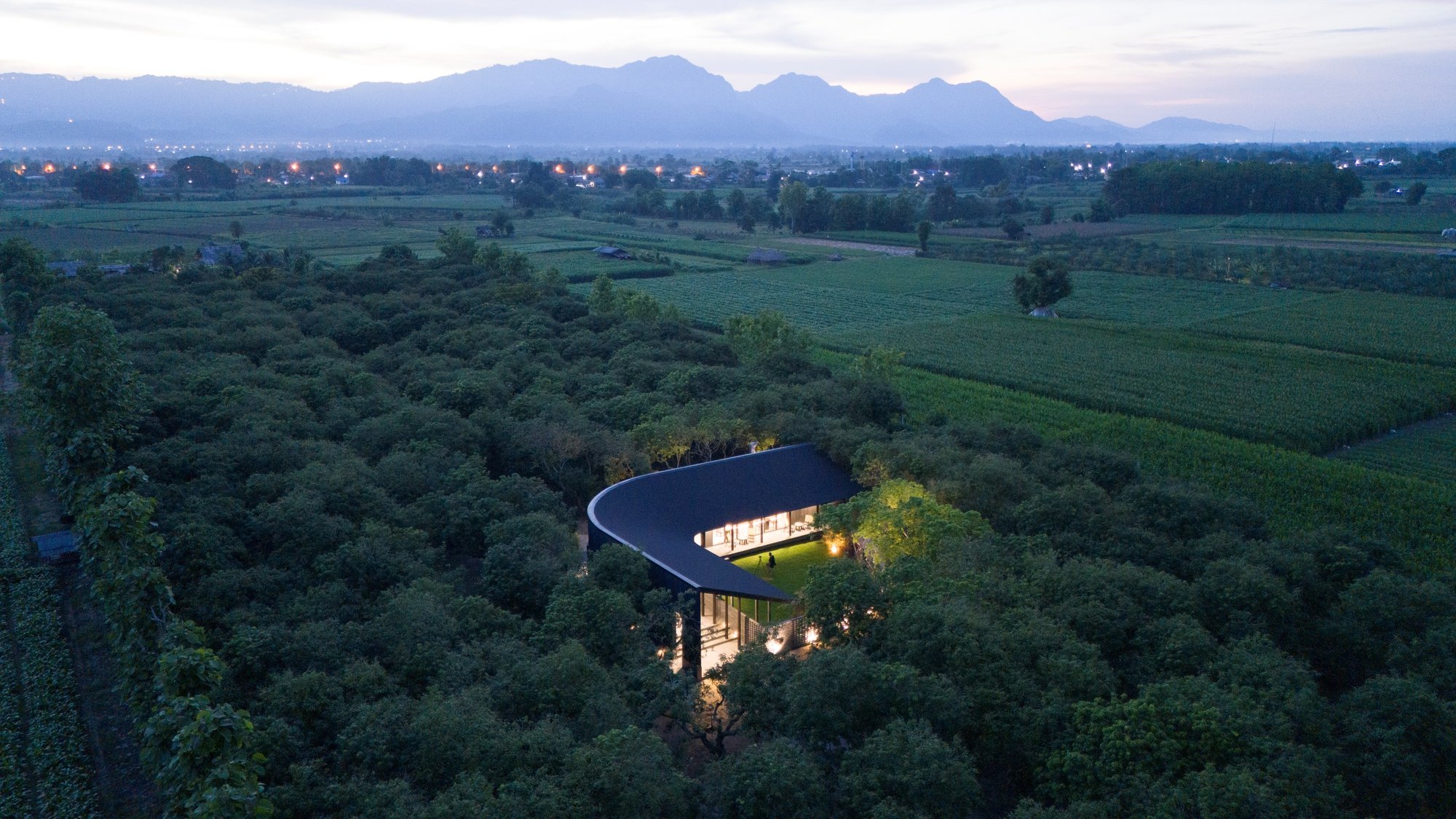
Cafe MADA: A Chiang Rai Pavilion in a Mango Orchard
BodinChapa Architects threaded a 254 m² black-roofed cafe through an existing mango orchard in Chiang Rai, Thailand, built around mature trees.

Chiang Rai is the northernmost province of Thailand, a region of rice fields, mango orchards, and mountains along the Myanmar and Laos borders. It is one of the more contemplative parts of Southeast Asia, and it does not usually appear in architecture coverage. Cafe MADA in the Little Garden, a 254 square metre pavilion completed in 2025 by BodinChapa Architects, is one of the more thoughtful small buildings to come out of the region in recent years and worth a slower read than a coffee shop usually gets.
The brief was simple and the execution is not. The architects, Bodin Mueanglue and Phitchapa Lothong, were asked to make a sanctuary of tranquillity, an escape from everyday chaos. That is the kind of language that can go badly. It usually means a generic pavilion in a landscape, with some calming materials and a lot of photographs taken at sunset. Cafe MADA does something harder. It threads a low, dark-roofed building through an existing mango orchard and lets the trees, not the building, be the headline.
A Cafe Inside an Orchard
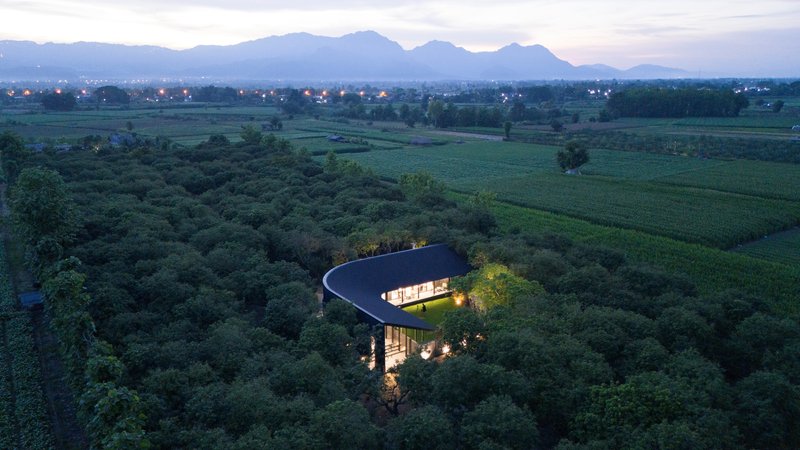
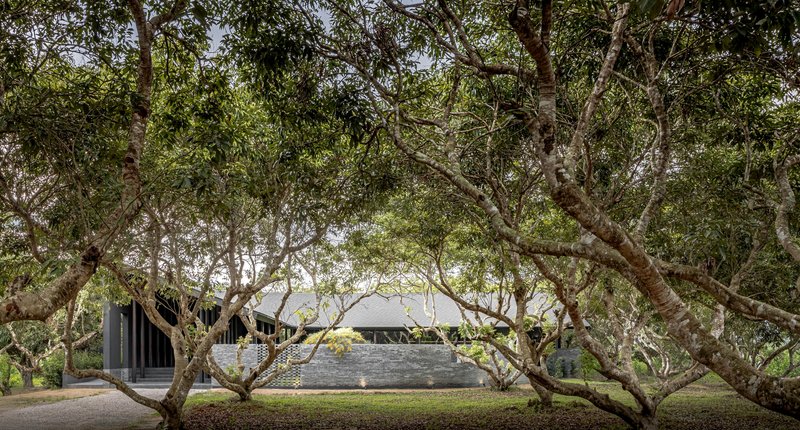
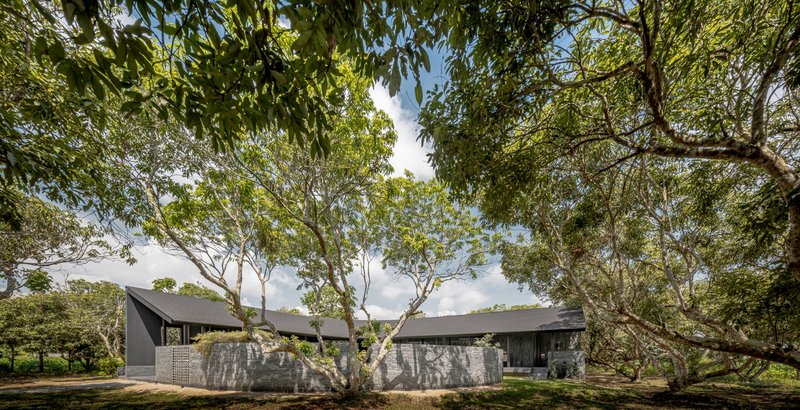
The first thing to notice from the aerial photographs is that the architects did not clear the site. The existing mango trees, with their gnarled trunks and wide branching canopies, were kept exactly where they were. The building winds between them, taking a curving, partly U-shaped plan that ducks around the larger specimens and encloses a central lawn on one side.
This is harder than it sounds. Building around mature trees requires a plan that can accept irregular geometry without feeling compromised, a construction sequence that protects roots, and a client patient enough to accept that the building will be shaped by things other than the ideal floor plate. BodinChapa's answer is to treat the orchard as the primary architectural element and the cafe as a second-order intervention inside it.
The Low Black Roof
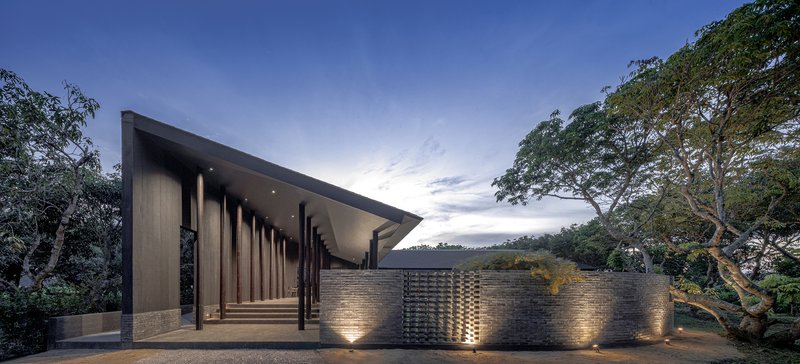
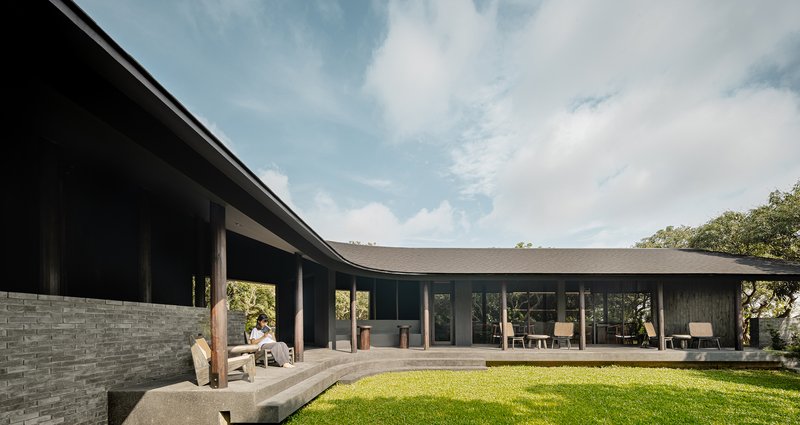
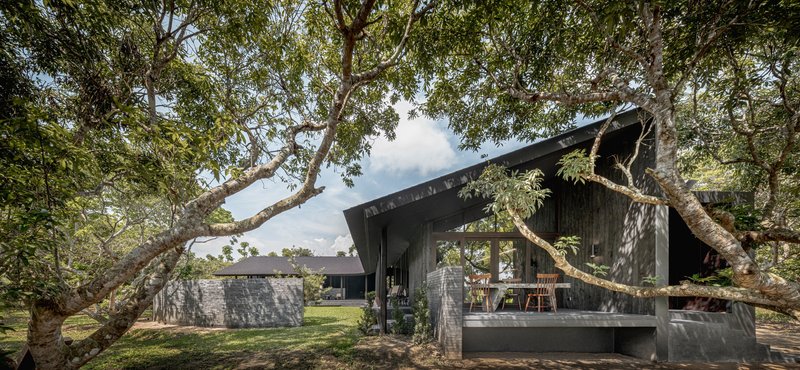
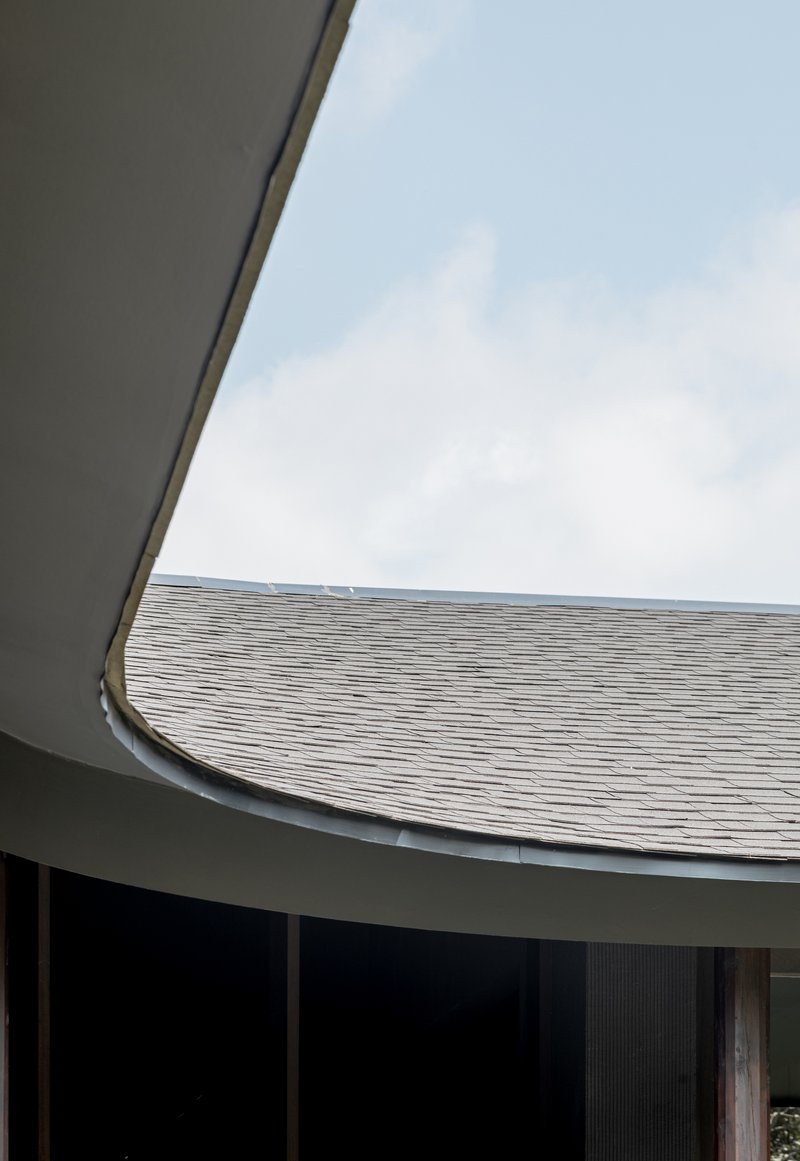
The dominant element of the building is its roof. A low, almost continuous black plane runs along the length of the structure, tilting slightly in different directions and sometimes folding up to meet a pitched tile section. Seen from outside, through the trunks of the mango trees, the roof becomes a long dark line hovering above the ground.
This is a regional move. Thai vernacular architecture leans heavily on low pitched roofs that push the eaves out to protect against sun and monsoon rain. Cafe MADA takes that logic and makes the roof the building's identifying feature, dramatised by the dark colour and the way the eaves lift at key points to frame views out to the garden.
The Colonnade and the Ritual of Arrival
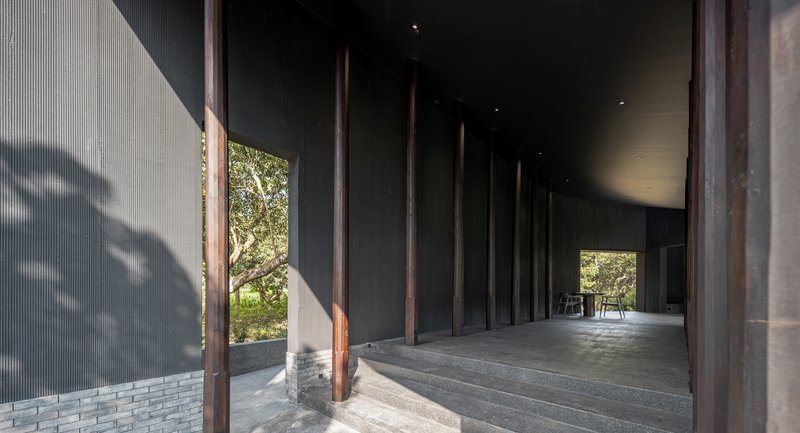
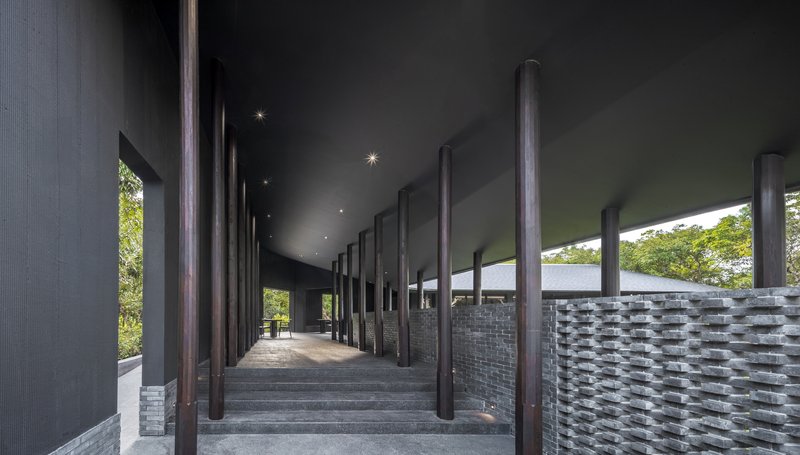
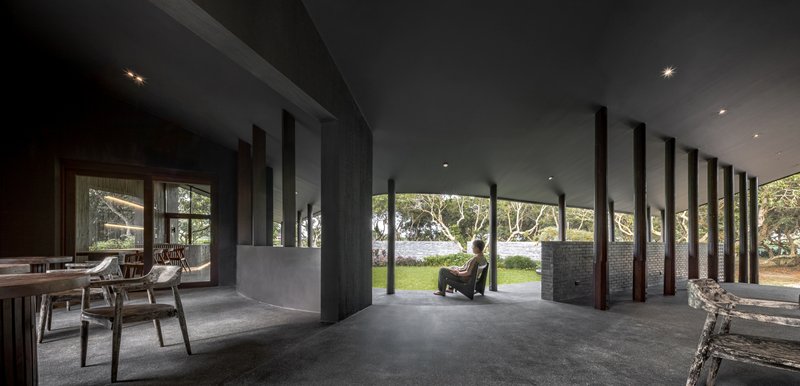
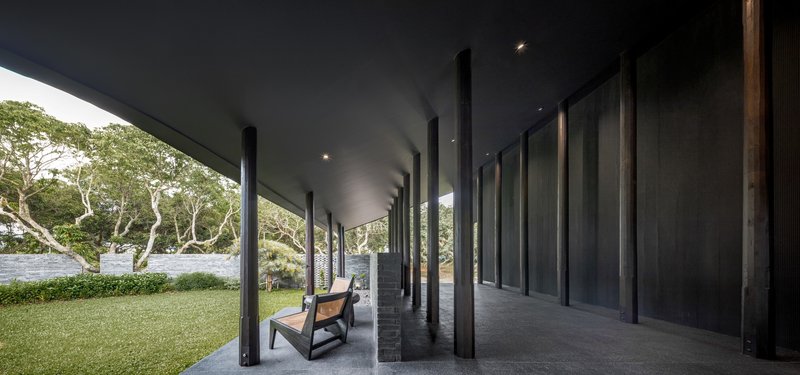
You approach the cafe through a covered walkway that runs under the roof on one of the long sides. Tall, dark, slender timber columns line the walkway at close intervals, and a grey brick screen wall runs alongside them at waist height. The space is cool, shaded, and deliberately slow. The architects are not trying to push you into the building quickly.
This colonnade is the project's ritual element. Thailand has a long tradition of extending the approach to temples, halls, and rest houses with covered walkways that slow the visitor and prepare them for the interior. Cafe MADA reuses that device for a secular programme. You walk through the trees, then under the columns, then into the cafe. By the time you sit down, the architecture has already done its work.
Views to the Courtyard
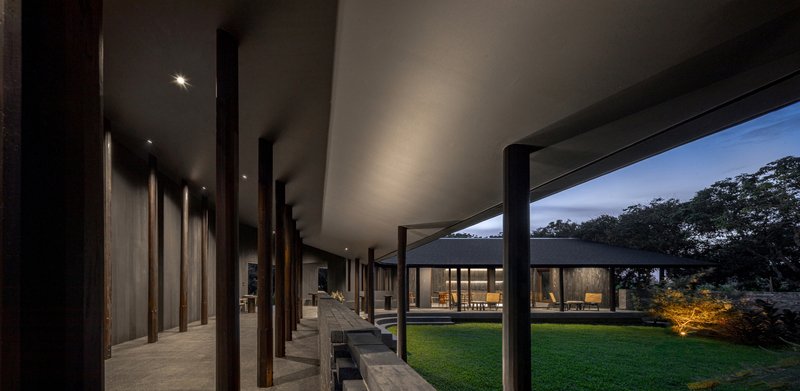
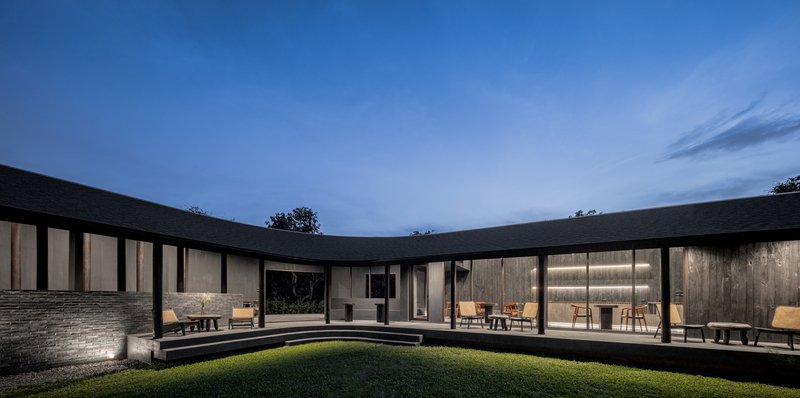
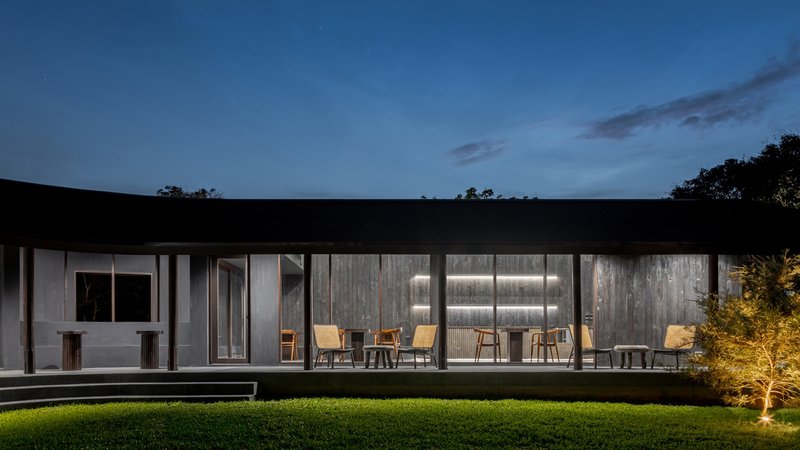
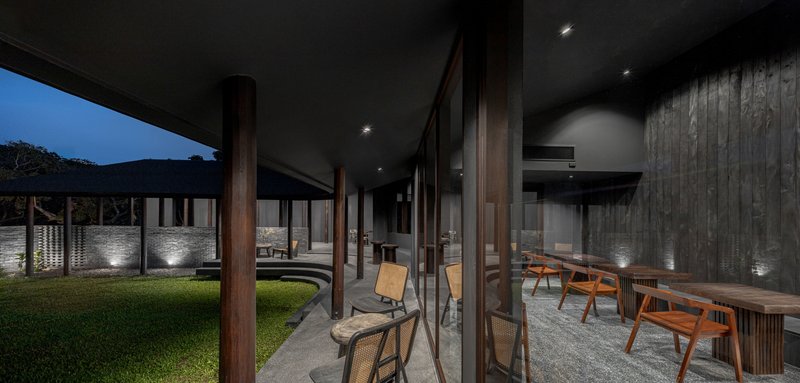
The building's plan wraps loosely around a central grass courtyard. The dining room is glazed on the courtyard side, so customers sit with a direct view out to the lawn and the trees behind it. The covered terrace sits on the opposite side of the lawn, which means that from inside you are always looking across an outdoor room to another outdoor room, with the mango branches framing both.
At night, the whole sequence reverses. The interior glows softly across the lawn, and the colonnade on the far side becomes a line of warmly lit columns reflected in the grass. This is one of the project's best moments, and it is earned by the plan rather than by lighting tricks.
Material Detail and Interior Warmth
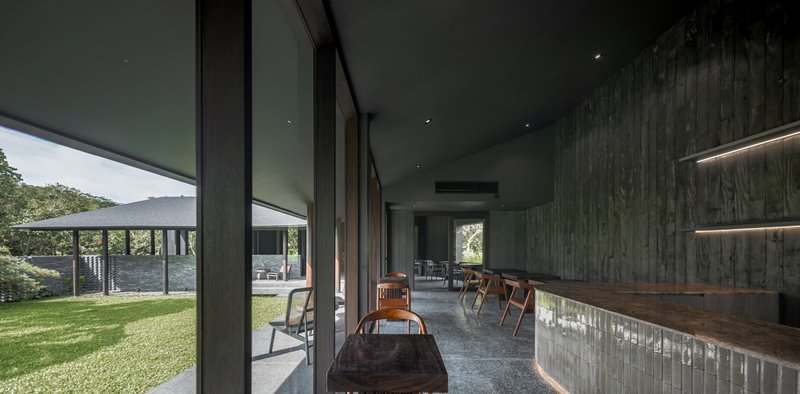
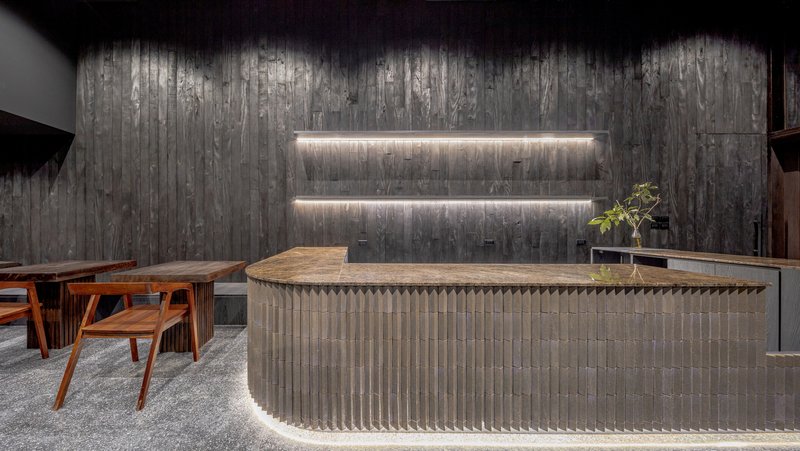
Inside, the material palette shifts from the dark exterior to something quieter. A bar counter clad in fluted grey brick by Ayothaya Tile and Brick is topped with a honed stone surface and backed by a wall of dark timber boards with recessed linear lighting. The dining tables are honest pieces of solid timber. The seating is a mix of dark hardwood chairs in traditional Thai and Scandinavian profiles.
The restraint here is important. With a cafe of this ambition, there is always a temptation to add a feature light, an accent wall, a bright colour somewhere. Cafe MADA resists all of it. The only saturation in the room comes from the views out to the garden, which means that every time someone looks up from their coffee, they see the trees.
Detail at Close Range
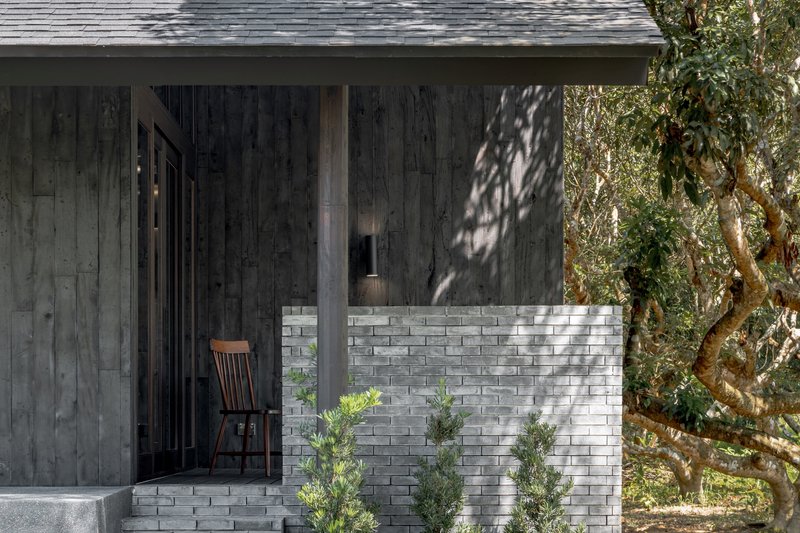
Up close, the construction is cleanly done. The dark timber column bases meet the concrete floor with a simple reveal. The covered terraces have smooth concrete slabs and just enough furniture to invite lingering. The low grey brick screen walls are laid with clean, even joints. A single timber chair on a side porch becomes a small framed vignette on its own.
This is the kind of detailing that only works when every decision is disciplined. You could photograph almost any corner of this building and find a composition that feels considered. That consistency across a 254 square metre project is harder to achieve than most architects admit.
The Round Window and the Punched Openings
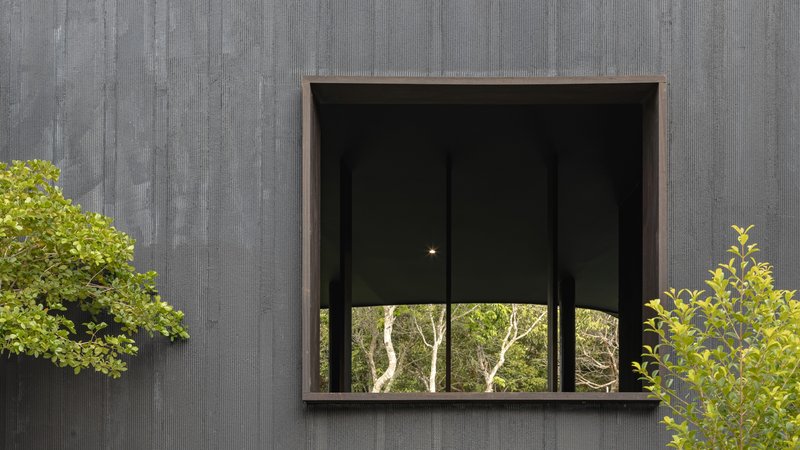
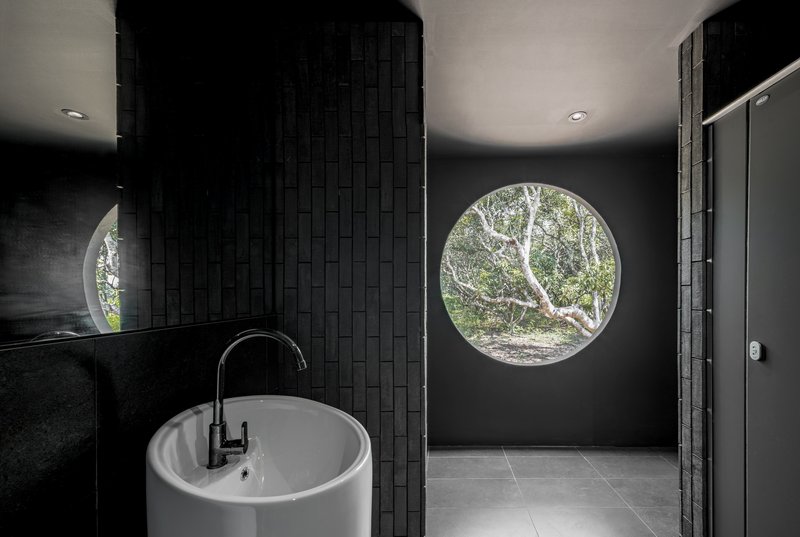
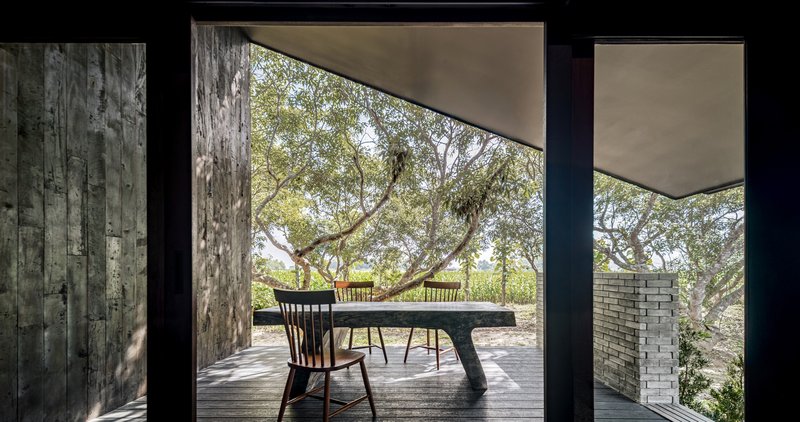
Two of the building's quieter details are worth calling out. The first is a deep-set square window punched into the charred-timber facade: a simple frame around a slice of garden, with the timber reveal doing the work of drawing your eye. The second is a round window in the dark-tiled bathroom that frames the orchard like a painting. Both moments belong to a small catalogue of gestures the project returns to again and again: a frame, a view, a piece of nature made into architecture.
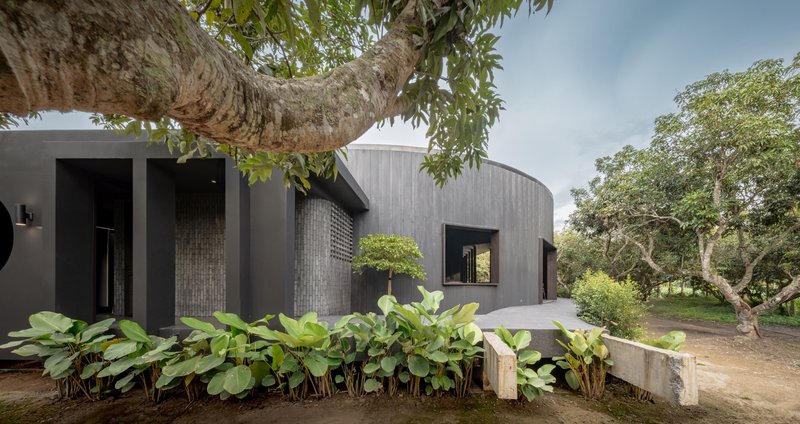
The curving rear wing of the building is another example. Its dark timber cladding follows a gentle arc, and a low concrete planter filled with large-leaf foliage runs along its base. The geometry is not dramatic, but it softens the corner and gives the orchard a reason to continue right up to the wall.
Why This Project Matters
Cafes are the most overexposed building type in contemporary architecture. They have become the default testing ground for every studio that wants to experiment with materials, atmosphere, or new forms. Most of them fail by trying to do too much. Cafe MADA succeeds by doing one thing thoroughly: it inserts a calm, dark, horizontal building into an existing orchard and lets the trees remain the reason to visit.
The lessons are transferable to anyone working on small public buildings in a natural setting. Respect the site. Build around the trees, not through them. Use a single strong roof as the primary architectural gesture. Hold the material palette to two or three families and trust them to do the work. Make the approach as important as the arrival. BodinChapa Architects has produced a small project that is easier to learn from than most, and the photographs by shootative / Witsawarut Kekina show why the argument is worth paying attention to.
Plan and Context
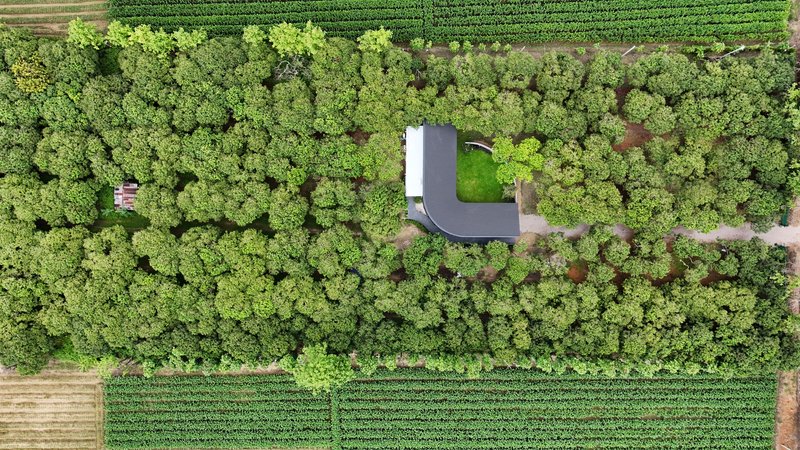
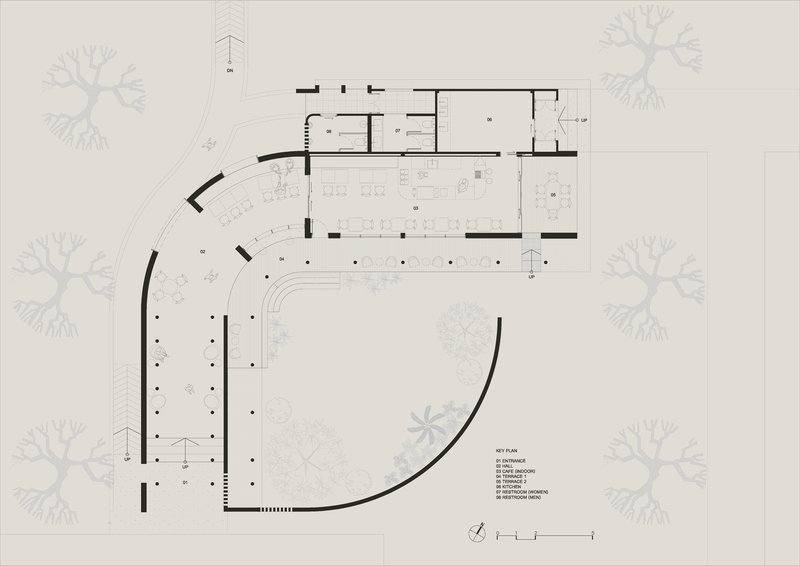
The aerial photograph and the plan together explain the project's most important decision: the building traces a curving L through the existing trees, enclosing a central grass courtyard on one side while preserving the orchard on the others. The plan labels the sequence clearly — entrance, hall, cafe, terraces, kitchen, restrooms — and the long covered walkway that runs the length of the curve becomes the building's circulation spine.
About the Studio
Share Your Own Work on uni.xyz
If you are working on cafes, small public buildings, or garden-led architecture, uni.xyz is a place to publish your work, find collaborators, and enter design competitions.
Project credits: Cafe MADA in the Little Garden by BodinChapa Architects. Chiang Rai, Thailand. 254 m². Completed 2025. Lead architects: Phitchapa Lothong, Bodin Mueanglue. Tile and brick: Ayothaya Tile and Brick. General contractor: Studio Const. Photographs: shootative / Witsawarut Kekina.



Popular Articles
Popular articles from the community

20 Most Popular Office Building Projects of 2025
From biophilic workspaces in India to net-positive energy offices in New Delhi, 20 office building projects that defined architecture in 2025.

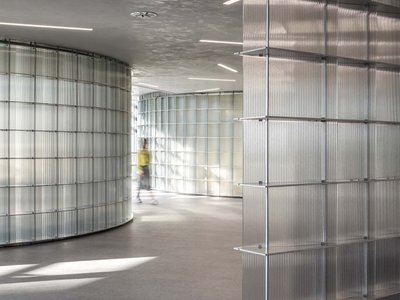
HCCH Studio Wraps a Shanghai High-Rise Office in Curved Walls of Translucent Glass
A 1,000 square meter fit-out in Lujiazui replaces the typical tech-office palette with layered glass, micro-cement, and quiet rigor.
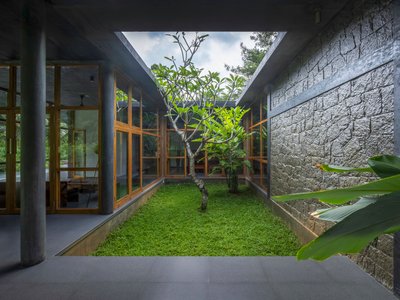
3dor Concepts Wraps a Kerala Home in Mirrored Concrete Arcs Around a Courtyard Tree
In the Western Ghats foothills of Thamarassery, a 270 m² single-story house uses two curved volumes to frame nature as its center.
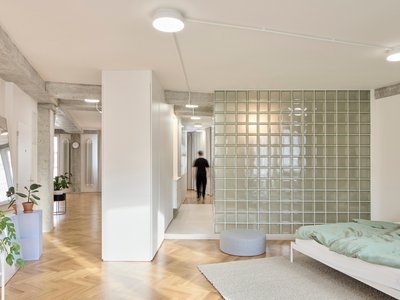
RDTH architekti Rips Out Nearly Every Wall in a Prague Apartment and Replaces Them with Furniture
A 101-square-meter post-war flat in Prague trades rigid partitions for a single rotated furniture block, curtains, and glass concrete.

Similar Reads
You might also enjoy these articles

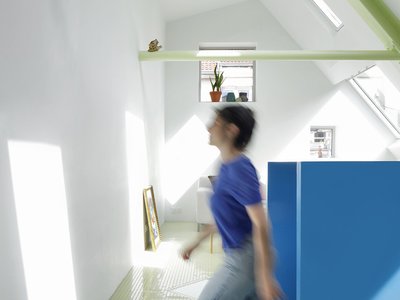
127af Flips a Tiny Bagnolet Rowhouse Upside Down with a Handcrafted Roof Extension
A 55-square-meter terraced house on the edge of Paris gains a luminous upper living floor through lightweight timber and steel.
1.61 Design Workshop Wraps a 600-Square-Meter Café in Vietnam in Sculptural Burgundy Drama
Reden Café & Bistro pairs a helical staircase, mosaic floors, and deep red interiors to rethink Vietnamese hospitality space.
The Unbound Brain: A School Shaped by Cognitive Architecture
Cylindrical learning pods radiate like neurons from a central cortex, turning the floor plan into a spatial model of human thought.
Revival Vernacular Architecture: Rammed Earth Settlements for the Sahara
A modular desert community in Mauritania that fuses passive cooling techniques with earthen construction and local craftsmanship.
Explore Commercial Buildings Competitions
Discover active competitions in this discipline




The Global Benchmark for Architecture Dissertation Awards


Challenge to design a portable theatre


Challenge to design a portable music platform

Challenge to design an open learning module for the elderly
Comments (0)
Please login or sign up to add comments
No comments yet. Be the first to comment!