


Set Design
Design of physical environments for film, television, theatre, and performance productions.
Set design is the design of the physical world in which a play, opera, film or live event takes place: the stage, the scenery, the furniture and props, and the way all of them change during a performance. In theatre it is also called scenic design or scenography, and in film and television the same work is usually called production design.
What is set design?
In theatre, a "set" is everything built or placed on stage to tell the audience where and when the action happens and how it should feel. The reference entry on scenic design defines the field as the creation of scenery for theatrical productions, and notes that in film and television the role is called production design. A set designer works with the director, the lighting and costume designers and the technical team, and has to balance three demands at once: the story, the actors' movement and what the stage, budget and crew can physically handle.
So the meaning of set design goes beyond decoration. A set organises space and time. It decides where entrances are, how far apart two characters stand, what the audience sees first and how a scene change happens in eight seconds rather than eighty. That is why the discipline sits so close to architecture and interior design, and why many set designers train as architects.
"A set designer is responsible for creating a world for stories to exist on stage."
Set design overlaps with scenography, a broader term that usually covers the whole visual and spatial composition of a performance, including light, sound and costume, and with exhibition design, which uses the same tools to stage objects rather than actors.
A short history of set design
The history of scenic design is usually traced back to the outdoor amphitheatres of ancient Greece. The next big shift came in the Renaissance, when painters and architects learned to draw convincing perspective and brought the illusion of depth onto the stage.
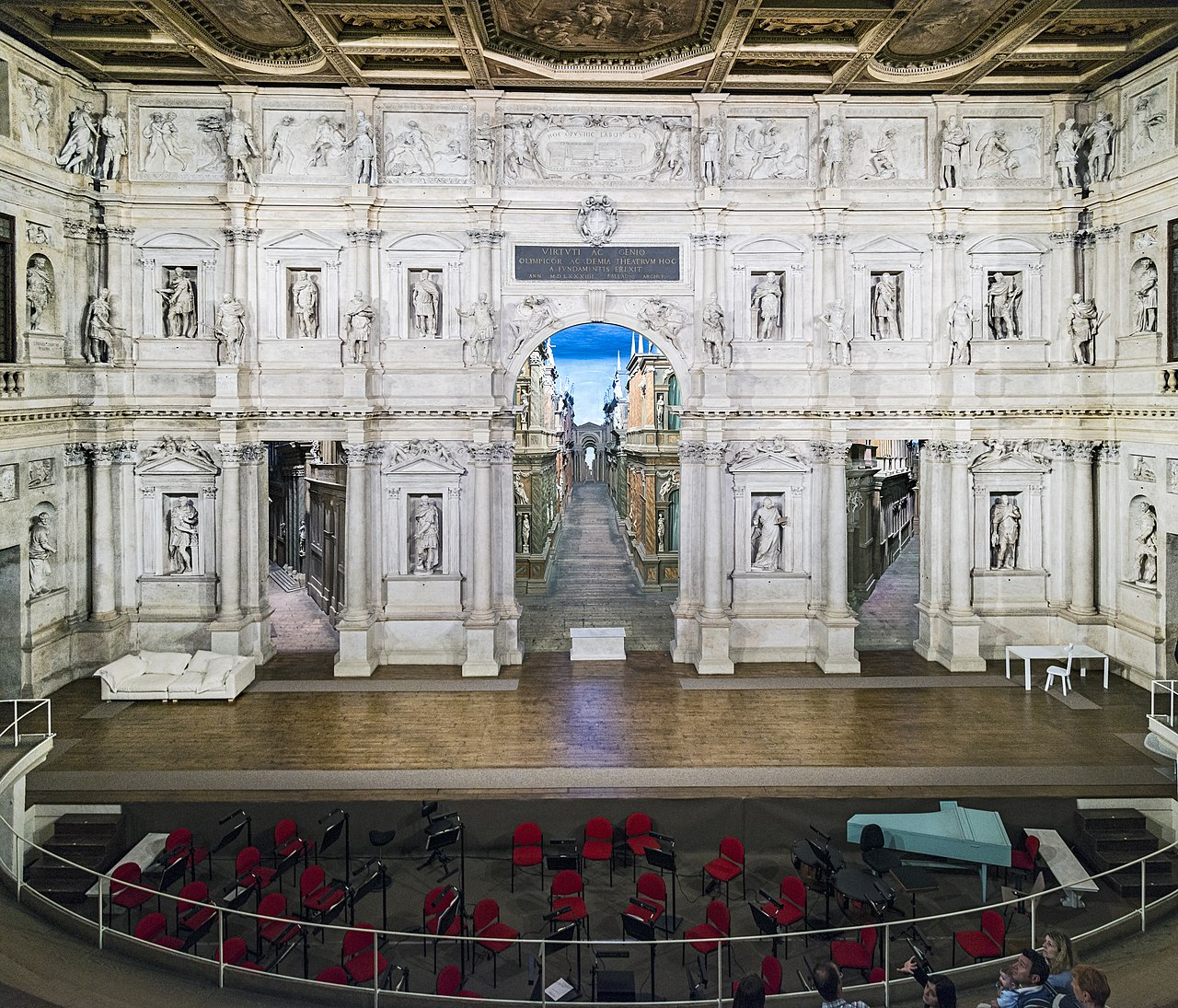
The finest surviving example is the Teatro Olimpico in Vicenza, built between 1580 and 1585 to Andrea Palladio's final design. After Palladio's death, Vincenzo Scamozzi added trompe-l'oeil streets of ancient Thebes that seem to recede to a distant horizon. That scenery is the oldest surviving stage set still in existence, and the theatre has been part of a UNESCO World Heritage Site since 1994.
For centuries afterwards much scenery was painted: flat canvas wings and backdrops that slid on and off to change the location. In the nineteenth century, realist drama needed real rooms, and the box set appeared: three solid walls with the proscenium opening acting as an invisible fourth wall. Its introduction is traditionally credited to the actress and manager Elizabeth Vestris, and it became central to realist plays such as Ibsen's A Doll's House and Chekhov's The Seagull.
Around 1900 two European pioneers, Adolphe Appia and Edward Gordon Craig, changed the direction of stage design. Their drawings replaced painted detail with simple masses, steps and light, and their ideas fed the New Stagecraft movement in early twentieth-century America.

In the twentieth century the Czech designer Josef Svoboda, who saw himself as a scenographer rather than a designer, combined live actors with filmed projections in the Laterna Magika productions for Expo 58 in Brussels, opening the way to the projection and video sets common today.
Types of set design in theatre
There is no official list, but designers and teachers tend to group sets by how they handle place and change. These are the types you will meet most often.
Box set
A realistic room with three walls and practical doors and windows, seen through the missing fourth wall. It suits domestic drama and television sitcoms, where the whole story happens in one or two rooms.

Unit set
A single architectural structure, often of stairs, platforms and openings, that stays on stage all night and becomes different places through small changes of furniture, light and use. It is efficient for plays with many short scenes.
Multiple and wagon sets
Several complete settings built on rolling platforms (wagons), turntables (revolves) or flown pieces, so whole scenes can move in and out quickly. Musicals and opera rely on them.
Permanent set
A fixed architectural setting that does not change during the production, or even between productions, as at the Teatro Olimpico. Open-air and festival stages often work this way.
Minimal or abstract set
A few elements, or an almost empty stage, that suggest rather than describe. A well-known example is Ralph Koltai's set model for As You Like It (National Theatre Company at the Old Vic, 1967), built of perspex, acetate, paint, plastic and wood, which implied the location instead of recreating it realistically. The V&A's gallery label sums up the approach.
"A theatrical reality can be created with symbols and abstract forms."
V&A gallery label for Ralph Koltai's As You Like It set model (1967)

Projection and digital sets
Projected images, LED walls and video replace or overlay built scenery, so a location can change instantly. This is the lineage of Svoboda's experiments, and it now meets virtual and augmented reality.
Stage configurations and how they shape the set
Where the audience sits decides as much about a set as any style. A design that works behind a proscenium arch can block half the house on a thrust stage. These are the stage types a set designer meets most often.
Proscenium stage
The audience faces the stage from one side through a frame, the proscenium arch, which acts as a window around the scene. Because everyone looks from roughly the same direction, the designer can use tall walls, backdrops and forced perspective, and hide machinery, flown scenery and waiting actors in the wings and fly space. Box sets and big wagon or revolve changes belong here.
Thrust stage
A thrust stage extends into the audience on three sides and keeps a backstage area at its upstage end. It is the earliest stage type in Western theatre, used in Greek theatres and in the open stages where Shakespeare's plays were performed. Since spectators look from several sides, every piece of scenery needs thought: a high-backed chair can create a blind spot. Designers keep tall elements against the back wall and treat the floor as the main scenic surface.
Arena, or theatre in the round
In theatre in the round, also called arena staging, the audience surrounds the stage and actors enter through the audience or from beneath it. With no backstage and no back wall, set design is typically minimal so that no angle is blocked: low furniture, a designed floor, pieces lowered from above, and light. Ringsail, described below, answers the same problem with a backdrop that rotates for audiences on every side.
Traverse stage
On a traverse stage, also called an alley or catwalk, the audience sits on two sides facing each other. Scenery stays low so it does not block sight lines across the stage, and the opposite bank of spectators becomes part of the backdrop. In some variants the ends of the alley are enlarged to give room for actors and set pieces.
Black box
A black box theatre is a plain square or rectangular room with black walls and a flat black floor, flexible enough to host any of the layouts above. Sets are simple and small and costs are lower, so the choice of configuration becomes part of the design for each production.
Promenade and site-specific
Site-specific theatre is performed somewhere other than a theatre, such as a hotel, courtyard, converted building or forest, and uses the qualities of the place to add depth. In promenade staging the audience stands and walks about, following the performers. The set designer works here like the architect of a route: adapting existing rooms, deciding where crowds stand and move, and adding only what the site lacks. The mobile street stages on uni.xyz belong to this family.
The set design process
Most productions follow the same sequence, even if the time available ranges from weeks to years.
- Script analysis. Reading the text for every location, entrance, prop and change of mood, and agreeing a concept with the director.
- Research. Collecting images of period, place, materials and atmosphere.
- Sketches. Quick drawings and thumbnails to test ideas.
- Model box. A scale model of the stage. Designers often make several models and renderings before the final drawings.
- Technical drawings. Floor plans, a composite plan of moving pieces and front elevations that the technical director, scenic artists and prop makers build from, now often produced from a 3D CAD model.
- Build and technical rehearsal. Workshops build and paint the set, and the designer adjusts it on stage with light and actors.

The model is where most decisions are actually made. Director, actors, lighting designer and workshop can all look at the same miniature stage, test sightlines and scene changes, and agree on what will be built before any money is spent on full-size scenery.
Set design for film and television
On screen, the set is designed for the camera, not for spectators in fixed seats. The head of the department is the production designer, responsible for the overall look of a film or series: its tone, setting, period and locations. The production designer works directly with the director, cinematographer and producer, while the art director runs the art department of concept artists, set designers, draftspeople, prop makers and set builders, and the set decorator dresses each set. The title dates from Gone with the Wind, when producer David O. Selznick coined it to describe William Cameron Menzies' contribution. Ken Adam's War Room for Dr. Strangelove (1964) is one of the best-known film sets.
Studio builds and locations
A sound stage is a large soundproof building with big doors and high ceilings, where interiors are built so dialogue can be recorded with the picture. Exterior streets and facades go on the studio backlot, whose permanent sets can be dressed to suggest almost any period or city. The alternative is location shooting in a real place, which may be the actual setting or a stand-in: Amadeus, set mainly in Vienna, was filmed in Prague. On location the designer's work shifts to finding, altering and dressing buildings that already exist.
Virtual production and LED volumes
On-set virtual production surrounds actors and physical sets with LED panels showing computer-generated backgrounds in real time. It spread after the first season of The Mandalorian (2019), shot on Industrial Light & Magic's StageCraft stage, known as the Volume, using Epic Games' Unreal Engine. Unlike a green screen, the wall lets actors see their surroundings, lights them realistically and can be realigned as the camera moves. For the designer the set splits in two: a built foreground of floor, props and pieces the actors touch, and a digital environment that has to match it in scale, colour and light.
Set design on uni.xyz
Set design on uni.xyz is a small but specific body of work. Members come at it from architecture, so their sets tend to be built objects that move through the city rather than painted rooms behind a proscenium.
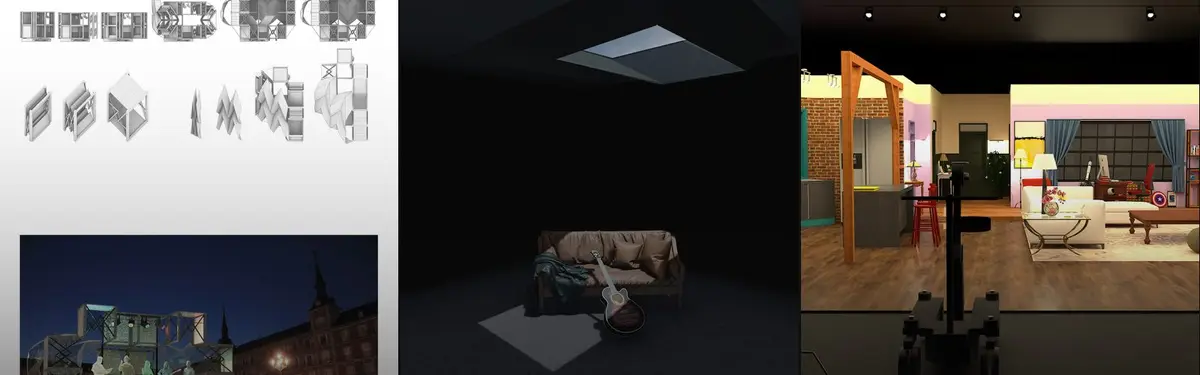
The One with Sheldon by ChiCheng Vong, a winning entry in The one with Sheldon competition, reimagines the Friends apartment when Sheldon Cooper from The Big Bang Theory moves in with Monica and Rachel. It is a neat exercise in set design for television: the room has to describe three characters before anyone speaks. Aishwarya Subramanian's version, an Editor's Choice entry in the same competition, uses the set to show the quirks the two roommates share and do not.

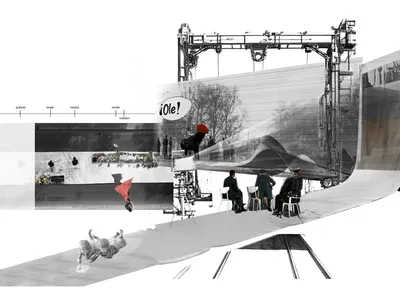
The Madrid Art Bioscope competition produced a cluster of mobile stages for street performers. Blank Canvas by Anthony Ramirez, which won a People's Choice Award there, drapes a canvas across the street that recalls a red carpet, a theatre curtain and a cinema screen. A cart with extendable rails and a pulley lets it shift from a horizontal stage to an upright surface, and the design stays deliberately minimal so the symbol does the work.

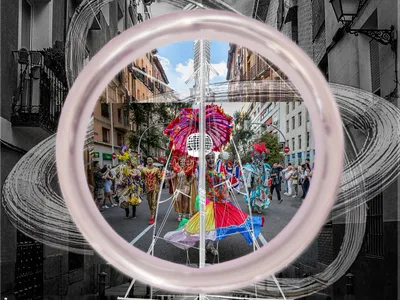
Ringsail by Yannet Mercado is a portable theatre whose ring-shaped sail rotates behind the performers, so the backdrop changes as audiences gather on every side. Caja de Maravillas by Angela Uribe and Alexis Escobar folds into a compact box for transport and opens into a stage, while Azure Wave by Tobias Maiden is a system of modular platforms that can be set at different configurations and angles.

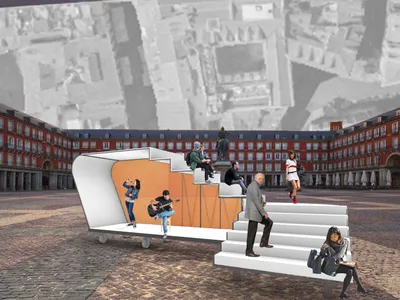
Our feature on Ascension Scope reads Naomi Molina's stair modules as part bleacher, part podium: there is no fixed front or back, so audience and performers can swap places. The Interfusion by Ömer Seçim and Barkin Karabas, entered in the Opera Truck competition, sets out to fuse the street with art and to develop the relationship between art and its observer.
The richest essay on the topic is Serra Katırcıoğlu's Spatial Fiction and the Gazing Eye, which argues that cinema and architecture share one aim, drawing on Juhani Pallasmaa's idea of "lived spaces", and that the architect is now a director of atmosphere.
"The architect is, in fact, a secret screenwriter who choreographs the daily life of users, directing human movement through voids and masses."
Serra Katırcıoğlu, Spatial Fiction and the Gazing Eye
Challenges and future directions
Sets are temporary by nature, and that is their biggest problem. A production can need tonnes of timber, steel and paint for a run of a few weeks, and much of it is skipped afterwards. Theatres are responding with stock scenery reused across shows, modular systems, recyclable materials and designs planned for disassembly from the first sketch.
Technology is the second pressure. LED walls, projection mapping and real-time game engines let a set change as fast as a camera cut, and film studios now shoot actors in front of digital backgrounds instead of built locations. The craft question is how to keep the physical, touchable quality that makes live performance different from a screen.
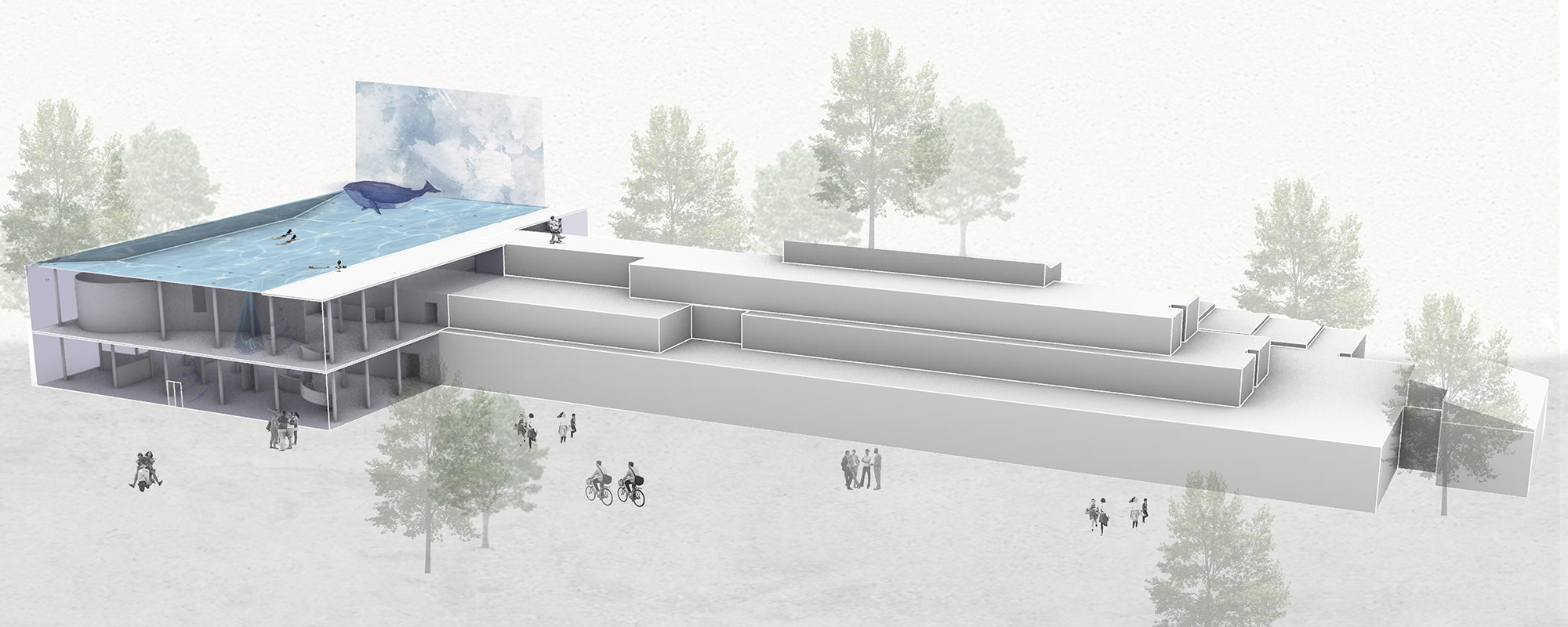
FDA2044 by Jelena Lekovic, entered in the Bauhaus Neue competition, imagines a new school attached to the Faculty of Drama Arts at the University of Belgrade, built around VR and AR technology in scenography: a sign that training is changing as fast as the stage.
Set design for students and designers
Architecture students make strong set designers because they already think in plan, section and sequence. A good thesis angle treats the set as architecture with a script: a mobile stage that turns a plaza into a theatre, a reusable unit set for a touring company, a sitcom room designed from the characters outward, or a hybrid of built scenery and projection. Build a model early and photograph it at eye level, the way the audience will see it. Related topics on uni.xyz include performing arts, lighting design and open-air theatre, and you can find live briefs on our design competitions page.
Frequently asked questions
What is the meaning of set design?
Set design means designing the physical environment of a performance or film: the stage, scenery, furniture and props, and how they change from scene to scene. In film and television it is usually called production design.
What is a set in theatre?
A set is everything built or placed on the stage to show where and when the action happens, from walls, platforms and backdrops to doors, stairs and furniture. It also shapes how actors move and how scenes change.
What are the types of set design in theatre?
Set design is grouped two ways. By set type, the common kinds are the box set, unit set, multiple or wagon sets, permanent set, minimal or abstract set and projection or digital sets. By stage type, sets are shaped by the configuration they are built for: proscenium, thrust, arena (in the round), traverse, black box and promenade or site-specific. Most productions combine one of each.
What does a set designer do?
A set designer reads the script, agrees a concept with the director, researches, sketches, builds a scale model and produces technical drawings for the workshop, then refines the set during technical rehearsals.
How is set design for film different from theatre?
A film set only has to work from the camera's viewpoint, shot by shot, and can be a studio build, a dressed real location or an LED volume. A theatre set must work live, from every seat, for the whole run, and change in front of the audience.
Is set design the same as scenography?
They overlap. Set design usually means the scenery itself, while scenography often covers the whole visual and spatial composition of a show, including light, sound and costume.
References and further reading
- Scenic design, Wikipedia
- Teatro Olimpico, Wikipedia
- Box set (theatre), Wikipedia
- Josef Svoboda, Wikipedia
- Thrust stage, Wikipedia
- Theatre in the round, Wikipedia
- Production designer, Wikipedia
- On-set virtual production, Wikipedia
- Express yourself through set-design, Young V&A
- Set model for As You Like It, Ralph Koltai (1967), Victoria and Albert Museum


Open competitions in Set Design
See all Set Design competitions

Popular projects
View all 13 projects


Latest journals
View all 6 journals

SPATIAL FICTION AND THE GAZING EYE: A NEW READING AT THE INTERSECTION OF CINEMA AND ARCHITECTURE
Through 'The Gazing Eye,' this essay redefines space as an active subject, arguing the architect is now a director of atmosphere.

Ascension Scope: A Portable Staircase That Becomes a Stage
Naomi Molina's modular theater unit transforms urban streets and plazas into impromptu performance venues through reconfigurable stair sections.
Ringsail: Playful Waves of Madrid
Portable theater designed for vibrant street performances, seamlessly blending art and community in the heart of the city.
Blank Canvas
Radicalizing public performance by taking back the streets


