


Urban Ecology
Design and planning work that integrates ecological systems, habitat, and resilience into dense urban environments.
Urban ecology is the study of cities as ecosystems: how plants, animals, water, soil, climate and people interact in places that humans have built and keep rebuilding. For architects, landscape architects and planners, it is also a design brief, because every roof, street, plot and riverbank either supports those living systems or cuts them off.
What is urban ecology?
The term covers two traditions that share a name and little else. The older one comes from sociology: in the 1920s, researchers at the University of Chicago borrowed ideas from plant ecology to explain how neighbourhoods form and change. The newer one is ecology in the strict sense, the science of organisms and their environment, applied to streets, parks, vacant lots and rivers. When a designer says "urban ecology" today, they almost always mean the second.
"Sometimes people trace urban ecology in the US to the Chicago School in the 1920s at the University of Chicago. In reality, that intellectual tradition was sociological in nature."
Within the ecological strand there are two scales of attention. One looks at habitats and species inside the urban area: which birds nest on which roofs, which plants colonise which lots. The other treats the whole city, people included, as one system. The Baltimore Ecosystem Study, for example, is described by the Cary Institute as investigating the ecological, cultural and economic forces that shape the environmental quality of urbanized areas. The second view is the more useful one for design, because it puts buildings and infrastructure inside the ecosystem instead of outside it.
Urban ecology overlaps with several neighbouring fields on uni.xyz. Green infrastructure is the planned network of parks, street trees and drainage landscapes that puts ecological knowledge to work, and sustainable urbanism deals with density, transport and energy at city scale. Urban ecology is the science underneath both: it asks what actually lives in a city, why, and what changes when we build.
A short history of urban ecology
The sociological strand begins with The City (1925) by Robert E. Park, Ernest W. Burgess and Roderick D. McKenzie. Burgess's chapter proposed that a city grows outward from its centre in concentric zones, from the business district through a "zone in transition" to residential rings and commuter suburbs. Park framed the whole book in ecological terms.
"It is involved in the vital processes of the people who compose it; it is a product of nature, and particularly of human nature."
The biological strand took longer. According to the overview of urban ecology on Wikipedia, ecologists mostly ignored cities until the 1970s. Among the first studies to treat the city as its own ecological subject was Herbert Sukopp's 1979 article on the soil, flora and vegetation of Berlin's wastelands. The idea that derelict, unplanned ground could be worth studying, and even worth protecting, is one of the field's founding insights.

Berlin later turned that insight into a park. The Natur-Park Südgelände occupies the former Tempelhof railway yard and opened to the public in 1999. It is known for its mix of wild nature, decaying railway facilities and art, and as habitat for a large number of plant, animal and insect species, many of them endangered.
In the United States, two cities joined the Long Term Ecological Research network in the late 1990s: Central Arizona-Phoenix and the Baltimore Ecosystem Study. Steward Pickett, the Baltimore study's founding director, is working, according to his Cary Institute profile, to help convert cities and suburbs from ecological liabilities into ecological assets, and the same profile credits that research with building lasting connections between urban designers, policymakers and managers.
Key principles of urban ecology
Urban ecology is a research field, not a style, but its findings settle into a handful of principles that designers can test a project against.
The city is one ecosystem, people included
Water, food, energy and waste move through a city the way nutrients move through a forest. Seeing a site as part of these flows changes the questions a brief asks: where does rain go after it hits this roof, where does this building's organic waste end up, and which species already use the plot before construction starts?
Heat is an ecological problem
Paving and roofs absorb and re-emit more of the sun's heat than vegetation does, and tightly spaced buildings slow the wind that would carry it away. The result is the urban heat island. The US Environmental Protection Agency's review of heat island research reports daytime temperatures in US urban areas about 1 to 7°F higher than in outlying areas. Trees, planted roofs, lighter materials and open water are the main design responses; see urban heat island for more.
Habitat comes in fragments, so connect them
Urban wildlife lives in patches: gardens, rail edges, canal banks, cemeteries. Generalist species, which use a wide range of resources, tend to cope with these uniform, broken-up conditions, while specialists with narrow needs tend not to, so cities lose variety even when they keep plenty of animals. Linking patches through ecological corridors such as rivers, green streets and planted bridges is one of the most direct things a masterplan can do for biodiversity.

Design for coexistence, not just for people
Some member projects set out to share space with a named species. HuLa Village by Duc Chu, Ánh Maii, Kiên Tố Nguyễn and Son Au studies the ecosystem a koala needs and pairs it with modular buildings that change in stages, so that people and koalas learn to live together. It was an Organizer's Choice Award winner in the Haven 2020 competition.

Ecosystem services are the shared language
The United Nations' Millennium Ecosystem Assessment grouped the benefits people obtain from ecosystems into four categories: provisioning (food, water), regulating (climate, disease), supporting (nutrient cycles) and cultural (recreation, meaning). In a city, a wetland that cleans runoff, cools a street and gives children a place to watch birds is delivering three of the four at once, and that is the argument that wins budgets.
Restore with real habitat, at real scale
The UNI Editorial journal on Harbor Wetland by Ayers Saint Gross describes a 10,000 square foot floating wetland in Baltimore's Inner Harbor, planted with more than 30,000 native grasses and shrubs to recreate a salt marsh habitat close to the region's original ecosystem. It shows how restoration can double as a public exhibit.

Urban ecology on uni.xyz
Members working on this topic tend to start from a damaged or overlooked piece of city: a polluted street corner, a degraded waterfront, a residential block with no green ground. The strongest proposals treat that damage as the brief.
Rotate 90°, the most liked project in this topic, is by Asli Ozge Zabun, Pelin Gür, Ecrin Akkaya and hande zabun and received a People's Choice Award in the Live x Learn competition. Sited in Levent, Istanbul, it takes the metro's movement network from horizontal to vertical and aims to produce energy and water in response to global warming.
Mud-Ular Bus Stop by Sule Kipel, Beyza Oktar, Buket Gürbüz and Gökçe Tekin, a People's Choice Award winner in the Better Bus Stop competition, pilots a bus stop for Chandni Chowk in New Delhi built from sustainable materials, with recycling and clean air at the centre of the concept.

Urban Regenerative Design: AGOS Water Hyacinth Research and Development Complex by Frialyn applies industrial ecology, a system that harvests waste as a resource for production, to recover a degraded waterfront.

Among the journals, Productive Organism covers Amod Nargund's thesis for Marve, Malvani on Mumbai's western periphery, a landscape of mangroves, creeks and wetlands under development pressure. Nargund carries landscape-led urbanism down to the wall section and asks a pointed question.
"If development is going to happen anyway, can it become the instrument that repairs the bond between a city and its ecology rather than the force that severs it?"
UNI Editorial, Productive Organism: A Mumbai Thesis That Treats Peripheral Housing as a Tool for Ecological Repair
The journal on the Public Infill Library follows Rachel George's proposal, shortlisted in the Public Architecture '20 competition, for a residential block in Sharjah with almost no green open space. Instead of filling the plot, the library splits it with an incision, sinks a reading room below ground and gives the freed ground back as landscape.

Two more journals push the theme to city scale. ProEixample 4.0, by Paul Strobel, Max Blake and Jochen Schumacher and a winning entry in the Hyperblock competition, asks what should happen to Barcelona's surplus road space once cars leave, and answers with a parametric rulebook and a land trust that decides who builds on the reclaimed ground. A group of cemetery proposals for Shanghai, among them Good Death Best Park in the Hongkou district, turn burial into a source of soil and urban tree canopy.
Challenges and future directions
The first challenge is evidence. Many projects claim ecological benefits that are never measured after opening, while the research programmes in Phoenix and Baltimore were set up to run for years, because much ecological change only shows up over long periods. Designers who partner with ecologists from the start, and budget for monitoring, produce work that can actually be learned from.
The second is equity. Urban ecologists, including researchers at the Cary Institute, increasingly study how segregation shapes who gets environmental risks and who gets benefits in a city, so where ecological investment goes is a social decision as much as a technical one. A park that raises rents until the original residents leave has not repaired much.
The third is space. Dense cities rarely have spare land, which is why so much member work looks for ecological ground in leftovers: road surfaces freed by car-free streets, ground floors opened up by infill, roofs, bridges and even cemeteries.

Looking ahead, climate adaptation is pulling urban ecology from the margins of a project to its core. Cooling, stormwater storage and habitat are increasingly specified together, and the projects that will age best are the ones that let living systems grow and change rather than freezing them into a finished image.
Urban ecology for students and designers
For a thesis, pick a site where ecology and development are already in conflict: a mangrove edge, a buried river, a heat-stressed street, a block without green ground. Map what lives there and how water moves before drawing any building. Then test your design against the four ecosystem service categories and state honestly which ones it improves.

Useful precedents on uni.xyz include the journal on the Chapultepec Environmental Culture Center, which pairs a pavilion with gardens of native plants for environmental education. For related reading, see the urban forest topic, and browse open architecture competitions for briefs that ask for ecological repair.
Frequently asked questions
What is urban ecology in simple terms?
It is the study of how living things, including people, interact with each other and with their environment in cities. It looks at species, habitats, water, soil and climate in places shaped by buildings and infrastructure.
What is the difference between urban ecology and the Chicago School?
The Chicago School was a group of sociologists in the 1920s who used ecological metaphors to describe how human communities sort themselves across a city. Modern urban ecology is a branch of biology and environmental science that studies actual organisms and ecosystems in urban areas.
Why is urban ecology important for architects?
Buildings change temperature, drainage, light and habitat on and around their sites. Understanding urban ecology helps architects reduce heat, manage stormwater, support wildlife and create outdoor spaces people actually use.
What are examples of urban ecology in design?
Floating and constructed wetlands, planted roofs, street trees, river restoration, wildlife corridors and parks made from abandoned rail land such as Berlin's Südgelände are all common examples.
References and further reading
- Urban ecology, Wikipedia
- The City, by Robert E. Park, Ernest W. Burgess and Roderick D. McKenzie (1925), Project Gutenberg
- Dr. Steward T.A. Pickett, Cary Institute of Ecosystem Studies
- Learn About Heat Islands, US Environmental Protection Agency
- Ecosystem service, Wikipedia
- Natur-Park Südgelände, Wikipedia


Popular projects
View all 95 projects


Latest journals
View all 15 journals

Public Infill Library: A Crack Through a Sharjah Block Turns a Tight Plot into Shared Green Ground
Rachel George fragments a library across a dense Sharjah plot, sinking communal reading below ground and wrapping upper floors in a timber screen.

ProEixample 4.0: A Land Trust and a Parametric Rulebook for Barcelona's Leftover Streets
A Hyperblock winner that reads Barcelona through eleven historical layers and turns surplus Eixample road space into commons run by a land trust.
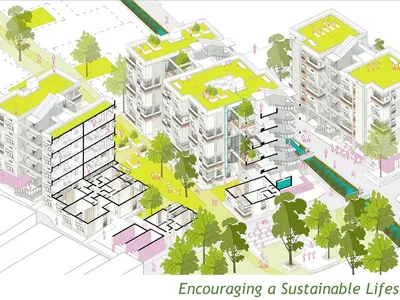
Productive Organism: A Mumbai Thesis That Treats Peripheral Housing as a Tool for Ecological Repair
Amod Nargund's thesis for Marve, Malvani layers mangrove ecology, adaptive housing and water cycles into a habitat that works like a living organism.
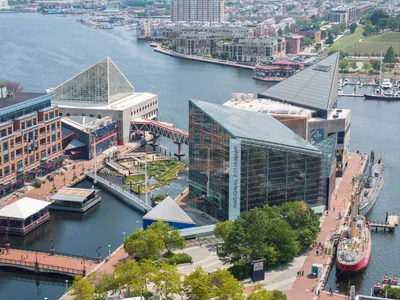
Harbor Wetland by Ayers Saint Gross: Transforming Baltimore’s Inner Harbor Through Sustainable Design
Harbor Wetland by Ayers Saint Gross is a 10,000 ft² sustainable floating wetland in Baltimore, restoring habitats, educating visitors, and promoting urban ecology.


