


Urban Landmark
Architectural works that become recognizable civic landmarks, from bridges and campuses to shelters and research centres.
An urban landmark is a building, structure or public work that gives a city a recognizable identity and anchors how people orient themselves in it. Designers working on landmarks must balance visual presence with daily function, public access and the long lifespan of infrastructure. The form is often shaped as much by how it is crossed, approached or seen from a distance as by its internal program.
Community work under this topic includes pedestrian and cycle bridges, transport links, research and educational campuses, and public shelters. Recurring concerns are how a single structure can connect districts, how light and water can be built into a crossing, and how a sculptural roof or dome can turn an ordinary route into shared public space.


Popular projects
View all 33 projects


Latest journals
View all 64 journals
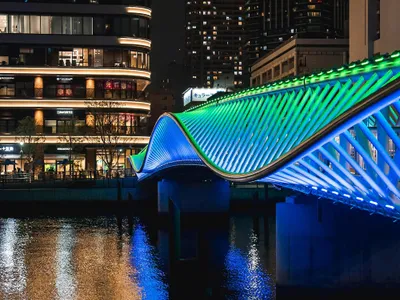
A Pedestrian Bridge That Choreographs Light and Water
Hoshino Architects' Reimei Kobashi footbridge in Tokyo's waterfront district turns infrastructure into a luminous urban landmark.


Hsinchu Biotechnology Research and Incubation Center Phase III by JJP Architects & Planners
Hsinchu Biotechnology Research Center Phase III combines biomimetic design, sustainable energy, flexible labs, and collaborative spaces within Taiwan’s Zhubei Biomedical Park.

School Group Samuel Paty in Béziers: A Contemporary Educational Campus by Ateliers O-S Architectes and NAS Architecture
Samuel Paty School in Béziers features concrete massing, porous courtyards, metal structures, and landscaped playgrounds, creating a child-scaled, light-filled learning environment.

Cephalic Bridge: A Tortoise-Shell Dome That Turns a Copenhagen Crossing into Public Space
A parametric steel and glass shell with a planted inner layer splits cyclists from walkers and stacks a café and lookout above Copenhagen's water.


