
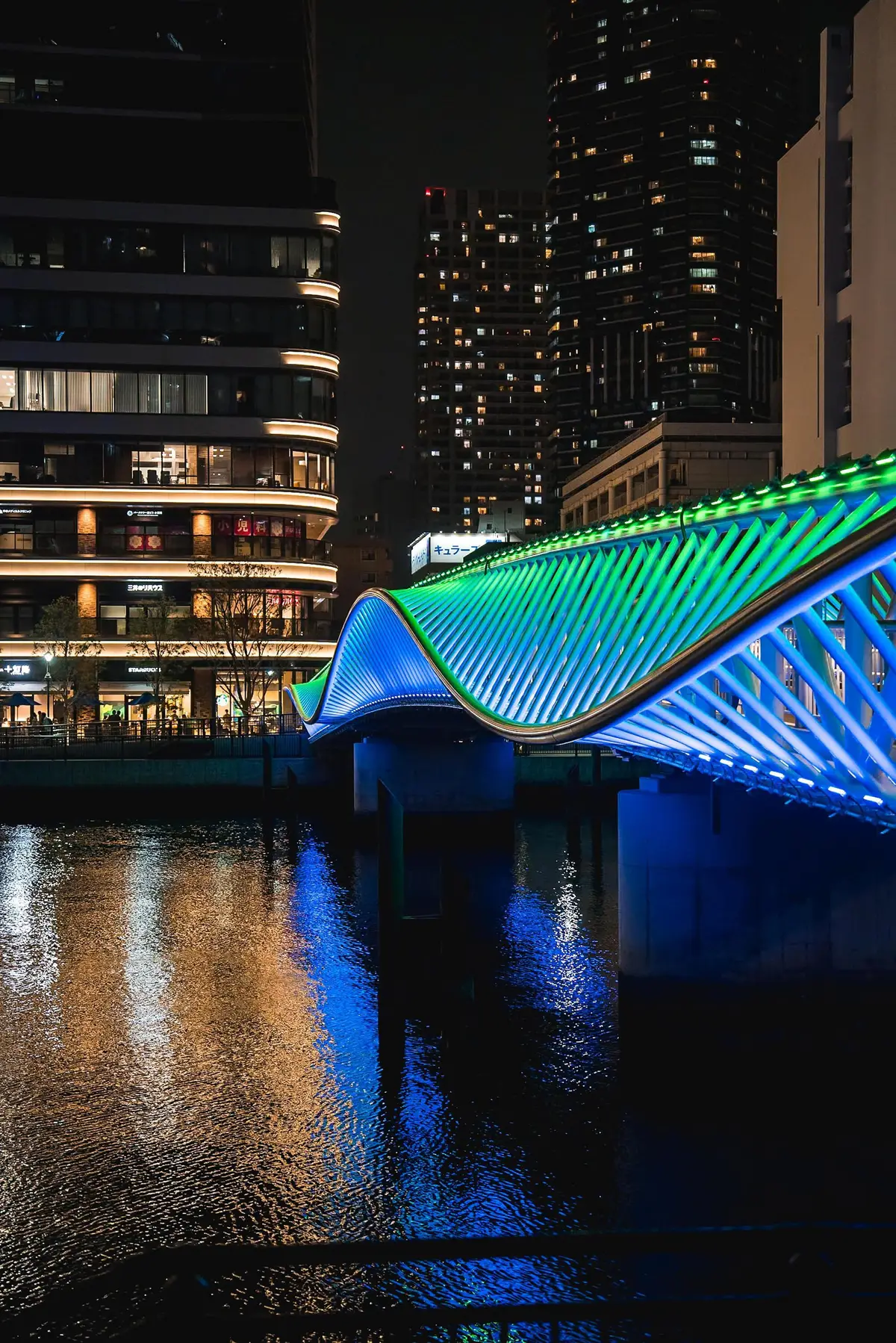
A Pedestrian Bridge That Choreographs Light and Water
Hoshino Architects' Reimei Kobashi footbridge in Tokyo's waterfront district turns infrastructure into a luminous urban landmark.


Tokyo's waterfront has spent decades accumulating towers. What it has lacked, until recently, is the connective tissue that turns a collection of residential slabs into something resembling a neighborhood. The Reimei Kobashi Pedestrian Bridge by Hoshino Architects is exactly that kind of tissue: a 425 square meter footbridge linking Kachidoki Station to the Harumi 3-chome district across a canal, opening to the public in March 2024. On paper it solves a simple mobility problem. In person it does something far more ambitious.
The bridge operates on two registers simultaneously. By day it is a clean, white latticed span with a timber deck, calm enough to disappear into the routine of commuters and cyclists. By night it becomes a slow-moving light installation, its undulating canopy cycling through gradients of color that reflect off the canal surface. Hoshino Architects have essentially designed two bridges occupying the same coordinates, and neither feels like a compromise for the other.
Structural Geometry as Ornament
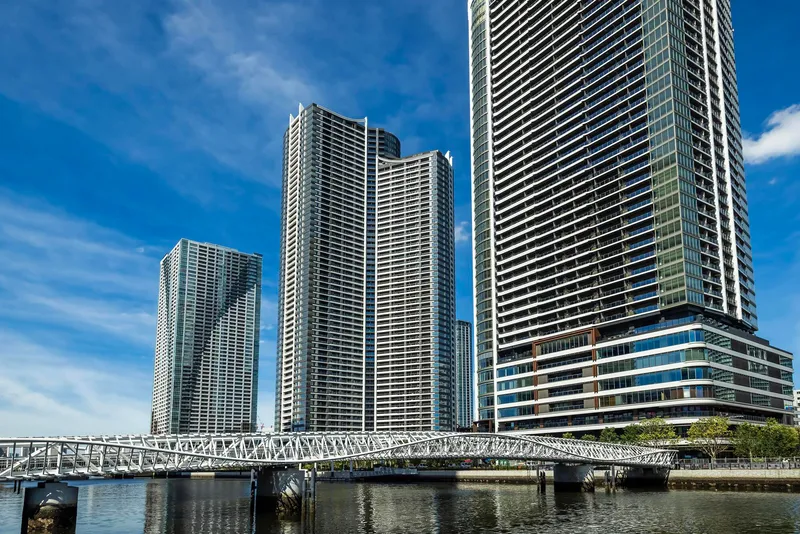


The bridge's triangulated steel truss is not decoration applied to structure; it is the structure. The lattice of tubular members creates a rhythmic pattern that changes dramatically depending on your viewing angle. From the canal level it reads as a dense web of diagonals, while from the deck it opens up into a surprisingly airy envelope. The geometry does double duty, providing both the structural depth needed to span the waterway and the visual permeability that keeps the bridge from feeling like a wall dropped onto the canal.
At the support piers, where the truss meets the concrete foundations, the tubes twist and converge with a legibility that rewards close inspection. There is nothing hidden here. The forces flow visibly through the members, and the connections are detailed with a precision that reflects Japanese structural craft at its best.
The Daytime Bridge


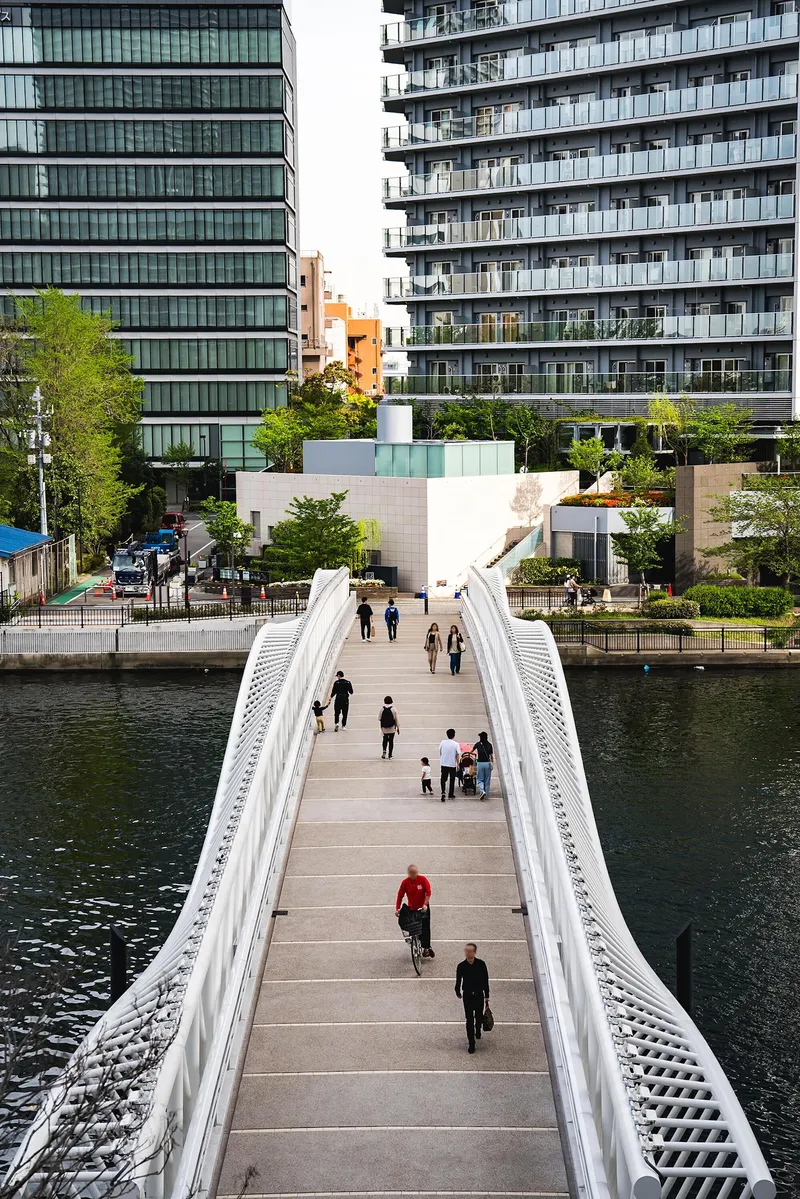
In daylight the bridge belongs to the pedestrians and cyclists who use it. The timber deck is warm underfoot and wide enough to accommodate both modes of movement without conflict. White-painted steel lattice railings filter light and frame views of the canal and the surrounding towers without ever blocking them. Cherry blossoms along the waterfront promenades complete what is essentially a new public room for the neighborhood, suspended over water.
What stands out is the restraint. The white palette, the natural wood, the absence of signage clutter. Hoshino Architects clearly understood that a bridge used daily by commuters needs to recede into routine. It should be pleasant, not demanding. The diagonal lattice provides just enough visual interest to elevate the crossing above the purely functional, but it never shouts.
A Second Life After Dark


The night bridge is a different creature entirely. LED fixtures integrated into the ribbed canopy structure wash the underside of the roof and the truss members with slowly shifting color. Blues, violets, warm whites, and teals cycle through on a choreographed timeline, transforming the bridge into something closer to a public art installation than a piece of transport infrastructure. The undulating profile of the canopy, barely noticeable in daylight, becomes the dominant formal gesture at night, its pleated surface catching and directing light into layered gradients.
The canal amplifies everything. Reflections double the bridge's luminous presence, and passing boats create rippling distortions that no lighting designer could script. It is worth noting how well the bridge frames these incidental moments: the scale of the openings in the truss, the height above the waterline, and the curvature of the span all conspire to make a tourist ferry gliding underneath feel like a scene from a Miyazaki film.
Bridge and Water
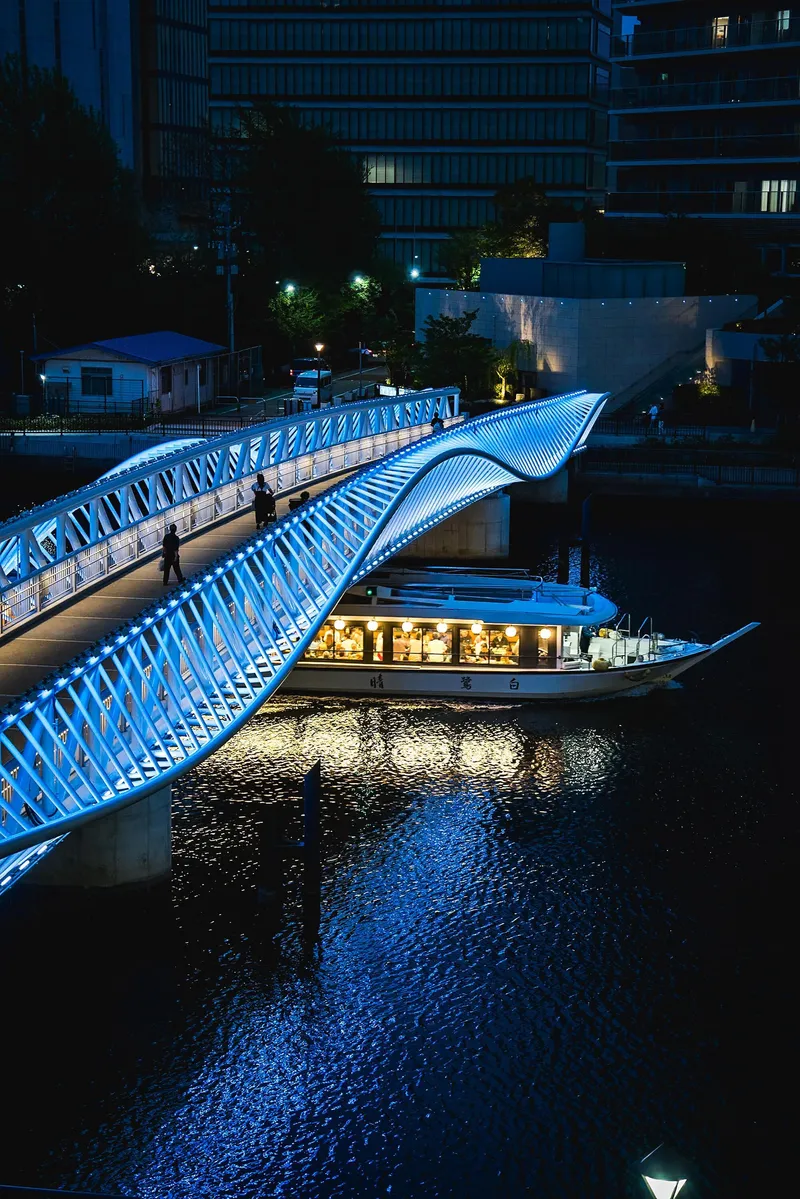


A bridge over water has an obligation to acknowledge its context, and this one does so generously. The clearance beneath the deck allows boat traffic to pass freely, maintaining the canal as an active waterway rather than reducing it to a decorative moat. Spring views from the deck connect the cherry-blossom-lined promenades on either bank into a continuous landscape sequence, and the gentle curve of the span draws the eye along the canal rather than simply across it.
The relationship between the white structure and the dark water beneath it shifts throughout the day. In overcast conditions the bridge nearly dissolves into the sky. At dusk, as lighting begins to activate, the water becomes a second canvas. This is infrastructure designed with a cinematographer's eye for how surfaces interact with ambient light.
Approach and Context
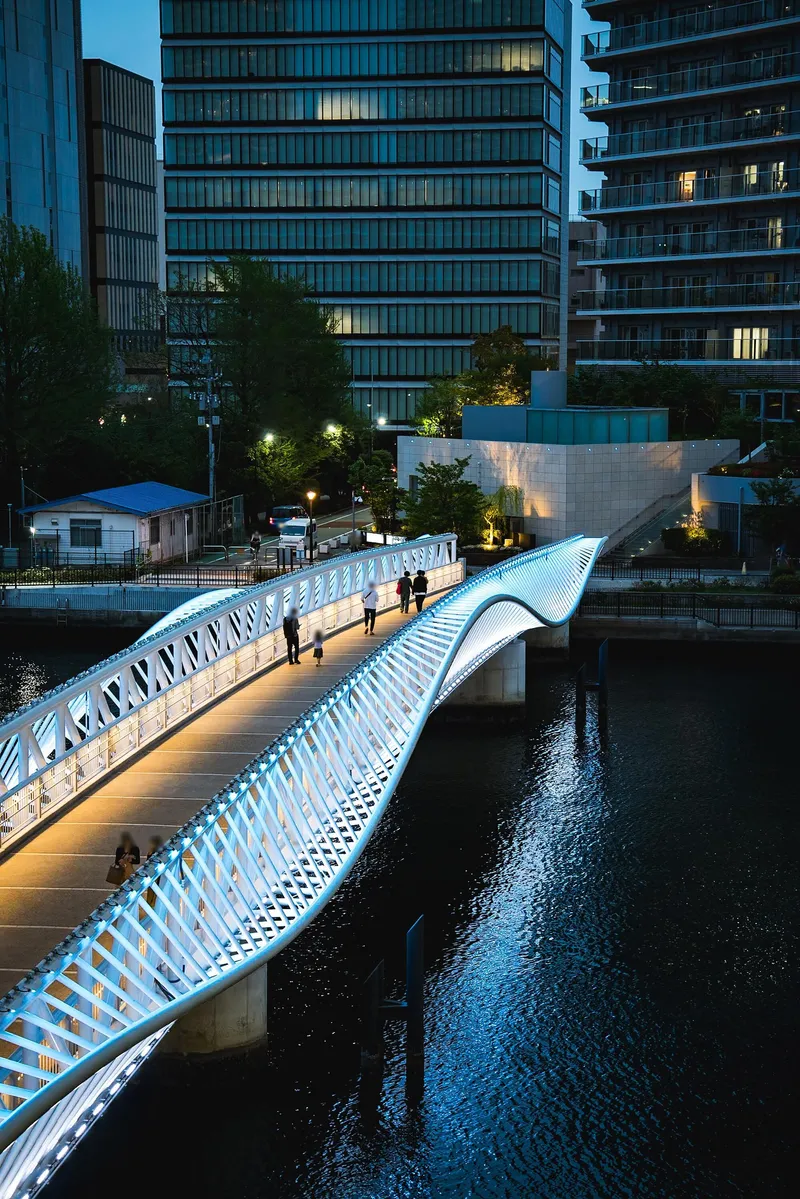

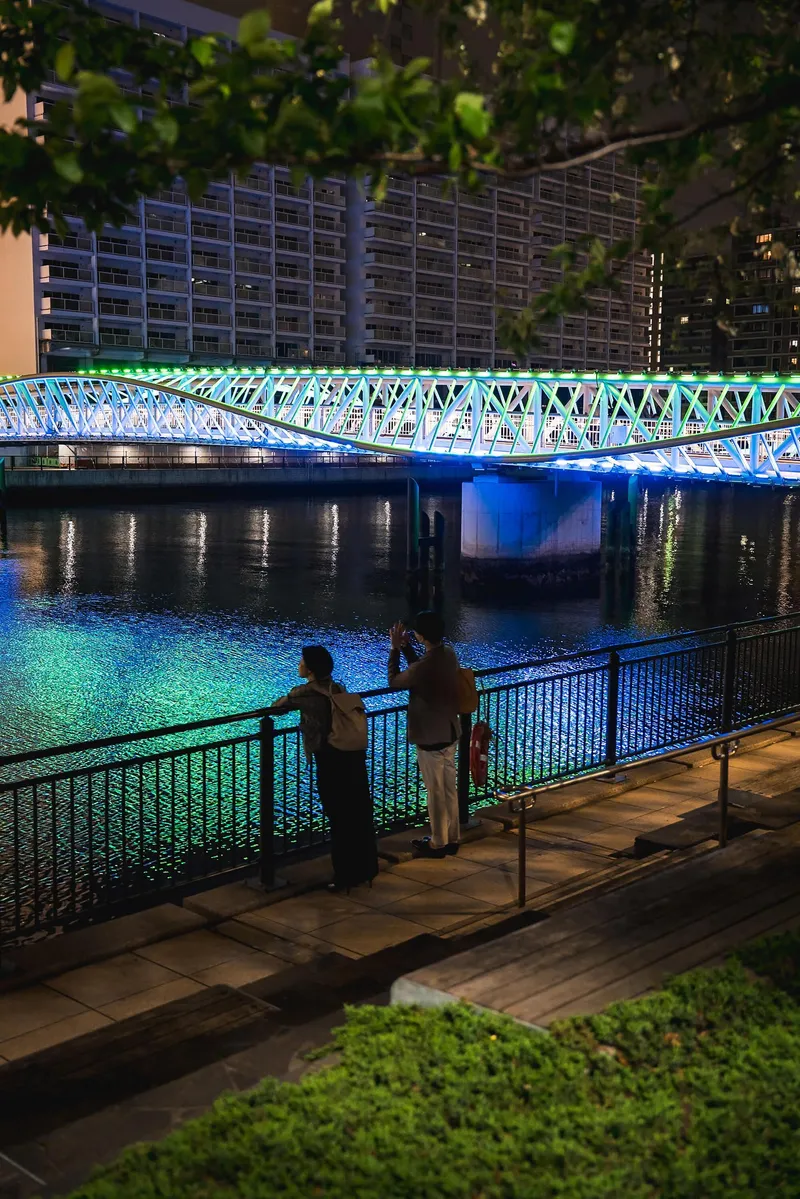
The bridge landings integrate into the existing waterfront promenades on both banks, grounding the structure in a landscape of low plantings and paved walkways. From a distance, the white lattice reads as a singular object against the glass curtain walls of the surrounding residential towers. It is scaled to hold its own without competing, a civic gesture inserted into a context dominated by private development.
Approaching at twilight, with the perforated railings beginning to glow and pedestrians silhouetted against the lit deck, the bridge achieves the kind of urban theatre that cities spend millions chasing with temporary installations. Here it is permanent, functional, and freely accessible.
The Illuminated Canopy Up Close


Seen from the waterfront promenade, the canopy's wavelike profile becomes legible as a series of curved steel ribs that rise and fall along the length of the span. Each rib serves as a mounting point for integrated lighting, creating a continuous luminous surface when viewed from below. The effect is less like a lit bridge and more like a lantern floating above the canal, its glow contained within the depth of the structure rather than projected outward.
The perforated steel panels that form the railing add another layer of texture. At close range, the perforation pattern creates a moiré effect as you walk, subtly animating the boundary between deck and water. It is a detail that costs nothing extra to experience but rewards the attentive pedestrian.
Plans and Drawings



The elevation and section drawings reveal the bridge's structural logic with clarity. The curved deck profile is not merely aesthetic; it accommodates the required navigational clearance at the canal's center while meeting grade on both banks. The truss depth varies accordingly, deepening at mid-span where bending forces are greatest and tapering toward the supports.
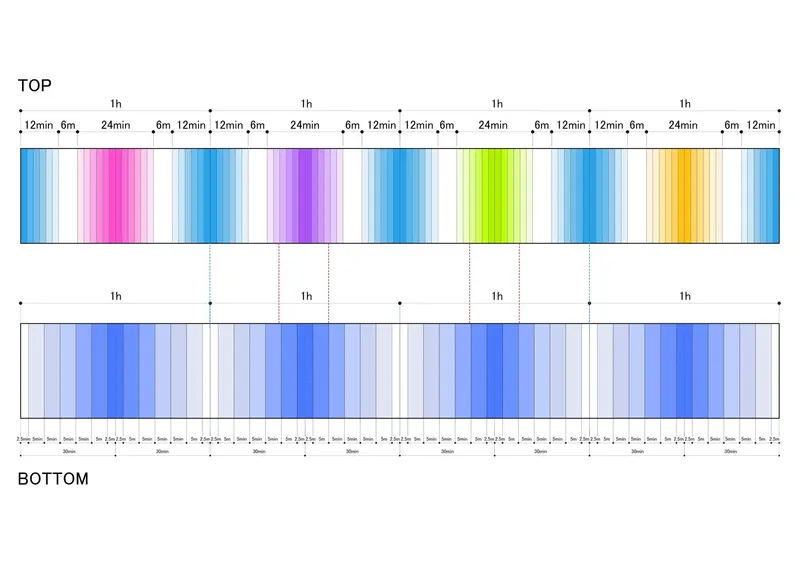
The lighting diagrams are unusually detailed for a bridge project and speak to how seriously Hoshino Architects treated the nocturnal experience as a design problem equal in importance to the structural one. Upper and lower lighting zones operate on independent color cycles, creating layered gradients that shift hourly. The composite diagram showing the full one-hour color sequence reads almost like a musical score, each phase composed to transition smoothly into the next.
Why This Project Matters
Pedestrian bridges rarely receive this level of architectural attention, and when they do the results tend toward spectacle at the expense of daily usability. The Reimei Kobashi bridge manages both. It is a commuter route that thousands of people will cross without thinking twice, and it is simultaneously a landmark that visitors will photograph from boats below. That dual identity is not accidental; it is the product of a design team that understood infrastructure as a cultural act, not just an engineering problem.
In a waterfront district defined by repetitive residential towers and developer-driven urbanism, the bridge introduces something genuinely public and generous. It does not sell anything. It does not gate-keep access. It simply connects two places and, in doing so, gives the neighborhood a center of gravity it previously lacked. For Tokyo's evolving bayfront, that is worth far more than another tower.
Reimei Kobashi Pedestrian Bridge by Hoshino Architects. Tokyo, Japan. 425 m². Completed 2024. Photography by ebi_times and Mitsui Fudosan Residential.
About the Studio
Share Your Own Work on uni.xyz
If projects like this are the kind of work you want to make, uni.xyz is a place to publish your own, find collaborators, and enter design competitions.


Popular Articles
Popular articles from the community


Manzana Morphosis: Stretching Barcelona's Grid into a Living Landscape for 2050
A radical reworking of the Eixample manzana turns density into a tool for generous public space, vertical ecology, and environmental performance.
Extended Shell: Retrofitting Kolkata's Balconies as Living Urban Thresholds
A modular retrofit system recovers the social and environmental intelligence of Kolkata's historic verandas for contemporary Park Street residents.

Temporary Home for Dogs: A Reversed Zoo Rethinks Animal Shelter Architecture
In Bucharest, a sinuous corridor and freed landscape flip the logic of containment, designing a shelter that works to make itself unnecessary.

Faces of the Soviet Avant-Garde: Turning Moscow's Street Names into an Open-Air Museum
A network of sculptural installations across a Moscow residential district transforms forgotten architect names into spatial encounters with cultural memor

Similar Reads
You might also enjoy these articles

Pixel Gardens: One Repeated Module Stacked Into a Terraced Social Housing Tower for Famagusta
Salem Bader's shortlisted housing tower builds a vertical neighbourhood from one repeated module, offsetting units to carve terraces, light and air.

Bao Huynh Watercolor Atelier: A Serene Art Retreat in Hội An
Bao Huynh Watercolor Atelier in Hội An blends multifunctional art spaces, sustainable design, local materials, and family-friendly living in a serene environment.

Atelier Macri Concept Store Interior Design by CASE-REAL
Atelier Macri store features a "ko" counter, walnut wood details, cork displays, blending retail, gallery, and seamless customer experiences.

Manuel Vargas Izquierdo Stadium and High-Performance Sports Center: Architectural Excellence in Jalpa de Méndez
The Manuel Vargas Izquierdo Stadium blends sustainable design, inclusive sports facilities, and cultural-inspired architecture, revitalizing Jalpa de Méndez’s public spaces.

Explore Pedestrian Bridge Competitions
Discover active competitions in this discipline

Challenge to design a portable theatre

Challenge to design a portable music platform

Challenge to design an open learning module for the elderly
Comments (0)
Please login or sign up to add comments
No comments yet. Be the first to comment!