
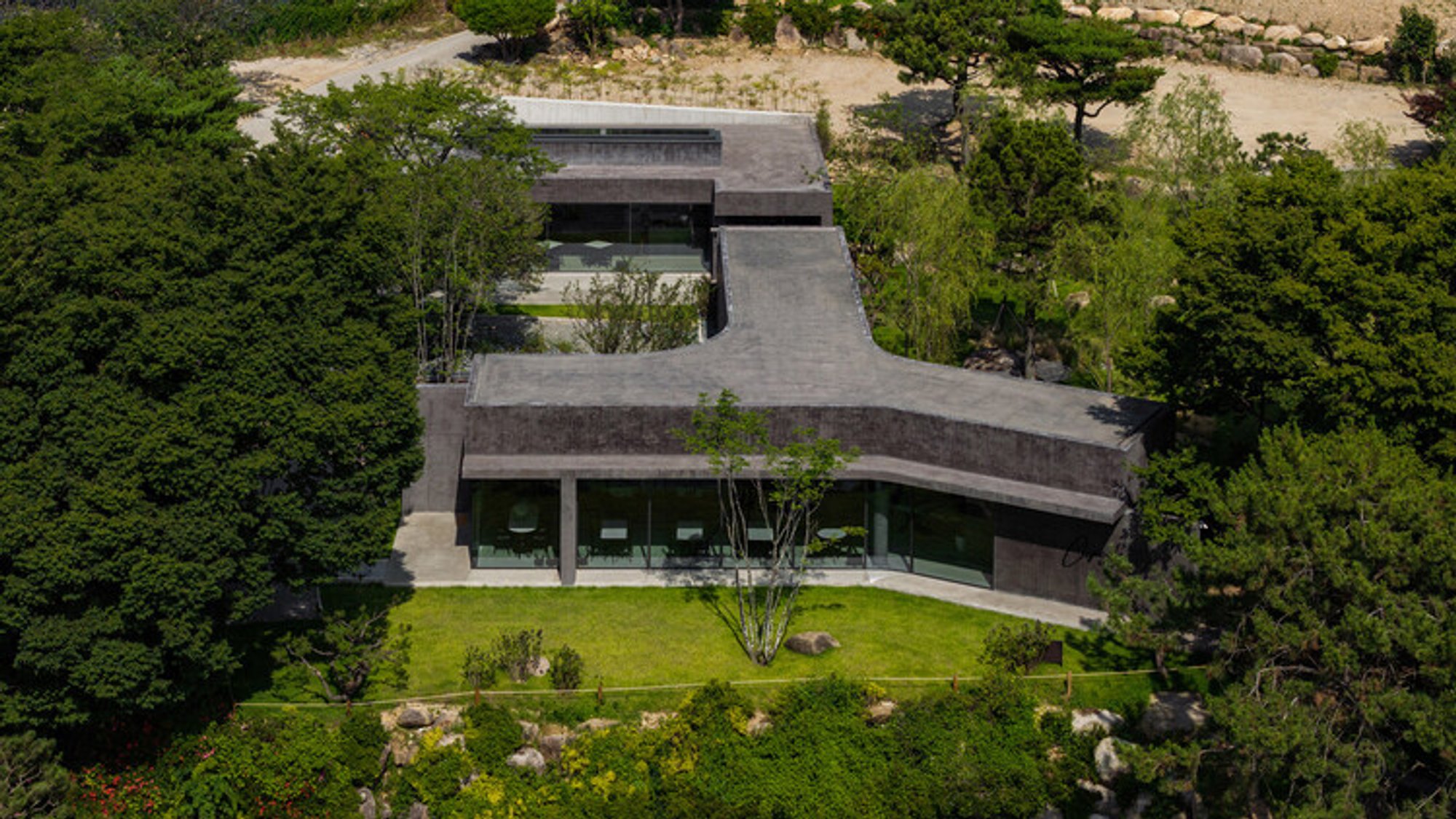
Charcoal Haus by moc architects
A minimal commercial project in Yangsan where thickened boundaries, shifting landscapes, and restrained architecture redefine an ambiguous hillside site.

Defining Place Through Minimal Boundaries and Ambiguous Landscapes
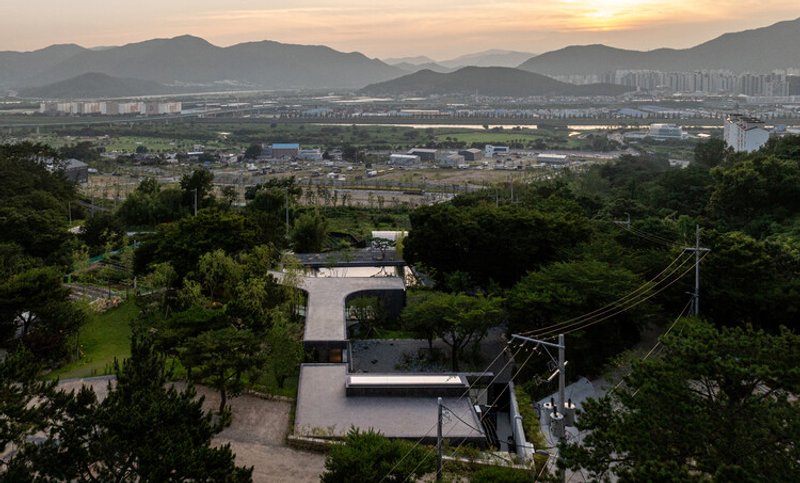
Set halfway up a quiet hillside in Yangsan-si, South Korea, Charcoal Haus by moc architects is a small but deeply reflective commercial architecture project that explores how architecture can redefine an uncertain landscape. Completed in 2024 with a total area of 247 m², the project does not impose a strong formal gesture onto its surroundings. Instead, it works with restraint, minimal elements, and subtle spatial shifts to transform an awkward, unfinished site into a place of calm inhabitation.
Charcoal Haus is less about creating an object and more about reframing perception—of land, boundary, and atmosphere.
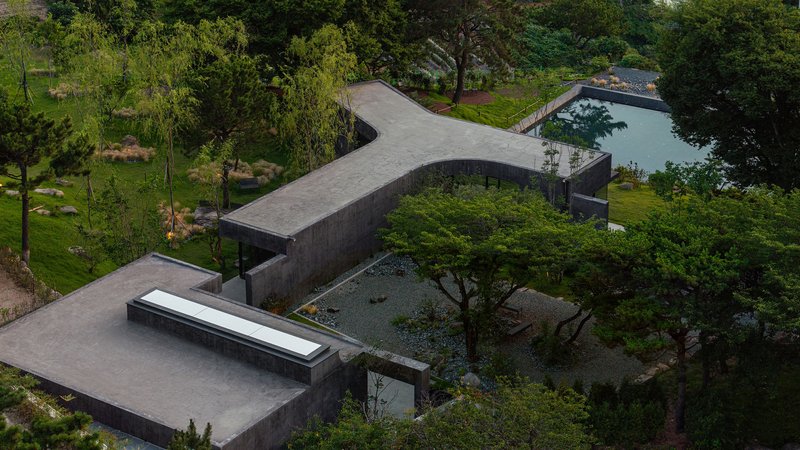
An Ambiguous Site Between Forest and Industry
The site occupies a peculiar position. Located within a greenbelt zone, it is densely surrounded by pine trees and largely free of neighboring buildings. At the same time, an industrial complex is planned below, opening up an unexpectedly expansive view. Rather than feeling naturally serene, the land carries a sense of incompletion.
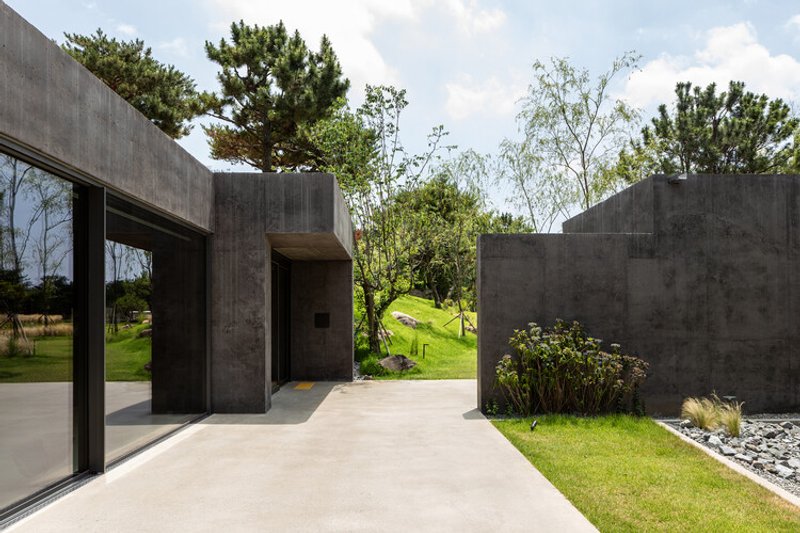
Remnants of a former business remain: a half-finished garden and a fish pond, elements that disrupt the natural continuity of the forest. These traces create an atmosphere that is neither abandoned nor resolved—an uneasy in-between condition.
For moc architects, the first question was not architectural form, but how to define the place itself. Before shaping space, the project sought to understand how architecture could give meaning to an otherwise vague landscape.
Architecture as a Tool for Reframing Place
Charcoal Haus approaches architecture as an act of clarification rather than domination. The intervention acknowledges that even an ordinary or awkward site can gain significance when spatial relationships are carefully restructured.
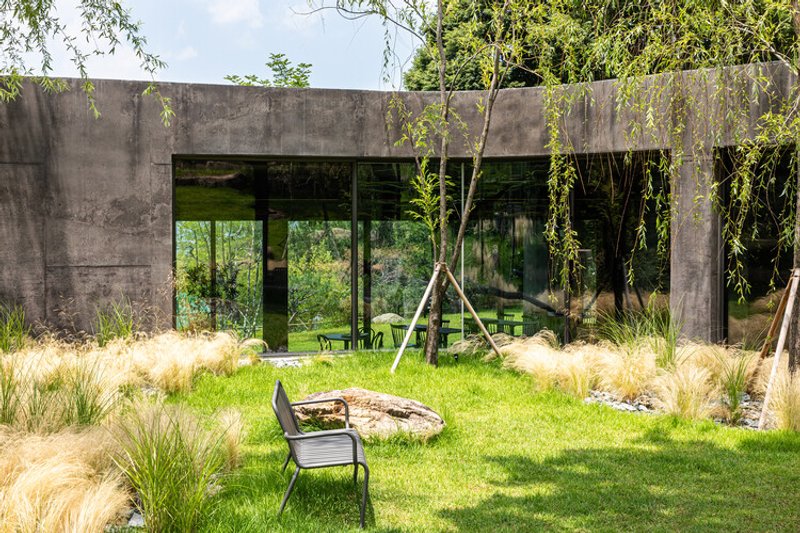
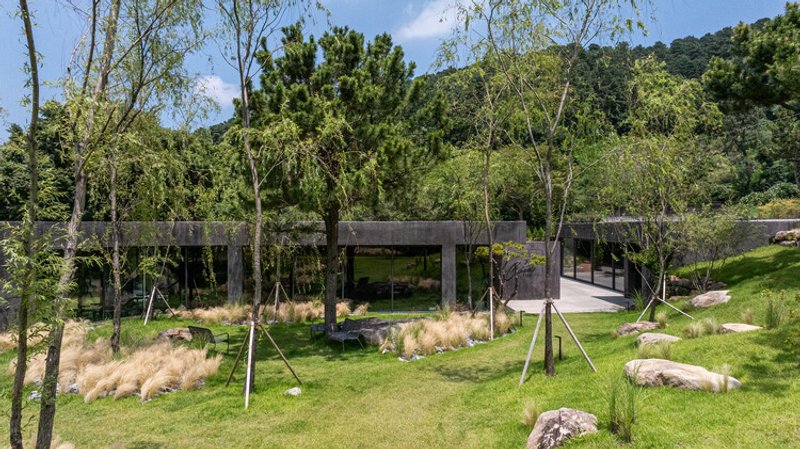
Rather than erasing the site’s ambiguity, the project embraces it. The architecture does not attempt to “correct” the land but instead offers a framework that allows the environment to settle into a new equilibrium. In this sense, Charcoal Haus becomes an instrument for quiet transformation—a way to shift perception through minimal means.
Two Buildings, One Continuous Logic
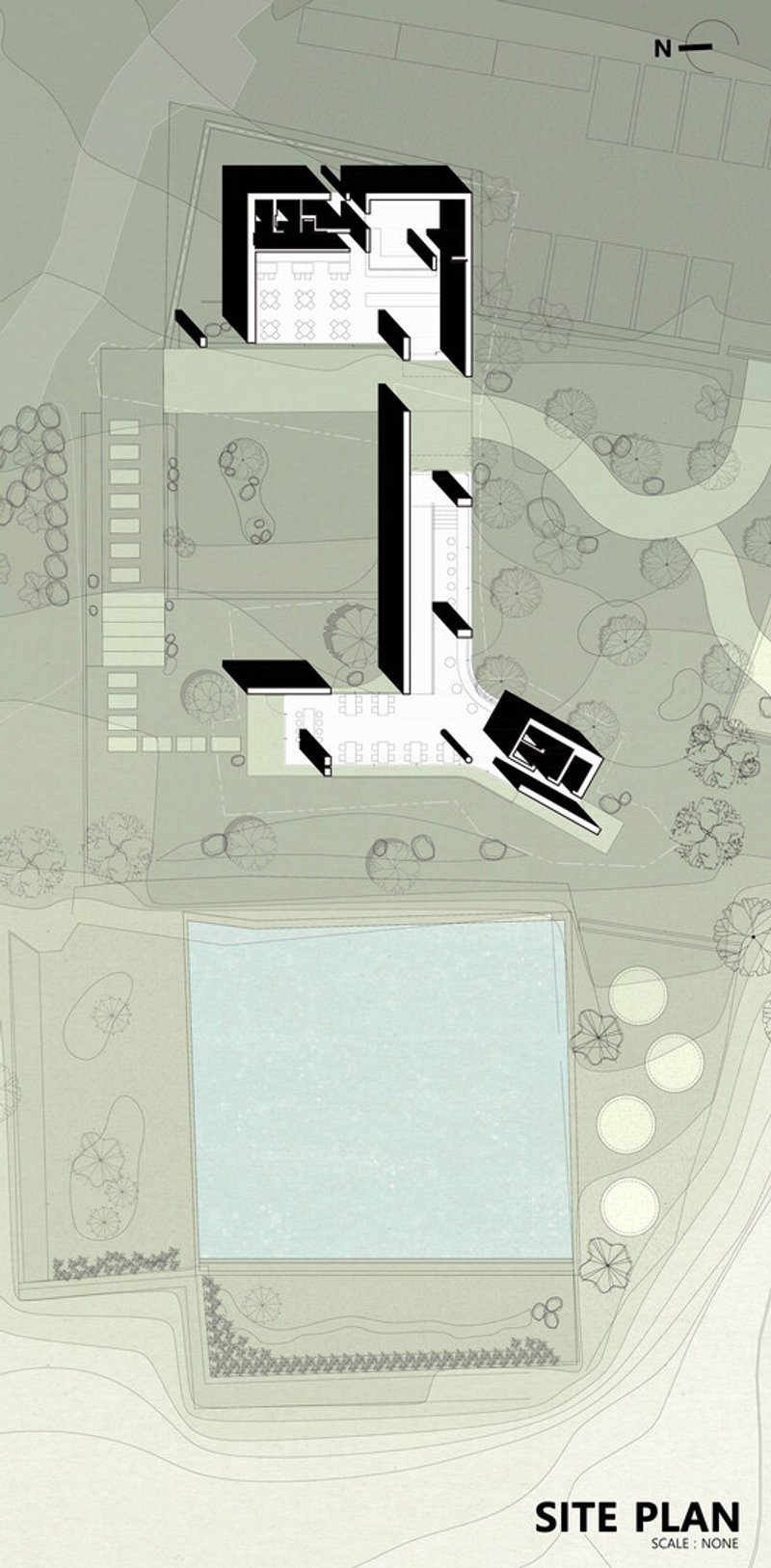
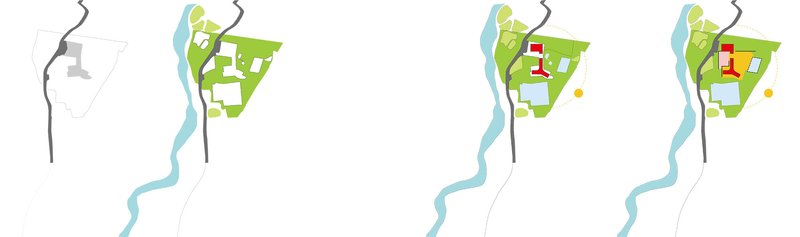
The project consists of two buildings on adjacent plots, each following the natural slope of the land. A one-meter height difference between the sites becomes a key design driver rather than an obstacle.
Construction is deliberately reduced to four basic architectural elements:
- Wall
- Column
- Floor
- Roof
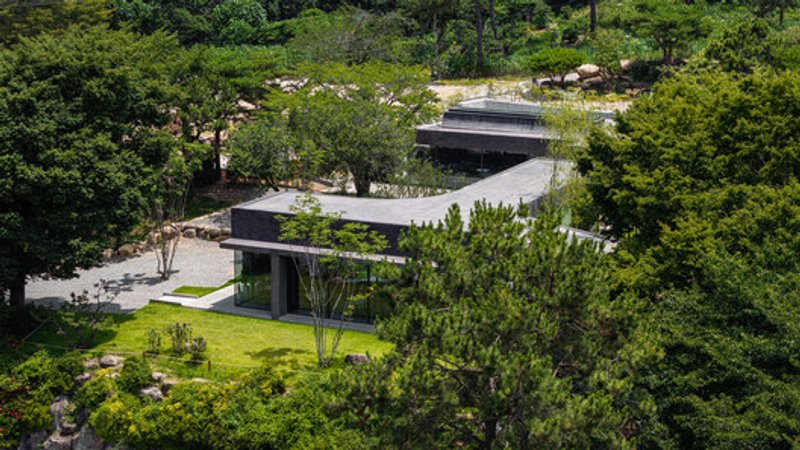
By limiting the vocabulary, moc architects create clarity and coherence. Each element carries spatial responsibility, and nothing is decorative or redundant.
A long wall running along the slope anchors the composition. This wall does more than divide the land—it gives scale to the openness of the site. It establishes a horizontal datum that organizes movement, sightlines, and spatial sequence.
Courtyard and Garden: Order and Wildness
On one side of the wall, visitors encounter a clean, controlled courtyard. This space offers a moment of calm and clarity—a threshold between architecture and landscape.
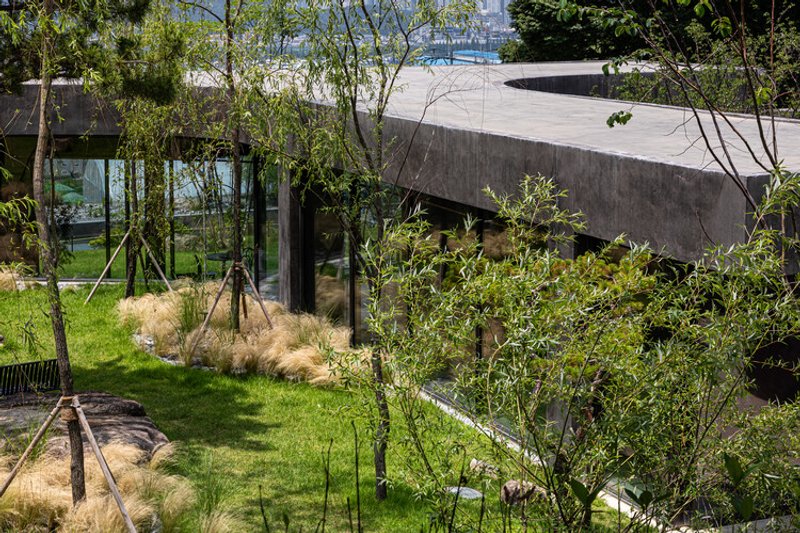
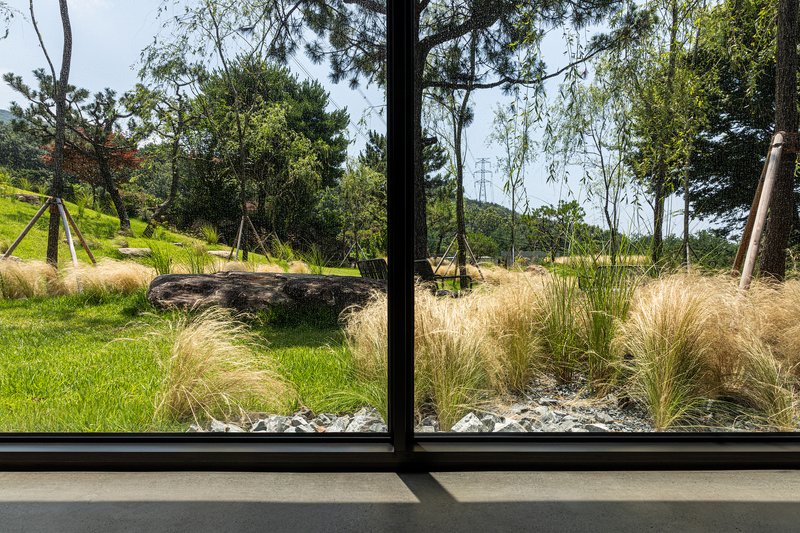
On the other side, a messy, revived garden reintroduces a sense of nature that feels less curated and more alive. Instead of maintaining the existing pine trees, willows were planted, chosen for their ability to express seasonal change. Their flexible branches move at eye level, replacing rigid landscaping with softness and motion.
This contrast—between order and looseness, control and growth—creates a dynamic spatial dialogue. The architecture does not sit apart from the landscape; it actively participates in its transformation.
Sectional Experience and Ground-Level Shifts
The floor plane absorbs the site’s one-meter level difference, allowing movement along the slope to feel gradual rather than abrupt. As visitors walk through the project, the garden below slowly rises into view, creating a more intimate encounter with the forest.
This sectional strategy enhances spatial depth without increasing building size. Although the interiors are compact, they feel protected and inwardly focused, offering a sense of enclosure without isolation.
The architecture responds not only to plan but to movement, height, and perspective, making the experience richer than the modest footprint might suggest.
Interior Atmosphere: Variation Within Continuity
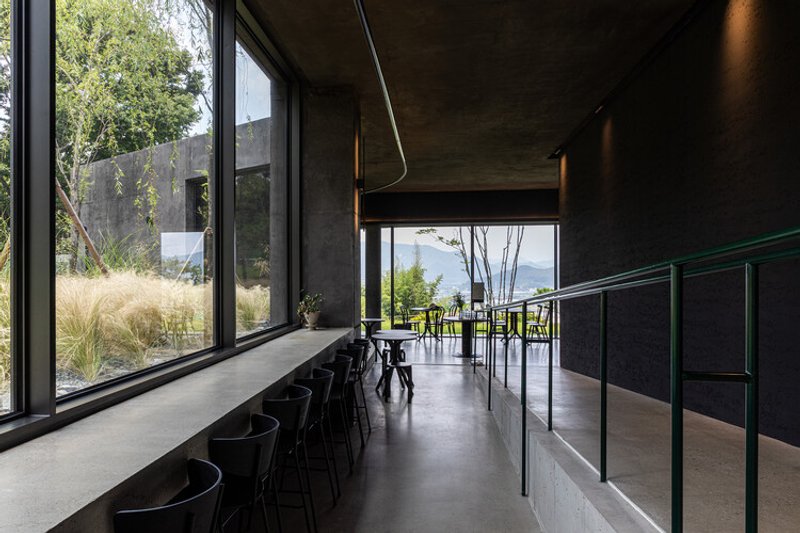
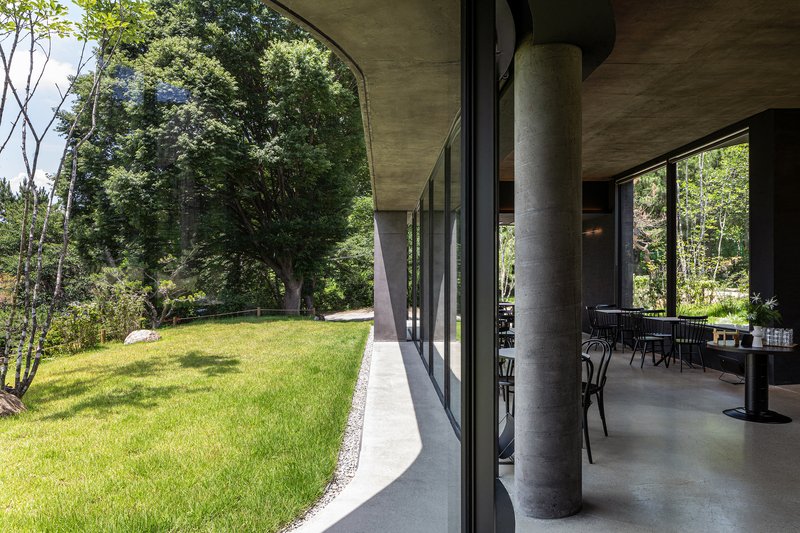
Inside Charcoal Haus, spatial variety is achieved through subtle shifts rather than formal complexity. The roof maintains a continuous horizontal line, but ceiling heights vary across different rooms. This variation creates changing spatial moods—from compressed and intimate to open and expansive.
Columns and walls are positioned with precision. Some extend outward to create additional breathing room, while others frame carefully selected views of the surrounding landscape. These gestures generate a diverse series of facades, including:
- Curved openings
- Straight-edged windows
- Bold triple sliding doors
Each opening offers a different relationship to light, garden, and sky, ensuring that the interior remains visually connected to its environment.
Architecture in the Gray Zone
The name Charcoal reflects both material sensibility and philosophical stance. Like charcoal, the project exists in a gray zone—between black and white, natural and artificial, defined and undefined.
Light shifts throughout the day, vegetation grows and moves, and boundaries soften over time. The architecture does not assert permanence through monumentality but through quiet adaptability.
In this way, Charcoal Haus demonstrates that architecture does not need to be loud to be meaningful. Through restraint, precision, and sensitivity to context, it transforms ambiguity into atmosphere.
All the Photographs are works of texture on texture




Popular Articles
Popular articles from the community


Solar Steam: A Climate-Responsive Architecture That Redefines the Monument
A climate-responsive memorial architecture that transforms heat, decay, and time into a living system reflecting humanity’s ecological impact.
On the Brooks House by Monsoon Collective – A Contemporary Kerala Home Rooted in Tradition
Kerala home blending tradition and modernity with water-inspired design, brick architecture, courtyard planning, and sustainable rainwater harvesting strategies.
Treehouse Apartment: A Warm Timber Interior Blending Craft, Play, and Contemporary Living
Warm timber apartment with integrated treehouse, combining natural materials, craftsmanship, and playful design to create a flexible, family-oriented living environment.
Inverted Architecture Installation by Studio Link-Arc: Exploring the Intersection of Architecture and Living Organisms
Inverted Architecture Installation by Studio Link-Arc blends mycelium, sustainability, inverted design, ecological cycles, and urban adaptive architecture in Shenzhen.


Similar Reads
You might also enjoy these articles


The Ken Roberts Memorial Delineation Competition (Krob)
As the most senior architectural drawing competition currently in operation anywhere in the world, it draws hundreds of entries each year, awarding the very best submissions in a series of medium-based categories.


Waterfront Redevelopment and Urban Revitalization in Mumbai: Forging a New Dawn for Darukhana
A transformative waterfront redevelopment project reimagining Darukhana’s shipbreaking heritage into an inclusive urban future.

OUT-OF-MAP: A Call for Postcards on Feminist Narratives of Public Space
Rhizoma Design and Research Lab invites artists, designers, architects, researchers, and students to reflect on how feminist perspectives can reshape public space. Selected works will be exhibited in Barcelona, October 2026. Submissions open until 15 April 2026.


Documentation Work on Buddhist Wooden Temple
Architectural syncretism and cultural hybridity: A comparative study of the Buddhist temples in Chattogram Hill tracks


Explore Architecture Competitions
Discover active competitions in this discipline




The International Standard for Design Portfolios


The Global Benchmark for Architecture Dissertation Awards


The Global Benchmark for Graduation Excellence


Challenge to reimagine the Iron Throne
Comments (0)
Please login or sign up to add comments
No comments yet. Be the first to comment!