

Deconstructivism: Reflect Modernism in architecture design
Result Story - Decode - Cultural Architecture Competition


This competition was for Students only.
'Decode' is an architecture competition that intends to encourage an authentic understanding of one of the '-isms' in the history of architectural styles, i.e. Deconstructivism. Most often, 'movements' begin as a response to a set of circumstances, as steps to bring about change, or as critique. Over the course of time, the reasons, original ideologies, and principles can take a different form as compared to the motivations of the original movement. This competition invites architects and designers to communicate the 'essence' of deconstructivism, by means of architecture itself. Through a pavilion design, the competition aims to bring out ideas to sensitize users/the public towards the values of deconstructivism. It also provokes thinking about how public built spaces can imbibe certain ideas in their physical forms and play a part in subtly communicating those to its users.
Deconstructivism - an answer to the rules of modernism
Deconstructivism is a post-modernist movement that was started in the 1980s, against the architectural style of modernism. Created with the original intent of extending boundaries and breaking architectural stereotypes, this movement in itself, gathered many misconceptions.
Computer-aided design software helped to create these designs effectively and its eye-catching style spread instantly, facing criticisms as well. The style consists of buildings designed in a fragmented nature.
As the term suggests, the design takes dramatic turns and angles that allow its viewers to experience a realm of structures that look dynamic and almost futuristic.
Deconstruction is essentially stripping down the different layers of a building and abstracting them in a way that can allow the viewer to visualize the space, with a different perspective.
Understanding architectural deconstructivism today
Today, many architects and designers create aesthetically disruptive and abstract designs, while balancing the functionality of the building effectively. But even though the structure is built soundly, the deceiving nature of fragmented facades pushes people to perceive the building as illogical or absurd. One of the reasons may be the unusual and unconventional forms of deconstructivist architecture that contrast the aesthetic that people are most familiar with. Another reason is the lack of education or awareness about the movement of deconstructivism and why it exists.
Structures designed by architects such as Frank Gehry and Daniel Libeskind are enlightening examples of deconstructivism and they push architects and designers to aspire for more. This movement is capable of producing buildings, at both calming and enthralling ends of the spectrum.
With such volatile architectural styles, situations usually get out of hand when later, after the beginning of the movement, its subsequent renditions are unable to sync their meaning with the essence. While as architects we appreciate deconstructivism, the message that is relayed through its expression may get lost in translation towards the end-user.
How can we create a positive impression of deconstructivism in this era?
When the world predominantly links architecture with the economy, it is tough for an audience to appreciate deconstructive buildings. What if we could tone down the experience of the movement, in a building that celebrates public gatherings?
Brief: The challenge of the design competition was to create a pavilion that sensitizes people experiencing it, about the deconstructivism movement.
Pavilions are a great way of showcasing the bite-sized version of a story while packing some essential features in its spatial design. These spaces deliver the story through an engaging experience. The story can not only be shared with a function (direct sell) but can also be done by adding meaning to the neighborhood (soft sell).
The deconstructivism approach, as lucrative as it may sound, requires a very meticulous approach when designing a civic space within some set conditions. The competition urges participants to explore such relationships with the context.
The jury for the competition consisted of esteemed designers, professionals and academicians from around the world. The Lead Jurors for the competitions were as follows:
Wolfgang Buttress, Founder, Wolfgang Buttress, Nottingham, UK
Alan Dempsey, Founder, Nex Architecture, London, UK

Some of the Best of competition projects are as follows:
Winning Project: The Pebbles
By: Piotr Pawłowski

Fig: 1 Street View
Description: The project uses soft, curvy lines to create an inviting environment. Buildings are inspired by river pebbles which refer to the city's industrial history in which water played a huge role. Their unique shape makes them easily visible in this urban environment.
----------------------
Editor’s Choice: Museum/Manchester
By: Zhenya Zhenev
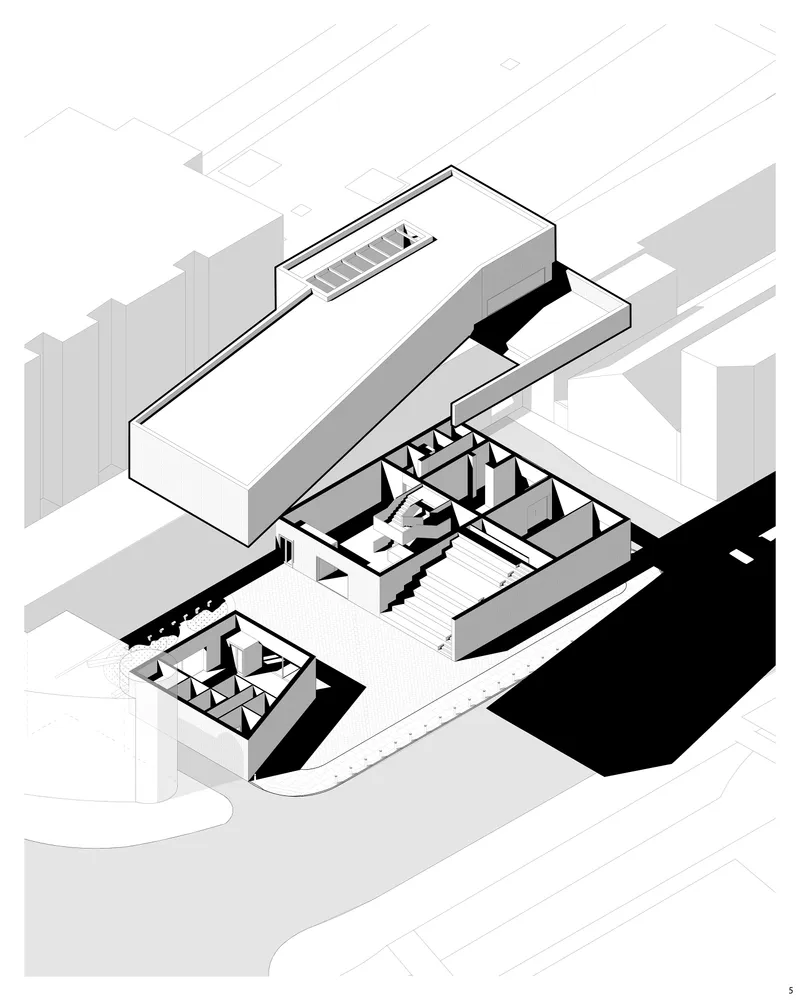
Fig: 2 Desing model
Description: Museum of deconstructivism: Our architectural design was based on a detailed study of the contextual environment and the study of the museum as a social and cultural phenomenon based on a rotational and pragmatic approach to design. We have tried to achieve spaces that are as effective and flexible as possible.
----------------------
Editor’s Choice: Journey to Recovery
By: Sungmin Park, Rakki Lee & IkHan Yoo

Fig: 3 Interior and Exterior view
Description: Many people live with hardly controllable emotions that arise from various unexpected events in their lives. Among these emotions, inevitable depression and frustration weigh on us. However, in modern society, there are many restrictions to express these dark emotions outwardly. So we wanted to create a pavilion on our site that would help people experience.
--------------------
Follow us on social media: Facebook | Instagram | LinkedIn | Twitter | Youtube
References (3)




Popular Articles
Popular articles from the community


The Earth Pod: 3D Printed Homes for Resilient Refugee Communities
The Earth Pod reimagines refugee housing through 3D printed homes made from clay, combining resilience, self-sufficiency, and rapid shelter.
EW PARK: Sustainable Architecture Reimagines the Future of Urban Parking
EW PARK reimagines city parking as a modular wooden tower combining automation, solar energy, electric mobility, and adaptable urban design.

AL-JANNAH: Sustainable Architecture and Permaculture for Afghan Widows
AL-JANNAH uses sustainable architecture and permaculture to create resilient oasis of housing, learning, work and renewal for Afghan widows.

Co-life: Sustainable Architecture for Age-Friendly Community Living
Co-life reimagines sustainable architecture for seniors through courtyards, rammed earth, shared gardens, and spaces designed for belonging.


Similar Reads
You might also enjoy these articles

The Musturak Paradise: Senior Living Architecture for a Connected Future in Temara, Morocco
The Musturak Paradise reimagines senior living architecture in Temara via private homes, social spaces, culture, community, and shared care.

The Leaf Center: Cultural Center Architecture for Social Integration in Amsterdam
Cultural center architecture becomes a bridge at The Leaf Center, connecting international students with Amsterdam through art and exchange.

Conexión: Biophilic Design Reimagines High-Rise Living in Hong Kong
Conexión reimagines high-rise living in Hong Kong through biophilic design, green facades, shared spaces, daylight, water and nature within.

Wander to Wonder: Modular Playground Design for Children in Kutupalong Refugee Camp
Wander to Wonder uses modular playground design to create flexible, imaginative play spaces for children in Kutupalong refugee camp.





Comments (0)
Please login or sign up to add comments
No comments yet. Be the first to comment!