

Suspended: Reimagining Paris Through Adaptive Reuse Architecture
A suspended intervention transforms abandoned Paris railways into inclusive, adaptive reuse architecture bridging heritage, mobility, and public life.


In the evolving discourse of adaptive reuse architecture, the project Suspended by Ronez A positions itself as a speculative yet grounded intervention within the historic fabric of Paris. Conceived as a response to the abandoned railway corridors of the city, the proposal rethinks how dormant infrastructural landscapes can be reactivated without erasing their memory.
This project, a shortlisted entry in the Salut Paris competition, explores the delicate balance between preservation and transformation. It does not impose architecture onto the site. Instead, it operates above it, respecting its past while introducing new spatial and social possibilities.


Context: A Railway Frozen in Time
The site exists as a vestige of Paris’ industrial and mobility history. Left untouched for decades, it retains a raw authenticity that many contemporary urban interventions often erase. Unlike sites subjected to aggressive redevelopment, this railway corridor has resisted transformation, preserving both its physical structure and cultural narrative.
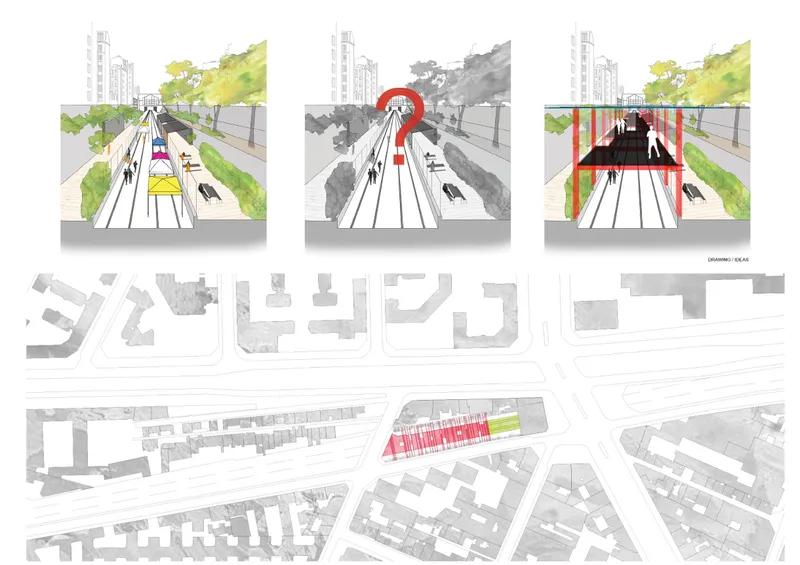
Before initiating the design, the project acknowledges the interventions already present, particularly those associated with La Recyclerie. These informal and community-driven adaptations reveal an important insight: the site is not empty. It is already active, layered with subtle human occupation.
This understanding becomes foundational to the architectural strategy.
Design Strategy: Building Above, Not Over
At the core of Suspended lies a decisive architectural move: lifting the intervention above the railway tracks. This strategy aligns strongly with contemporary adaptive reuse architecture principles, where minimal ground disruption and maximum contextual sensitivity are prioritized.
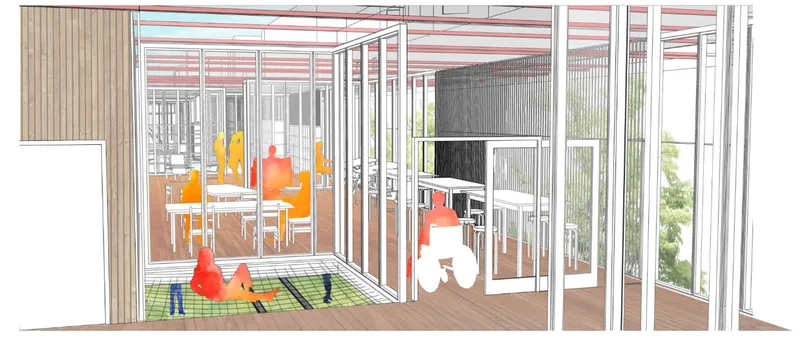
Rather than blocking or redefining the railway, the project suspends its programmatic elements, creating a continuous public void beneath. This void is not residual space. It becomes the primary public realm, allowing pedestrians, cyclists, and informal activities to coexist within a protected urban corridor.
The elevated structure ensures that the original tracks remain visible and legible. In doing so, the project preserves the identity of the site while enabling new uses to emerge.
Programmatic Integration
The architectural program extends the ecosystem of La Recyclerie, creating a cohesive network of social, cultural, and productive spaces. The proposal includes:
- A restaurant that anchors social interaction
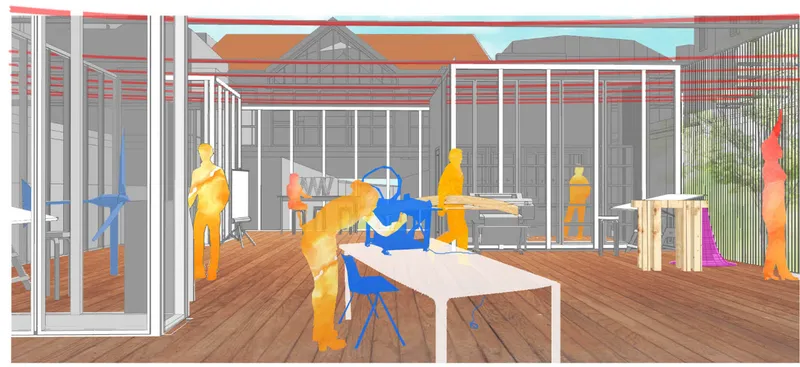
- A workshop and fab lab supporting making and experimentation
- A co-living space encouraging temporary habitation
- A library and coworking areas fostering knowledge exchange
- Technical and support spaces integrated within the linear system
This mix of functions transforms the site into a hybrid infrastructure. It is not just architecture. It is a platform for activity, collaboration, and urban engagement.
Spatial Organization and Movement
The linearity of the railway strongly informs the spatial logic of the project. Circulation follows the axis of the tracks, reinforcing the memory of movement embedded in the site.
Access points are carefully distributed, ensuring permeability from both sides of the urban fabric. Vertical connections, including elevators, are introduced to guarantee accessibility for people with reduced mobility.
This commitment to inclusivity is critical. It shifts the project from being an architectural gesture to becoming a socially responsive environment.
Structural Expression: The Language of Suspension
The project derives its identity from its structural system. A post-beam framework supports the suspended volumes, while tension cables extend across the site, reinforcing the visual and physical notion of suspension.
This approach achieves multiple objectives:
- Minimizes ground intervention
- Creates a lightweight architectural presence
- Establishes a strong visual rhythm across the site
- Enhances structural efficiency through distributed loads
Additionally, openings within the structure introduce light wells that connect the elevated program with the ground level. These voids act as visual and environmental bridges, allowing light, air, and views to permeate the system.
Environmental and Public Realm Strategy
The ground plane is reimagined as a green promenade. Free from vehicular traffic, it becomes a safe and flexible public domain.
This space supports:
- Walking and cycling paths
- Informal seating and relaxation zones
- Temporary markets and cultural events
- Small-scale performances sheltered by the overhead structure
The suspended architecture provides climatic protection, shielding users from rain and excessive sun while maintaining openness.
This dual-layer system, active above and free below, creates a dynamic urban section that responds to both environmental and social conditions.
Materiality and Atmosphere
The material palette reflects a balance between industrial heritage and contemporary intervention. Lightweight metal structures, transparent enclosures, and modular components define the elevated volumes, while the ground retains a softer, landscape-driven character.
This contrast reinforces the conceptual clarity of the project: a precise insertion within an existing, organic context.
Critical Reflection
While the project demonstrates a strong conceptual foundation within adaptive reuse architecture, it has also received critical feedback.
Rachel Luchetti, Juror“Simplistic and bulky solution that does not enhance the site.”
This critique highlights an important tension. The ambition to remain minimal and respectful may, in some readings, reduce the architectural impact or fail to fully activate the complexity of the site.
Such feedback is valuable. It opens a broader discussion about the role of intervention in adaptive reuse projects. Should architecture remain neutral, or should it assert a stronger identity?
Suspended contributes meaningfully to the ongoing discourse on adaptive reuse architecture. By prioritizing preservation, accessibility, and programmatic diversity, it proposes a model where architecture coexists with history rather than replacing it.
Its strength lies in its restraint. By building above rather than over, it creates space, both physically and conceptually, for the past and future to intersect.
As cities continue to grapple with abandoned infrastructure, projects like Suspended offer a compelling direction: one where architecture is not an imposition, but a careful negotiation with time, memory, and urban life.



Popular Articles
Popular articles from the community


Riyadh For All: Intergenerational Urban Design for Active Aging in Rabat
Riyadh For All reimagines urban design in Rabat with intergenerational co-living, adaptive courtyards, and Moroccan cultural exchange today.

Hill & Cross Opera: Sculptural Opera House Architecture Shaped by Tallinn’s Landscape and Identity
Hill & Cross Opera reimagines opera house architecture in Tallinn through its sculptural hill, civic plaza, glass wave and a luminous cross.

Lunar Spiral: Space Architecture Shaped by the Mathematics of the Universe
Lunar Spiral reimagines space architecture through Fibonacci geometry, lunar regolith, levitating habitats, and self-sustaining Moon living.

Co-Life: Senior Housing Design That Reconnects Older Adults With the City
Co-Life reimagines senior housing design through healing gardens, shared streets, workshops, and a sustainable community across generations.


Similar Reads
You might also enjoy these articles

Eco Chapel: A Green Architecture Pavilion Designed in Symbiosis with the Forest
Eco Chapel uses green architecture to weave prayer, learning and reuse into a forest pavilion shaped by modular hexagonal canopies for life.
Kaffeebühnen: Coffee Shop Architecture Designed as a Civic Stage Between Vienna’s City and Park
Kaffeebühnen turns coffee shop architecture into a civic stage, linking Vienna’s park edge, urban life, warm timber yards, and coffee craft.
Healing Façade: Sustainable Architecture for Reforestation, Community, and Sacred Ecology in Ethiopia
Healing Façade reimagines sustainable architecture as a living wall that restores soil, catches water and renews Ethiopia's forest churches.


Urban Forest: A Vertical Ecosystem for 5,000 Workers in Singapore's Changi Business Park
Radially stacked pods and layered green decks turn a 7-acre plot into 47 acres of ecological workspace projected for 2040.


Explore Architecture Competitions
Discover active competitions in this discipline



Challenge to reimagine the Iron Throne


Photograph architecture without architects


Illustrate the lost glory of Angkor Wat - Render Challenge


Design challenge to reuse E-waste
Comments (0)
Please login or sign up to add comments
No comments yet. Be the first to comment!