

Rolly: Movable Architecture That Turns Paris' Petite Ceinture Railway into a Participatory Public Realm
Pushable modules ride the abandoned tracks, retail pavilions line the retaining walls, and a central tent shifts from daytime market to night venue.


Most proposals for disused rail lines treat the tracks as a relic to be paved over, planted, or framed behind glass. Rolly does something more provocative: it keeps the rails working. Instead of trains, the tracks carry small architectural objects that visitors can push and pull along the corridor, so the public space reshapes itself every time someone decides to sit, play, or gather somewhere new. The railway's oldest logic, linear movement, becomes the engine of a new kind of civic room.
Designed by Yuna Kim, the project received the Organizer's Choice Award in the Salut Paris competition. Its site is La Petite Ceinture, the ring railway that once served Paris as both transport network and defensive boundary before it was abandoned in the early twentieth century. Since then it has lingered as a fragmented condition, isolated from the city and embedded within it at once. Kim reads that ambiguity as an opportunity for urban regeneration through reinterpretation rather than demolition or replacement.
Reading the Corridor as a Framework, Not an Artifact
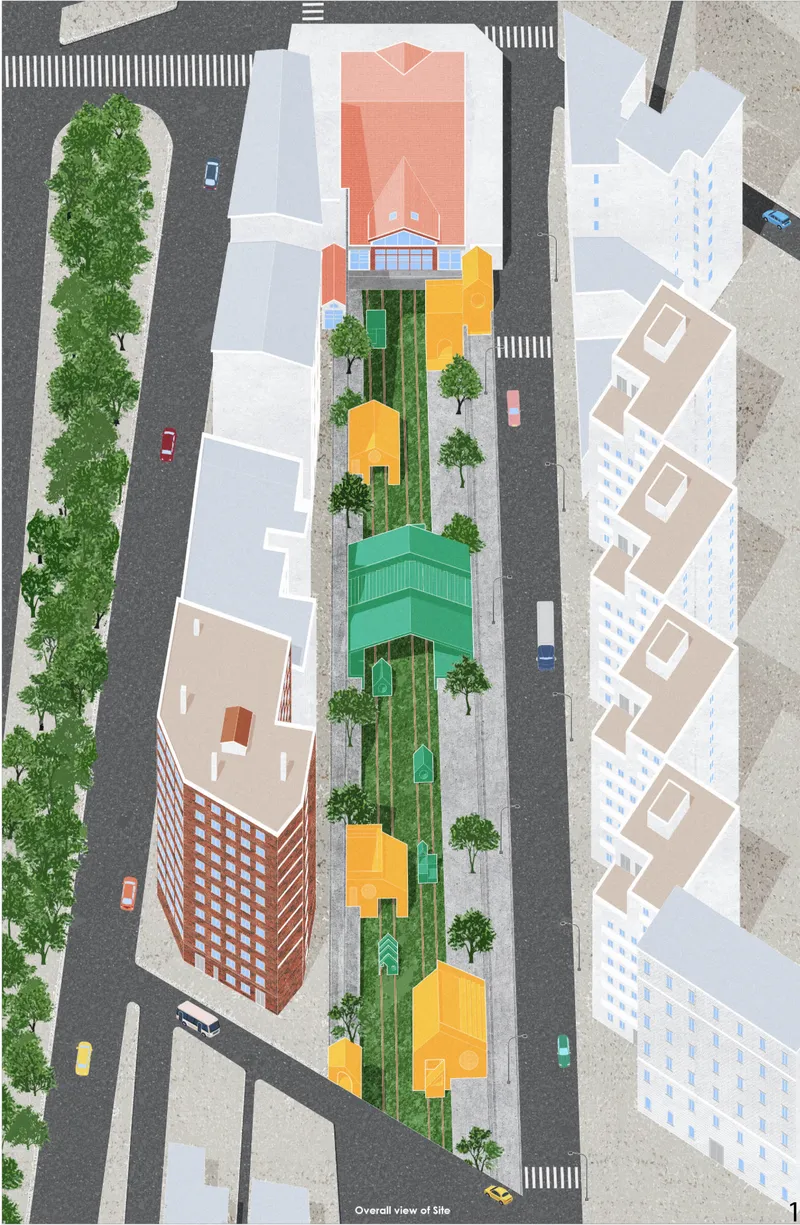
The strongest move in Rolly happens before any object is designed. Kim refuses to treat La Petite Ceinture as a static heritage piece and instead identifies the qualities embedded in the infrastructure: its linearity, its continuity, and its capacity to stitch neighbourhoods together. These become the generative rules of the scheme. The trench, the retaining walls, and the tracks are not obstacles to work around; they are the armature that organises everything else.
This matters because linear sites are notoriously difficult to activate. A long, narrow strip tends to become a corridor people pass through rather than a place they stay. By amplifying the linearity instead of resisting it, Rolly turns the constraint into a circulation system for architecture itself.
Small Objects on the Rails, Moved by Hand
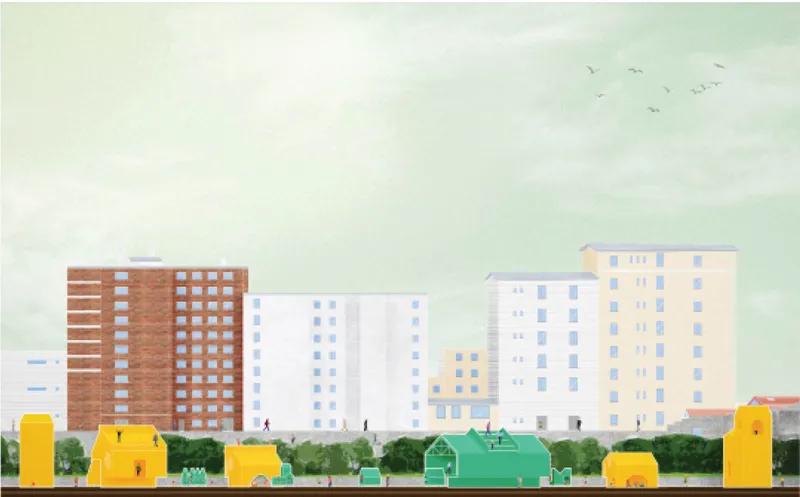
The first tier of the system is a family of lightweight units that sit directly on the tracks. Users push or pull them into position, and depending on configuration they serve as seating, play structures, reading nooks, or informal gathering spots. They can be clustered into a crowd, spread out for quiet, or rolled away entirely when the corridor needs to be clear.
The idea carries real weight because it hands authorship to the public. The layout of the space is never finished; it is renegotiated by whoever happens to be there. That is a rare quality in urban design, where furniture is usually bolted down precisely to prevent this kind of improvisation. Here, the act of moving an object becomes a form of participation.
Pavilions Along the Walls and a Tent at the Centre
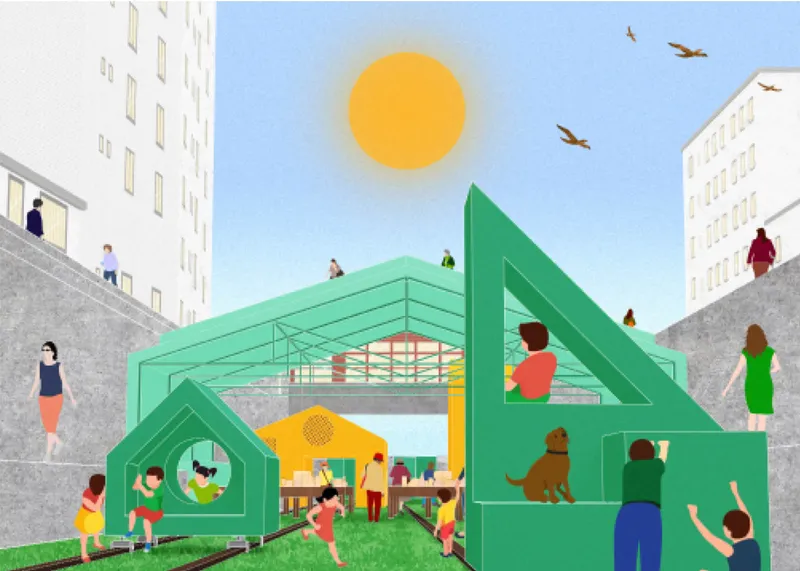
Where the small objects drift, the medium-scale elements hold their ground. Positioned against the retaining walls, these semi-permanent structures house retail or activity spaces, with openings and perforations that invite both physical interaction and sightlines across the corridor. Their roofs are occupiable, extending the public realm vertically and giving the sunken railway a second layer of movement above the tracks.
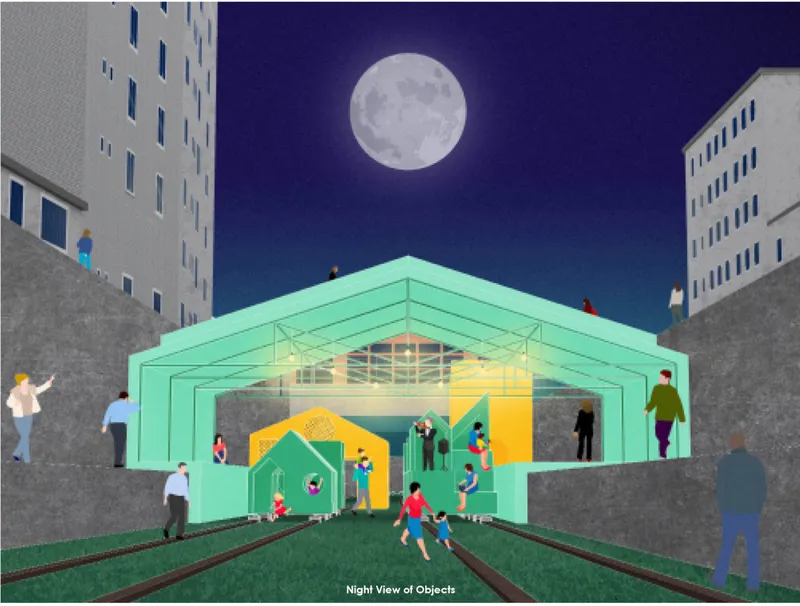
At the heart of the site sits a large tent-like structure that anchors the composition. By day it operates as a marketplace, extending the commerce already found on the adjacent streets down into the corridor. This is a smart urban gesture: rather than inventing a destination from nothing, the scheme borrows the energy of the surrounding neighbourhood and threads it into the railway. The three scales, mobile, static, and central, give the proposal a clear hierarchy without sacrificing flexibility.
The Same Corridor, Two Different Cities by Day and Night
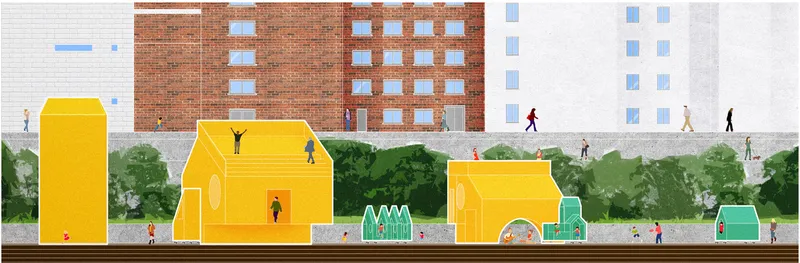
Rolly is designed to change across the day. As evening falls, the central marketplace transforms into a communal venue for events and performances, and the movable objects can be regrouped to suit the new programme. The project gains a temporal dimension that most fixed interventions lack, allowing the same stretch of railway to serve tourists, local residents, and diverse communities at different hours.
Rather than prescribing fixed programmes, the scheme offers an open-ended framework. The mobile units enable spontaneous encounters, while the static pavilions and the tent provide enough structure to anchor regular activity. It is this balance between the predictable and the improvised that makes the day-to-night cycle feel convincing rather than gimmicky.
Why This Project Matters
Rolly offers a lesson in restraint. It does not erase the railway or bury it under a new landscape; it lets the existing infrastructure keep doing what it was built for, moving things along a line, and simply changes what gets moved. That reframing gives the proposal an intellectual clarity that many adaptive reuse schemes miss, where the original structure survives only as backdrop.
Just as importantly, Kim's project treats public space as something users actively shape rather than passively consume. A modular, scalable kit of parts, deployed across three distinct scales and two distinct times of day, suggests a model that could extend along other stretches of La Petite Ceinture and to abandoned linear infrastructure in other cities. For a competition about reimagining Paris, it is a fitting answer: a city fragment brought back to life by the people who push it into motion.
View the Full Project
About the Designers
Designer: Yuna Kim
Enter a Design Competition on uni.xyz
uni.xyz runs architecture and design competitions year-round that reward proposals with spatial conviction and real site intelligence.
Project credits: Rolly by Yuna Kim Salut Paris (uni.xyz).


Popular Articles
Popular articles from the community


Opera on the Sea: Driftwood Logic Shapes a Timber Opera House on Estonia's Coast
Trevor Orgill's opera house translates the entangled drift of floating timber into a civic building where wood, water, and music converge.

Aquadapt: An Underwater Habitat That Rewrites Its Rooms by the Hour
Curved modules ring the seabed while one shell shifts from breakfast room to cinema, farm and football pitch as residents' needs change.


FCC Arquitectura Expands a Portuguese Granite House with a Board-Marked Concrete Wing
In Portugal, JV House pairs a cleaned-up whitewashed and granite dwelling with a timber-shuttered concrete extension, courtyards and a garden pool.

Cube Design Draws an Ecological Corridor Between Two Shenzhen Hills with the Nankai Building
Beside Shenzhen's container docks, the Nankai Building pairs stacked balconies with a climbing green screen to connect two hillsides across its height.

Similar Reads
You might also enjoy these articles
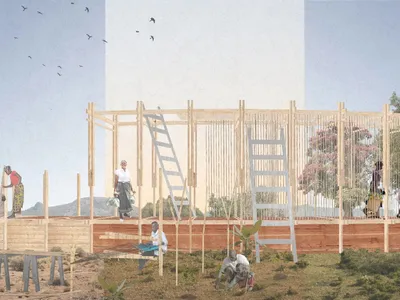
Healing Façade: A Modular Chapel System That Restores Ethiopia's Sacred Forests
Winner of the Eco-Chapel competition, this circular timber façade collects water from air to rebuild soil and reforest degraded Ethiopian landscapes.
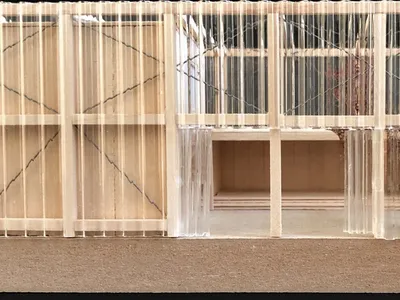
Kaffeebühnen: Where Coffee Shop Architecture Becomes a Civic Stage in Vienna
A linear sequence of timber boxes, transparent shells, and open yards turns the Viennese café tradition into a public performance space.
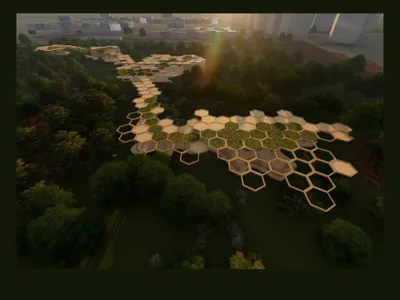
Eco Chapel: A Modular Forest Pavilion That Grows Like the Landscape It Protects
Hexagonal timber modules weave through existing trees, turning a chapel into a living system for prayer, education, and reforestation.


Urban Forest: A Vertical Ecosystem for 5,000 Workers in Singapore's Changi Business Park
Radially stacked pods and layered green decks turn a 7-acre plot into 47 acres of ecological workspace projected for 2040.

Explore Architecture Competitions
Discover active competitions in this discipline

Challenge to reimagine the Iron Throne

Photograph architecture without architects

Illustrate the lost glory of Angkor Wat - Render Challenge

Design challenge to reuse E-waste
Comments (0)
Please login or sign up to add comments
No comments yet. Be the first to comment!