
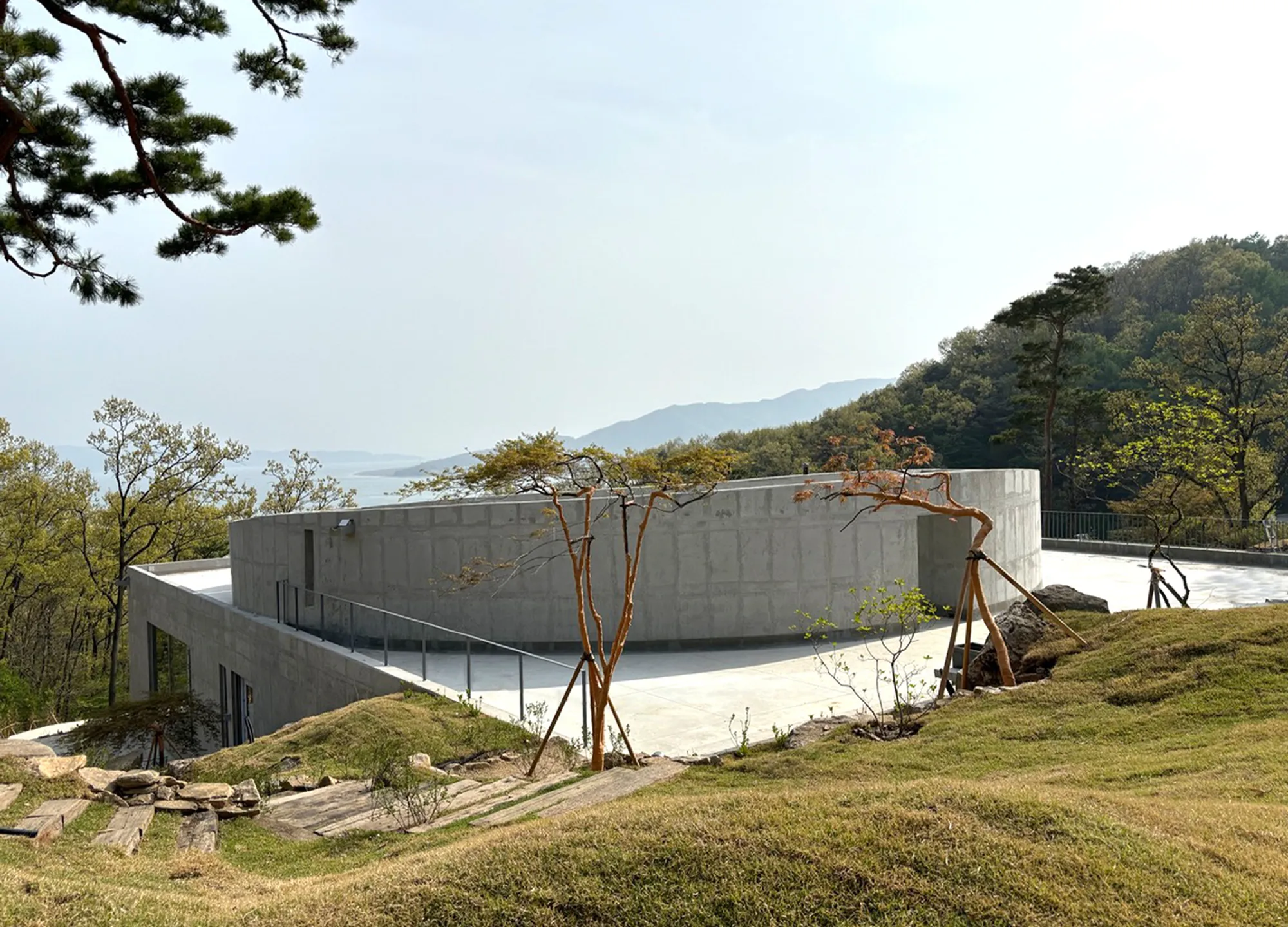
Space Design A.LIVE Turns a Joseon-Era Fortress Typology into a Hilltop Café on Ganghwa Island
OUTPOST reinterprets the circular stone Dondae of Korea's coastal defense history as a concrete sanctuary for coffee and contemplation.


Ganghwa Island, about 70 kilometers west of Seoul, is layered with military memory. Circular stone watchtowers called Dondae once lined its coast during the Joseon Dynasty, built to spot approaching ships and repel invasion. That defensive typology, a concentric ring of thick walls punctuated by narrow gun ports, is the unlikely source material for OUTPOST, a 731-square-meter café designed by Space Design A.LIVE within the Stonery resort complex. Lead architect Jeon Heesu has taken the fortress plan literally, wrapping two levels of café program inside concentric circular walls, but has inverted its purpose entirely: instead of keeping enemies out, the architecture pulls nature in.
What makes OUTPOST genuinely compelling is the precision with which it translates a military diagram into a sequence of hospitality moments. The narrow vertical slots that once served as gun ports now frame individual views of trees and hills. The open rooftop that once offered surveillance now delivers a 360-degree panorama for guests with a latte. A two-meter-diameter skylight drills light down through both levels like a controlled detonation of daylight into an otherwise dim, meditative ground floor. It is rare that a historical reference in café design goes beyond mood-boarding; here, the reference actually generates the plan.
A Fortress in the Landscape

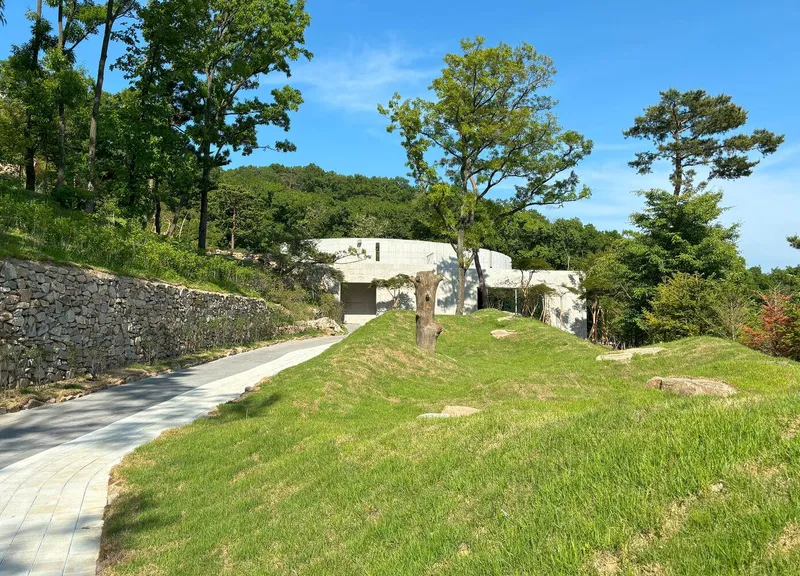
From a distance, OUTPOST barely announces itself. The board-formed concrete structure sits partially embedded in a hillside, its curved roof terrace reading as a continuation of the grassy slope rather than a building. Young trees planted on and around the structure reinforce the impression that this is something excavated, not erected. The approach along a paved path through mature deciduous trees reveals the entrance only gradually, a deliberate slowdown that mirrors the transitional experience the architects sought.
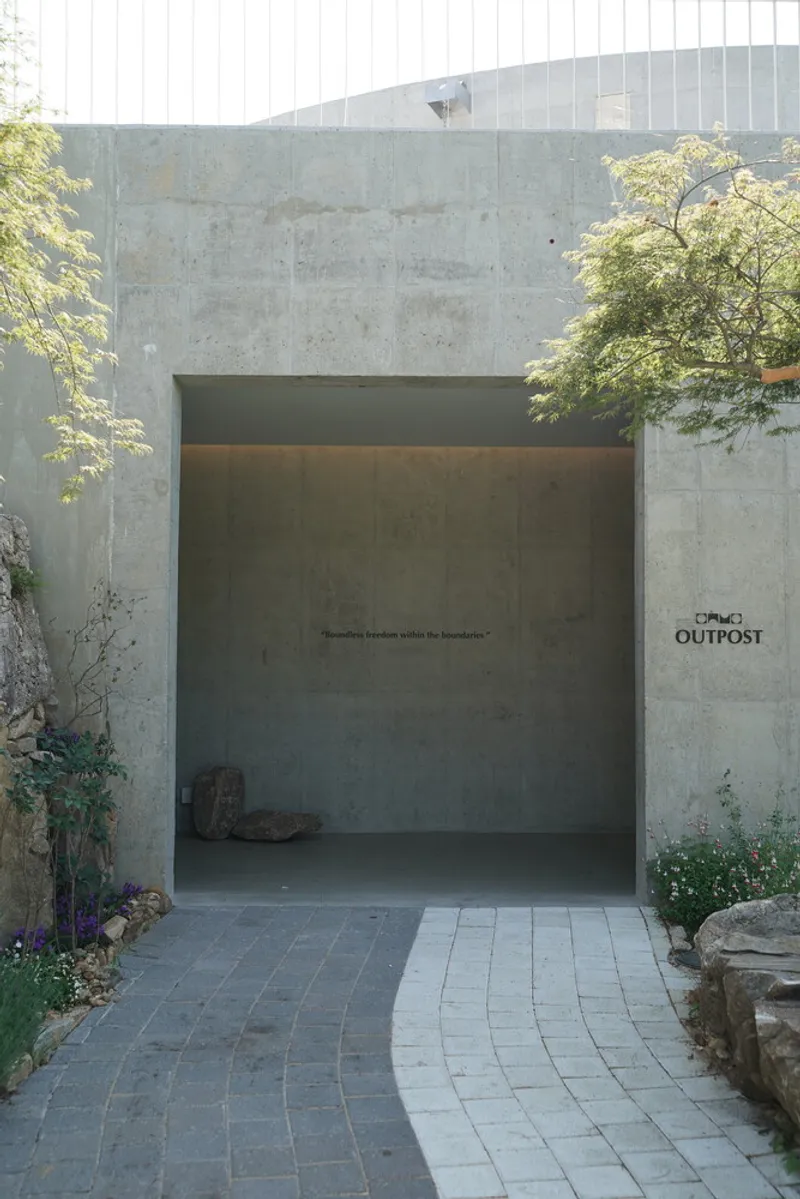
The entrance itself is a narrow slot cut into thick concrete walls, flanked by planted beds. There is no grand signage, no glass curtain wall broadcasting the interior. You enter the way you might have entered a Dondae: through a controlled aperture that compresses your field of vision before releasing you into the space beyond. The effect is immediate and physical.
The Rooftop Ring
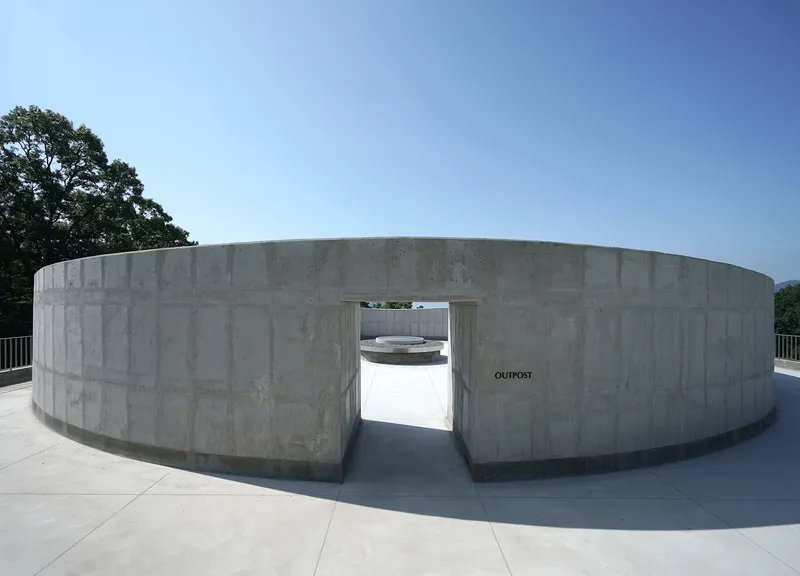


The second floor is organized between two concentric circular walls, with the inner ring completely open to the sky. Tall, narrow windows between the walls function exactly like the poja, the gun ports of the original Dondae, framing slices of the surrounding landscape. Seating is tucked into the gap between the rings, so guests sit within the thickness of the "fortification" itself. It is an unusually direct translation of a defensive section into a social one.
The inner courtyard, paved in a circular pattern with a central planter, operates as a kind of open-air room. Without a roof, it catches weather, light, and season changes with complete exposure. Ribbed concrete walls and simple black cylindrical stools keep the material language spare, letting the sky do the work of decoration. The restraint is welcome in a café market where themed interiors often compete for attention at the expense of spatial quality.
Vertical Slots and Framed Views
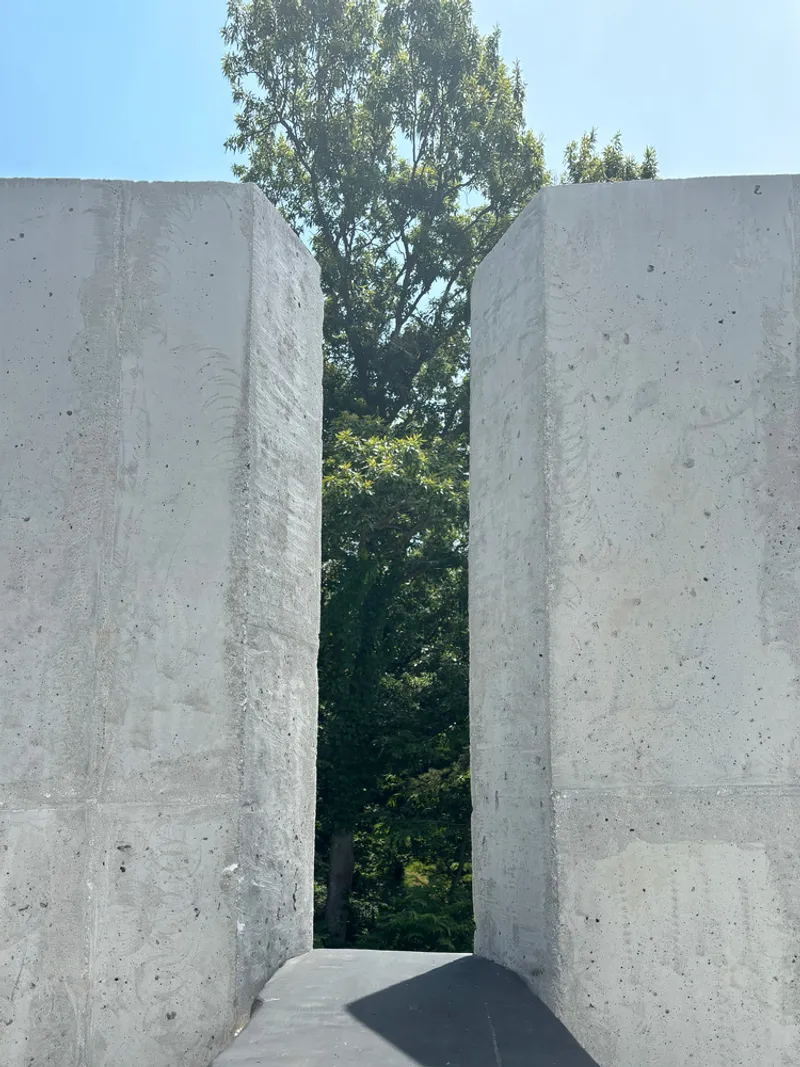
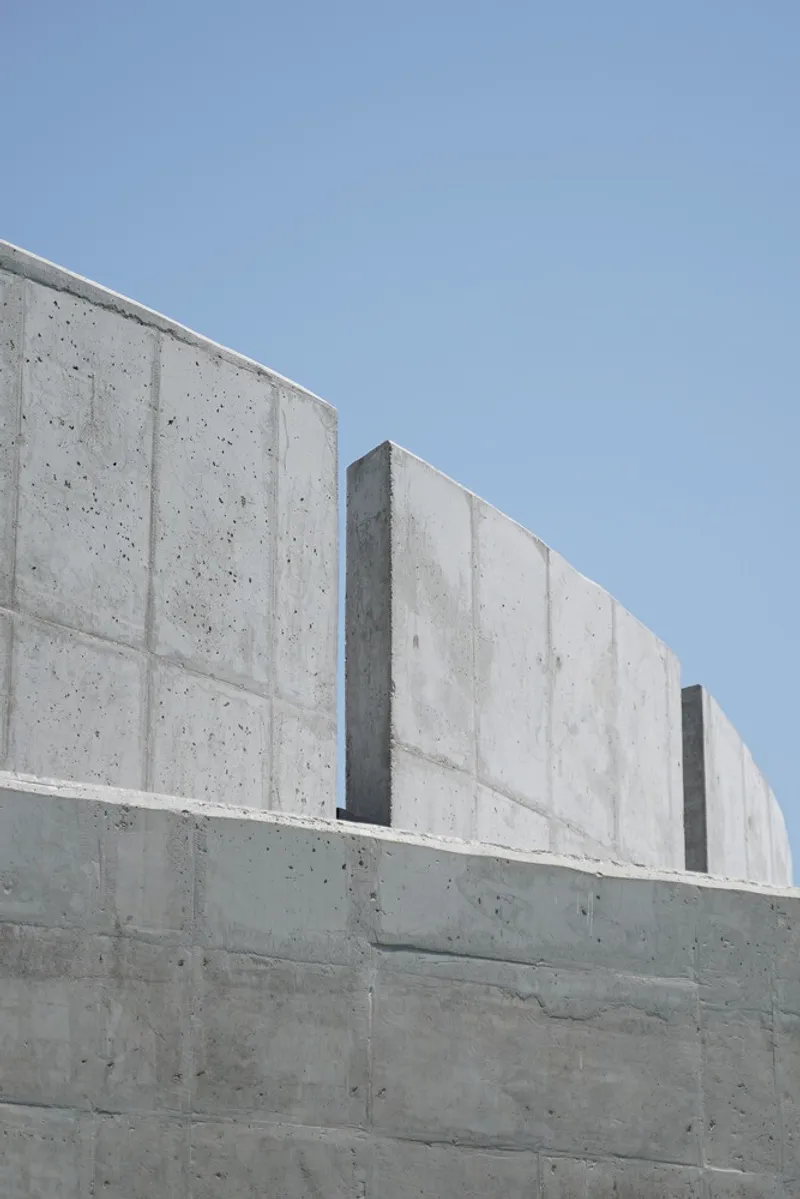

The narrow vertical openings carved through the concrete walls are OUTPOST's most recognizable gesture, and its most architecturally productive one. Each slot isolates a single tree, a patch of sky, or a band of distant hills, turning the surrounding landscape into a series of composed portraits. The board-formed texture of the concrete gives the edges of each opening a rough, handmade quality that softens the precision of the framing.
Seen from below, the stepped profile of the walls and the vertical panel joints create a fortified silhouette against the sky. There is something genuinely imposing about the geometry, which avoids the trap of making the fortress metaphor cute or decorative. The open-air nooks with angled walls and black seating offer more intimate moments within the larger ring, each one oriented to capture a different angle of the canopy overhead.
The Stone Garden Below


The first floor inverts the openness of the rooftop. Here, light arrives selectively: through the two-meter-diameter circular skylight at the center, through horizontal windows that frame green foliage at eye level, and through carefully subdued artificial lighting that never competes with natural illumination. The result is a dim, contemplative interior where the stone garden at the center becomes a kind of secular altar, natural stones arranged with small candles on a terrazzo floor beneath the oculus.
This metaphorical reinterpretation of the Dondae, stones arranged not as defensive masonry but as a meditative composition, is the most conceptually layered move in the project. Floor-level differences across the ground floor ensure that each seating zone has an unobstructed sightline toward the landscape beyond the glazing, a tiered amphitheater turned outward. The low circular walls that separate these zones manage circulation and privacy without ever blocking the view, functioning as spatial furniture rather than partitions.
Counter, Light, and Material Restraint
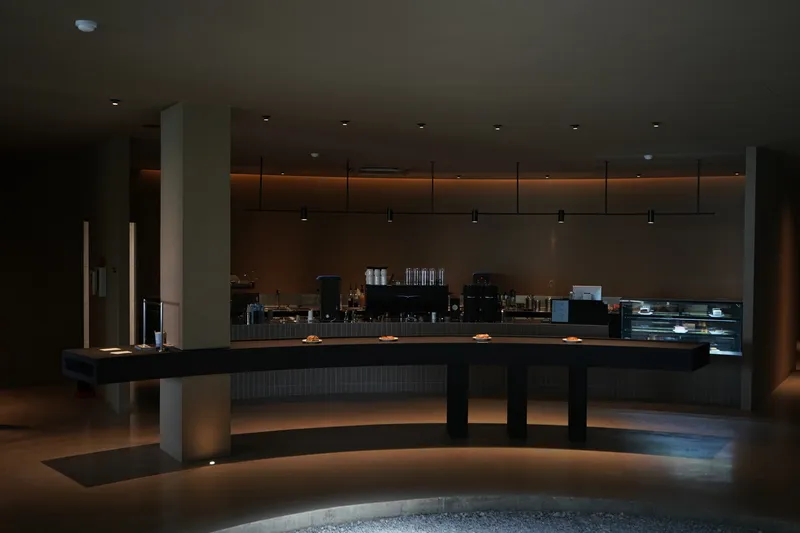
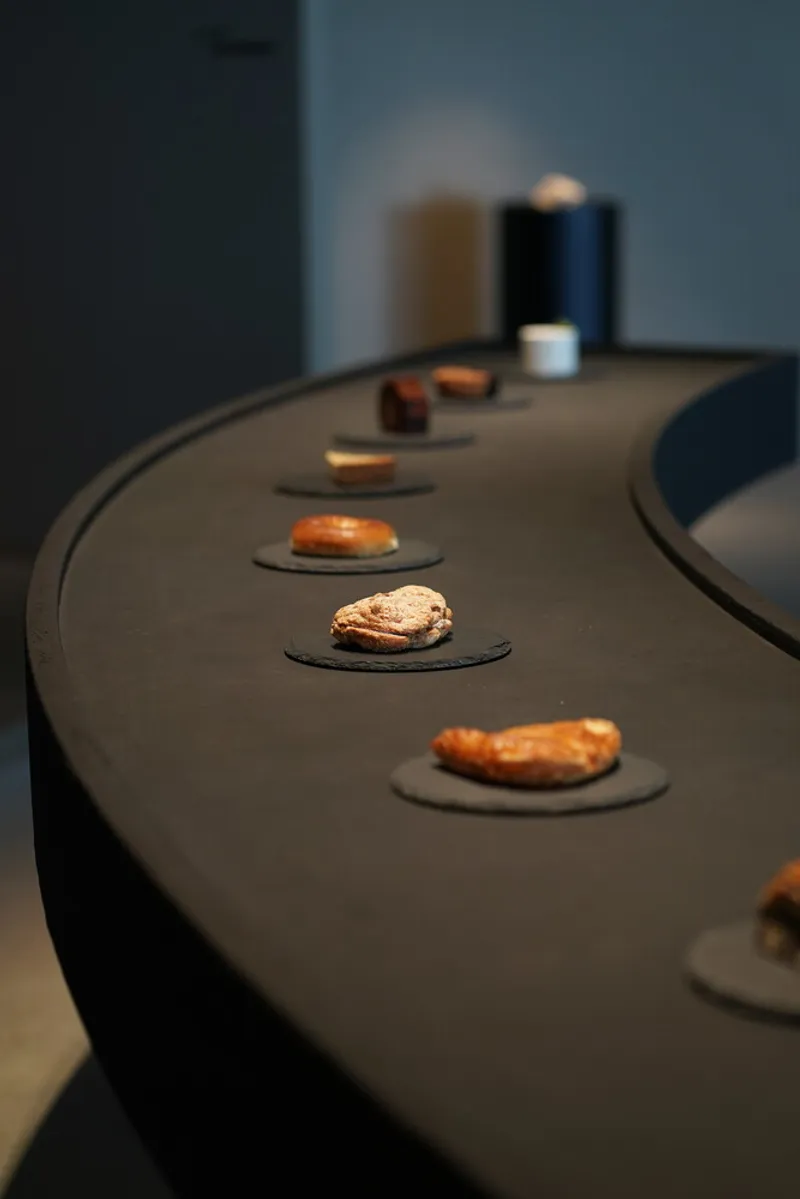

The café counter is treated as a piece of the architecture rather than a freestanding insert. A curved black surface displays baked goods on individual ceramic plates under soft warm light, while the back bar is defined by suspended ceiling panels with linear lighting that glows against the concrete ceiling. The palette across both levels, raw concrete, black metal, natural stone, earthen tones, never deviates. Every material decision reinforces the idea that this is a carved-out landscape element, not a decorated box.
Small details accumulate to sustain the mood: a row of miniature lamps on a deep window sill, recessed spotlights washing a curved wall, the brass threshold mat at the entrance. These are quiet touches that reward attention without demanding it, consistent with a design philosophy that treats the café visit as a sequence of discoveries rather than a single spectacle.
Threshold and Entry Sequence
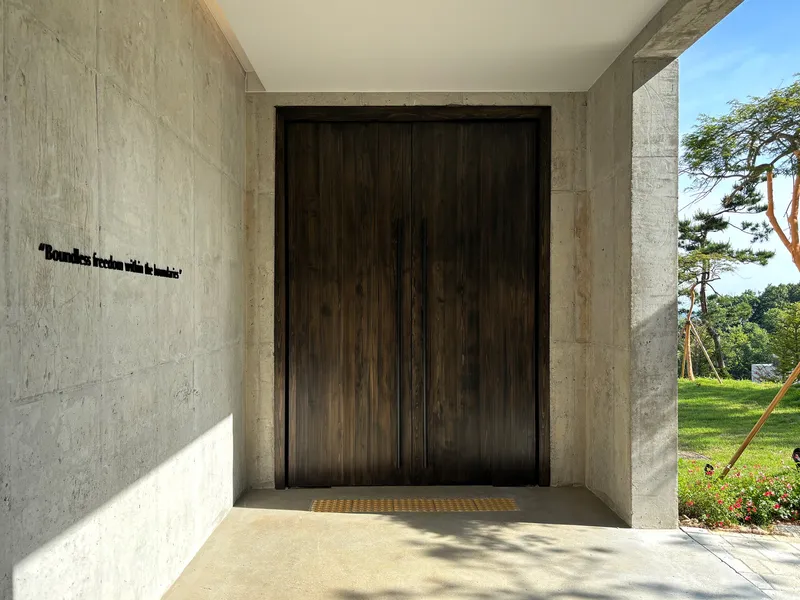

The recessed entrance, a dark timber door set within a deep concrete frame, marks the transition from the resort landscape into the café's controlled interior world. The depth of the reveal is deliberate: you pass through several feet of wall thickness before arriving inside, a haptic reminder that you are entering a fortification, however peaceful its purpose. The garden visible beyond the threshold provides a green counterpoint to the grey concrete, ensuring the transition never feels oppressive.
Plans and Drawings
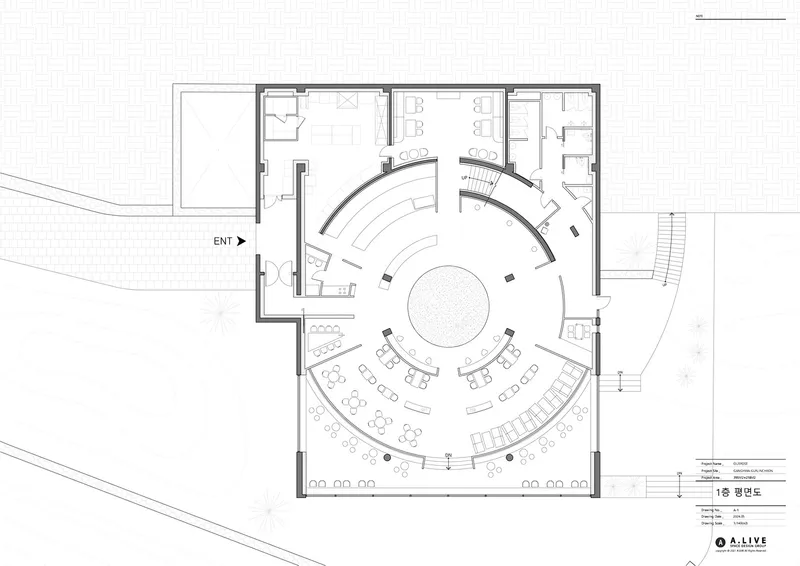


The floor plans confirm what the photographs suggest: the entire project is organized around a central circular void that acts as both skylight well and stone garden on the ground level, and as an open-air courtyard on the upper level. Radiating seating tiers fan out from this core, with service rooms pushed to the perimeter where they do not interrupt the centripetal spatial logic. The exploded axonometric reveals the stacking clearly: two concentric rings on top, a more fluid arrangement of tiered zones below, all threaded together by the vertical cylinder of light at the center.
What the drawings make especially legible is how the curved geometry generates varied seat-to-view relationships without any two positions feeling identical. The radiating segments create wedge-shaped zones that naturally orient occupants toward different parts of the landscape, giving each table its own framed panorama. It is a plan that works hard while appearing effortless.
Why This Project Matters
South Korea's café culture has produced an extraordinary range of architectural ambition over the past decade, from rural concrete pavilions to urban rooftop greenhouses. OUTPOST earns its place in that conversation not through visual novelty but through the rigor of its historical reference. The Dondae is not a mood board image here; it is the generative diagram. The concentric plan, the vertical slots, the hilltop siting, the thick walls: every major design decision traces back to a specific feature of the Joseon-era fortress. That level of commitment to a single idea is rare and, when it works, it produces architecture that feels inevitable rather than designed.
More broadly, OUTPOST demonstrates that a café can be a serious piece of architecture without being a solemn one. The stone garden, the skylight, the tiered seating: all of these create pleasure and comfort while sustaining the conceptual framework. Jeon Heesu and the team at Space Design A.LIVE have delivered a building that honors its location's military past while offering its visitors exactly the opposite of vigilance: a place to lower your guard, sit within thick walls, and look out at the trees.
OUTPOST Café by Space Design A.LIVE. Ganghwa Island, South Korea. 731 m². Completed 2024. Lead Architect: Jeon Heesu. Design Team: Jeon Heesu, Shin Hwakyung. Technical Team: Lee Kenbok, Paik Sangin. Photography by Park Jongsu.
About the Studio
Share Your Own Work on uni.xyz
If projects like this are the kind of work you want to make, uni.xyz is a place to publish your own, find collaborators, and enter design competitions.




Popular Articles
Popular articles from the community


Co-life: Sustainable Architecture for Age-Friendly Community Living
Co-life reimagines sustainable architecture for seniors through courtyards, rammed earth, shared gardens, and spaces designed for belonging.

The Musturak Paradise: Senior Living Architecture for a Connected Future in Temara, Morocco
The Musturak Paradise reimagines senior living architecture in Temara via private homes, social spaces, culture, community, and shared care.

Riyadh For All: Intergenerational Urban Design for Active Aging in Rabat
Riyadh For All reimagines urban design in Rabat with intergenerational co-living, adaptive courtyards, and Moroccan cultural exchange today.

EW PARK: Sustainable Architecture Reimagines the Future of Urban Parking
EW PARK reimagines city parking as a modular wooden tower combining automation, solar energy, electric mobility, and adaptable urban design.
Similar Reads
You might also enjoy these articles


Hodi-Mandai Geram
Project Function: Preservation and revitalization of the Intangible heritage and socio-spatial identity of the Hodi by Housing, Cultural Memory Center, Sacred Grove, landscape, local tourism economy


Olio Towers: A Mid-Rise for Performers That Fuses Housing, Rehearsal, and Stage
Located blocks from Houston's Theater District, this modular tower stacks living units around a central performance atrium.

Oasis: Modular Green Housing Carved into Dhaka's Urban Fabric
A shortlisted Plugin Housing entry reclaims unauthorized settlements in Dhaka with stepped concrete volumes, green roofs, and ventilation-driven design.

Black Hole: A Floating Megastructure for the Post-Physical Era
Emiliano Mazzarotto envisions a spherical, self-scaling arena where e-sports, digital hotels, and holographic stadiums replace traditional public space.

Explore Cafe and Restaurant Design Competitions
Discover active competitions in this discipline



Challenge to reimagine the Iron Throne


Photograph architecture without architects


Illustrate the lost glory of Angkor Wat - Render Challenge


Design challenge to reuse E-waste
Comments (0)
Please login or sign up to add comments
No comments yet. Be the first to comment!