
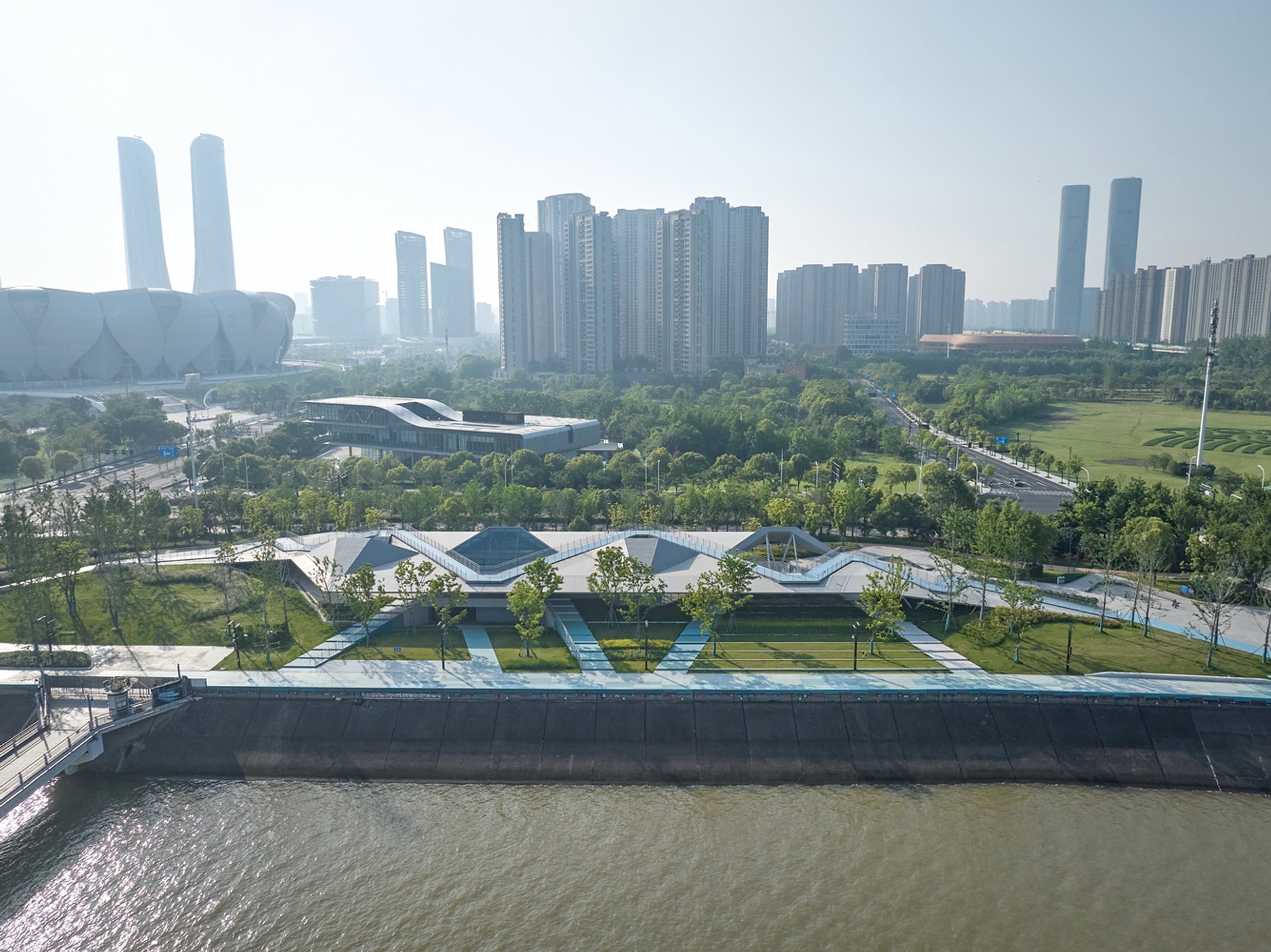
Hangzhou Riverfront Public Space – Sanqiao Asian Games Park by TJAD Original Design Studio
Sanqiao Asian Games Park revitalizes Hangzhou’s riverfront with sports, ecology, art, and architecture, blending urban life and nature.

Location: Hangzhou, China Architects: TJAD Original Design Studio Area: 1,945.4 m² Year Completed: 2023 Lead Architects: Ming Zhang, Zi Zhang, Bo Chen Photography: Yong Zhang, TJAD Original Design Studio
Revitalizing the Qiantang Riverbank for the Asian Games
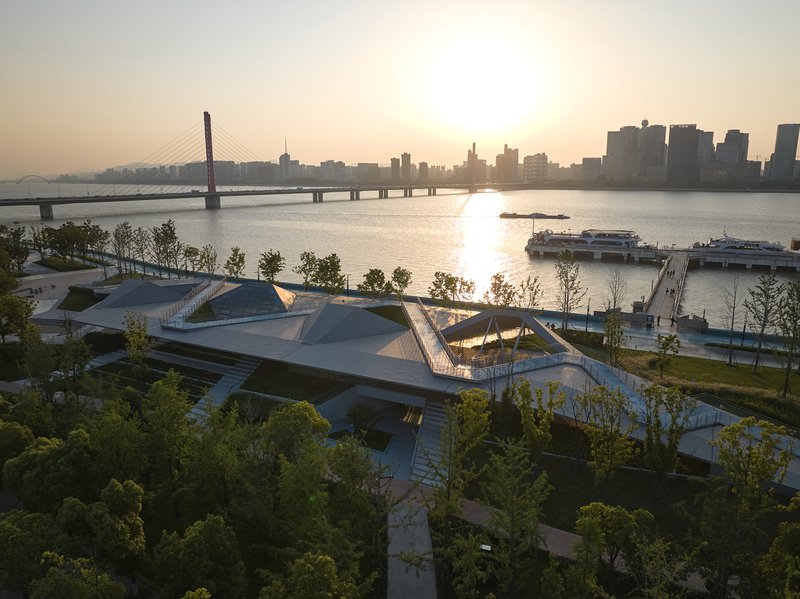
Located on the south bank of the Qiantang River in Hangzhou’s Binjiang District, the Sanqiao Asian Games Park forms a key component of the city’s 12-kilometer waterfront public space revitalization project. Designed by TJAD Original Design Studio, this riverfront park exemplifies Hangzhou’s broader vision of creating an ecologically integrated, culturally vibrant, and intelligently designed urban landscape in preparation for the 2023 Asian Games.
With a design strategy rooted in the philosophy of “hosting a great event and enhancing the city,” the park is part of a transformative shift from “Asian Games” to “Asian Games+.” It not only elevates the user experience during the games but also ensures lasting civic benefits.
A Multifunctional Urban Waterfront
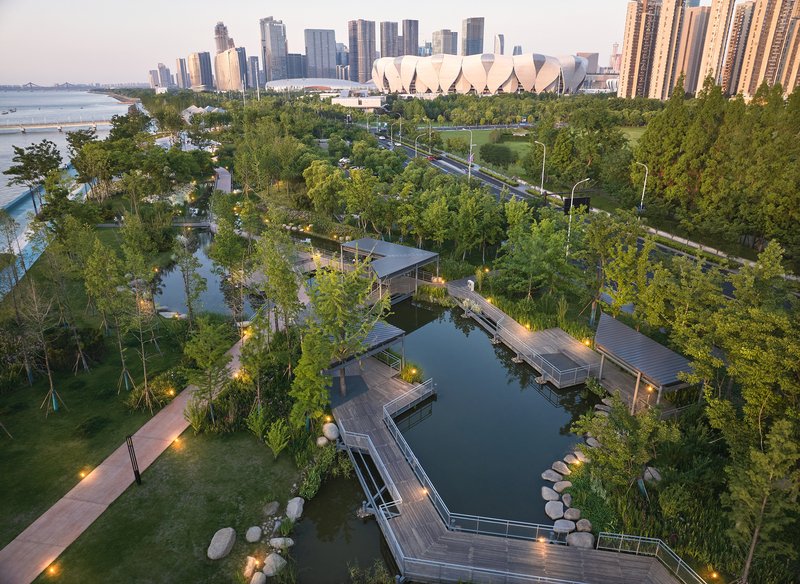
Sanqiao Asian Games Park acts as the northern gateway to Hangzhou’s expansive riverfront greenway. Its core components—Skateboard Park, Wetland Park, Yundu Station, and the Asian Games Mound—anchor a multi-use public space designed for recreation, ecological preservation, education, and sporting engagement. The design supports everyday use while integrating seamlessly with the infrastructure of the Olympic Sports Center.
Notably, the park contributes to the creation of a 17.4-kilometer sports belt free of physical walls, promoting continuity, safety, and interaction between the urban core and the riverside.
The “Orange-Blue Ribbon” Strategy and Super Seawall
At the heart of the project is the "Orange and Blue Ribbon" design concept, which symbolizes connectivity and vibrancy. The orange ribbon represents active movement paths, like running tracks and bike lanes, while the blue ribbon references ecological and landscape features along the water. Together, they form a unified system that makes the waterfront visually dynamic and spatially accessible.
A critical infrastructural element is the super seawall, integrated as part of the Anlan Trillion Seawall Project by the Zhejiang Provincial Water Resources Department. Without altering the height of the river barrier, the design achieves an elevation increase to 10.3 meters using an artistic wave-dissipation platform, upgrading the flood defense standard from a 100-year event to a 300-year event. Approximately 4.5 kilometers of seawall was elevated and reinforced.
Urban “Slices” for Seamless Connectivity
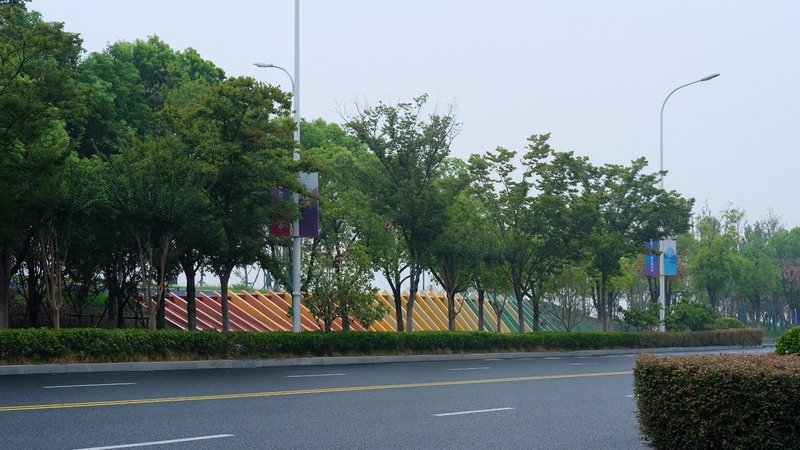
The landscape is punctuated by urban slices—sections that transition between the riverfront and the urban hinterland. These slices feature tree pits, display walls, rest pavilions, and fitness equipment, all unified by a design language derived from waveforms. Plantings and tree species enhance the natural experience, forming river-facing corridors that invite movement and relaxation.
Yundu Station: Blurring Architecture and Landscape
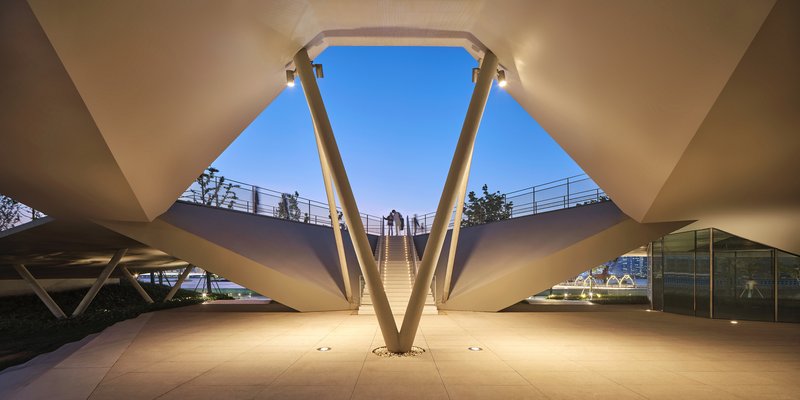
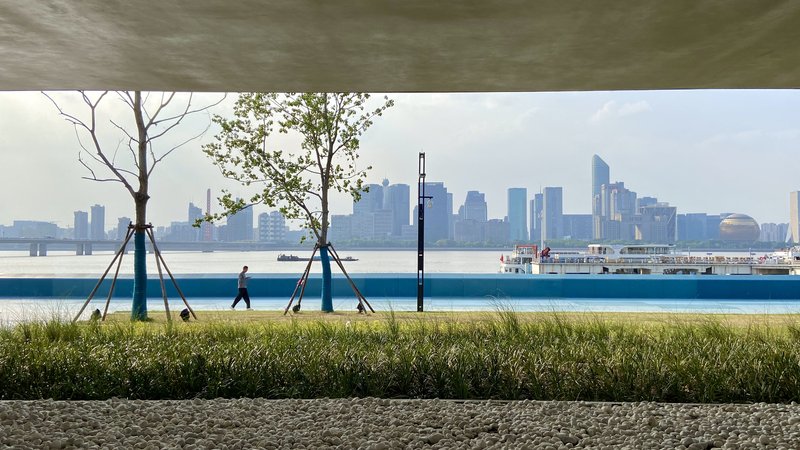
A central architectural feature is Yundu Station, covering 1,945.4 m² across two levels—an underground concrete level and an above-ground steel-structured pavilion. Originally the site of a cruise wharf, Yundu Station now functions as an urban service hub and event venue. Its design approach is described as a surgical intervention, respecting the site’s history while enhancing its relevance for today’s city life.
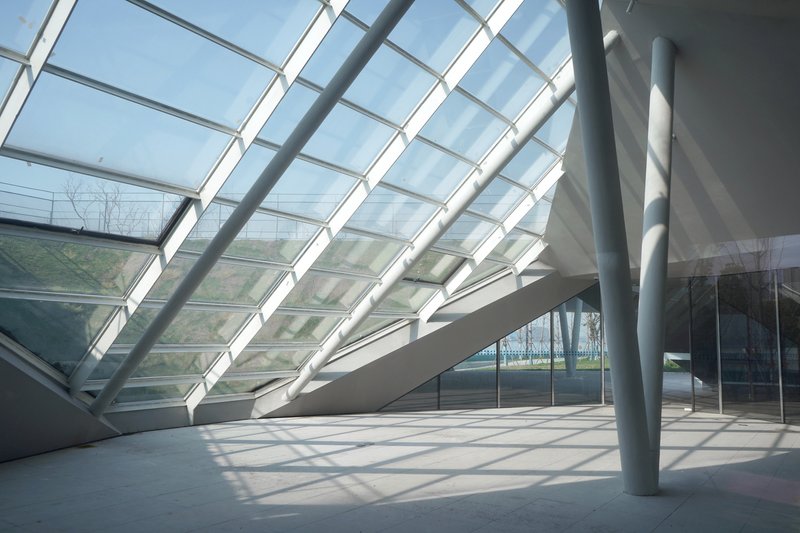
The structure’s floating blue path, framed by four rhomboid roof units supported by V-shaped diagonal struts, creates a lightweight, transparent feel. The cantilevered roof, just 200mm thick, appears to float, symbolizing the architectural lightness of the park itself. All mechanical and service rooms are tucked underground, maximizing surface-level openness for public engagement.
Interactive and Playful Design for All Ages
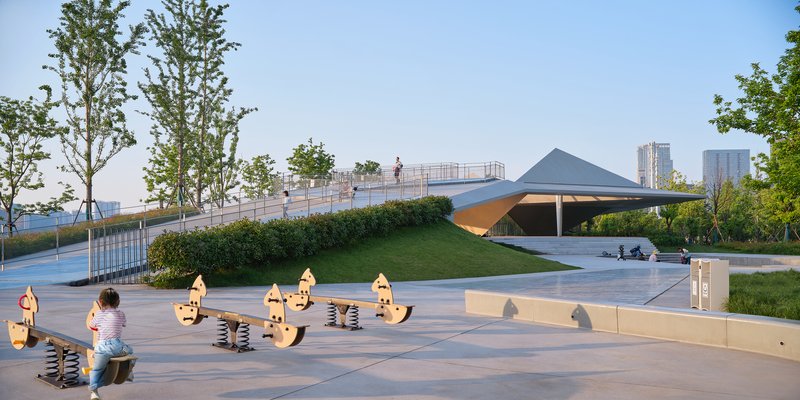
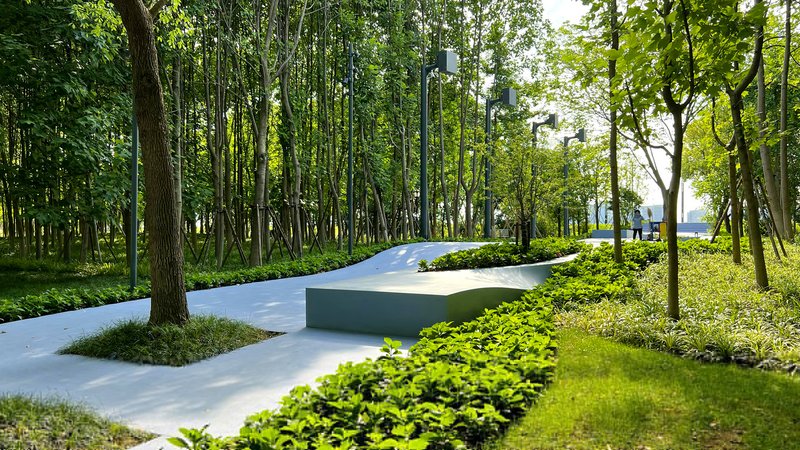
The park includes multiple recreational zones: basketball courts, a children's sandpit, rocking horses, and an extreme skateboard park. The Asian Games Mound, located near Wentao Road, features artistic concrete sculptures incorporating colors from the Asian Games logo and historical Olympic year markers. These not only serve as sculptural seating but also double as educational installations celebrating Asian Games history.
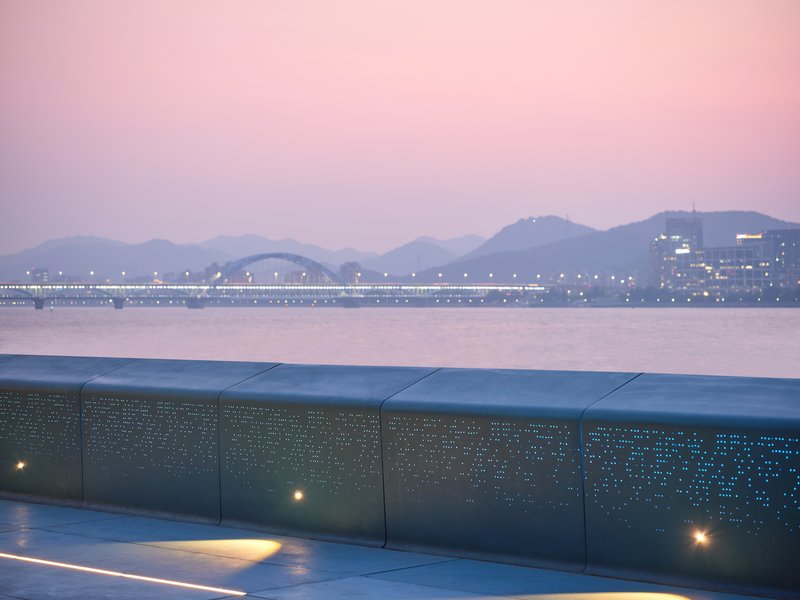
A signature element is the blue translucent concrete railing, a prefabricated design that functions as both a safety feature and a light-integrated viewing platform, offering an inviting space to rest, view, and interact with the riverfront.
A Model for Future Public Space Design
Recognized as the “Most Beautiful Greenway in Hangzhou” in 2023, the Zhijiang Greenway’s riverfront section in Binjiang District—anchored by Sanqiao Asian Games Park—embodies the future of urban design in China. It harmonizes infrastructure, landscape, architecture, and public engagement into a vibrant, resilient, and multifunctional space.



Popular Articles
Popular articles from the community

Foster + Partners Wraps a 200-Meter Shanghai Tower in Stainless Steel and Industrial Memory
The Suhe Centre Office Tower anchors a regenerated waterfront district in Shanghai with an all-steel structure that nods to local warehouse heritage.
gru.a Builds a 70 m² Timber Shelter That Opens Like a Farm Door in Brazil's Valley of the Vines
In the mountainous region near Rio de Janeiro, a compact retreat uses plywood panels and deep eaves to blur the line between inside and out.
OMCM arquitectos Builds a Summer House in Paraguay from Quarry Waste Blocks and Three Sacred Trees
In the young hillside neighborhood of Altos, a 696-square-meter concrete volume hovers on six pillars around three preserved native Yvyraju trees.
BLDUS Turns a 250-Square-Foot Screened Porch into a Pine Forest Temple in East Hampton
A gabled cedar pavilion mimics the rhythm of surrounding pines, anchoring a 1990s wooded home to its hollow in Long Island.

Similar Reads
You might also enjoy these articles

Olio Towers: A Mid-Rise for Performers That Fuses Housing, Rehearsal, and Stage
Located blocks from Houston's Theater District, this modular tower stacks living units around a central performance atrium.
Oasis: Modular Green Housing Carved into Dhaka's Urban Fabric
A shortlisted Plugin Housing entry reclaims unauthorized settlements in Dhaka with stepped concrete volumes, green roofs, and ventilation-driven design.

Black Hole: A Floating Megastructure for the Post-Physical Era
Emiliano Mazzarotto envisions a spherical, self-scaling arena where e-sports, digital hotels, and holographic stadiums replace traditional public space.
Compact & Sustainable Living in Piraeus: A Four-Level Family Home Built Around Light and Air
A narrow townhouse in one of Greece's densest port cities uses a central atrium and passive strategies to house three generations under one roof.

Explore Architecture Competitions
Discover active competitions in this discipline




The International Standard for Design Portfolios


The Global Benchmark for Architecture Dissertation Awards


The Global Benchmark for Graduation Excellence


Challenge to reimagine the Iron Throne
Comments (0)
Please login or sign up to add comments
No comments yet. Be the first to comment!