
Hiwali School by pk_iNCEPTiON: Innovative Rural Education in Nashik, India
Hiwali School by pk_iNCEPTiON in Nashik is a sustainable, modular rural school fostering innovative, activity-based learning in open, flexible spaces.

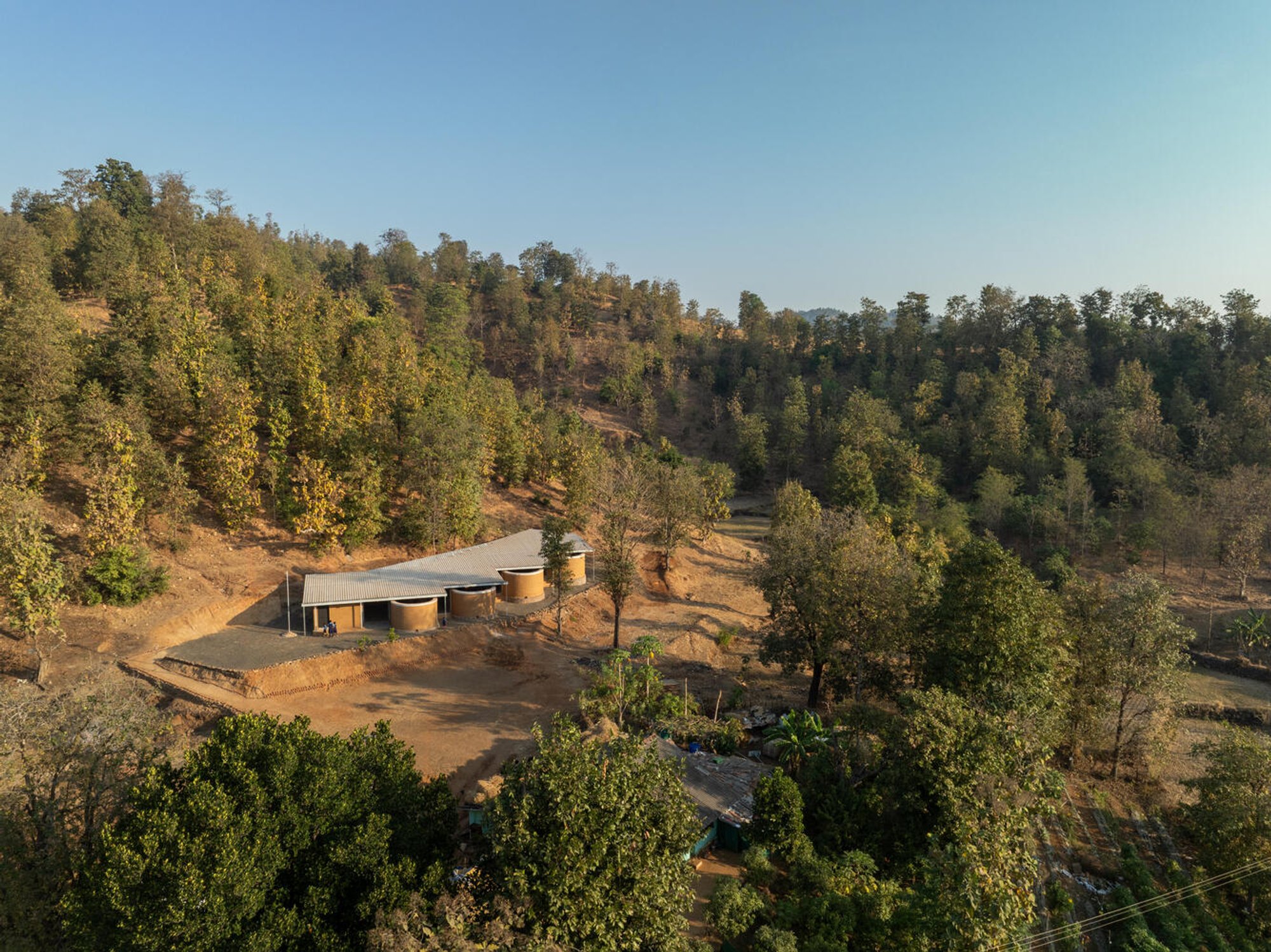
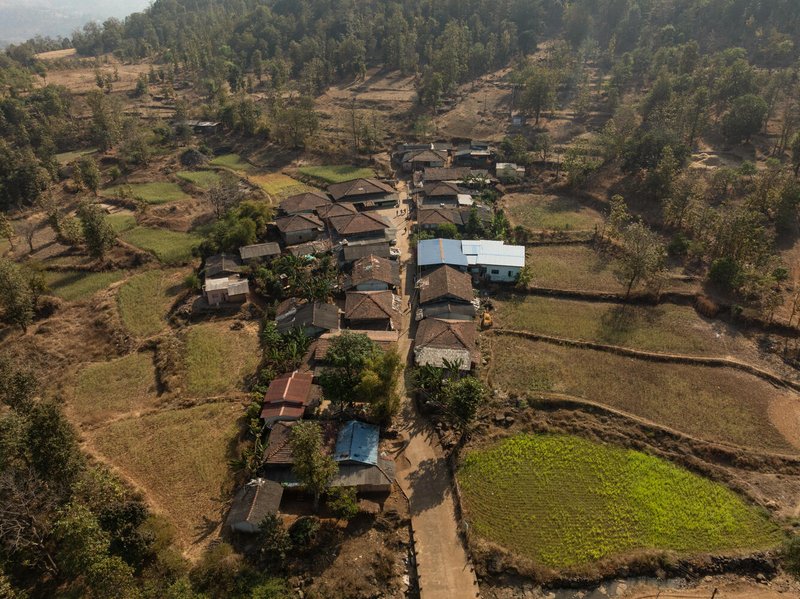
Hiwali School is a transformative educational project located in a small, remote rural settlement of approximately 25 farming households in the Satmala mountain range, about 70 km from Nashik city. Set in the hilly terrain of the Western Ghats, this underserved community previously relied on a temporary shelter for primary education.
Initiated by the Give Welfare Organization and Armstrong Robotics & Technologies, Hiwali School emerges as a beacon of rural education, designed to nurture creativity, life skills, and holistic learning. The site sits atop terraced farmland, accessible via a 50-foot hike from the village road. It is a narrow strip, bordered by the mountain to the northwest and terraced slopes to the southeast, presenting unique architectural challenges.
Innovative Teaching and Community Impact
Hiwali School thrives under the guidance of the remarkable educator Keshav Gavit, celebrated for his innovative teaching methods. His students exhibit extraordinary skills, writing with both hands and memorizing over 1,100 tables. The school serves more than 70 children from nearby settlements and operates year-round, functioning as a daycare and learning hub for ten hours each day. Education here combines academic lessons with life skills, group activities, and experiential learning, creating a vibrant, engaging environment for all students.
Design Philosophy
The architectural approach draws inspiration from Louis Kahn’s “TO and THROUGH” theory, emphasizing meaningful movement, spatial integration, and an engaging connection with the natural surroundings. The design prioritizes how the building interacts with its site and how circulation becomes a part of the learning experience.
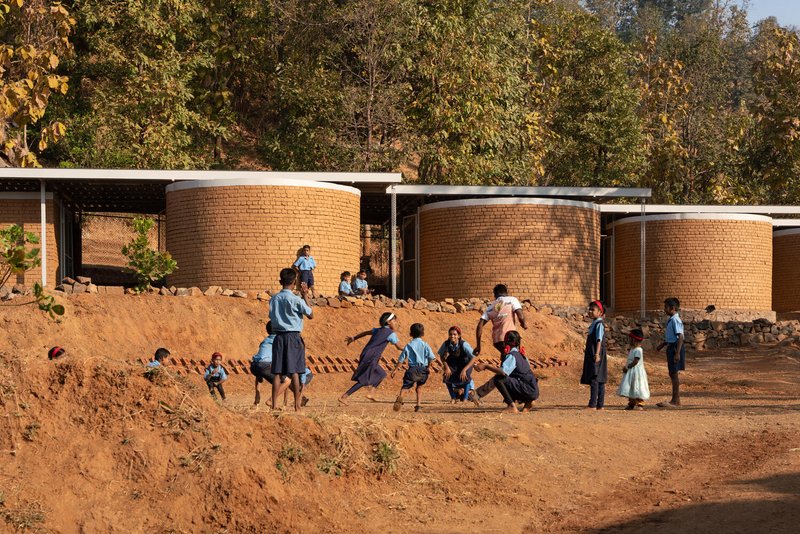
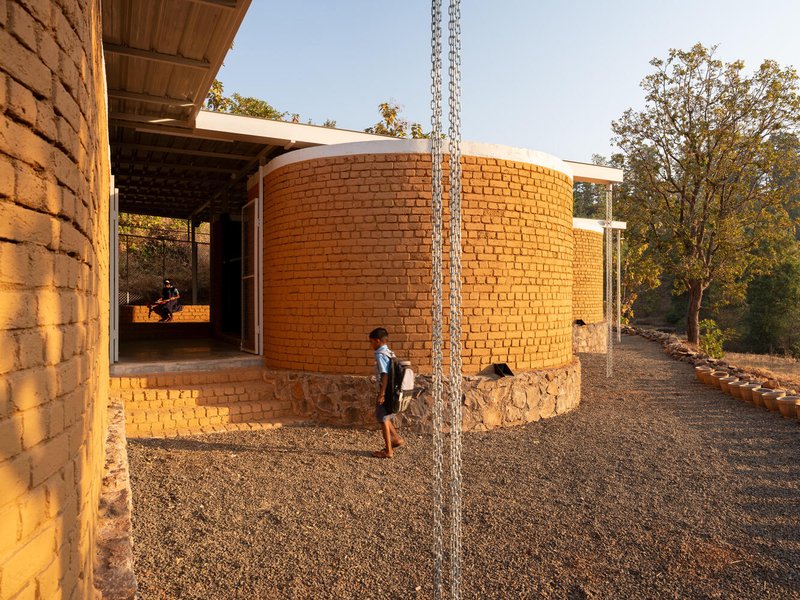
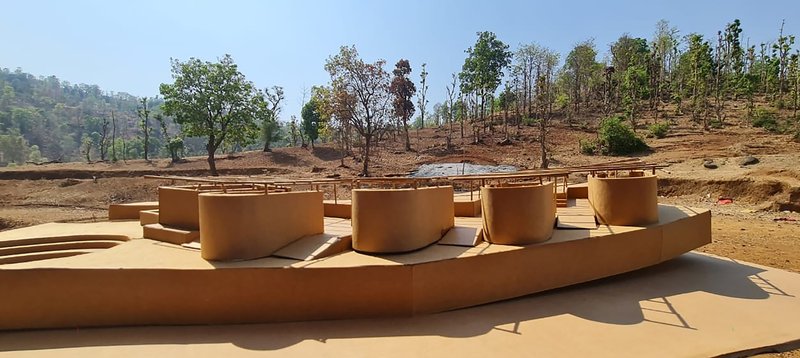
A protective water moat channels mountain runoff, safeguarding the school, while modular blocks—housing the Office, Computer Room, Science Room, Projector Room, and Library—are arranged diagonally. This layout allows for future expansion toward the mountain while aligning with prevailing winds. The U-shaped, aerodynamic block arrangement responds to its windward setting.
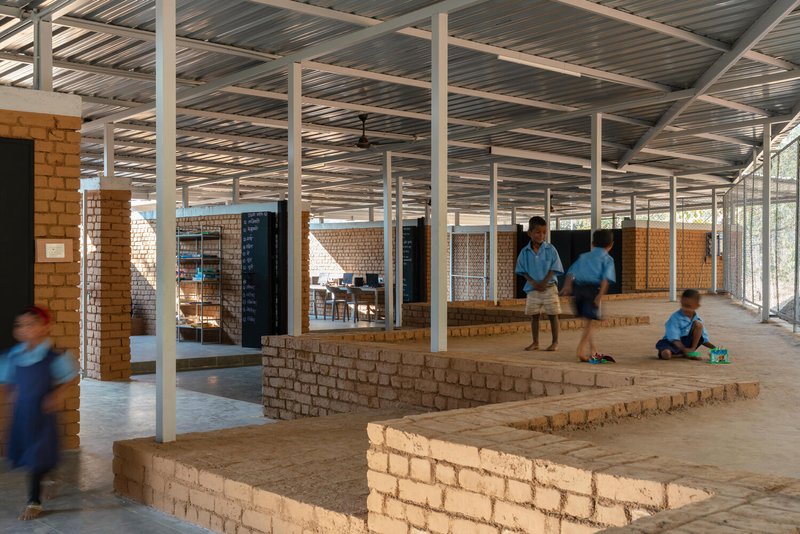
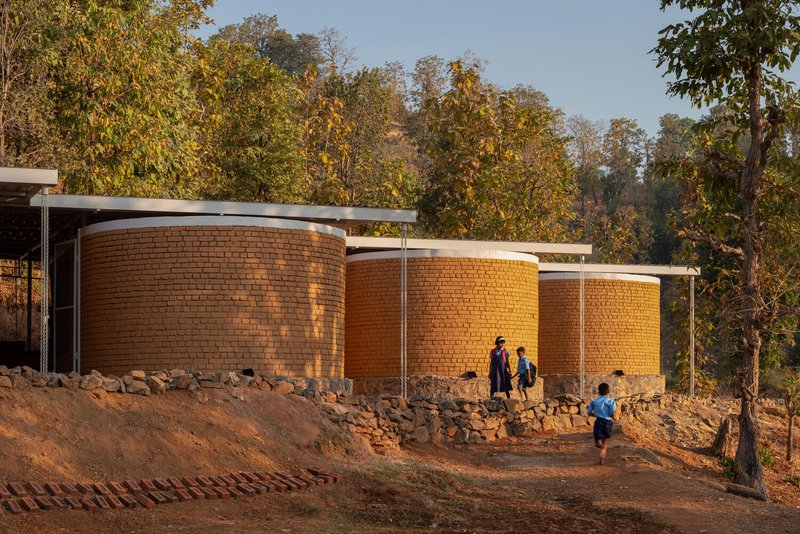
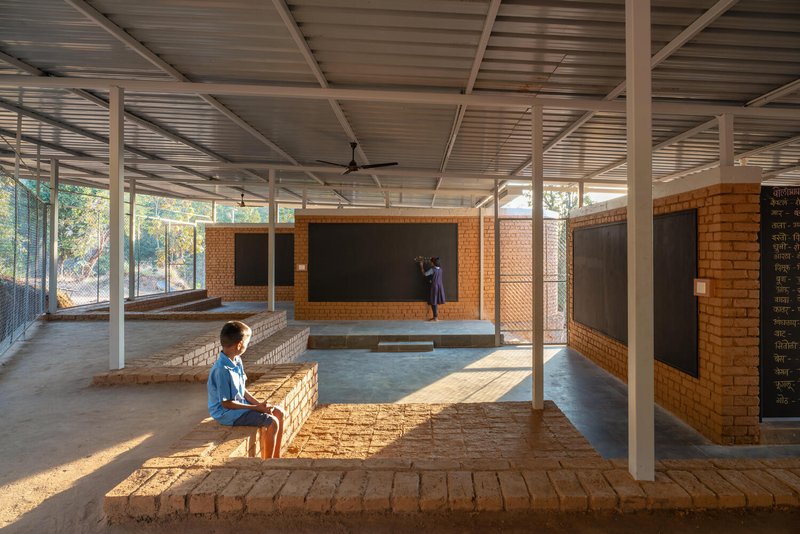
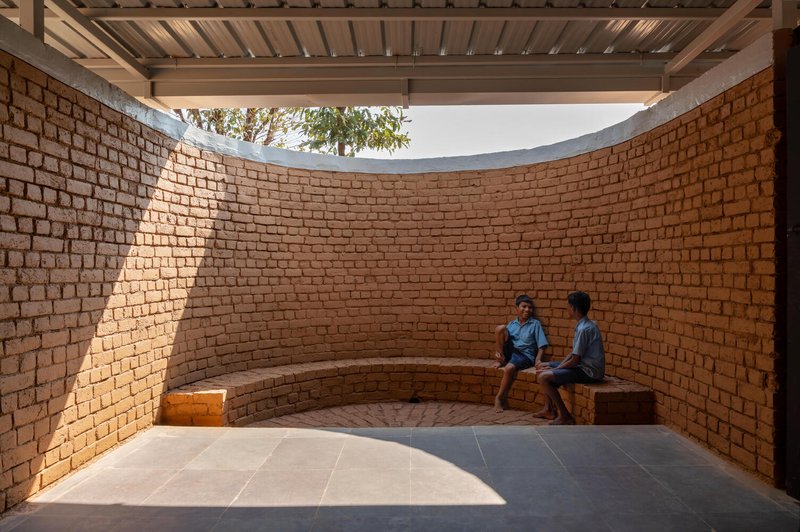
A zigzag plinth between the moat and the blocks channels water while creating playful nodes that double as indoor amphitheaters for learning and recreation. The gently sloping roof and dynamic volumes, ranging from 5 to 8 feet, establish a human scale relatable to children, allowing daylight to penetrate informal areas and semi-circular courtyards.
Flexible and Multifunctional Learning Spaces
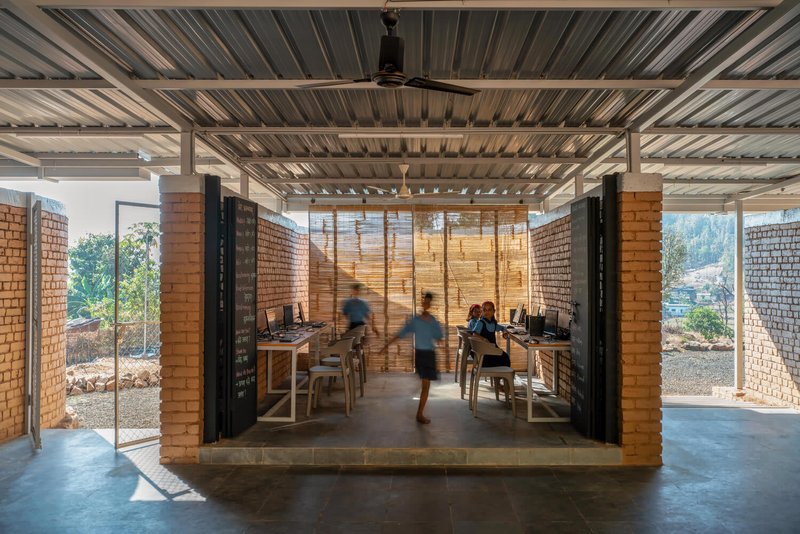
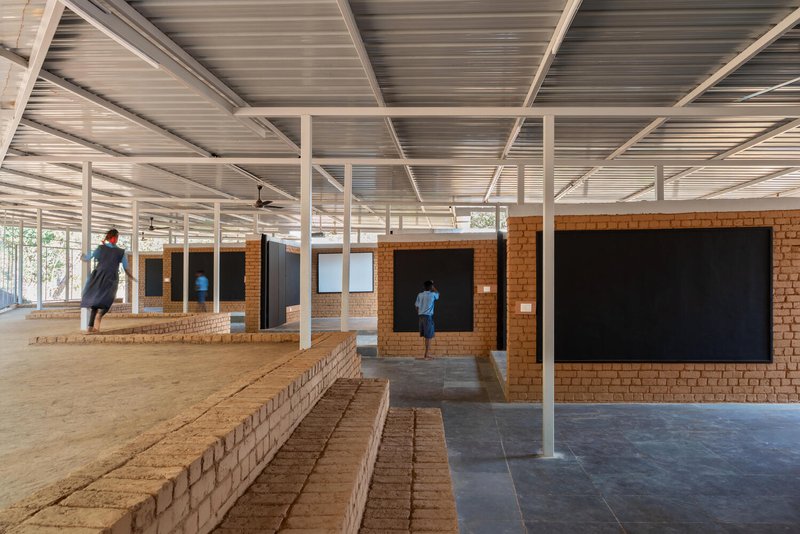
Hiwali School is conceptualized as an open, interconnected learning environment. Folding doors, blackboards, and writable stone floors enhance multifunctionality, enabling both structured and informal education. The load-bearing exposed brick walls provide durability and allow for easy display of student work.
The flat roof improves ventilation and doubles as a canvas for artistic expression, while the high plinth with cow dung flooring offers comfort for sitting, resting, or sleeping. The design supports both students and teachers, with diverse spatial scales, flowing steps, and flexible activity zones, eliminating traditional classrooms and creating multiple entry and exit points. Children are encouraged to explore, play, and build a connection with their environment, peers, and educator, cultivating independence and creativity.
Sustainability and Community-Centric Approach
Hiwali School not only serves as a rural education hub but also embodies sustainable, site-responsive design. The use of local materials, adaptive layout, and passive climate strategies ensure a minimal environmental footprint while enriching the learning experience.
This project stands as a model for innovative rural architecture, combining community engagement, educational excellence, and context-driven design.
All Photographs are works of Pranit Bora Studio




Popular Articles
Popular articles from the community


Solar Steam: A Climate-Responsive Architecture That Redefines the Monument
A climate-responsive memorial architecture that transforms heat, decay, and time into a living system reflecting humanity’s ecological impact.
Inverted Architecture Installation by Studio Link-Arc: Exploring the Intersection of Architecture and Living Organisms
Inverted Architecture Installation by Studio Link-Arc blends mycelium, sustainability, inverted design, ecological cycles, and urban adaptive architecture in Shenzhen.
Atelier Macri Concept Store Interior Design by CASE-REAL
Atelier Macri store features a "ko" counter, walnut wood details, cork displays, blending retail, gallery, and seamless customer experiences.
Gads Hill Early Learning Center by JGMA: Adaptive Reuse Shaping Community-Focused Educational Architecture
Adaptive reuse transforms fragmented structure into vibrant early learning center with playful façade, natural light, and community-focused sustainable design.


Similar Reads
You might also enjoy these articles


The Ken Roberts Memorial Delineation Competition (Krob)
As the most senior architectural drawing competition currently in operation anywhere in the world, it draws hundreds of entries each year, awarding the very best submissions in a series of medium-based categories.


Waterfront Redevelopment and Urban Revitalization in Mumbai: Forging a New Dawn for Darukhana
A transformative waterfront redevelopment project reimagining Darukhana’s shipbreaking heritage into an inclusive urban future.

OUT-OF-MAP: A Call for Postcards on Feminist Narratives of Public Space
Rhizoma Design and Research Lab invites artists, designers, architects, researchers, and students to reflect on how feminist perspectives can reshape public space. Selected works will be exhibited in Barcelona, October 2026. Submissions open until 15 April 2026.


Documentation Work on Buddhist Wooden Temple
Architectural syncretism and cultural hybridity: A comparative study of the Buddhist temples in Chattogram Hill tracks


Explore Architecture Competitions
Discover active competitions in this discipline




The International Standard for Design Portfolios


The Global Benchmark for Architecture Dissertation Awards


The Global Benchmark for Graduation Excellence


Challenge to design public laboratory
Comments (0)
Please login or sign up to add comments
No comments yet. Be the first to comment!