
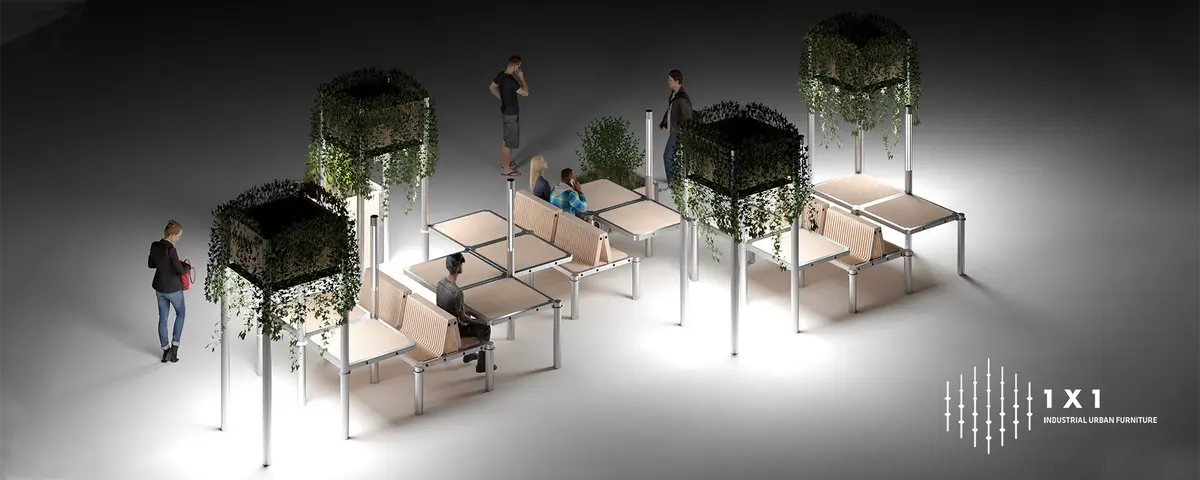
1x1 Industrial Urban Furniture: One Square Meter at a Time on Copenhagen's Shipyard Island
A modular system built on a 1x1 meter grid transforms Refshaleøen's post-industrial waterfront into adaptable, planted public space.


What if a city's public furniture could grow, shrink, and reconfigure itself as freely as the communities it serves? The 1x1 Industrial Urban Furniture system answers that question with a deceptively simple premise: a standardized one-meter-by-one-meter three-dimensional grid of vertical pipe structures that accepts interchangeable modules for seating, planting, shading, and vertical circulation. The result is not a fixed object but a spatial toolkit, one that lets a waterfront promenade become a street food market by the weekend and a community garden by the following month.
Designed by Mykolas Šečkus and Antonio Gandolfo, the project won the Urbanscape: Symbiosis competition. The site is Refshaleøen Island in Copenhagen, a former shipyard that has reinvented itself as a hub of creative and cultural activity. That industrial lineage runs through every detail of the proposal: steel pipe frames, timber cladding, and a deliberately scaffolding-like aesthetic that treats permanence as optional and adaptation as the default.
Refshaleøen's Industrial DNA as Design Language
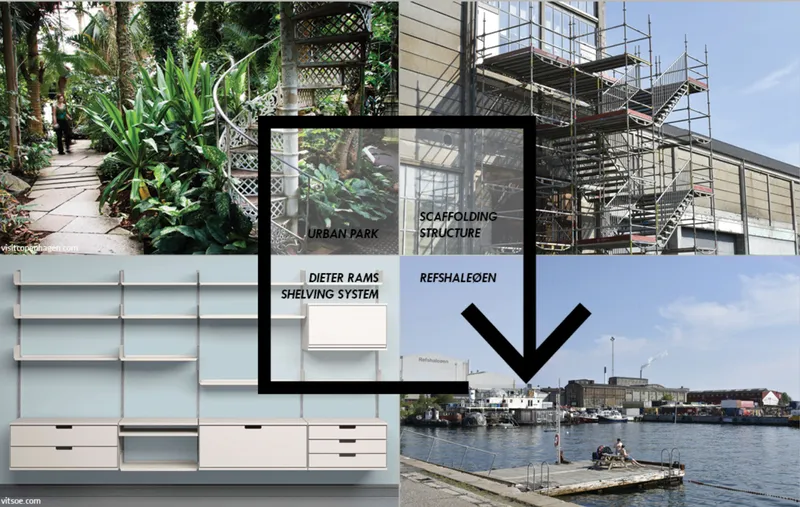
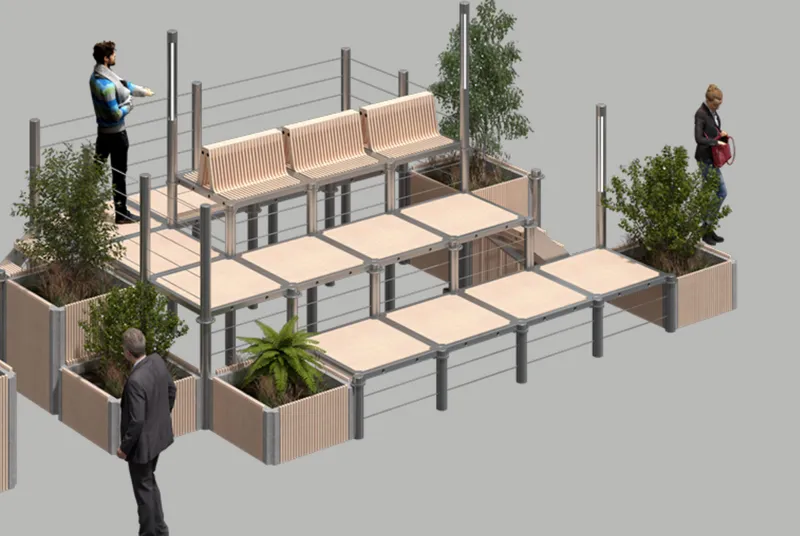
The collage of site references sets the tone immediately: planted pathways, scaffolding wrapped around warehouse facades, cyclists along the waterfront. Refshaleøen is not a blank slate but a palimpsest of heavy industry, emerging culture, and provisional landscapes. Šečkus and Gandolfo read that context carefully. Their system echoes the structural grammar of shipyard scaffolding, using steel frames as the primary organizing element while timber cladding softens the surfaces people actually touch. The isometric rendering of the base module reveals the logic: a steel skeleton at the one-meter increment, with planters and seating slotted into its bays like cargo into a ship's hold.
Configurations that Scale from Bench to Boulevard


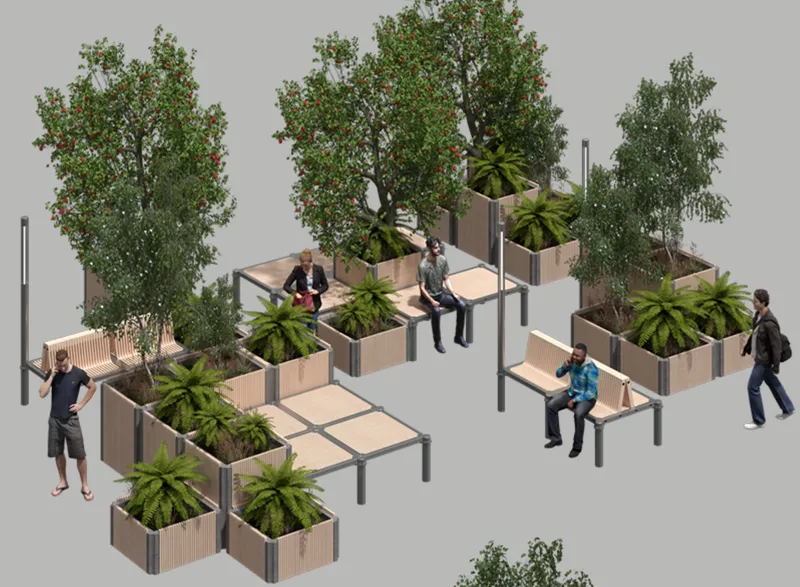
The strength of any modular system lives or dies in the range of configurations it can produce without losing coherence. Here the designers demonstrate at least three distinct assemblies. Rows of benches gain overhead trailing planters that create a green canopy, turning a simple seating row into a shaded linear garden. A stacked planter structure integrates stairs and multiple planted levels, pushing the grid vertically and suggesting the system could serve as an inhabited green wall or a tiered viewing platform. A third arrangement clusters benches and planters around mature trees, creating an informal courtyard within the grid.
What holds these variations together is the consistent structural rhythm. The one-meter grid never disappears; it simply accepts different programmatic infills. That discipline is what separates a genuine system from a collection of one-off installations. You can imagine a city maintenance crew swapping modules seasonally, or a festival organizer reconfiguring an entire plaza in a matter of hours.
The Waterfront Test: Rendered Ambition Meets Photorealistic Context

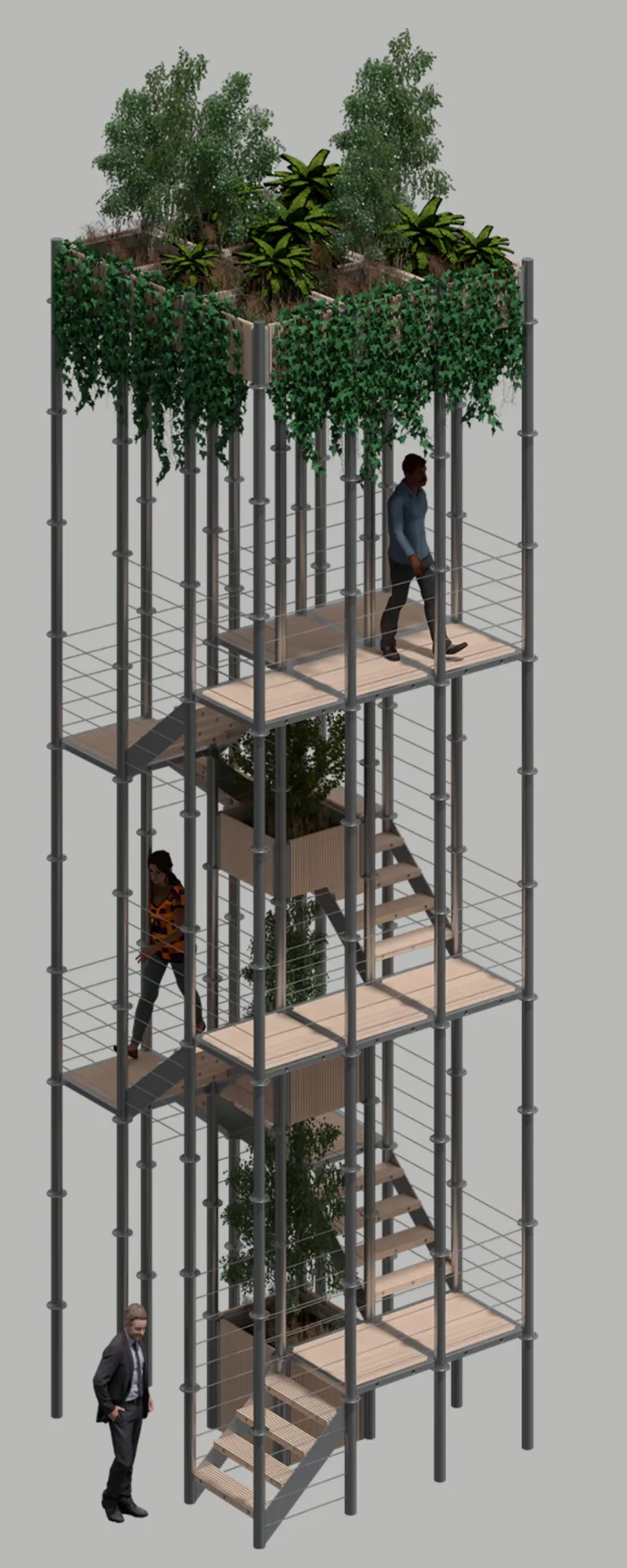
Placing modular furniture on a sun-drenched harbor promenade is the ultimate test of whether a system reads as architecture or as equipment. The waterfront rendering succeeds because the overhead planters lend the installation a canopy-like presence, giving it enough visual weight to hold its own against the scale of the harbor without blocking sightlines to the water. Adjacent to this, the vertical tower configuration pushes the system to its most ambitious expression: steel columns, timber platforms at multiple levels, and plantings cascading down. Figures stand and sit at different heights, suggesting that the grid can generate not just furniture but genuine public infrastructure, something closer to a pavilion than a bench.
Gravel, Timber, and the Quiet Power of Material Restraint
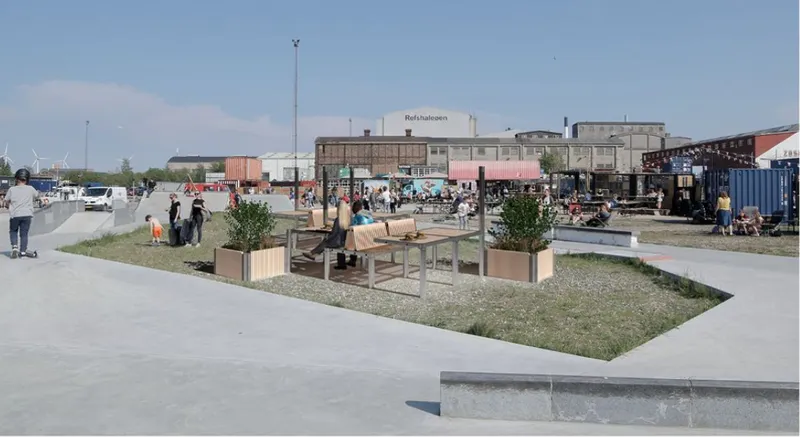
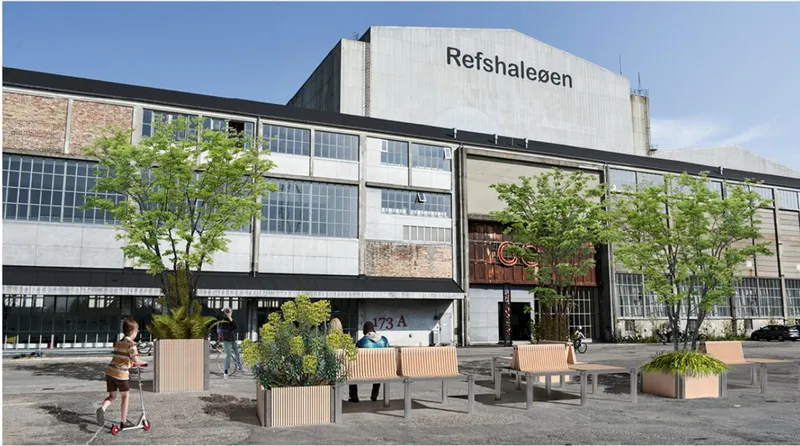
The most convincing images are often the quietest. A gravel plaza with timber benches and planted boxes, backed by existing industrial buildings, shows the 1x1 system at its most understated. Slatted timber planters and seating arranged before a converted warehouse facade reinforce the point: these modules do not compete with their context but absorb it. The material palette of steel and timber is deliberately limited, ensuring the system ages alongside the industrial structures rather than against them. Durability is built into the selection, with materials chosen to withstand coastal urban conditions while maintaining an honest, low-maintenance character.
Why This Project Matters
Modular urban furniture proposals are common in student competitions, but most fall into one of two traps: they are either so generic that they could be placed anywhere, or so site-specific that their modularity becomes moot. The 1x1 system avoids both. Its industrial aesthetic is clearly born from Refshaleøen's shipyard heritage, yet the underlying grid logic is universal enough to migrate to any mixed-use urban environment. That balance between specificity and portability is rare and worth studying.
Šečkus and Gandolfo also resist the temptation to over-design. The one-meter grid is a constraint that generates variety rather than limiting it, and the decision to foreground resilience and reconfigurability over formal novelty speaks to a mature understanding of how public spaces actually evolve. Cities do not need more signature objects; they need spatial systems that can absorb change gracefully. The 1x1 system offers exactly that, one square meter at a time.
View the Full Project
About the Designers
Designers: Mykolas Šečkus, Antonio Gandolfo
Enter a Design Competition on uni.xyz
uni.xyz runs architecture and design competitions year-round that reward proposals with spatial conviction and real site intelligence.
Project credits: 1x1 Industrial Urban Furniture by Mykolas Šečkus, Antonio Gandolfo Urbanscape: Symbiosis (uni.xyz).


Popular Articles
Popular articles from the community


ALGAL REALM: A Bio-Integrated Lunar Habitat Design for Life Beyond Earth
ALGAL REALM reimagines lunar habitat design with algae-powered life support, 3D-printed regolith, and vertical living for a lunar future.

Lunar Spiral: Space Architecture Shaped by the Mathematics of the Universe
Lunar Spiral reimagines space architecture through Fibonacci geometry, lunar regolith, levitating habitats, and self-sustaining Moon living.

Co-Life: Senior Housing Design That Reconnects Older Adults With the City
Co-Life reimagines senior housing design through healing gardens, shared streets, workshops, and a sustainable community across generations.

Conexión: Biophilic Design Reimagines High-Rise Living in Hong Kong
Conexión reimagines high-rise living in Hong Kong through biophilic design, green facades, shared spaces, daylight, water and nature within.

Similar Reads
You might also enjoy these articles

Day and Night Park: A Time-Based Urban Newsstand in Beijing
A temporary urban newsstand in Beijing blending travel, light, and reading through poetic colors, compact form, and community-focused design.

Modernist Patio Renovation in El Masnou, Barcelona by Oliver Segura Arquitectura + Cebrià Arquitectura
Modernist patio renovation blending tradition and innovation with a movable pool, leveled floors, and Catalan materials in El Masnou.

Alto Residencial Coop: Cooperative Housing Development in Santiago de Compostela by Carbajo Barrios Arquitectos
A linear cooperative housing complex blending white volumes and perforated metal façades, enhancing community living, natural light, privacy, and urban integration.
Vil Genis School by BPA ARCHITECTURE – Massy, France
Vil Genis School in Massy, France, features sustainable design, south-facing classrooms, community integration, accessible spaces, and modern educational architecture.

Explore Modular Furniture Competitions
Discover active competitions in this discipline

Challenge to merge furniture with learning

Competition to design a workstation for architects

Packaging challenge - Design meets sustainability
Comments (0)
Please login or sign up to add comments
No comments yet. Be the first to comment!