

MARBÄ Artquitectura Carves a Green Courtyard into a Dense Barcelona Ground Floor
A former parish, printing press, and bazaar in L'Hospitalet de Llobregat becomes a bioclimatic live-work home organized around a central garden.


L'Hospitalet de Llobregat is one of the most densely populated cities in the European Union, a place where ground-floor spaces cycle through identities faster than the buildings themselves age. The site that became Oasi House has been a parish, a printing press, and a bazaar. When architect Júlia Marbà Prats of MARBÄ Artquitectura first walked in, all three lives were still visible in the walls. Rather than erase that accumulated memory, the 350-square-meter renovation leans into it, stripping surfaces back to their honest bones and inserting a central garden courtyard that turns the plan into something closer to a Roman domus than a typical Barcelona ground floor.
What makes Oasi House genuinely interesting is not the courtyard idea itself, which is ancient, but the specificity of its execution in an extremely constrained urban condition. The garden is not decorative. It is the building's thermoregulatory core: a retractable glass roof allows it to breathe in summer and close in winter, while the rooms around it receive daylight, ventilation, and temperature moderation from the green center. Lighting designer Maria Alonso Sala of Cálida Lighting developed the artificial illumination in parallel with the architecture from the start, an approach that is still rare and that pays off in every evening photograph of this project.
The Courtyard as Climate Machine
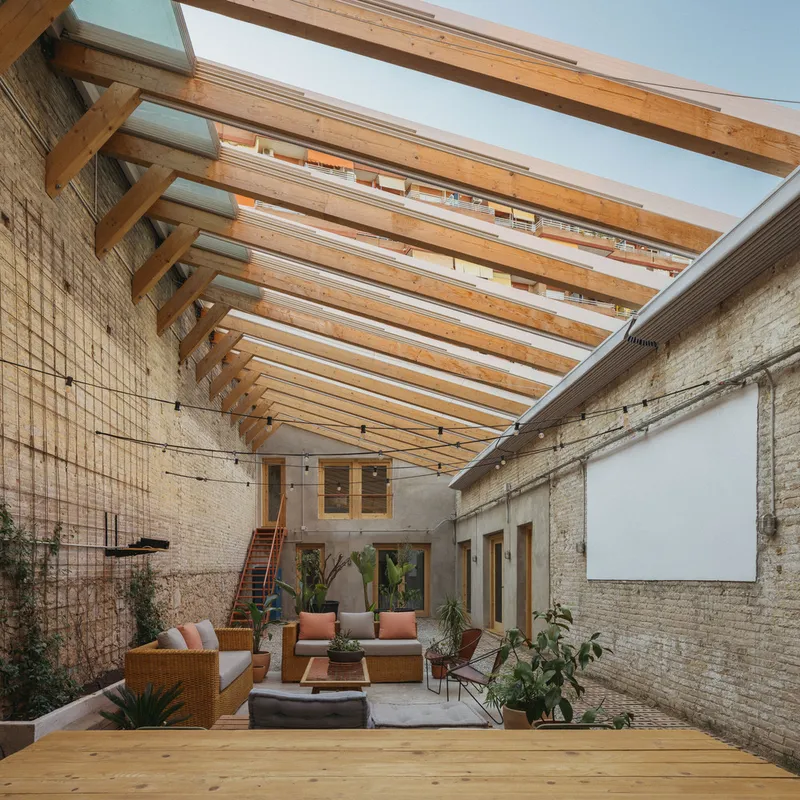
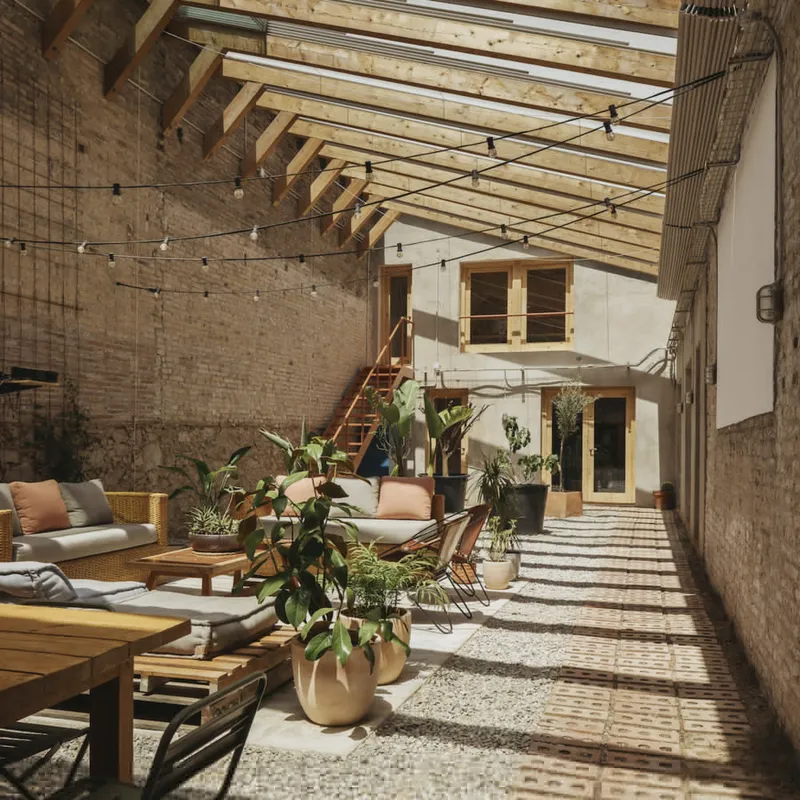
The central courtyard is framed by exposed brick walls and spanned by solid timber beams from local supplier Grau i Grau. Potted plants, a patterned tile floor, and carefully placed gravel create a sequence of textures that reads more like a garden room than a corridor. Afternoon sun enters at a steep angle, casting sharp shadows across the floor and activating the space as a sundial of sorts, constantly reminding occupants of the day's rhythm.
The retractable glass rails overhead are the key move. Open, they turn the courtyard into a true outdoor space that pulls hot air upward and out. Closed, they trap warmth and create a greenhouse effect that tempers adjacent rooms in cooler months. It is a passive strategy borrowed directly from Mediterranean precedent, but refined with contemporary hardware so the homeowners can adjust it in seconds rather than seasons.
Light After Dark

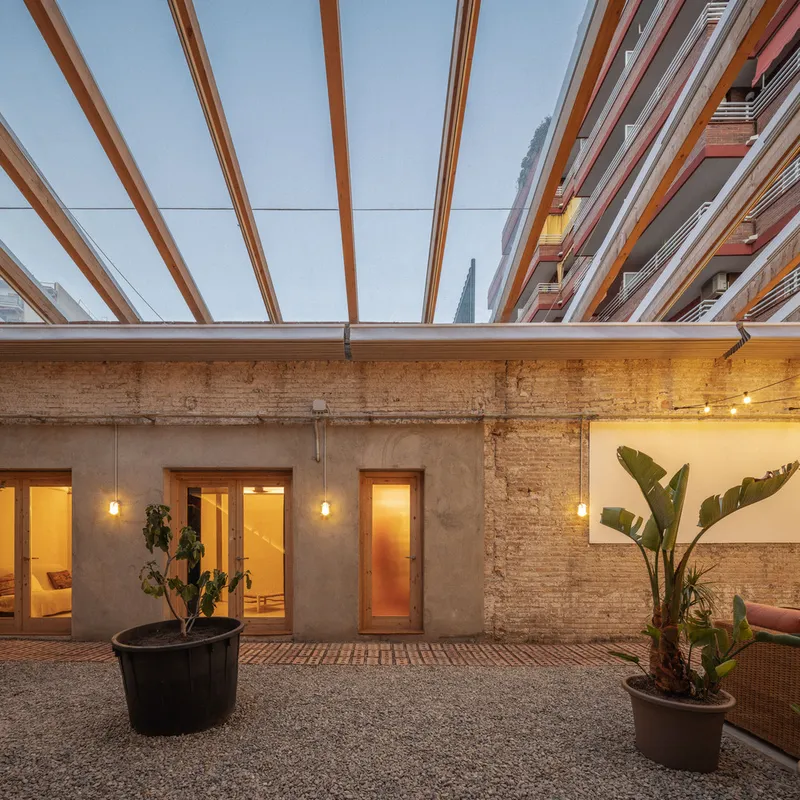
At dusk the courtyard reveals its second personality. Warm artificial light floods the timber-framed openings and washes the brick walls from below, transforming the garden from a climate device into a social stage. The timber slat canopy overhead filters the last daylight while the banana plants and potted trees become silhouettes against glowing interiors. Cálida Lighting's contribution is legible here: the fixtures are invisible, but their effect is architectural, carving depth into surfaces that would otherwise go flat at night.
The timber staircase that connects to the upper level reads as a piece of furniture at this hour, its treads catching light from multiple directions. There is no single focal point. Instead the eye moves continuously between greenery, structure, and glow, which is exactly the effect a good courtyard should produce.
Working in Honest Materials
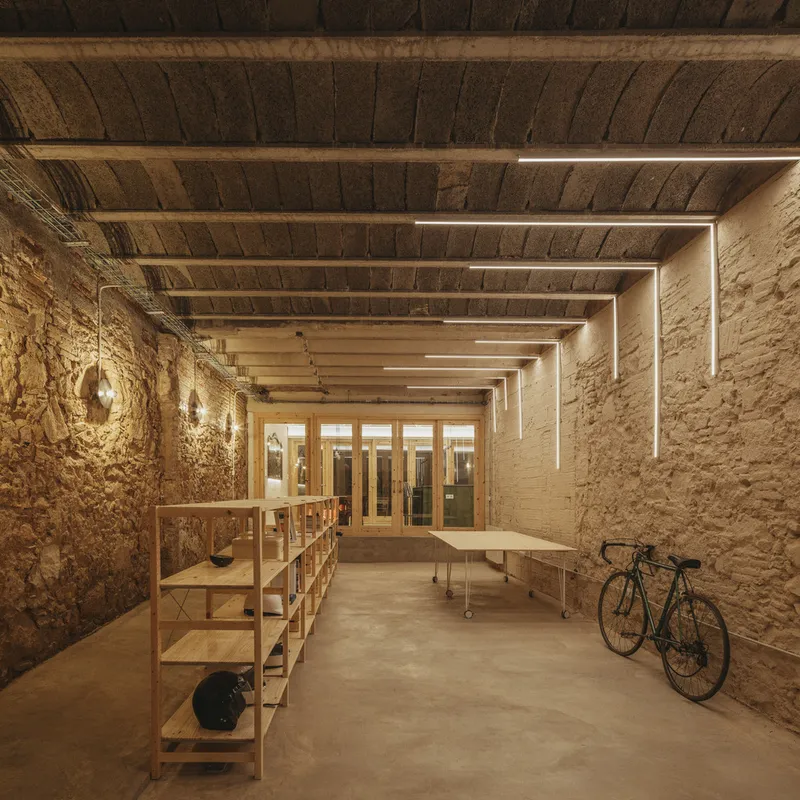
The workspace runs the full depth of one wing, its exposed stone walls and timber ceiling beams left deliberately unfinished. A bicycle parked against the wall and a long desk beneath linear strip lighting give the room the casual discipline of a studio that is actually used. MARBÄ calls their material approach "sincere," and the word fits: installations are revealed rather than concealed, original wall textures are preserved, and defects are treated as evidence of the building's long biography rather than problems to be solved.
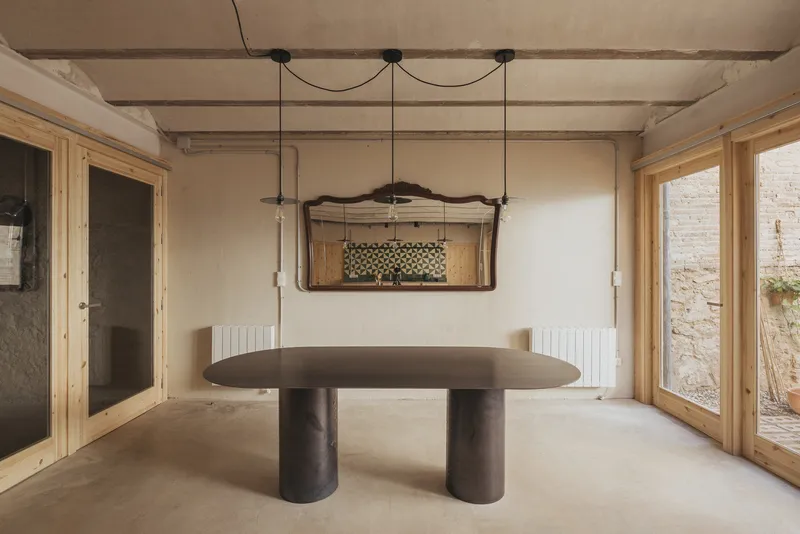
Elsewhere, a polished concrete floor anchors a room where a cylindrical table sits beneath pine-framed glazing. The material palette across the entire project, glazed ceramic, clay, wood, concrete, and glass block, is entirely local and deliberately limited. Each element does double duty as both surface and story, connecting the new intervention to the building's previous lives without nostalgia.
Domestic Warmth in the Details

The kitchen island, clad in green glazed tile, is a moment of deliberate color against the otherwise earthy palette. Its geometric patterned backsplash and timber joinery push the room toward something more craft-oriented than the raw aesthetic of the workspace, a smart tonal shift that signals the transition from professional to personal life within the same 350 square meters.
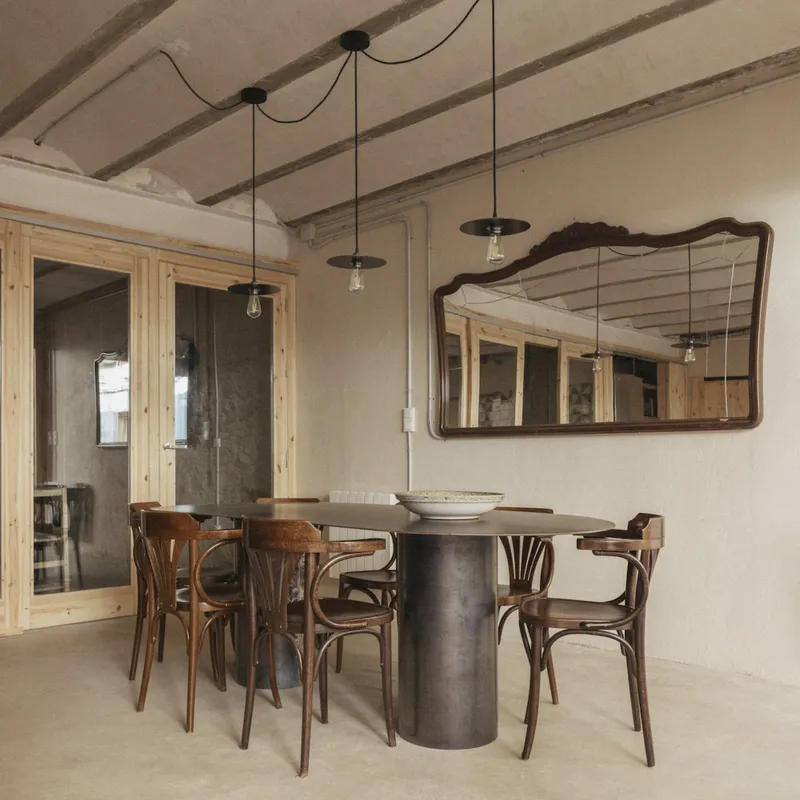
The dining area continues that warmth with a round table, bentwood chairs, and an organic-shaped mirror that softens the geometry of exposed beams overhead. These rooms are not styled for photographs; they are scaled and furnished for two people who live and work here daily. The flexibility that MARBÄ built into the plan, the ability for rooms to shift function as the young couple's needs change, is less visible in images but critical to the project's long-term success as a home.
Why This Project Matters
Dense European cities are full of ground-floor commercial spaces that have outlived their original purpose. The reflexive response is to gut them and insert white-walled apartments that ignore both the building's history and the climate outside. Oasi House offers a more intelligent model: use the depth of the plan to create a courtyard, use the courtyard to regulate temperature and daylight, and use honest local materials to hold onto the spatial memory that makes the place worth inhabiting in the first place.
The project also demonstrates something that the profession still struggles to internalize: lighting design is architecture, not decoration. By bringing Cálida Lighting in at the concept stage, MARBÄ ensured that the spaces work as well at nine in the evening as they do at noon. In a city where ground floors are often the darkest, least desirable addresses, that integration is not a luxury. It is the difference between a renovation and a genuine transformation.
Oasi House by MARBÄ Artquitectura, with lighting design by Cálida Lighting. L'Hospitalet de Llobregat, Barcelona, Spain. 350 square meters. Completed February 2023. Lead architect: Júlia Marbà Prats. Lighting designer: Maria Alonso Sala. Photography by Alejandro Gómez Vives.
About the Studio
Share Your Own Work on uni.xyz
If projects like this are the kind of work you want to make, uni.xyz is a place to publish your own, find collaborators, and enter design competitions.



Popular Articles
Popular articles from the community


Co-Life: Senior Housing Design That Reconnects Older Adults With the City
Co-Life reimagines senior housing design through healing gardens, shared streets, workshops, and a sustainable community across generations.

Hill & Cross Opera: Sculptural Opera House Architecture Shaped by Tallinn’s Landscape and Identity
Hill & Cross Opera reimagines opera house architecture in Tallinn through its sculptural hill, civic plaza, glass wave and a luminous cross.

AL-JANNAH: Sustainable Architecture and Permaculture for Afghan Widows
AL-JANNAH uses sustainable architecture and permaculture to create resilient oasis of housing, learning, work and renewal for Afghan widows.

The Earth Pod: 3D Printed Homes for Resilient Refugee Communities
The Earth Pod reimagines refugee housing through 3D printed homes made from clay, combining resilience, self-sufficiency, and rapid shelter.


Similar Reads
You might also enjoy these articles


Hodi-Mandai Geram
Project Function: Preservation and revitalization of the Intangible heritage and socio-spatial identity of the Hodi by Housing, Cultural Memory Center, Sacred Grove, landscape, local tourism economy


Olio Towers: A Mid-Rise for Performers That Fuses Housing, Rehearsal, and Stage
Located blocks from Houston's Theater District, this modular tower stacks living units around a central performance atrium.

Oasis: Modular Green Housing Carved into Dhaka's Urban Fabric
A shortlisted Plugin Housing entry reclaims unauthorized settlements in Dhaka with stepped concrete volumes, green roofs, and ventilation-driven design.

Black Hole: A Floating Megastructure for the Post-Physical Era
Emiliano Mazzarotto envisions a spherical, self-scaling arena where e-sports, digital hotels, and holographic stadiums replace traditional public space.


Explore Green Oasis Competitions
Discover active competitions in this discipline



Challenge to reimagine the Iron Throne


Photograph architecture without architects


Illustrate the lost glory of Angkor Wat - Render Challenge


Design challenge to reuse E-waste
Comments (0)
Please login or sign up to add comments
No comments yet. Be the first to comment!