
Steimle Architekten Carves a Monolithic Fire Station from Red Concrete in Germersheim
A sculptural civic building at the southern gateway to Germersheim channels the weight of red sandstone into a flexible emergency facility.


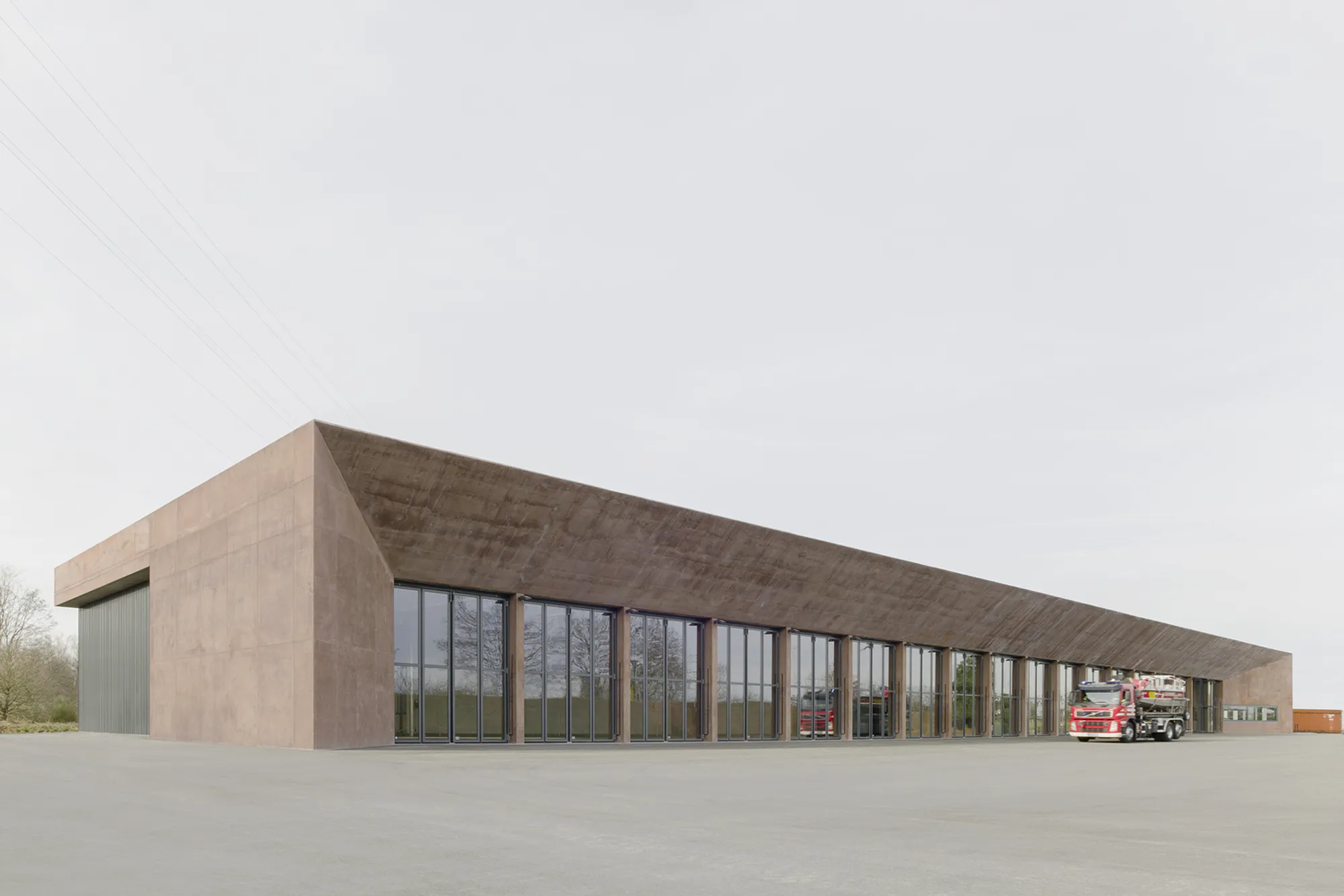
Fire stations rarely get to be architecture with a capital A. The brief is utilitarian: park trucks, store gear, get people out the door fast. But when Steimle Architekten took on the new Service Facility North for the Germersheim Volunteer Fire Brigade, they treated the program as raw material for a genuinely monolithic civic building. Positioned parallel to the B9 expressway at the southern entrance to the city, the 3,640 square meter station reads like a block of red sandstone quarried and hollowed to fit its purpose. Reddish pigmented concrete shifts in hue with the weather, turning a deep crimson in the rain and warming to terracotta under direct sun.
What makes the project worth studying is how literally its form follows its operations. Two massive concrete cubes flank an 18-bay vehicle hall, their outer walls canting inward to frame the hall entrances with a polygonal, almost geological profile. Behind that sculptural gesture sits a rigorously organized plan: foyer, operations center, workshops, respiratory protection area, clothing care, social rooms, and a drive-through wash hall, all arranged so that every route from alarm to departure is as short as possible. Completed in 2023 after seven years of design and construction, it sets a benchmark for how civic infrastructure can carry architectural ambition without sacrificing a second of response time.
The Concrete as Character
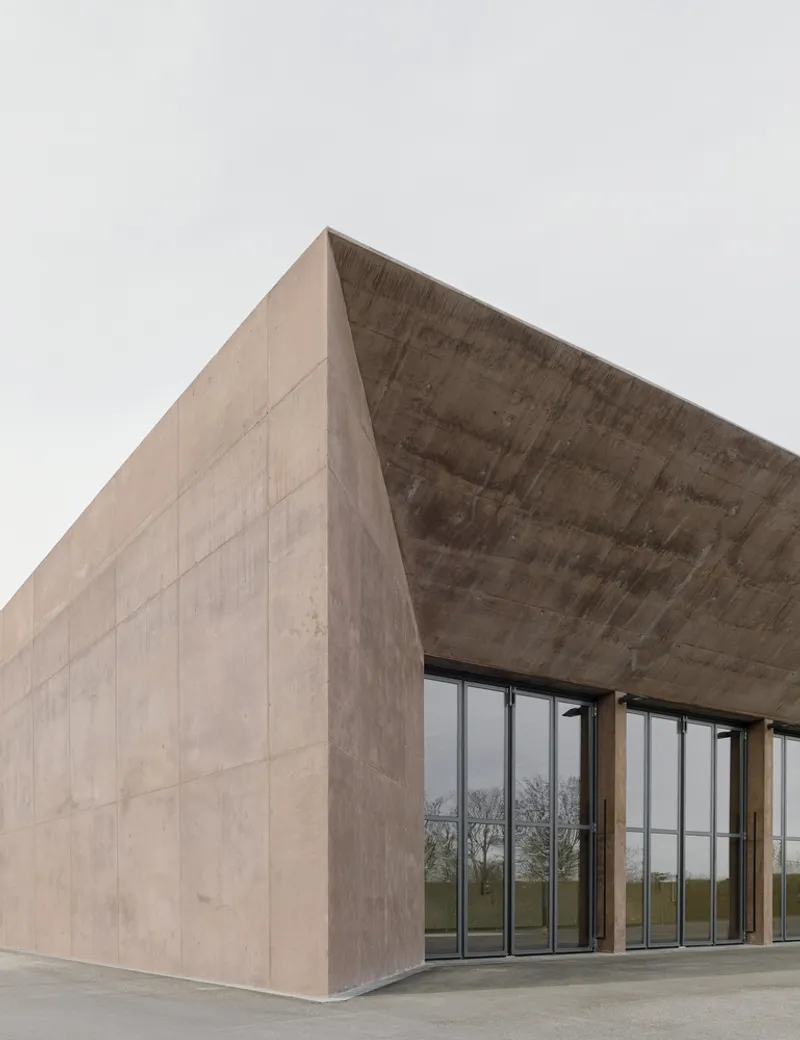
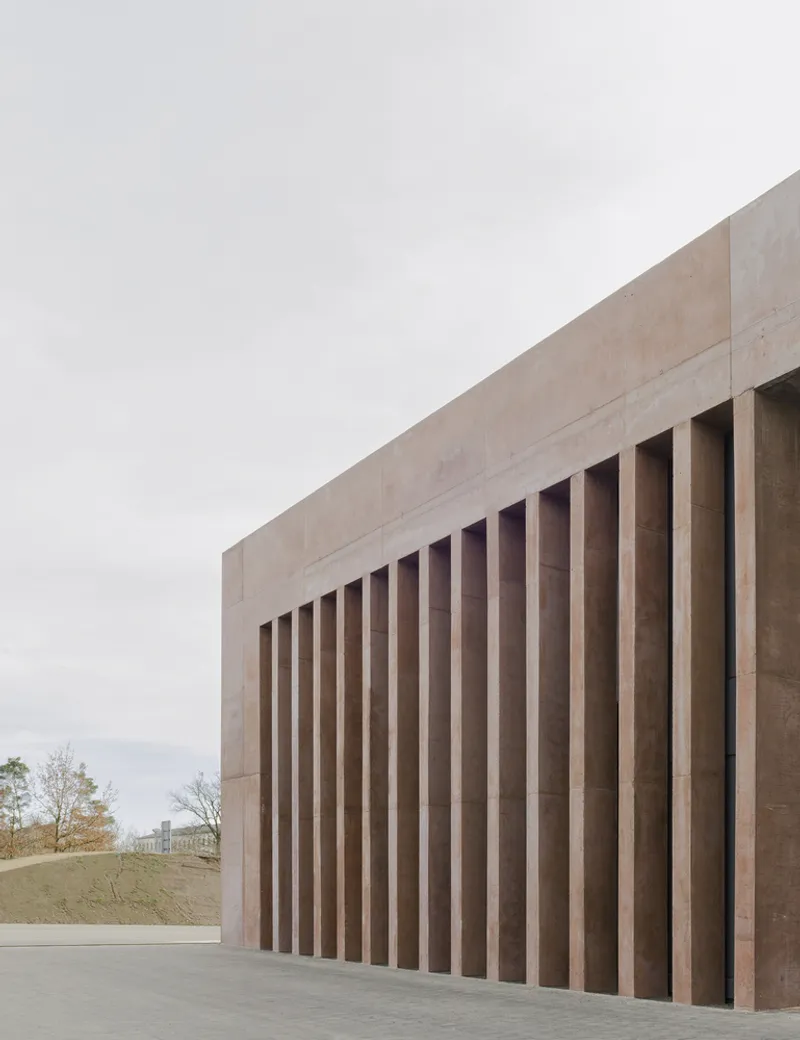
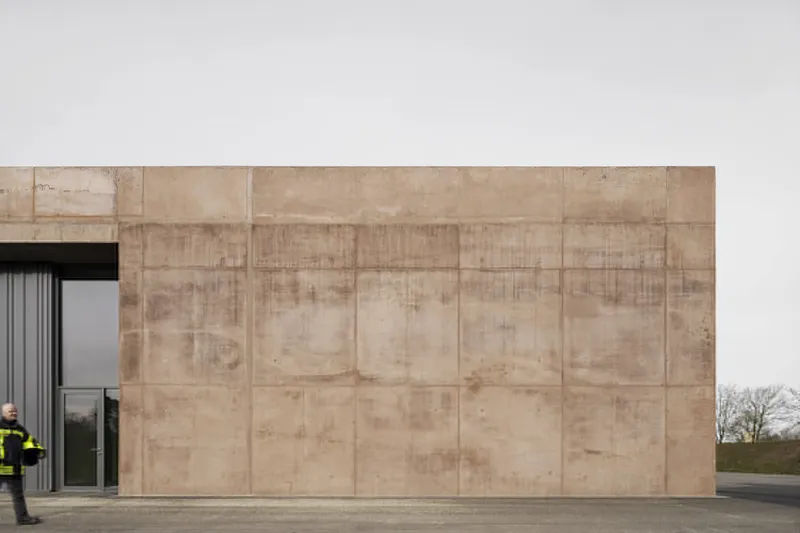
The building's identity comes down to a single material decision: board-formed, reddish-tinted concrete used as both structure and skin. Steimle Architekten push the concrete vocabulary hard. Vertical fins project from the facade to create deep shadow recesses, giving the long elevations a rhythm that reads differently at every angle. Up close, the board marks in the formwork are legible, lending a grain-like texture that reinforces the sandstone analogy. There is no applied cladding, no rain screen, no secondary layer. What you see is the building.
The recessed glass entrance bays are set far enough back that the concrete mass dominates the street view, yet they pull daylight deep into the plan. It is a careful calibration: the building needs to look solid and permanent, a civic anchor, but it also needs to be transparent enough for the foyer to function as a public exhibition space for a historic fire engine. The gridded panel zones and fin systems visible across the facade are not decorative; they correspond to the structural bays and program zones behind them.
Vehicle Hall and Operational Frontage
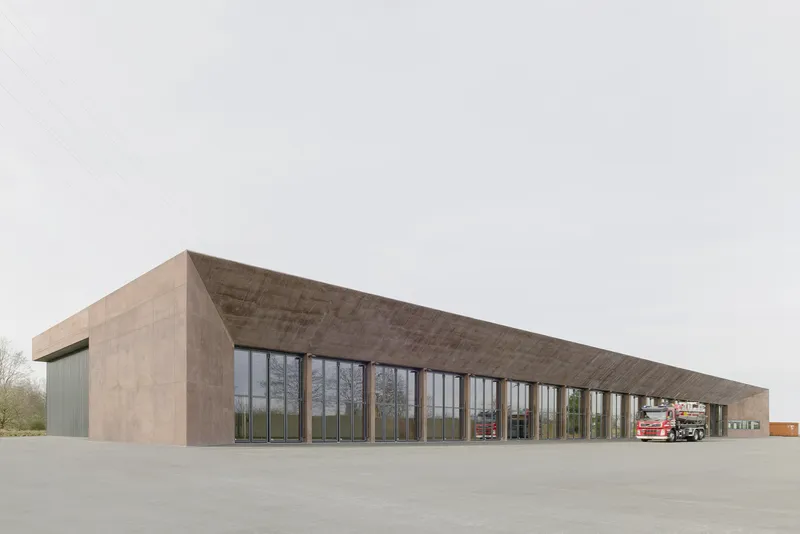
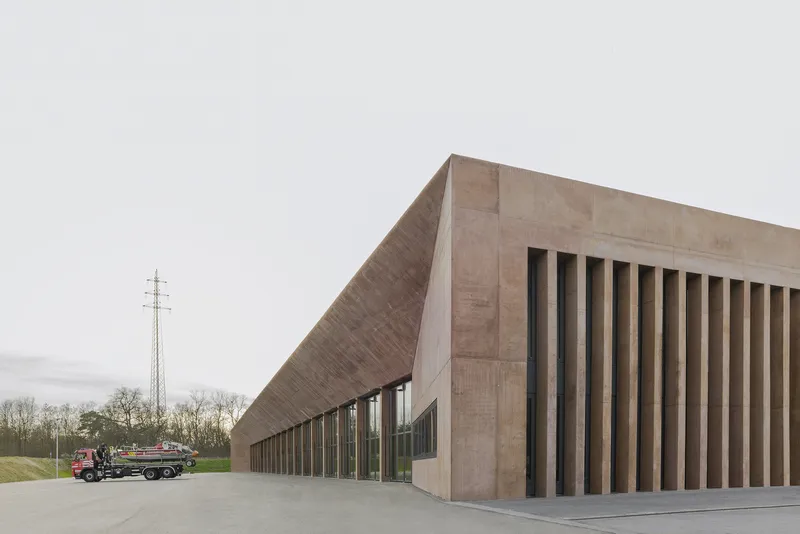
The southeast-facing vehicle hall is the operational heart of the station, housing 18 parking spaces behind a long glazed frontage shielded by a cantilevered canopy. The two flanking cubes slope their outer walls toward the hall, and together with the sloping canopy roof they form a polygonal sculptural frame around the entrances. It is a move that gives the utilitarian act of rolling out fire trucks a sense of ceremony. The long elevation reads as a controlled rhythm of concrete, glass, and the bright red of the parked engines visible through the bays.
Operationally, the hall connects along its entire northern length to workshops, warehouses, and service rooms. Emergency personnel arriving by car can access their stations directly from the parking area behind, bypassing the public foyer entirely. The wash hall at the northwest corner allows drive-through access, so returning trucks can be cleaned and restaged without reversing. Every circulation decision prioritizes the sequence of an alarm response.
Interior Logic: Workshops and Infrastructure
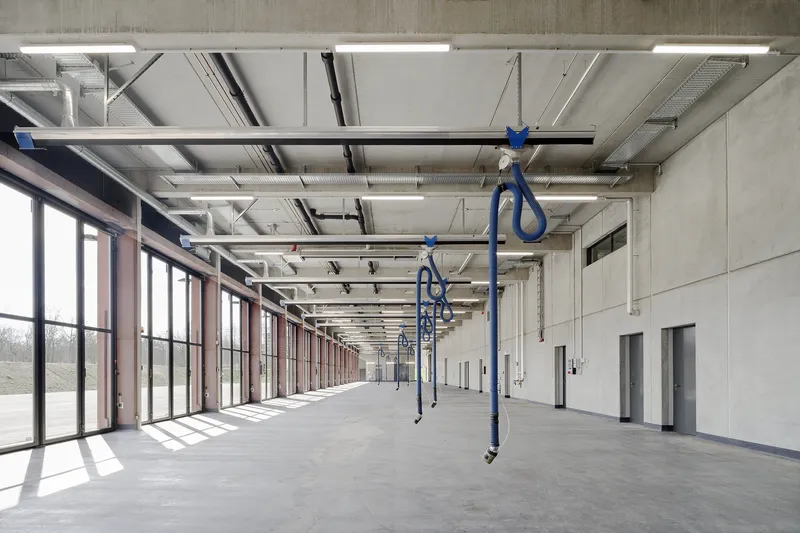
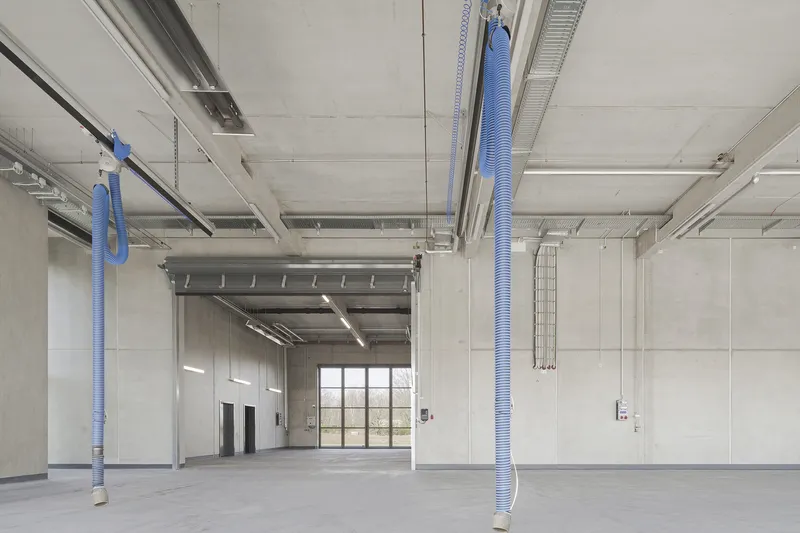
Inside the service zones, the architecture steps back and lets the equipment speak. Exposed concrete waffle slab ceilings span the workshops, their coffers doubling as routing channels for the blue ventilation ducts and chain hoists suspended below. Continuous strip glazing along the north wall washes the work surfaces with even daylight, avoiding the glare issues that come with south-facing openings in deep-plan industrial spaces. The palette is deliberately restrained: raw concrete, steel fixings, blue mechanical systems. Nothing competes with the functional clarity of the room.
The waffle slab is not just an aesthetic choice. It reduces the dead weight of the floor structure while maintaining the clear spans needed for equipment access, and it integrates services without the need for a separate suspended ceiling. For a volunteer fire brigade with limited maintenance budgets, every exposed system is one fewer hidden problem.
Thresholds and Circulation
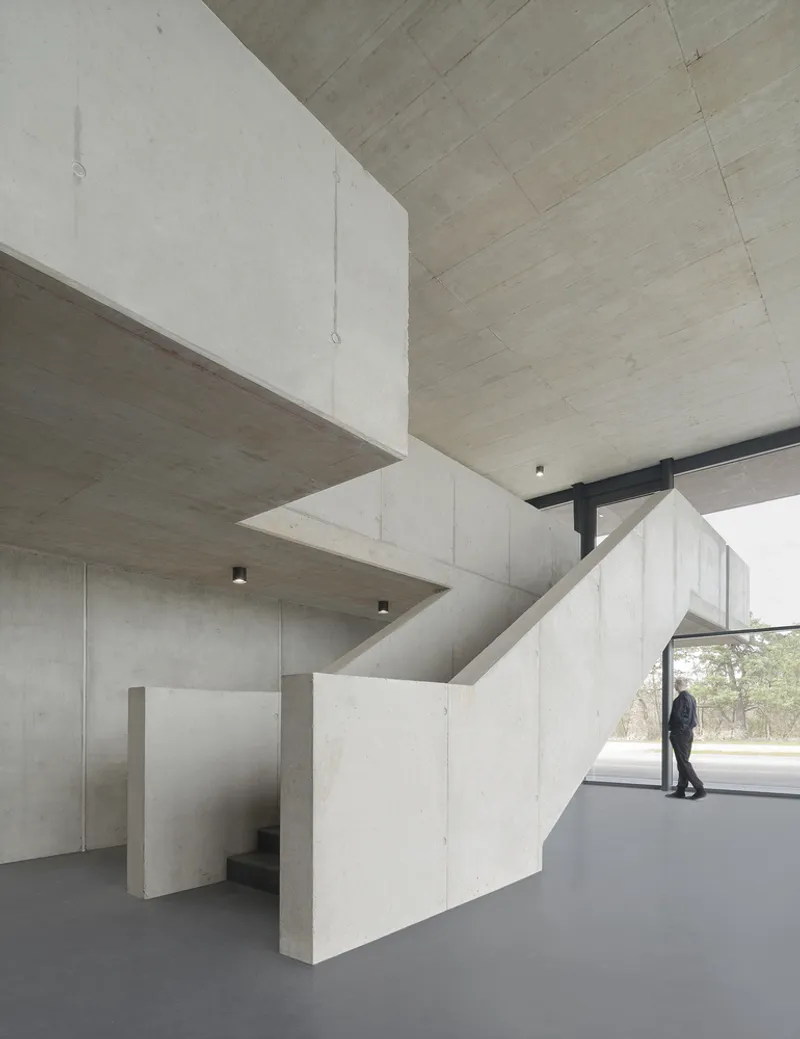
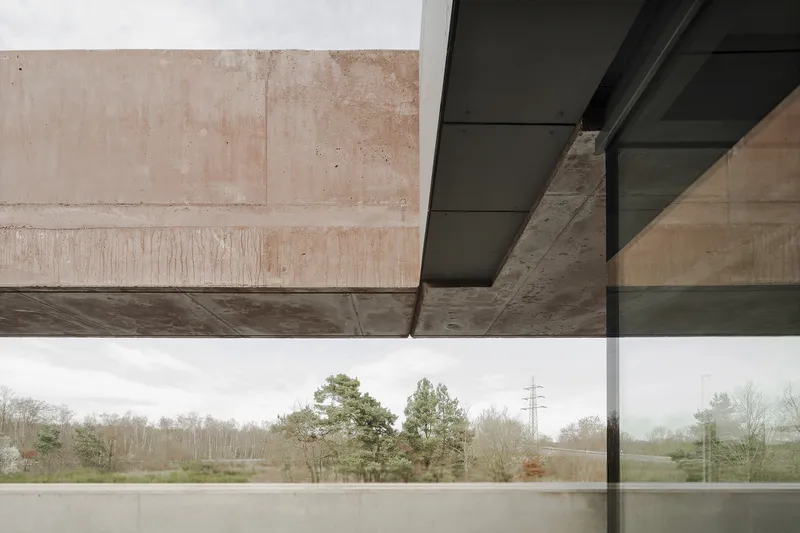
Steimle Architekten treat the vertical circulation and threshold moments with the same material intensity as the exterior. The interior stair volume is cast in the same board-formed concrete, creating a continuity between inside and out that reinforces the monolithic reading. A figure ascending toward a glazed opening at the top of the stair captures the quality of light these spaces produce: diffuse, directional, framed by mass. The cantilevered overhang at the building's edge extends this language outward, framing a foggy view of bare trees and transmission towers with the same sculptural precision.
The two-story foyer, completely glazed with an interior gallery, sits at the northeast corner and functions as the public interface. It is the arrival point for visitors and the exhibition area for the historic fire engine, but it also connects directly to the operations center, the administration wing, and the upper-floor training area via the terrace. The building reads as a single organism: every room links back to the foyer or the vehicle hall within a few steps.
Why This Project Matters
Fire stations occupy an awkward position in civic architecture. They need to be fast, tough, and cheap to maintain, but they also sit at the center of a community's sense of safety. The Germersheim station resolves this tension by making the functional logic itself into the architecture. The sloping walls, the cantilevered canopy, the fin system: none of these are applied gestures. They emerge from the structural and operational requirements of the building, then get pushed just far enough to give the whole thing a monumental presence at the city's edge.
Steimle Architekten have built a station that will look better as it ages. The pigmented concrete will weather, the board-form texture will deepen with grime, and the red will shift further toward the sandstone register that the architects had in mind from the start. For a volunteer brigade serving an inter-communal network across the northern district of Germersheim, that durability is not symbolic. It is the whole point.
Germersheim Fire Station | Service Facility North by Steimle Architekten. Germersheim, Germany. 3,640 m². Completed 2023. Photography by Brigida González.
About the Studio
Share Your Own Work on uni.xyz
If projects like this are the kind of work you want to make, uni.xyz is a place to publish your own, find collaborators, and enter design competitions.



Popular Articles
Popular articles from the community


The Ocean Hive: Sustainable Architecture for a Self-Sufficient Civilization at Sea
The Ocean Hive imagines sustainable architecture at sea, where modular habitats, algae, wave power and ocean waste sustain a growing colony.

Riyadh For All: Intergenerational Urban Design for Active Aging in Rabat
Riyadh For All reimagines urban design in Rabat with intergenerational co-living, adaptive courtyards, and Moroccan cultural exchange today.

Play: Fragments of Their World
Familiar architecture becomes modular playground design, creating safe spaces where displaced children can learn, connect, imagine and play.

Lunar Spiral: Space Architecture Shaped by the Mathematics of the Universe
Lunar Spiral reimagines space architecture through Fibonacci geometry, lunar regolith, levitating habitats, and self-sustaining Moon living.


Similar Reads
You might also enjoy these articles


Hodi-Mandai Geram
Project Function: Preservation and revitalization of the Intangible heritage and socio-spatial identity of the Hodi by Housing, Cultural Memory Center, Sacred Grove, landscape, local tourism economy


Olio Towers: A Mid-Rise for Performers That Fuses Housing, Rehearsal, and Stage
Located blocks from Houston's Theater District, this modular tower stacks living units around a central performance atrium.

Oasis: Modular Green Housing Carved into Dhaka's Urban Fabric
A shortlisted Plugin Housing entry reclaims unauthorized settlements in Dhaka with stepped concrete volumes, green roofs, and ventilation-driven design.

Black Hole: A Floating Megastructure for the Post-Physical Era
Emiliano Mazzarotto envisions a spherical, self-scaling arena where e-sports, digital hotels, and holographic stadiums replace traditional public space.


Explore B19 Architekten Bda – Weimar Competitions
Discover active competitions in this discipline



Challenge to reimagine the Iron Throne


Photograph architecture without architects


Illustrate the lost glory of Angkor Wat - Render Challenge


Design challenge to reuse E-waste
Comments (0)
Please login or sign up to add comments
No comments yet. Be the first to comment!