
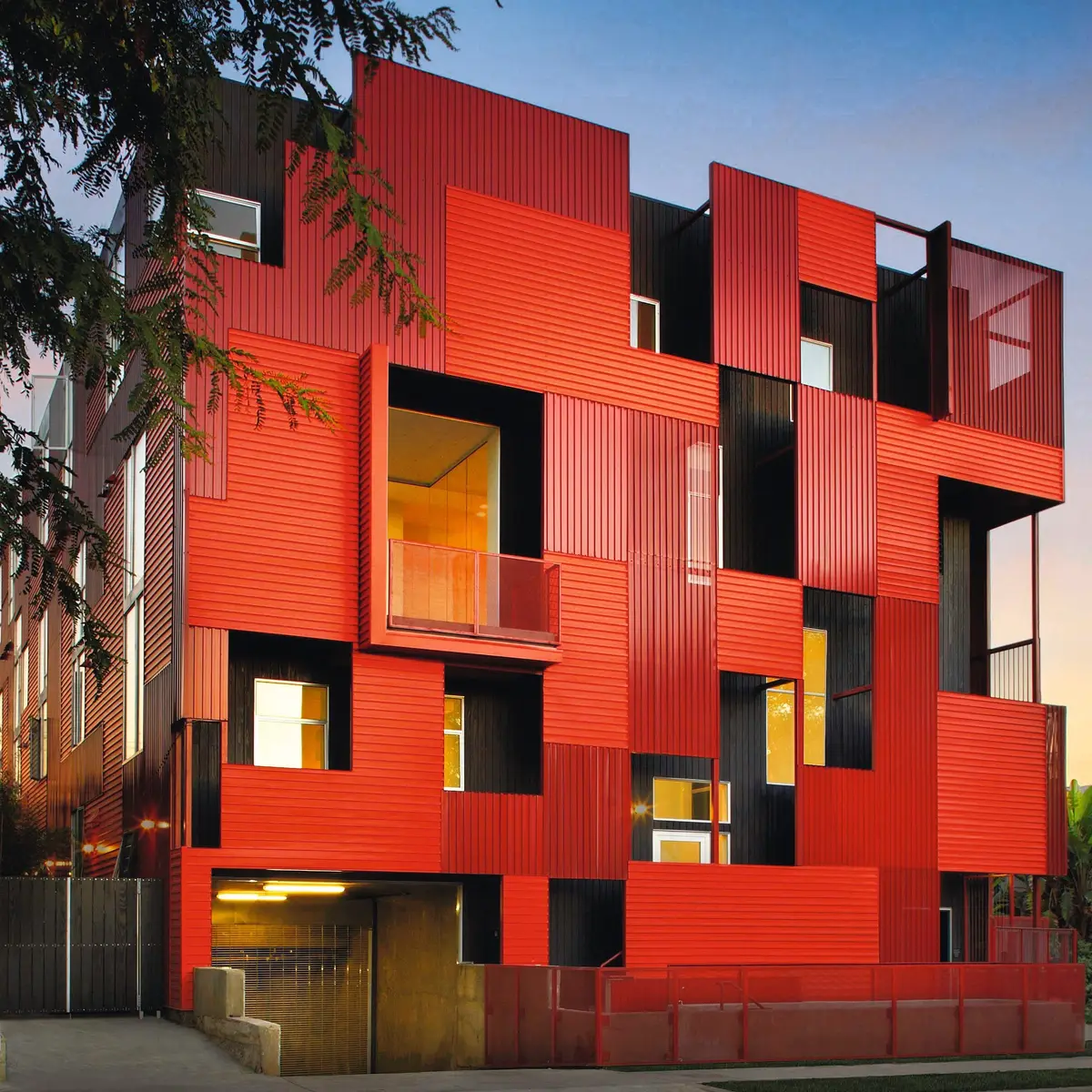
MUSEUM OF CHOCOLATE "BARS"
A space that is culturally integrative and promotes human bonding through chocolate.

Vienna is the cultural, political and economic centre of Austria. The district of Simmering is associated with the working and industrial area of the city and houses the largest Austrian cemetery.
In the above described topic I was interested in creating a new point of attraction on the map of Vienna and thus increasing tourism in a very interesting but less touristic area based on functional factors. I wanted to create a place which would stimulate development and improve the infrastructure of the district.
The architecture of the building is simple and modest, yet it fits in with the industrial surroundings of Simmering. The building is shaped by the use of arcades on the east-south and east-north sides. They create a buffer zone between the surroundings and the museum and at the same time serve as roofing and weather protection. The building has a square plan and consists of nine modules . The skeletal-core construction of the building allows for functional development of the space, as well as its redesign if necessary.
The west-north facade was shaped parallel to the roadway, while the east-south facade, to which the internal road leads, has a representative function with the main entrance. On the east-north façade there is an entrance to the goods lift, as well as space for a temporary exhibition under the arcade. Due to the fact that the steel columns inside are the load-bearing function of the frame and core structure, all the façades have been glazed with a curtain wall system. In order to improve the energy performance of the building, on the first and third floors the façade is made of a double layer (curtain wall + glass fibre textile layer) that acts as a thermal matrix. The transparency of the layer changes throughout the day. From the outside, during the day, the fabric looks uniform and unites the facades into a single mass. At night, the textile coating almost disappears, allowing the "inside of the building" to be seen. A special feature of the building is its glass form, which, when illuminated in the gloom, plays an important role in the environment.
The museum should have a room layout that allows the public to view the exhibits in a functional and best possible way..I analysed museum layouts and decided on a plan based on a circle. This layout makes it impossible for visitors to directly enter the room they are interested in, but it ensures that the viewing of the exhibits follows the correct sequence. One of the main objectives of the project is to tell the story of chocolate from ancient times to the present day. The museum itself is divided into two parts: historical-theoretica and practical. The historical-theoretical part is located on the ground floor of the museum and consists of four parts:
1) Mesoamerican application
2) European adaptation
3) Contemporary production
4) Problems of contemporary chocolate production
After the guided tour of the above-mentioned rooms, visitors go to the next floor (+2) where, thanks to local chocolatiers, they can see how chocolate is made from cocoa beans. At this point, visitors can also enjoy refreshments and a fresh dessert. The processing of chocolate includes:
1) Roasting the beans
2) Grinding
3) Refining
4) Conching
Summing up the work on the project I can say that all the goals have been achieved and the designed building meets the necessary needs of the visitors and the assumptions of the museum. It was important to draw attention to the problems associated with chocolate production. After analysing the location, its historical heritage, communication, infrastructure, greenery and functions, I tried to fit the building into the surrounding space as a complement to it. The internal layout of the museum, the arrangement of the rooms, was designed to present the history of chocolate from ancient times to the present day in a coherent and understandable way, showing the process of chocolate making in theory and in practice. The form of the building and its external appearance match the environment of the industrial district of Vienna. The modern building can become an attraction for the citizens of the city and tourists, as well as a lighting point - a kind of "lighthouse" for the nearby roads.

Popular Articles
Popular articles from the community


The Amber Palace Opera: A Geological Fiction Surfaces on Tallinn's Baltic Waterfront
Pierre Brillard reimagines a Baltic legend as a public landscape, opera house, and waterfront promenade rooted in Tallinn's coastal identity.

Opera on the Sea: Driftwood Logic Shapes a Timber Opera House on Estonia's Coast
Trevor Orgill's opera house translates the entangled drift of floating timber into a civic building where wood, water, and music converge.

Manzana Morphosis: Stretching Barcelona's Grid into a Living Landscape for 2050
A radical reworking of the Eixample manzana turns density into a tool for generous public space, vertical ecology, and environmental performance.

Opera by the Sea Estonia: Three Shells Dissolving Architecture into Tallinn's Coastline
A winning opera house proposal replaces monumental form with interconnected shells that blur the boundary between building, park and Baltic Sea.

Similar Reads
You might also enjoy these articles
The Rhythm of Seasons
A Farmers' Market Connecting Nature and the City

More Than a Building-Designing a Living System
More Than a Building-Designing a Living System
Base Beyond
DESERT COMPOUND ARID: TOURISM OF ABSENCE AND ABUNDANCE

Explore Cultural Architecture Competitions
Discover active competitions in this discipline


Challenge to reimagine the Iron Throne

Photograph architecture without architects

Illustrate the lost glory of Angkor Wat - Render Challenge

Bring back Drive In's
Comments (0)
Please login or sign up to add comments
No comments yet. Be the first to comment!