
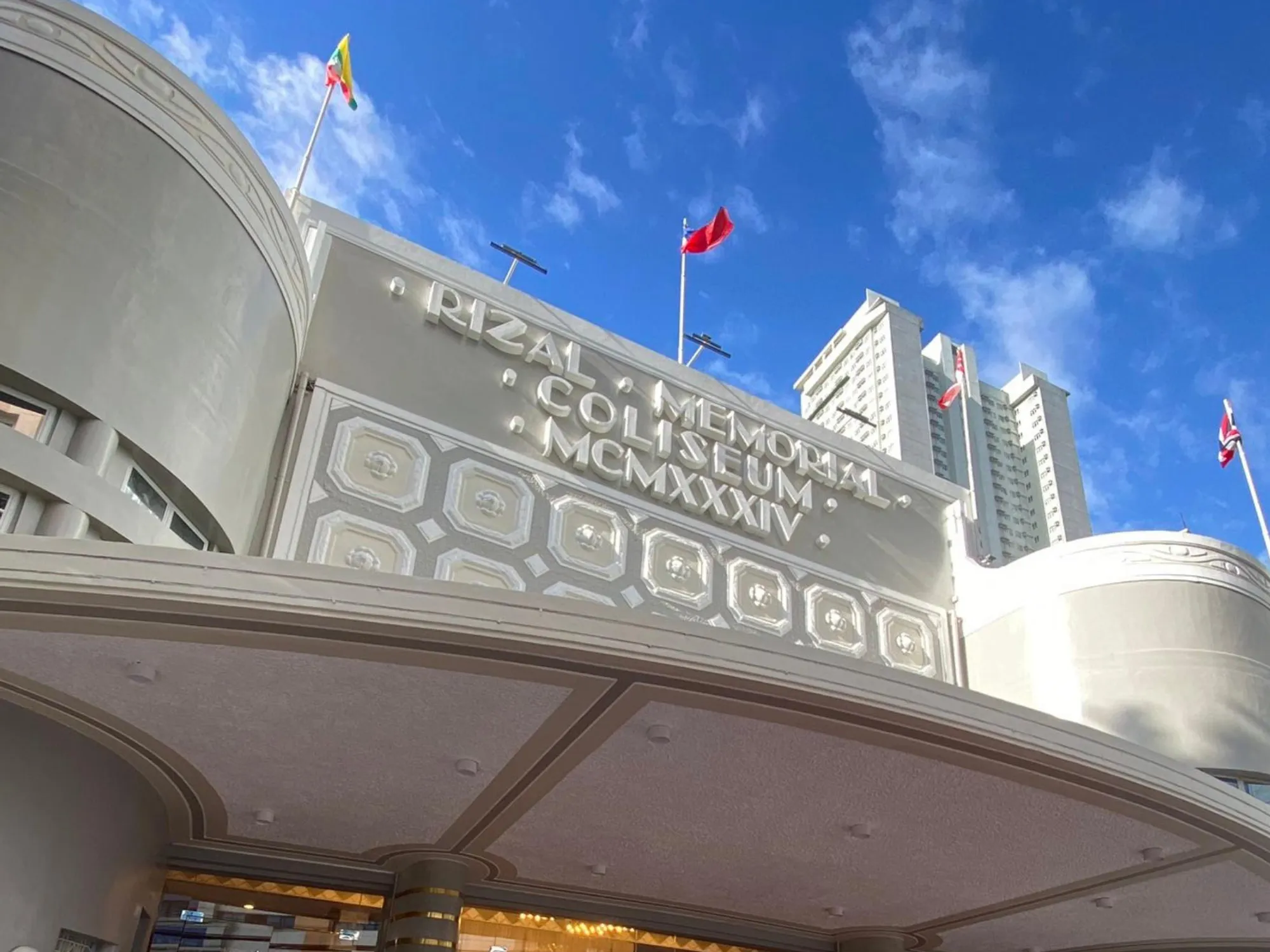
Rizal Revival: Inside the Rehabilitation of Rizal Memorial Coliseum
The Rizal Memorial Coliseum (RMC) is a historic 5,900-seater indoor arena in Manila, Philippines built in the Streamlined Art Deco style in 1934 and designed by Juan Arellano—a pioneering Filipino Architect. It underwent a massive rehabilitation and conservation effort in 2019 for the 30th Southeast Asian Games.

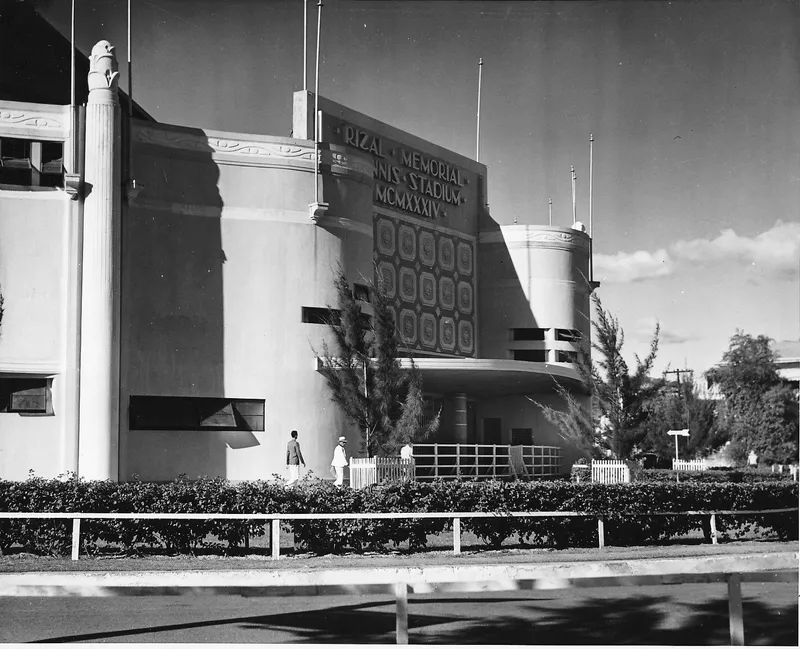
The fate of the Rizal Memorial Sports Complex almost ended tragically in 2016 if not for the vigilance of heritage groups. Nearly destined to face the wrecking ball, the Complex faced the threat of destruction in 2016 when the Local Government of Manila, which owns the property, expressed their interest in transforming the property into a mixed-use development through a partnership with a private company. Through public consultations and stakeholder discussions, the Philippine Sports Commission (PSC), which operates the sprawling sports complex, decided against the sale of the property. The continued existence of the complex was assured in April 2017, when the National Museum of the Philippines and the National Historical Commission of the Philippines jointly declared the Rizal Memorial Sports Complex as a National Historical Landmark and Important Cultural Property, recognizing the significance of the sports complex in the history and heritage of the country. This declaration was secured through the efforts of multisectoral advocacy groups, who lobbied against the property’s sale and conducted the necessary research and documentation to support their cause. Today, the Rizal Memorial Coliseum stands proudly as the product of multi-sectoral efforts to conserve our built heritage.
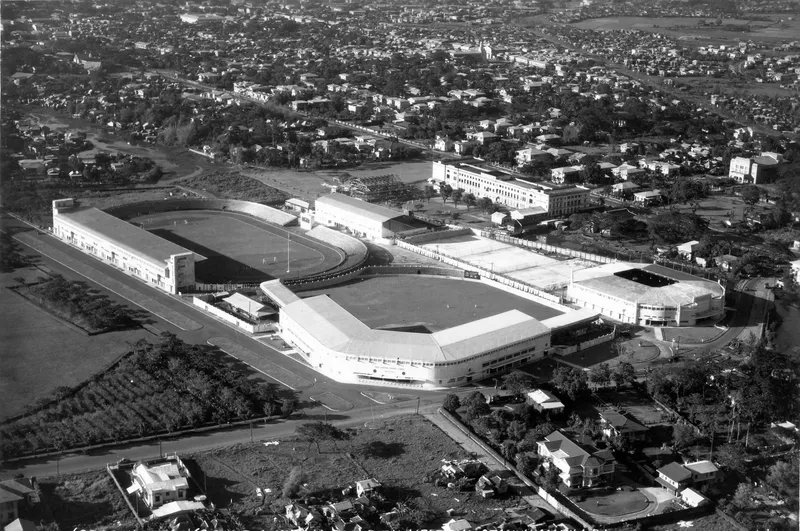 An aerial photo of the Rizal Memorial Sports Complex circa 1930s, showing the Rizal Memorial Coliseum on the right.
How we got here
The Rizal Memorial Sports Complex was envisioned to fill Manila’s need for a national sporting venue described as “an imposing structure which shall be known the world over for its beauty, its size, and its practical utility”. (R.N. Perley, 1918, 357-58)
Inspired by the prestige of the Osaka City Municipal Playground, which was built to host the 1923 Far Eastern Championship Games, Filipinos were set to embark on building their own. A Playground and Recreation Commission was formed, tasked to “further the cause of athletics in the Philippines”. First among the recommendations of the Commission was “to provide an athletic stadium for Manila to be used as public playground and athletic field capable of seating 30,000 people.” (Macaraig 1929, 367) This launched the movement to construction of a “great national playground to be named Rizal Stadium.” (Laubach 1925, 389) Rizal was a leading figure during the struggle against Spanish colonialism and advocated modernization and Western education.
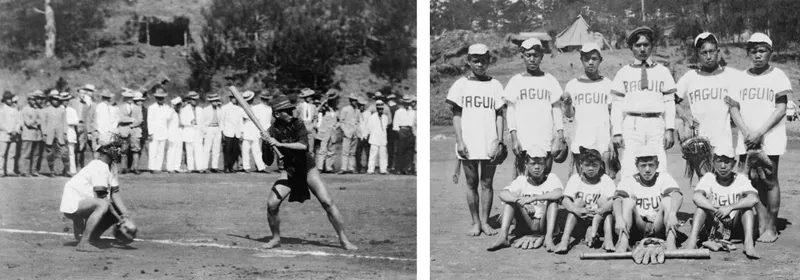 Civilizing the natives through modern Americans sports.
Designed by Juan Arellano, then Consulting Architect of the Bureau of Public Works, and sitting member of the commission, the plans called for a stadium with a seating capacity of 30,000 at the cost of one million pesos.
 A passport photograph of Juan Arellano, the architect of the Rizal Memorial Sports Complex.
Initially slated for completion in time for the 7th Far Eastern Championship Games scheduled in May 1925, the sports complex’s construction lagged due to a lack of funds. By 1927, the 400-meter track and field and two swimming pools were opened for public use. Work on the other structures in the complex dragged on. By 1934, the baseball, swimming, track-football stadia were ready for the use for Manila’s hosting of the 10th Far Eastern Championship Games. However, the coliseum was not finished in time and was completed in 1940.
The complex was designed in the Streamlined Art Deco style, taking cues from nautical and aeronautical forms, coupled with sparing use of geometric patterns executed in precast ornaments and grill works. First opened for public use in 1927, the Swimming Stadium or natatorium has a capacity of 4,000. It contains two swimming pools measuring 50 by 20 meters and another measuring 20 by 6 meters. The first one is used during competitions while the other is primarily for children. The Track-Football stadium has a 400-meter cinder running track and a soccer field. It is provided with a flood lightning system for night events and can seat 30,000 people. The Baseball Stadium has a seating capacity of 15,000 and is provided with an electrically operated concrete scoreboard. Finished in 1940, the Coliseum, originally known as the Tennis Stadium, had a capacity of 10,000 and is the only covered stadium in the Rizal Memorial Field. It contains a shell tennis court and a removable wooden platform for basketball, boxing, wrestling, volleyball, and other sports. It was provided with a boxing ring, Olympic wrestling platforms, glass-banked and steel-framed basketball goal standards, any of which facilities may be set up or dismantled in a few hours. The coliseum also boasted an electric scoreboard and timing device for boxing and basketball, skylights and electric lightning system for day and night events, and a ventilation system which reduces inside temperature and removes vitiated air through the use of large electric blowers.
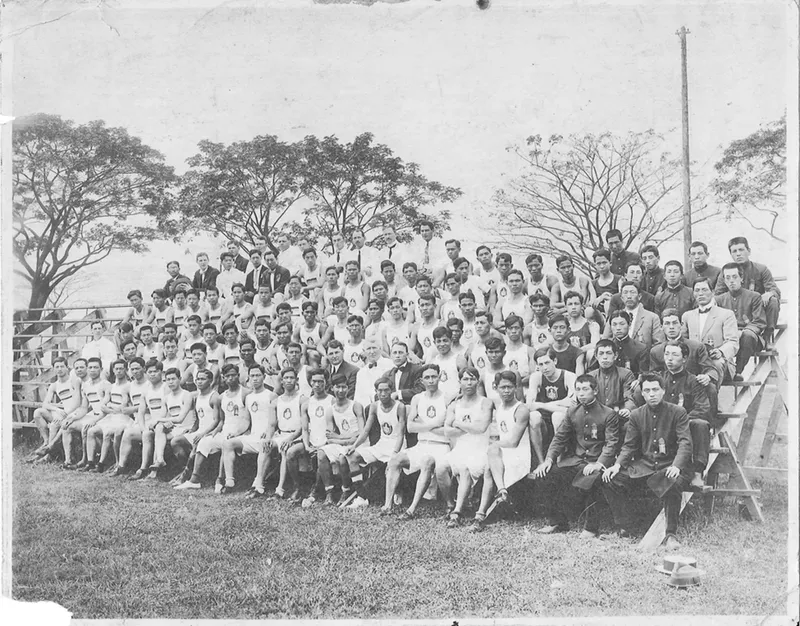 Participants during the Far Eastern Championship Games.
Golden Era
In its pre-war heyday, the sports complex was host to a plethora of national and international sporting events. Beyond sports, other events of national importance that happened in the sports complex include the unification of the Nacionalista Party in 1934, the acceptance of Manuel Quezon and Sergio Osmeña as the respective Presidential and Vice-Presidential candidates of the same party for the 1935 elections, to name a few. In the years before the Second World War, the Sports Complex served as the premiere venue for the events of the PAAF, the National Collegiate Athletics Association (NCAA), the University Athletics Association of the Philippines (UAAP).
In the analysis of Stephan Huebner, the stadium was part of the visual politics of modernity under a colonial power structure, a demonstration of progress through the “blessing of Protestant American modernity.” He asserts that: “…the stadium visually underlined the transformation of the Philippines from a ‘backward’ country into a modern one. Filipino politicians rejecting colonialism but not Western civilization itself.” (Huebner 2016, 86)
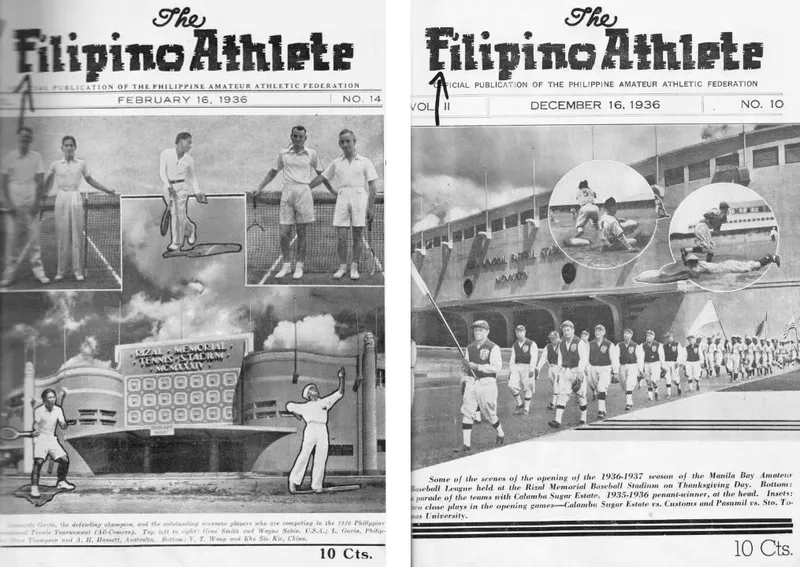 Issues of The Filipino Athlete magazine.
Streamlining towards Independence
As the country was marching towards independence during the Commonwealth era, Arellano, in his design for the buildings of the Rizal Memorial Sports Complex, turned away from Neoclassicism—which was strongly associated with American colonial rule—and embraced the progressive language of deco streamlining. Streamlining was modernist in inclination, eliminating ornamental excesses to highlight the mechanistically smooth building skin and reverence to the machine. Stylistically and ideologically, the streamlining was an opportunity to distance himself from the classical tradition with the erasure of classical ornaments and simplification of form. In this way, the stylistic departure manifested his rejection of American colonialism with his bold move towards the streamlined aesthetics and rejection of American imperialism.
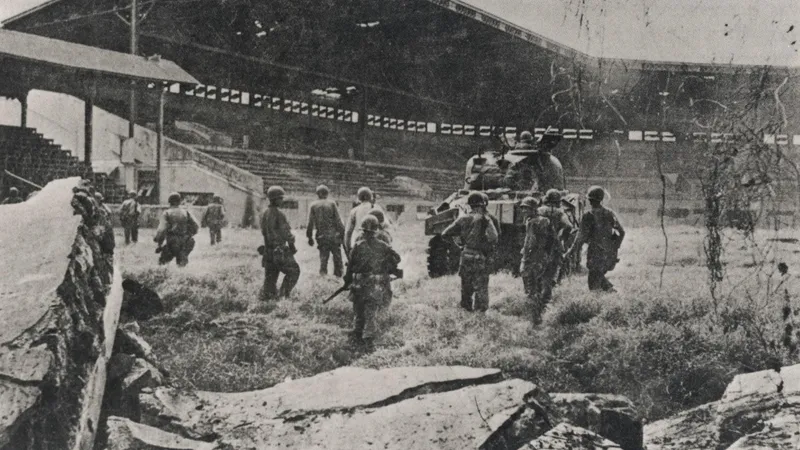 The sports complex became a battleground for the Battle for Liberation of Manila in 1945.
Battle for Manila and Post-Independence
The 1945 Battle for Liberation witnessed the massive decimation of Manila’s urban built heritage and the irreplaceable treasures of colonial architecture. The complex was part of the final stronghold of the Japanese Imperial Army. It was a site of a decisive battle between the 12th and 5th cavalry divisions of the American troops weeding out the 2nd naval battalion of Japanese soldiers holding garrison in the concrete structures of the sports complex. As the war came to a bloody end in Intramuros, the sports complex’s concrete shell, sustaining heavy damage, barely survived. Despite the seemingly impossible task to resuscitate war-ravaged Manila, the city rose again, and the rehabilitation of the Rizal Memorial Sports Complex was akin to a phoenix rising from the ashes.
The Philippines became an independent republic in 1946. Amidst the reconstruction and return to normality, the country hosted the 1953 Philippines International Fair in Luneta, which heralded to the world the 500-year progress of the Philippines and its recovery from the war. Participated in by ten foreign countries, this served as a showcase of national spectacle where the Philippines presented itself as a progressive, democratic nation embracing modernity. Concurrently, the reconstruction of the Rizal Memorial Sports Complex was in full swing. This regenesis would give the site a new life and meaning -- taking on a different symbolic mantle. It was to be the bearer of Filipino resilience and post-war recovery.
The culmination of this display of post-war national self-actualization was the country’s hosting of the Second Asian Games in 1954. The event served as the successor to the Far Eastern Championship Games in advocating the Pan-Asian diplomatic relations through sports. While brewing tensions between the democratic and communist nations overshadowed the event, the 2nd Asian Games served as an opportunity for the Philippines to project itself as a new nation of the free world. The Philippines’ hosting of the 1954 Asian Games was the first big international sporting event that the new Republic would undertake in its post-colonial existence.
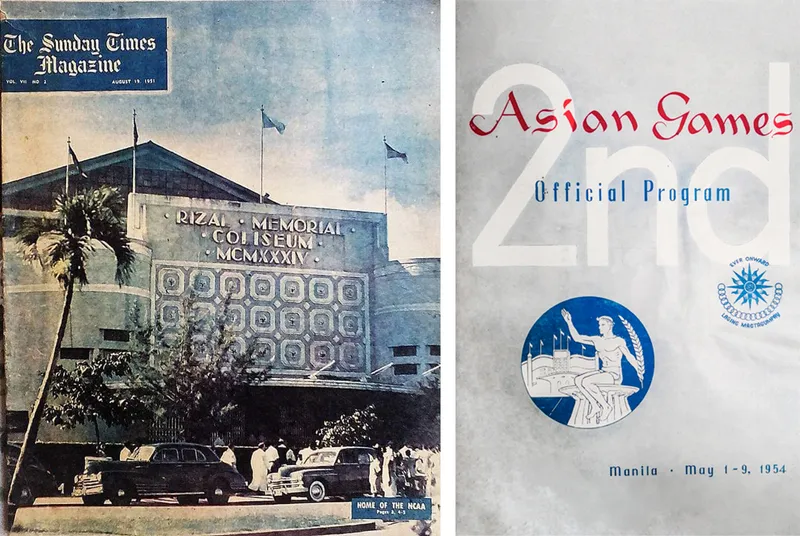 Memorabilia from the 2nd Asian Games held in Manila in 1954.
Owing to its unparalleled capacity as a collection of large venues, the Rizal Sports Complex was host to local, national, and international events. Annual collegiate sporting events of the NCAA and UAAP continued to be held here, along with the games of the Manila Industrial and Commercial Athletic Association (MICAA), which was the forerunner of today’s Philippine Basketball Association (PBA).
Other non-sporting events have also found a home in the Rizal Memorial Sports Complex. The Rizal Coliseum in particular, was the largest indoor venue of the period and was host to many local events and international shows, such as the concert of Jose Iturbi, exhibition bout of Rocky Marciano, the Holiday on Ice which was an ice-skating performance that premiered on April 29, 1955, and was a charity benefit for the Anti T.B. Society and Boys Town. Numerous other commencement exercises such as those of the Philippine Women’s University and the College of Physical Education, as well as various benefit performances were held at the Coliseum throughout the 1950s.
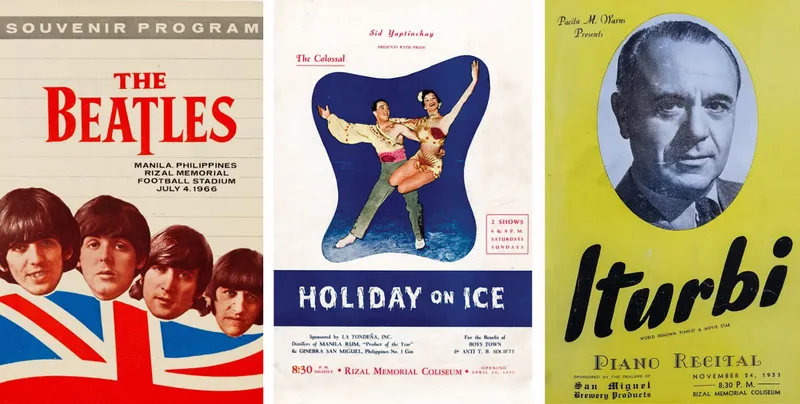
Rizal Memorial Sports Complex, especially the Rizal Coliseum’s preeminence as the multipurpose venue of Manila and its neighboring towns was unchallenged in subsequent years as it was perhaps the only indoor venue sizeable enough to accommodate a large audience, until the creation of other venues outside the city of Manila, such as the Loyola Center, now known as the Blue Eagle Gym, which opened in 1949, and the Araneta Coliseum which was inaugurated in 1959, both in Quezon City. One of the last major events before its steady decline into the 1970s, was the concert of The Beatles in 1966, which had an audience turnout of 80,000, one of the largest for the band’s concerts.
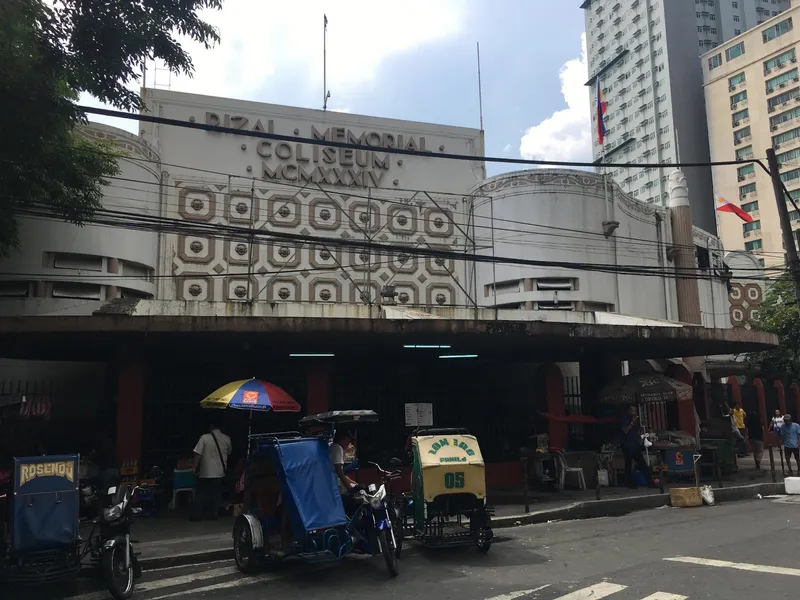 Rizal Memorial Coliseum in early 2019.
Decline and Revival
The Southeast Asian Games (SEA Games), regional counterpart to the Asian Games, paved the way for the Rizal Memorial Sports Complex to again return to the fore with the Philippines’ hosting of the 11th installment of the Games in 1981, and the subsequent hostings of the 16th SEA Games in 1991, and the 23rd SEA Games in 2005, and its counterpart 2005 ASEAN Para Games. As the de facto national stadium, Rizal Memorial Sports Complex had been the go-to venue for the hosting of international sporting events, but it was proving more and more inadequate, as was apparent in the opening and closing ceremonies of the 2005 SEA Games being held at the Quirino Grandstand in Luneta instead. In the years between hostings, the sports complex served as the training grounds for the national athletic teams who represent the country in international sporting events. The prominent games of its original collegiate and professional league residents have since transferred to the newer, better maintained, and far more adequate venues.
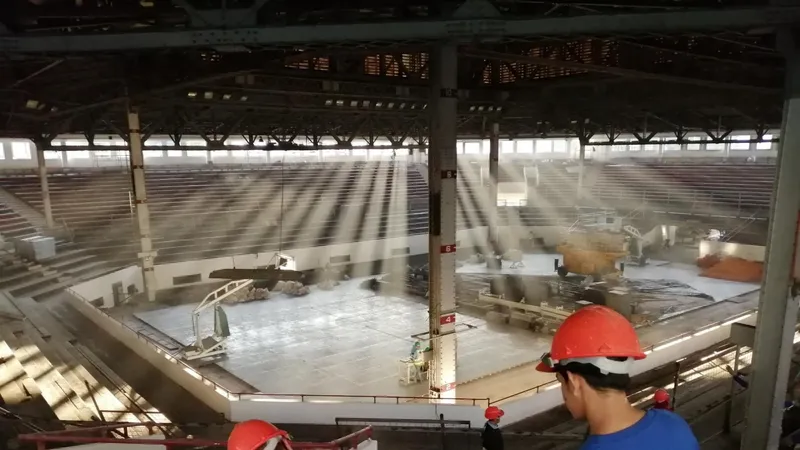 Inside the rehabilitation of the coliseum.
Rehabilitation
Recognizing the 2017 declarations of the National Museum and the National Historical Commission of the Philippines, in April 2019, the Philippine Amusement and Gaming Corporation (PAGCOR) remitted Php 842.5 million to the PSC for the rehabilitation its facilities for the SEA Games, including 250 million earmarked for the Rizal Memorial Coliseum. This allowed for a much-needed comprehensive rehabilitation of the coliseum, including the installation of a centralized air conditioning system, the installation of new stadium seating, and the total refurbishment of toilet and locker facilities, among others. The author, owing to his prior experience with the works of Juan Arellano, was commissioned as consulting architect for the rehabilitation of the Rizal Memorial Coliseum in the early half of 2019. For the reader to visualize the extent of the building’s deterioration, the building’s condition will be discussed.
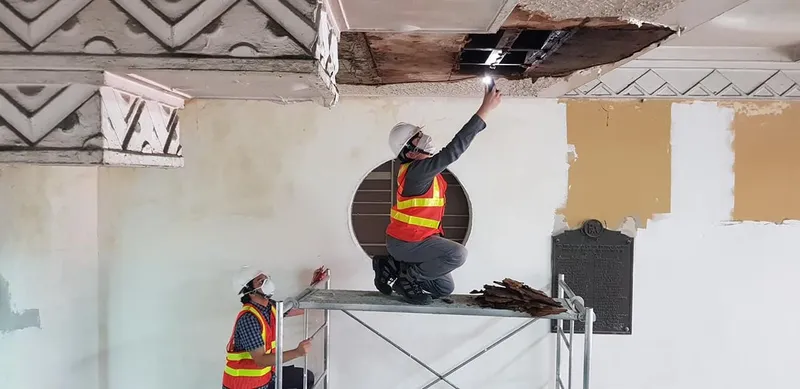 Documentation and condition analysis of various parts of the building, which exhibited advanced stages of deterioration.
Dilapidation
Not having undergone a comprehensive renovation since 1954, the Coliseum had deteriorated into a shadow of its former self. The roof was leaking in places, bleachers were rotting; the walls revealed multiple layers of peeling paint. Once ventilated by large machine blowers, these have since broken down; exhaust fans gathering dust. Over the years, minor modifications have been made—wooden mezzanine floors in some rooms added for office space, makeshift partitions, spectator wire fences, concrete flood barriers, and a large, freestanding concrete canopy fronting the façade. The piecemeal changes and haphazard repairs slowly disfigured the iconic art deco character of the building. Over decades of its use as a sporting facility, its poor maintenance resulted in its slow deterioration: with its outdated facilities, dimly lit interiors, and poor ventilation.
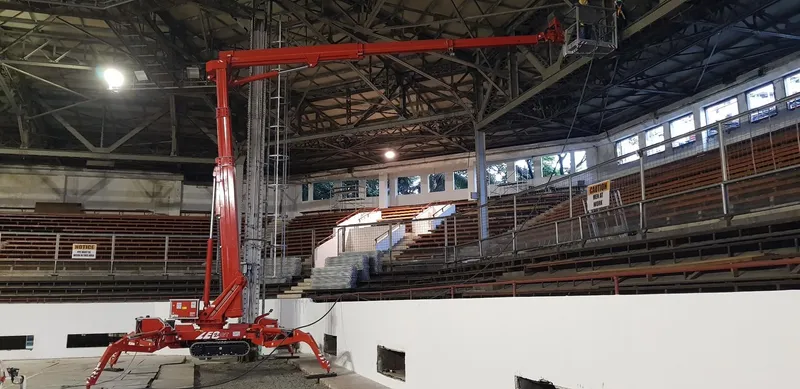 Ongoing rehabilitation works inside the coliseum.
Approach to Conservation
With its historico-social context and significance in mind, the interventions were specifically laid-out to highlight the character defining elements of the building and ensure the integrity of the structure. The objective of the rehabilitation was two-fold: first, to upgrade the existing facilities to suit the needs of modern sporting events; and second, to restore the heritage value of the building by returning it to its streamlined deco roots. This entailed comprehensive research on the history and significance of the complex, color studies, defects analysis, and a careful study on the effects of the proposed interventions. Some interventions required a cautious approach, such as the boring of holes in the slab for ducting; and the partial removal of a section of bleachers to make way for a service entrance to the arena.
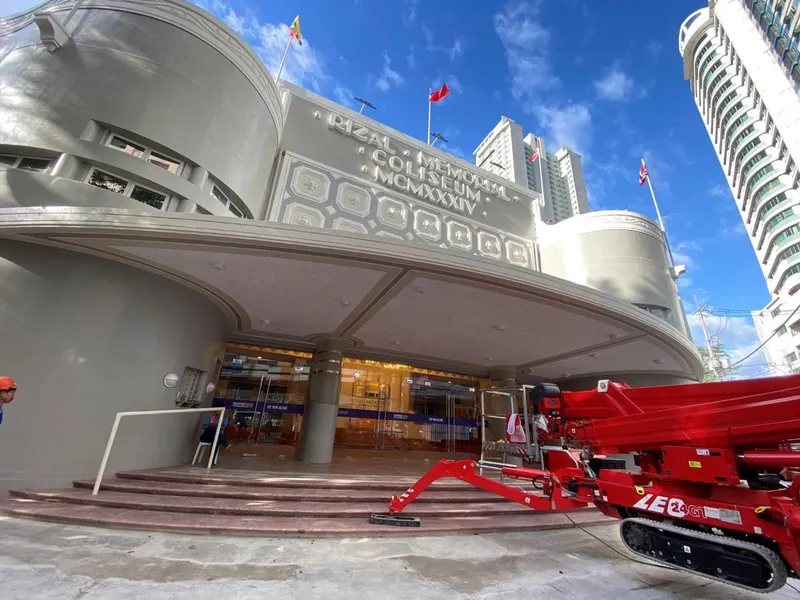
The 30th SEA Games
In addition to the challenges of rehabilitation, the Philippine Sports Commission designated the Rizal Memorial Coliseum as one of the venues for the 30th Southeast Asian Games slated to open on November 30, 2019. This condensed the rehabilitation timeframe from an ideal 12 months, down to four months. Key components and materials had to be sourced from local, readily available suppliers. Imported materials, such as the air-conditioning system had to have a guarantee for timely delivery from their suppliers. Towards the end of the third month, over 400 workers were on-site, working 24/7 in three shifts.
In July 2019, to engage the public in the process of rehabilitation, a fence exhibit was launched along the board-up fence of the site while rehabilitation works were on-going. The exhibit featured archival photographs of the Rizal Memorial Sports Complex, a timeline of its history, and a brief bi-lingual introduction to the complex’s origins and significance. This exhibit was intended to re-introduce the public to the building, generate anticipation for the rehabilitation, and to place government heritage conservation efforts into the public consciousness.
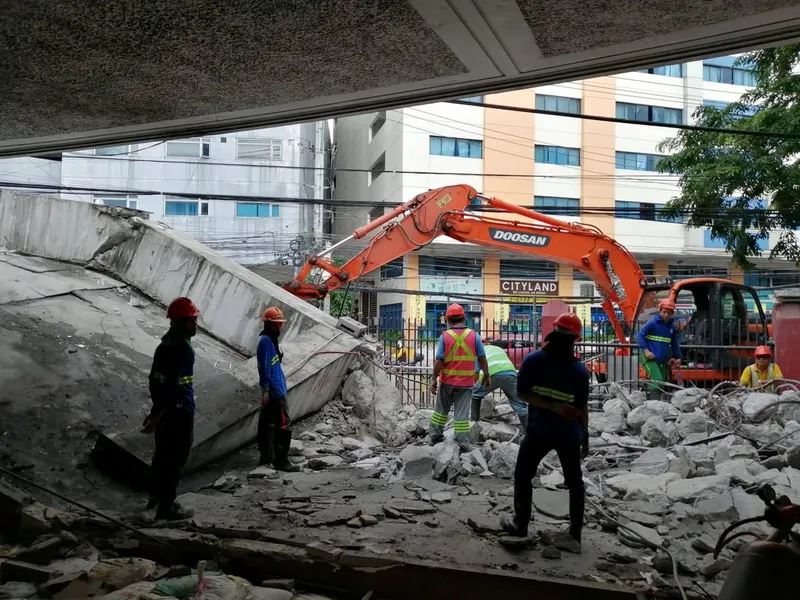 During the dismantling of the additional canopy, which blocks the façade.
First things, first
As the rehabilitation commenced, the first priority was to remove all debris, and dismantle all the unnecessary additions that have accrued over the years—light frame partitions, wooden mezzanines, defunct vents and exhaust fans, uncharacteristic gates and metalwork, obsolete seating, and old sporting equipment. The freestanding concrete canopy, which was thought to be built in the 1980s, was demolished as it diminished the aesthetics of the façade and blocked sunlight from entering the main lobby. As they were slated to be replaced to make way for air-conditioning, most of the windows were removed.
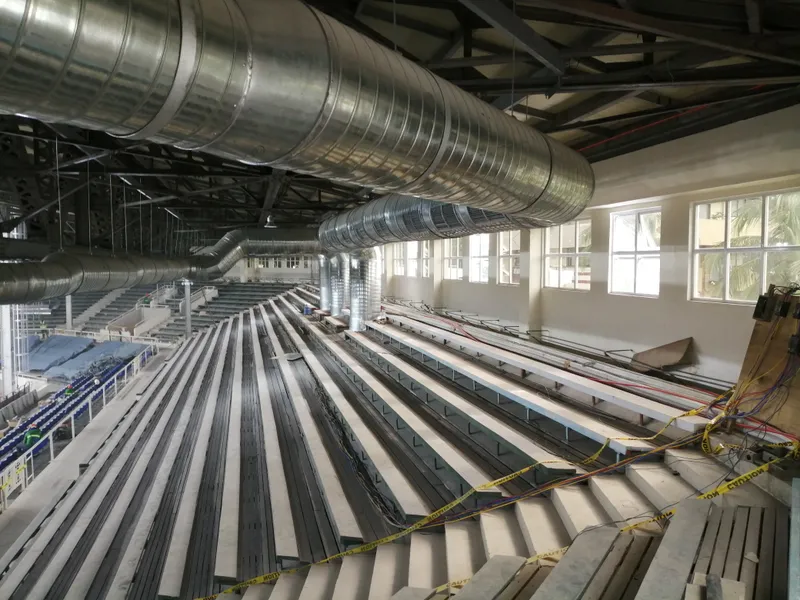 Utilities such as air-conditioning ducts were installed, exposed, and stylized to conform to the machine aesthetics of the Streamlined Art Deco.
Keeping it cool
By far, the largest component of the rehabilitation was the installation of a centralized air-conditioning system, which is composed of indoor air handling units (AHUs), outdoor air-cooled condensing units (ACCUs), and the air distribution system or (ducting). The installation of the system required rooms to be cleared and repurposed to accommodate AHUs. Wall and slab openings were created to accommodate vents, ducting, and facilitate return airflow.
The installation of the ACCUs, required the erection of an independent steel platform—a long, elevated deck along a narrow alley on the side of the Coliseum, hidden from view from the façade. The steel deck serves as a platform for the outdoor condensing units. Its erection proved challenging, as its supports were constrained by the space provided: the narrow alley. The footings of both the Coliseum, and the adjacent badminton hall made the placement of footings for the support difficult. The soil was composed of infill, as the site had formerly been part of a creek. Further limiting the support placement was the design constraint: that the alley had to be passable by delivery trucks and service vehicles.
A solution was arrived at by designing the elongated platform to have only one row of support columns instead of two. This avoided the complex and irregular footing and support configurations. The steel deck was to be cantilevered from the support and reinforced with a diagonal brace. The remaining width of the alley was enough for service vehicles to pass.
To seal the space and prevent the escape of cooled air, existing door, window, and roof openings were sealed or gasketed. The large roof louvers were covered with ribbed pre-painted galvanized steel roof sheets. Metal gates at the lobbies were replaced with glass doors and glass curtain walls. Exhaust fans were removed. Windows were replaced.
Large cylindrical ducts were suspended from the roof trusses, distributing cooled air evenly all throughout the venue. Since the ducts were to be exposed in the interior, a circular profile was selected so that the ducting would be visually compatible with the streamlined moderne style of the building and adhere to the poetry of machine aesthetics.
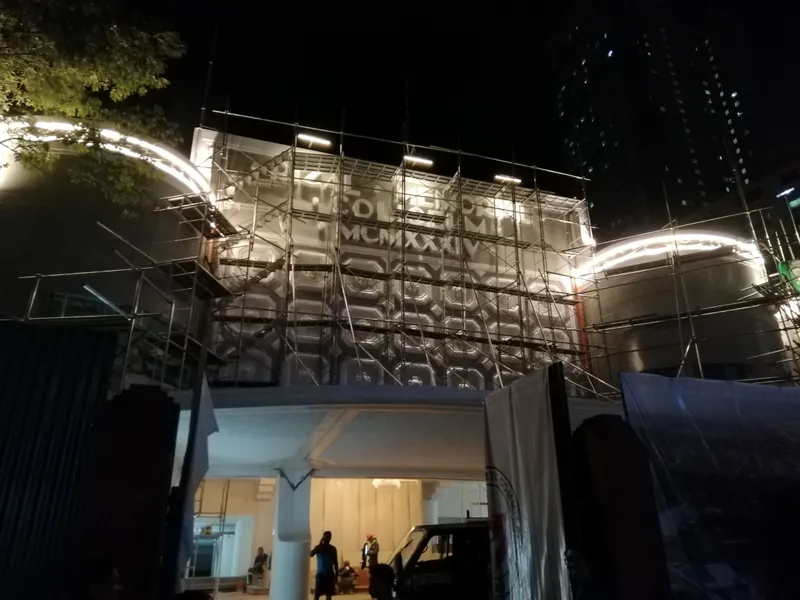 Installation of monumental façade lighting, highlighting the character-defining elements of the building.
Systems upgrade
The rehabilitation required a total overhaul of the electrical and plumbing systems of the building; as well as the introduction of a Fire Detection and Alarm System (FDAS), to enhance the safety of the building users, and to conform to modern building standards and codes. Existing electrical lines, lighting, and panel boards were removed; as the new electrical system was designed to accommodate higher electrical loads, owing to the installation of the air conditioning, and new pumps, water heaters, and lighting systems.
An all-new LED sports lighting system was installed, replacing the old metal halide lamps which took several minutes to achieve full illuminance. The new system was brighter, conformed to the standards set by the International Basketball Federation (FIBA), and energy efficient. Emergency lighting was introduced to facilitate orderly exit during power interruptions and emergencies.
The storm drainage system was also redesigned. Investigation into the roof leaks pointed to the insufficient drainage from the roof gutters as the cause. Roof drainage was organized and improved by the installation of a system of downspouts, catchment basins, and drainage lines. Likewise, new clean water and sanitary lines were installed to complement the new configuration of toilet and shower facilities. A new water cistern and septic tank were constructed to meet the new demand. To comply with the requirements of the Fire Code, a new FDAS was installed, which includes sprinklers, dry standpipes, and fire hose reels.
 Wide shot and detailed shots of the coliseum's lobby.
Deco decoded
The architectural requirements revolve around conserving the heritage value of the building and restoring its art deco character. Character-defining elements—the lobbies, the façade, grillwork, and terrazzo flooring were identified to be conserved, while new spaces such as toilets, showers, and locker rooms, were to be treated in a modern interpretation of art deco.
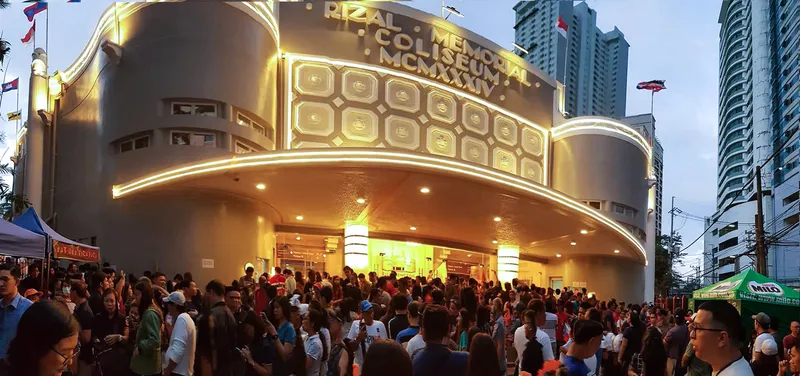
As rehabilitation work began, color studies were undertaken to determine the color palette of the building from different periods. The color palette selected by the client was a selection of greys and whites—which could be seen from pre-war archival photographs and videos of the complex. The grey palette provided subtlety and nuance, while highlighting the decorative elements without appearing garish. The painting of the façade was carefully matched from archival photos, taking care to be faithful to the original design, as it forms the most iconic and recognizable part of the building.
Special attention was given to the design of the lobby, which had most of the original art deco lauanit ceiling intact. The ceiling was treated for termite control, and portions of it were repaired. The terrazzo flooring was restored, polished to a smooth finish. As the layers of paint were stripped off, a layer of scagliola or faux marble was uncovered. It must be noted that one of the key principles of art deco is opulence. Perhaps due to budgetary or time constraints, natural marble was not installed during the Coliseum’s construction in the 1930s. Unfortunately, the scagliola was damaged. It had some chipping and missing fragments. Time constraints did not allow for a careful recreation of the technique used to facilitate its restoration. It was decided that this would be concealed with natural stone slabs. This would serve as an “upgrade” from the faux-marbling, and would serve as a protective layer for the time being until the technique to repair the scagliola could be found. Two large porthole windows were uncovered at the lobby, sealed off in concrete. This was “re-discovered” from archival photographs, which showed them prominently. They were subsequently restored to bring back the streamlined modern character of the lobby.
The original grillwork of the building was given proper care. Alterations were removed, and damaged portions were repaired. New spectator gates at the arena level were fabricated, deriving their design from the original gates at the lobbies. Interior lighting at the lobbies and corridors was designed to exude opulence and reflect the geometricism of art deco. Missing art deco lighting at the columns of the main lobby entrance and the two road-facing side lobby entrances were custom-fabricated using fiberglass and brass strips to recreate their original design based on archival photographs and postcards. Warm lights and increased luminance on the interiors had a transformative effect on the spaces, visually enlarging them while enhancing the luxuriant aesthetics of art deco.
As the lobby’s centerpiece, a large brass emblem was installed to welcome guests, to serve as a backdrop for selfies, and to underscore the character of the building. An art-deco inspired wayfinding and navigation system—a necessity in modern sporting venues—was designed to complement the new configuration of the building, so that guests could find their way to the restrooms, and to their seats. To conceal the new downspouts installed and reduce its visual impact, metal corbels were installed at the top of the downspouts, deriving from the concrete corbels at the base of the metal flagpoles.
Games Under Flak
As the opening of the SEA Games approached, media coverage intensified, focusing on the readiness of the organizers and venues to host the event. Concerned that the venues would not be completed in time, the media aired footage of the on-going rehabilitation projects at the Rizal Memorial Sports Complex and at the PhilSports Complex.
Several incidents during the run-up to the games—athlete’s delayed check-ins at the hotel, the lack of transportation to the venues, insufficient provisions for food and water, and frustrating unpaid volunteer work—had put the Philippine Sports Commission (PSC), and the Philippine SEA Games Organizational Committee (PHISGOC) under flak. Senator Franklin Drilon questioned the cost of the cauldron to be lit for the games, stating
“Php 55 million is an extravagance that is so unnecessary, and somebody had to answer for this… A classroom costs P1 million, so we could have built 56 classrooms if the money of the people was not abused.”
Citing that without concrete post-Games plans for the facilities, the new and rehabilitated venues could turn into white elephants.
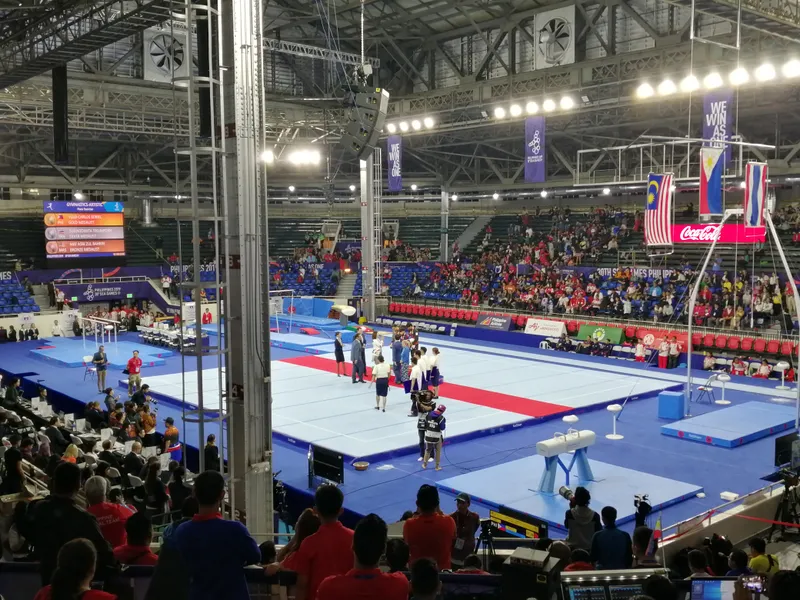 Awarding during the gymnastics event of the 30th Southeast Asian Games, held inside the coliseum in December 2019.
Saving Grace
As the Rizal Memorial Coliseum transformed through its rehabilitation, sports officials, the media, and the general public began to take notice. Article after article, news reports sprung up, praising the on-going rehabilitation. On social media, posts about the Rizal Memorial Coliseum went viral. The story of the transformation of the Coliseum was a much-needed bit of good news for the beleaguered Sports Commission. The coliseum re-opened on December 1, 2019, hosting the Gymnastics event with an attendance of about 3,000 people. On its opening day, 19-year-old Filipino gymnast Carlos Yulo clinched the gold medal, besting other ASEAN athletes for the prize; marking the triumphant revival of the Rizal Memorial Coliseum: a testament to Filipino excellence.
Conclusion
The Rizal Memorial Sports Complex demonstrates Filipino skill, ability, and achievement. Owing its design to Juan Arellano, the sports complex’s architecture demonstrated that the Philippines was finally ready for its long-awaited independence. With its rehabilitation, its continued role in international soft diplomacy, pop culture, and sportive camaraderie are ensured. Coming full circle, the Stadium’s own cathartic rehabilitation signals its own rebirth as an enduring symbol of the nation.
Bibliography
Huebner, Stefan (2016) Pan-Asian Sports and the Emergence of Modern Asia, 1913-1974. Singapore: NUS Press.
Laubach, F. C. (1925). The People of the Philippines, Their Religious Progress And Preparation for Spiritual Leadership in the Far East. New York: George H Doran Company.
Macaraig, S. E. (1929). Social problems [by] Serafin E. Macaraig. Manila: The Educational Supply Co.
Perley, R. N. (1918, May). The Proposed Civic Center. Philippine Review, 3(5), 357–359.



Popular Articles
Popular articles from the community


Hill & Cross Opera: Sculptural Opera House Architecture Shaped by Tallinn’s Landscape and Identity
Hill & Cross Opera reimagines opera house architecture in Tallinn through its sculptural hill, civic plaza, glass wave and a luminous cross.

Play: Fragments of Their World
Familiar architecture becomes modular playground design, creating safe spaces where displaced children can learn, connect, imagine and play.

Co-Life: Senior Housing Design That Reconnects Older Adults With the City
Co-Life reimagines senior housing design through healing gardens, shared streets, workshops, and a sustainable community across generations.

The Musturak Paradise: Senior Living Architecture for a Connected Future in Temara, Morocco
The Musturak Paradise reimagines senior living architecture in Temara via private homes, social spaces, culture, community, and shared care.


Similar Reads
You might also enjoy these articles

Day and Night Park: A Time-Based Urban Newsstand in Beijing
A temporary urban newsstand in Beijing blending travel, light, and reading through poetic colors, compact form, and community-focused design.

Modernist Patio Renovation in El Masnou, Barcelona by Oliver Segura Arquitectura + Cebrià Arquitectura
Modernist patio renovation blending tradition and innovation with a movable pool, leveled floors, and Catalan materials in El Masnou.

Alto Residencial Coop: Cooperative Housing Development in Santiago de Compostela by Carbajo Barrios Arquitectos
A linear cooperative housing complex blending white volumes and perforated metal façades, enhancing community living, natural light, privacy, and urban integration.
Vil Genis School by BPA ARCHITECTURE – Massy, France
Vil Genis School in Massy, France, features sustainable design, south-facing classrooms, community integration, accessible spaces, and modern educational architecture.


Explore Sports Architecture Competitions
Discover active competitions in this discipline




Challenge to design a barrier free sports center


Challenge to design an outdoor ice-rink and park
Comments (0)
Please login or sign up to add comments
No comments yet. Be the first to comment!