
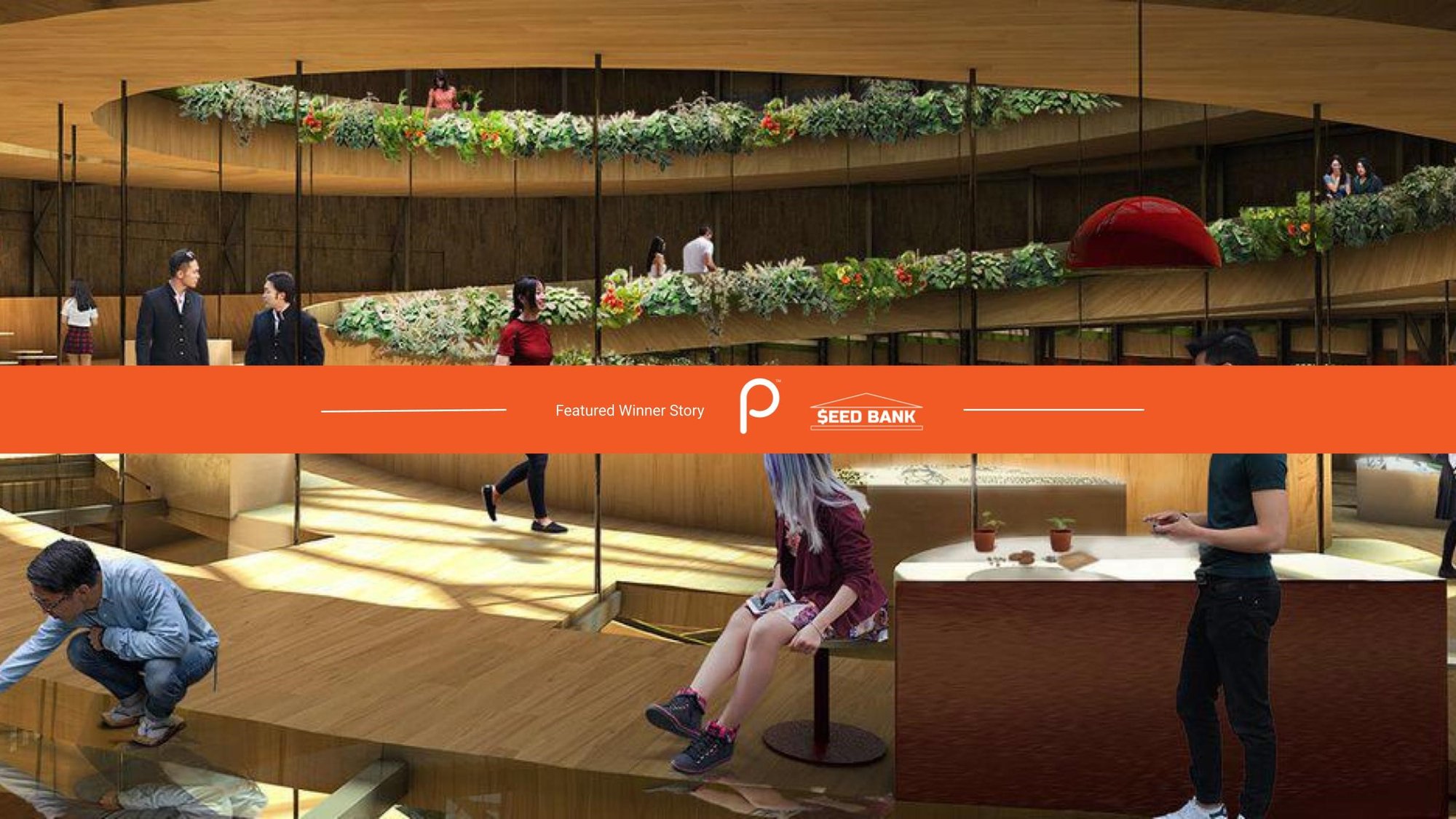
Building infrastructure for seed economies
Sowing fruitful Seeds

Overview
Food is one of the most fundamental elements of human existence. Humans have thrived and survived because our ancestors learnt how to gather, produce and consume food. Ours has sustenance has been ensured due to these crucial elements of knowledge passed through generations.
As industrialization percolated in civilization, mass production began. Then there was an influx of consumers - who were capable of paying for the food, instead of producing it. The need to grow food depleted, and as a result, skills and crafts related to agriculture and food production are gradually becoming mostly obsolete in the urbane environment. Mass consumerism through supermarkets is slowly changing how we perceive, acquire and consume food.
Issue
The Industrial Revolution has provided us with a highly consistent supply of processed food. In a way, it has given birth to issues like overconsumption, poor quality, high wastage and an over-dependence on manufacturing agencies.
On the flip side, we cannot escape mechanization, which successfully meets the soaring demands of consumers. Artificially increasing the speed of production and boosting longevity by adding preservatives is a hidden yet common practice. In the longer run, our perception of fresh food will be completely eroded.
By this model, only economically viable species will flourish, everything else will wither. This rampant commoditization is a slow time bomb that will deteriorate our environment.
Brief
In a situation when cities are landlocked and are officially labelled as consumers, this falling rate of biodiversity makes humanity more and more vulnerable gradually. Seeds may be insignificant things but, they evolve into things that feed or sustain the entire environment we live in.
How can we inspire a positive change in cities we live in where people can learn about these vanishing species and grow/maintain on their own? How can we change the downside of cities, i.e. overcrowding and increasing susceptibility to collapse, to more self-sufficient and more resilient places of living?
How can we create cities as micro seed economies where not only urban farming happens, but everyone contributes to the food chain by small endeavours and smarter techniques of farming?
Design Challenge: To design an urban seed bank and farming hub where people could learn about how agriculture works at large and borrow equipment and seeds from the bank.
The jury for the competition consisted of esteemed designers, professionals and academicians from around the world. The Lead Jurors for the competitions were as follows:
Emilio Alvarez Abouchard, Director, EMILIO ALVAREZ ABOUCHARD ARQUITECTURA, Mexico
Che-Fu Chang, Principal, Che Fu Chang Architects, Taiwan
Rok Jereb, Founder & Partner, Jereb in Budja arhitekti d.o.o. Slovenia
"Some of the Best of competition projects are:"
Winning Project: Germinated Seed
By: Audrey Bayle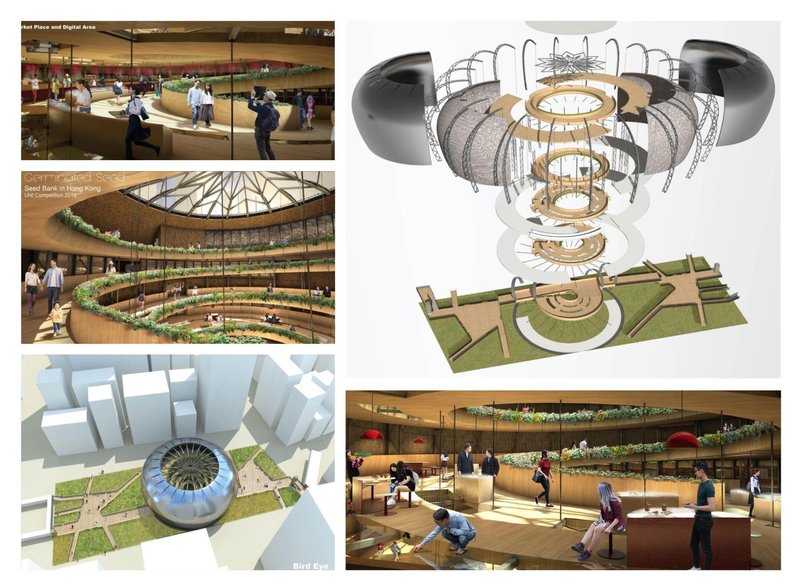
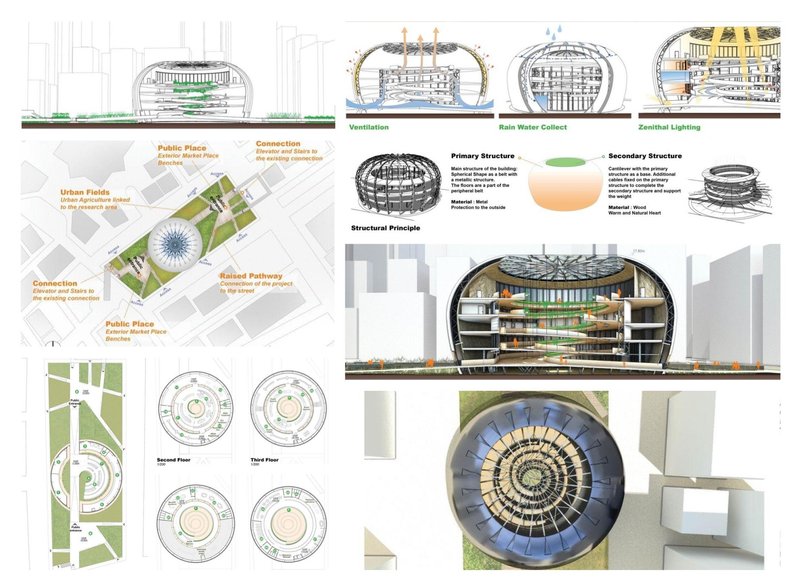
Description: The design idea for the project is to create a shelter where knowledge can be shared. The concept is a germinated seed: the protective shell provides a distance with the noisy and stressful city, the germinated heart is a favorable place to develop knowledge. The unique window of the project is the canopy. Like a growing plant, the visitor is immersed and can focus on the main topic: learn about urban agriculture. The center of the building is opened with a spiral of growing plants enjoying the sunlight. In contrast, the seed bank should be more obscure for optimal conservation. This main concept allows that duality while keeping the unity of the building.
-----------------
People’s Choice : The Future
By: Fulya Özmen, Enes Keleşmehmet, Dilara Bedir, Ömerfaruk Satçelik & Zeynep Çoban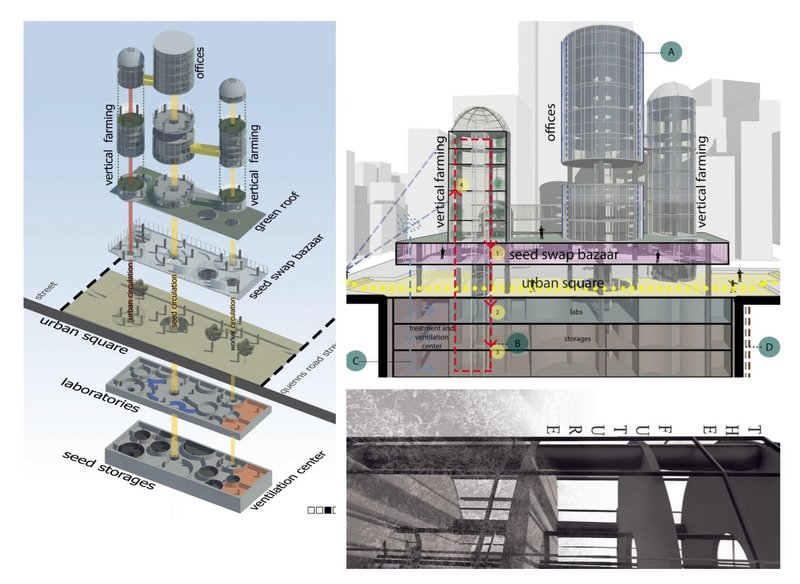
Description: Seed refers to regeneration as the metaphor and the beginning of a cycle. It was aimed to take the seed out of the area where it was stored and protected and to meet with the citizen and to become a part of the city as a continuation of the cycle as an image. Collision points were considered for urban and seed interaction. The way you approach the subject is very eye openning I hope they consider concept behind the project
-----------------
Editorial Choice: Seed Site
By: Paulina Mierzwiak, Joanna Przebięda, Agata Woźniak & Marta Babik 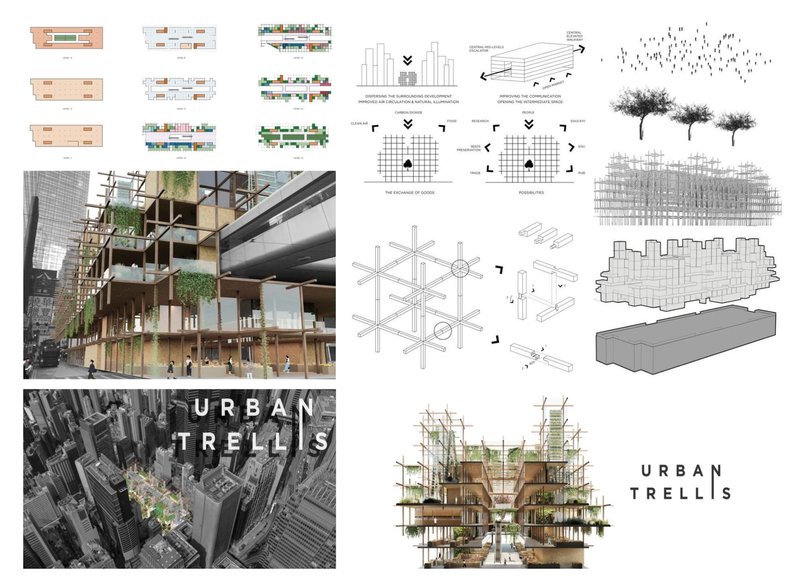
Description: The process of forming the building was conditioned directions of the world, urban context ("stepped" descending buildings as they move away from the coast) and emphasizing the hidden value - an underground Seed Bank. In order to continue the representative pedestrian route running from The Centre, we located a symbolic pond on it, which, in addition to aesthetic values, speaks about the location of the tanker with seeds. This treatment breaks our body into two towers, whose height depends on the surrounding buildings. The terrace level system, piled up from the inside, aims to create space for greenery. Their distribution is conditioned by the path of the sun. Appropriate selection of plant species and angles of sunlight in specific seasons of the year allowed designing a "flower calendar".
------------------------
Editorial Choice: Urban Trellis
By: Agata Mila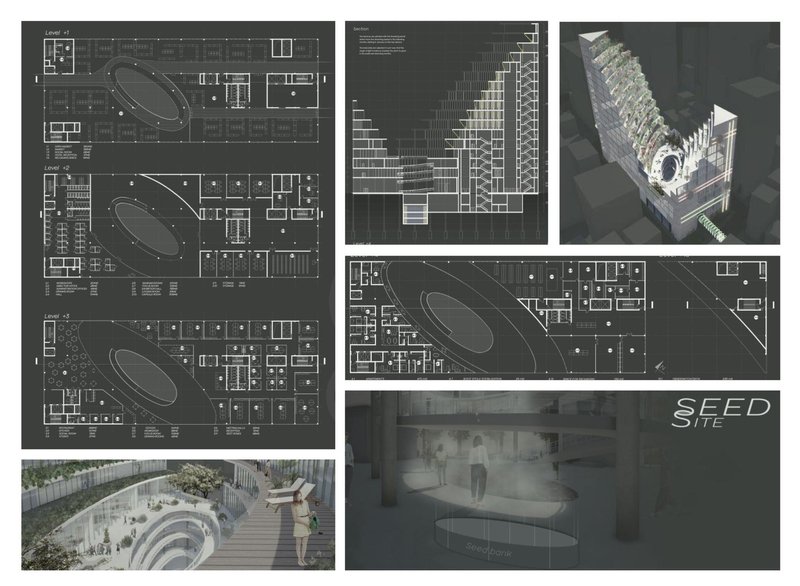
Description: The design bases on a concept of a vine trellis – an irregular and organic matter growing in an unpredictable way over a regular and manmade wooden structure. Like a living organism, its form grows into a city and is difficult to define, resembling a cloud.
The project significantly disperses the surrounding urbanization and improves the air circulation with its low height and abundant vegetation, becoming a green oasis in the concrete forest.
Nowadays the plot serves an important function in the urban tissue as the communication hub between the footbridges and escalators. In the design the former tunnel connecting both systems has been enlarged and converted into an open space where the passers-by can not only commute but also take a look into the work of the scientists as some of the seed bank facilities are located on the passage level, stop by the exhibition held by a seed bank, dine, attend workshops or simply enjoy a moment of the rest in a bustling city.
---------------------
Discover the design brief here: https://uni.xyz/competitions/seed-bank/info/about
Discover the full results here: https://uni.xyz/competitions/seed-bank/entries
Follow us on social media: Facebook | Instagram | LinkedIn | Twitter | Youtube
Discover other design competitions to participate here: https://uni.xyz/competitions



Popular Articles
Popular articles from the community

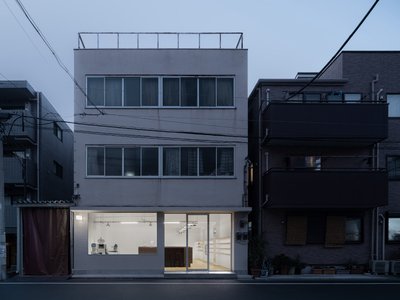
Atelier Macri Concept Store Interior Design by CASE-REAL
Atelier Macri store features a "ko" counter, walnut wood details, cork displays, blending retail, gallery, and seamless customer experiences.


The Ken Roberts Memorial Delineation Competition (Krob)
As the most senior architectural drawing competition currently in operation anywhere in the world, it draws hundreds of entries each year, awarding the very best submissions in a series of medium-based categories.
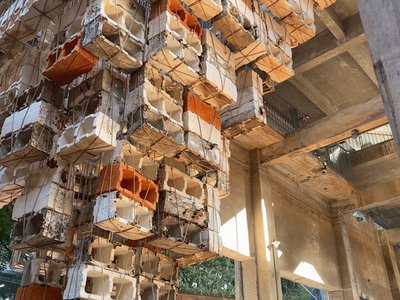
Inverted Architecture Installation by Studio Link-Arc: Exploring the Intersection of Architecture and Living Organisms
Inverted Architecture Installation by Studio Link-Arc blends mycelium, sustainability, inverted design, ecological cycles, and urban adaptive architecture in Shenzhen.
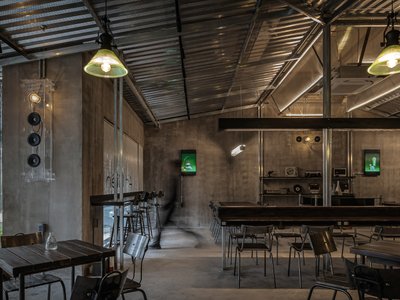
An Miên Lumière Cafe by xưởng xép, Ho Chi Minh City, Vietnam
An industrial-inspired café where layered steel and warm light create a dynamic, immersive environment shaped by reflection, depth, and perception.


Similar Reads
You might also enjoy these articles
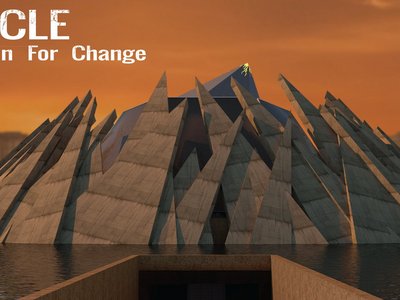
ORACLE: A Sustainable Memorial Architecture Responding to Climate Urgency
A sustainable memorial architecture in Cairo that transforms climate urgency into spatial experience, urging collective reflection and action
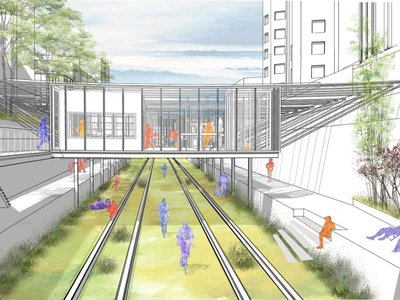
Suspended: Reimagining Paris Through Adaptive Reuse Architecture
A suspended intervention transforms abandoned Paris railways into inclusive, adaptive reuse architecture bridging heritage, mobility, and public life.
Solar Steam: A Climate-Responsive Architecture That Redefines the Monument
A climate-responsive memorial architecture that transforms heat, decay, and time into a living system reflecting humanity’s ecological impact.
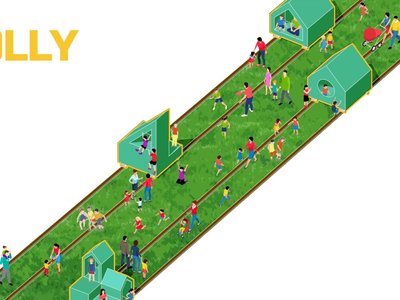
Rolly: A Modular Approach to Urban Regeneration Architecture on Paris’ Petite Ceinture
A modular urban regeneration architecture project transforming Paris’ abandoned railway into a dynamic, movable and community-driven public space






Comments (0)
Please login or sign up to add comments
No comments yet. Be the first to comment!