
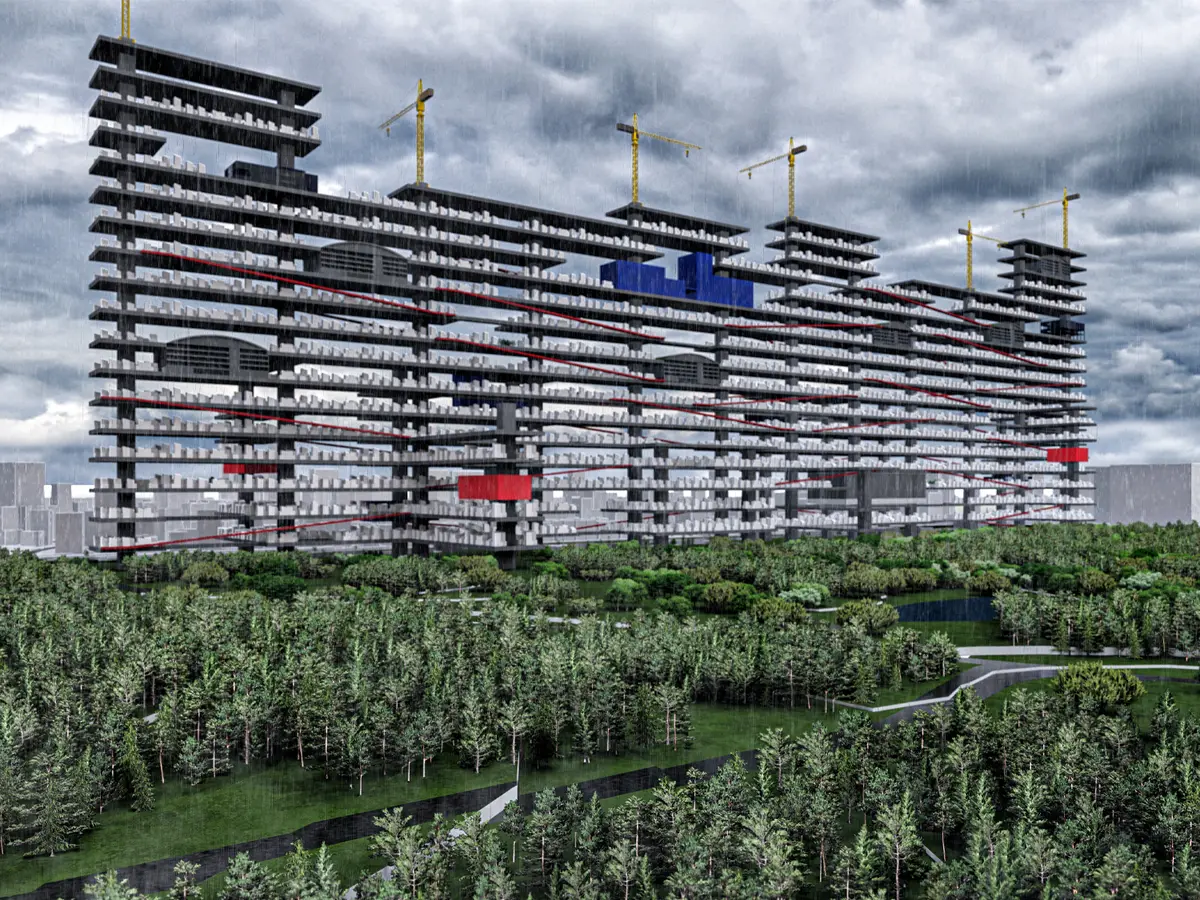
SLUMS IN TRANSITION: MEGA-STRUCTURE AS THE NEW “LAND”
While there are many issues to consider about the slums, the question that we need to answer is; ‘How to solve the social, environmental and urban problems due to slums?’

Nowadays, It can be said that the migration of people from the countryside to the city is experienced intensively. It is possible to mention about dense building stock in line with the need brought by the density of people in crowded cities. How cities respond to this increasing density is a question mark. It can be stated that in most cities, people coming from rural areas tend to build squatter settlements because they do not own a property in the city. From the environmental point of view, slums pose a great danger in terms of both the development and order of cities.
While there are many issues to consider about the slums, the question that we need to answer is; ‘’How to solve the social, environmental and urban problems due to slums?’’
The aim of the project is to find a solution to the problems of slums, to get rid of this congestion and to respond to environmental degradation to some extent. At the same time, it aims to offer the opportunity to live in better conditions by not disregarding the people living there and not tearing them away from the culture they are used to.
Mumbai was chosen as the project area because of its high level of inequality and environmental degradation. The fact that 50% of the city is shantytown was something that caught my attention. It is also known that there is difficulty in gaining a new function in the city due to squatter settlements. In fact, it was quite remarkable that the eastern part of the newly built airport could not be completed due to the slums. It is even known that this chosen area has the largest shanty settlement in Asia.
The fact that Dharavi district includes the 3rd largest slum in the world and has a dense population, has made my decision easier for choosing the land. It is also known that the neighborhood works like a big recycling factory. Plastic-style materials are collected, processed, and then sent to factories. In other words it is know that recycling is a major work in this region.
At the same time, the neighborhood is also called as the slum ocean. It is known that slums were built even for functions such as overpasses due to the lack of vacant land. It has been determined many times by Mumbai authorities that it is very difficult to intervene in the neighborhood life. In areas where narrow streets dominate, the distance between houses is very small. Since there is an unplanned and dense construction in the neighborhood, there is also a lack of public service. Appropriate living conditions and hygiene are almost nonexistent.mThere is no infrastructure in the neighborhood due to the low efficiency drainage system. On the contrary, there are open-top manhole pipes in the neighborhood. As a result of monsoon rains, the region is constantly flooded and has a devastating effect on human life. At the same time, the electrical cables of the region are hanging in the open, in a spiral form, hanging all over in an irregular way. Most of the people living in Dharavi district, live in slums, but there are also many people who do not live in slums and live on the streets.
In this project, while aiming to interfere with the existing congested and unplanned construction, I also aimed that this intervention would not disrupt the lifestyles of the people living there, and that cultural changes would be kept to a minimum. So, I tried to include cultural aspects of this community in spatial design. There is a green area in the part between the river and the chosen land. In my project, I aimed to create a green area that can be used by both the citizens of the city and the residents of the slums. So, the existing slum area is transformed to a green public space. I aimed to create a mega-structure on the border of the area where the high-rise building stock is located, and to create independent but at the same time related neighborhoods within this mega-structure, where different functions co-exist. It is thought that the designer will design some of the residences created in the neighborhoods and transform the remaining spaces in line with the needs of the user. The idea of moving the production areas that the people living in the neighborhoods had previously created in their own houses to the neighborhoods and continuing there was also considered. My aim is not to destroy the social and cultural exchange there. I designed a space that will create a public space between the structure and tall buildings and serve the city and the slum dwellers. The train line continues through the chosen land and the city.
Mega-Structure:
Housing types consist 5 different modules. Some of these residences were designed by architects. It is thought that the spaces will be transformable if necessary due to users’ changing needs. These houses are prefabricated and are produced in the areas on the main structure.
Neighborhoods are diversified within themselves. In each neighborhood, how housing types come together, how those relate with the green area, and the workshop and other functions differ. The main purpose here is to design without detaching people from their existing way of life.
Another benefit provided by the mega-structure is that many public services that were not previously available in the slums are now being developed in a way that people can easily access. Suitable living conditions and a hygienic environment are now also provided. The low-efficiency drainage system in the neighborhood, open sewers and the effect of monsoon rains were considered, and it was aimed to be rearranged to diminish the destroying effects.
While creating the neighborhoods, it is planned not to break away from the functions in the neighborhood and to use the workshop-house as before, not in the houses, but in the workshops created at very close distances.
The streets that are very narrow due to the slum ocean and the slums built at every point have left their place to wider walkable streets with planned construction.

Popular Articles
Popular articles from the community


Little Red Riding Hood: Architectural Design as a Journey Through Fear, Light, and Storytelling
Little Red Riding Hood reimagines the fairy tale through architectural design shaped by fear, light, scale, memory, uncertainty, and choice.

Conexión: Biophilic Design Reimagines High-Rise Living in Hong Kong
Conexión reimagines high-rise living in Hong Kong through biophilic design, green facades, shared spaces, daylight, water and nature within.

Hill & Cross Opera: Sculptural Opera House Architecture Shaped by Tallinn’s Landscape and Identity
Hill & Cross Opera reimagines opera house architecture in Tallinn through its sculptural hill, civic plaza, glass wave and a luminous cross.

The Musturak Paradise: Senior Living Architecture for a Connected Future in Temara, Morocco
The Musturak Paradise reimagines senior living architecture in Temara via private homes, social spaces, culture, community, and shared care.

Similar Reads
You might also enjoy these articles
The Rhythm of Seasons
A Farmers' Market Connecting Nature and the City

More Than a Building-Designing a Living System
More Than a Building-Designing a Living System
Base Beyond
DESERT COMPOUND ARID: TOURISM OF ABSENCE AND ABUNDANCE

Explore Slumscraper Competitions
Discover active competitions in this discipline


Challenge to reimagine the Iron Throne

Photograph architecture without architects

Illustrate the lost glory of Angkor Wat - Render Challenge

Design challenge to reuse E-waste
Comments (0)
Please login or sign up to add comments
No comments yet. Be the first to comment!