

Spaces that live beyond their time
Gather here! at the Stadiums of Future


Background
Since the origin of the Olympics in 1896, sports events have gained massive popularity worldwide. These events are big for all countries and a matter of great pride and responsibility for the host nation. It gives the host a chance to reflect upon their cultural values & promote tourism. Huge sums of public money are invested in organizing these events, out of which a major chunk is invested in preparing the venues for sports events to be witnessed by a global audience.
To cater to a larger audience, the scale of venues for major sports events like Olympics, commonwealth events is magnificent which requires a large investment of public money. However, this becomes a massive issue, majorly in developing regions. The limited usage of such buildings after the event adds a layer of an issue in the name of maintenance cost. These structures often become a liability for a host. Historically, a large number of such venues were demolished to reuse the land which may not be the most ideal way to deal with public resources.
The rampant investment of public money to host such events goes in vain once the event is over. But can these mega machines for viewing live sports be more than what they are today? Can we pre-plan the future life of the stadium and give this momentarily used asset back to its people?
Brief
Stadiums in the past banked on exclusivity that live sports could offer. The closed structure is a resultant of thought when narrow gates were ticketed and then sports was served live. This was the only way to consume the thrill of live sports in the past, which explains ‘why’ the crowd. Today thanks to our advancement in long-distance transmission, almost every major esports can be live previewed in our palms. The closed structure of stadiums which was then a necessity is now open to experimentation.
The challenge was to design a concept stadium for international events in a small city, such that the setup could be used/reused for many purposes beyond sports.
The sheer culmination of many facilities and building services makes a stadium an ideal box to serve many functions beyond sports. Eg. A public space, a Market or a Fitness park, and many many more such examples. The multi-use perspective is seen in a time span of decades where a stadium might sit idle for more than half a year.
The jury for the competition consisted of esteemed designers, professionals and academicians from around the world. The Lead Jurors for the competitions were as follows:
René van Zuuk, Director/Architect, René van Zuuk Architekten b.v., Netherlands
Carlos Banon, Co-Founder, SUBARQUITECTURA, Singapore

"Some of the Best of competition projects are:"
Winning Project: Hidden Stadium
By: Andres De La Paz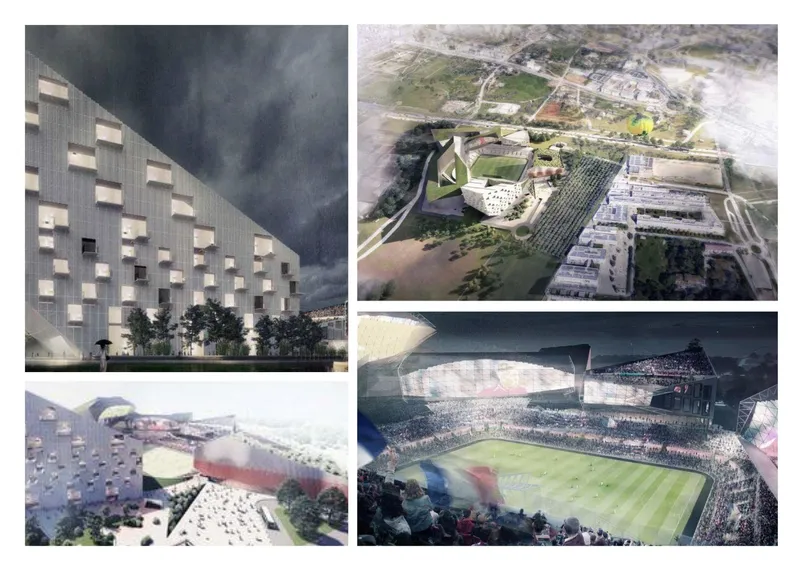

Description: It has become a status quo for stadia to become interchangeable objects on the ground, devoid of any connection between the two. We remember stadiums as these massive filled hubs of activity and myth. A stadium is a machine of collective memory. The proposal gives Montpellier a catalyst for urban development with a hidden stadium at its core. In recent years much thought has been placed on urban stadiums. Interwoven with the fabric of the city, urban stadiums are more likely to become useful place-making venues, rather than forgotten monoliths. In order to emphasize the memory of the stadium is stripped of its iconic bowl shape and structural shell.
-----------------
Runner - Up: MONT-PELE
By: Mitchell klecan & Jorden Zauel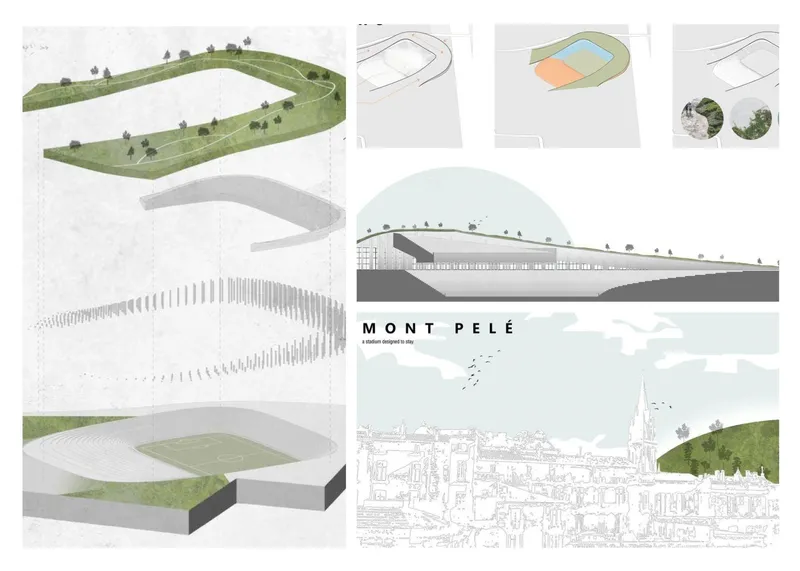

-----------------
People’s Choice : GREEN STADIUM MONTPELLIER
By: Misak Terzibasiyan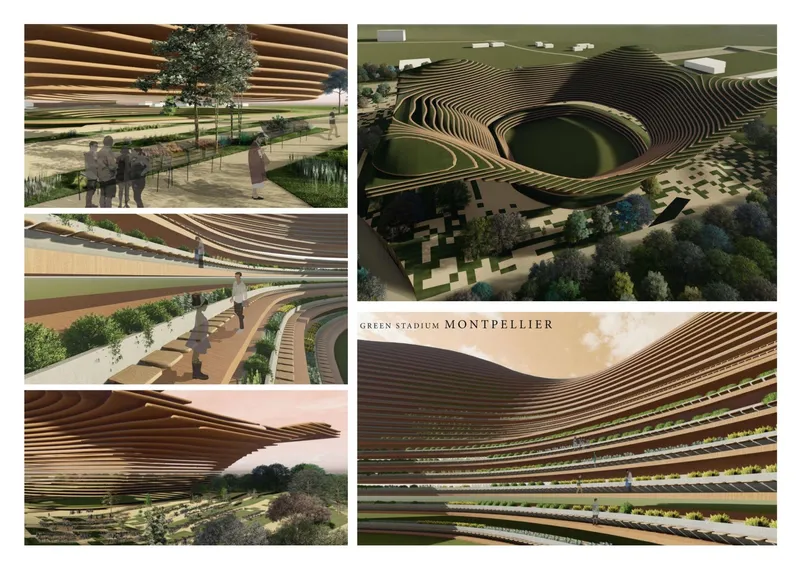

Description: The concept behind the design was to create a stadium whose function would go beyond today's standards for a sports arena. Closed structures and a very narrow target group are replaced here with open form and function. Together with the technologies used, the organic shape of the stadium - with its wavy, horizontal lines - represents the ecological aspects. The stadium should also be open to the people: in relinquishing the private character of a place, the arena would no longer be entirely dependent on one owner or considered as city property. Instead, the community would have a real impact on the stadium, helping keep it alive and influencing how it will look in the future by taking care of its greenery.
-----------------
People’s Choice : SILOS
By: Mexime Delvalle & Leo Marty

Description: "Silos" is not only a stadium but a landmark for Montpellier. Sustainability engages mutation, multi-use, and renewal which are the key concepts developed through the design of the project.
"Silos" claims the need to protect market gardening and wine-growing to support the identity of a region. It?s is a showcase for the territory's wealth and culture.
« Silos » isn’t something figurative, rather, it wants to take its roots on the actual landscape, both cultural and urban, to create something noble. The city and all the things representing the local culture will live through this project. Acknowledging the market gardening and wine-growing in the design of this JO 2023 stadium, it conceives a showcase for the territory’s wealth. Frank, direct and without cheating, the design sought to be an echo from the wealth of uses you could find into it. The use of polycarbonate permits to play with the inside out mutation of uses and all the techniques elements such as structure, mechanics or power grids are completely apparent. Like a real silo in a sense. Neon lights, mixing signage and cultural banner, paired with red walkway bring the pop touch needed.
------------------
Editorial Choice: Stadium - Cultural Center - Park
By: Dinah Brutsch & Simone Durrer
Description: The project intends the construction of a spatial infrastructure, which will change together with urban development. In 2023 it will serve as a stadium for the FIFA Women's World Cup. In the longer term, only slabs out of concrete will remind us of the former stadium, in the middle of an urban park. The football stadium for the FIFA Women's World Cup in 2023 will offer space for 30’000 visitors during the major event. From our point of view it does not make sense - as required by the task - to continue to use the stadium as such after the event, alternating half a year as a football stadium, the other half a year in an alternative function.
------------------
Editorial Choice: Stoenix
By: Mab Abdulrahman
Description: Stoenix follows the story of a stadium that has rid itself of all burdens to realize its true potential as a central piece of the city's infrastructure.
----------------
Editorial Choice: The Antistadium: Louis Nicollin Park
By: Gabriel Madrigal B & Federico Hernandez
Description: It's an invisible space created by people's way of thinking, promoting their culture, activities and different ways of living football, it's not a stadium, it's a park that can become a stadium of low physical impact to the city, though it's not necessary to recycle the space because it will remain being park even without functioning as a stadium.
------------------
Editorial Choice: Montpellier Stadium
By: Ralph Mirandilla

Description: We are submitting a proposal for a stadium for the city of Montpellier, our design prepared to be a stunning and focal point for the city. The new form and modern lines used with high tech and interactive facades. The design criteria of the stadium were prepared based on FIFA requirements to host international games.
-------------------
Organizer's Choice Award: CRATERRE
By: Giovanni Vaccarini
Description: The idea is to design a stadium that arises from nature, and can be reconverted into nature.
A stadium/park that turns into a green hill that can always be enjoyed by the community.
The urban vision is that of a "green corridor" that starts from the north (le Bosses Nature Reserve) and descends southwards to the sea intersecting notable urban elements. The idea is to design a stadium that arises from nature and can be reconverted into nature.
A stadium/park that turns into a green hill that can always be enjoyed by the community.
"Craterre '' is the crisis between earth and hill.
Discover the full results here:https://uni.xyz/competitions/staydium/entries
Discover the design brief here: https://uni.xyz/competitions/staydium/info/about
Follow us on social media: Facebook | Instagram | LinkedIn | Twitter | Youtube
Discover other design competitions to participate here: https://uni.xyz/competitions




Popular Articles
Popular articles from the community


Co-life: Sustainable Architecture for Age-Friendly Community Living
Co-life reimagines sustainable architecture for seniors through courtyards, rammed earth, shared gardens, and spaces designed for belonging.

Riyadh For All: Intergenerational Urban Design for Active Aging in Rabat
Riyadh For All reimagines urban design in Rabat with intergenerational co-living, adaptive courtyards, and Moroccan cultural exchange today.

The Musturak Paradise: Senior Living Architecture for a Connected Future in Temara, Morocco
The Musturak Paradise reimagines senior living architecture in Temara via private homes, social spaces, culture, community, and shared care.
AL-JANNAH: Sustainable Architecture and Permaculture for Afghan Widows
AL-JANNAH uses sustainable architecture and permaculture to create resilient oasis of housing, learning, work and renewal for Afghan widows.

Similar Reads
You might also enjoy these articles
The Musturak Paradise: Senior Living Architecture for a Connected Future in Temara, Morocco
The Musturak Paradise reimagines senior living architecture in Temara via private homes, social spaces, culture, community, and shared care.

The Leaf Center: Cultural Center Architecture for Social Integration in Amsterdam
Cultural center architecture becomes a bridge at The Leaf Center, connecting international students with Amsterdam through art and exchange.

Conexión: Biophilic Design Reimagines High-Rise Living in Hong Kong
Conexión reimagines high-rise living in Hong Kong through biophilic design, green facades, shared spaces, daylight, water and nature within.

Wander to Wonder: Modular Playground Design for Children in Kutupalong Refugee Camp
Wander to Wonder uses modular playground design to create flexible, imaginative play spaces for children in Kutupalong refugee camp.

Comments (0)
Please login or sign up to add comments
No comments yet. Be the first to comment!