

1Y Architects Build a Circular Sound Museum from the Ruins of a Chinese Industrial District
In Zhuzhou's abandoned Qingshuitang smelting zone, gabion walls of salvaged brick and steel form a labyrinth dedicated to memory.


Zhuzhou's Qingshuitang district once hummed with over 200 smelting and chemical enterprises, a pocket of heavy industry that defined the city's economy through most of the twentieth century. When tightening environmental standards forced production to slow and then stop, the workshops emptied, and the zone fell into a long, uneasy silence. Into that silence, 1Y Architects have placed a 380 square meter open-air museum whose entire purpose is to give sound and memory a physical address.
What makes the project genuinely interesting is the refusal to treat demolition debris as waste. Rather than clearing the site and starting fresh, lead architect Fan Chang and the team gathered broken bricks, concrete fragments, roof tiles, and salvaged steel from across the former industrial complex and packed them into gabion cages to form the museum's walls. The result is a circular labyrinth where every stone has a provenance, and the architecture reads less as a new building than as a rearrangement of what was already there. Construction becomes editing, not replacement.
A Centripetal Plan
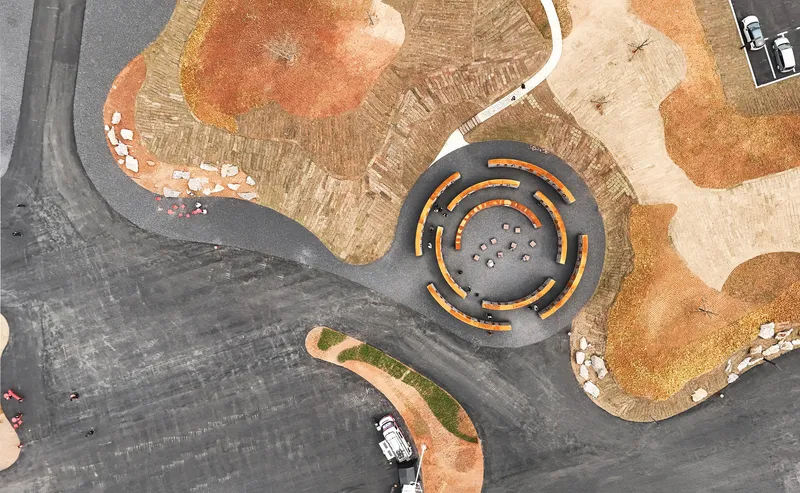

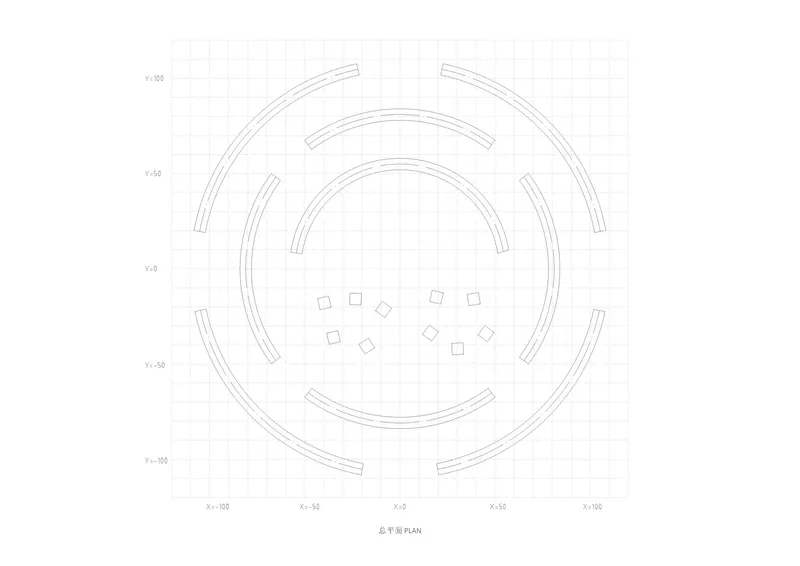
From the air, the museum's logic is immediate: concentric curved walls spiral inward toward a central amphitheater, the 16 meter wide Echo Plaza that serves as the site's heart. The plan is centripetal. Visitors are drawn through narrowing corridors toward a communal gathering space designed for performances, storytelling, and the simple act of listening. Radiating segments cut through the rings, creating moments of cross-axis view that frame the district's surviving industrial chimneys on the horizon.
Sited within a parking area beside derelict factory buildings, the pavilion makes no attempt to disguise its context. It sits among the ruins rather than apart from them, and its circular geometry contrasts sharply with the orthogonal grid of the former industrial fabric. That tension is productive: the museum announces itself as something deliberate, not leftover.
Gabion Walls as Memory Banks
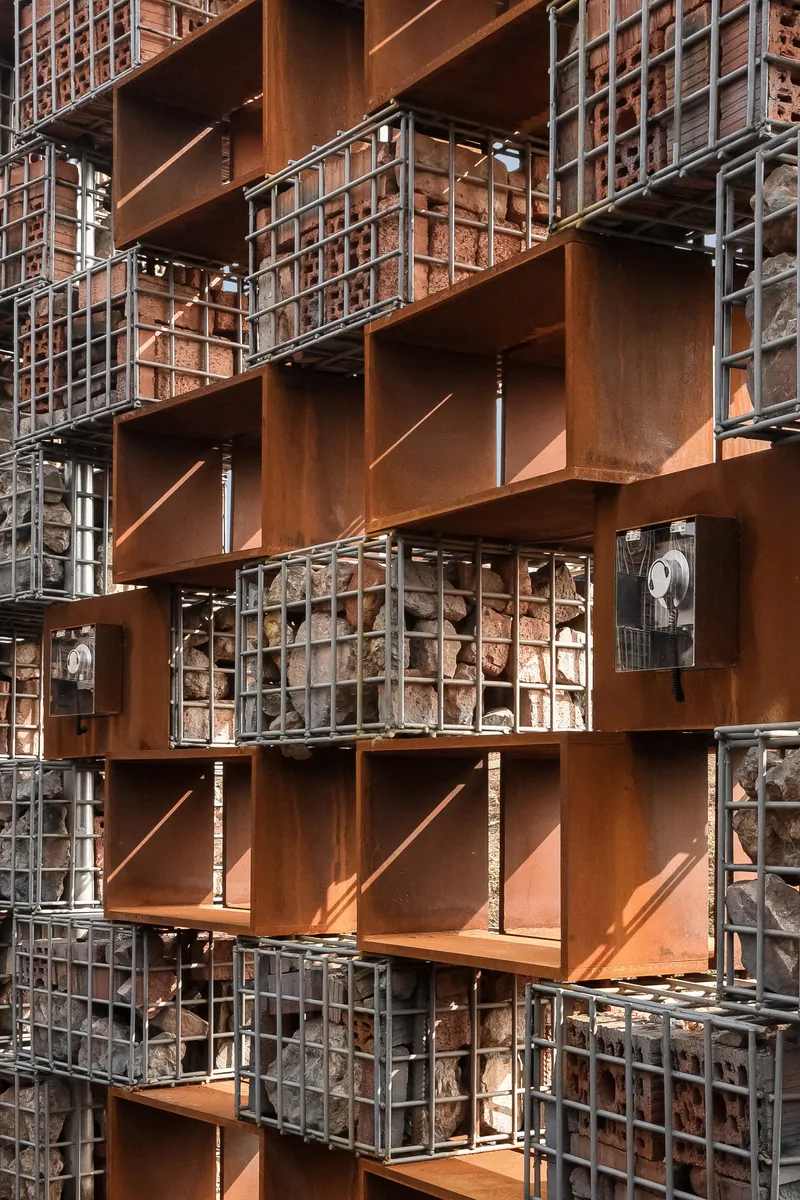


The gabion system, borrowed from hydraulic engineering, is the project's defining structural and aesthetic move. Steel mesh cages are stacked layer by layer to form the main walls, their contents visible through the wire: broken bricks in terracotta and grey, chunks of concrete still showing rebar scars, stacked traditional roof tiles whose curves create a different texture at every panel. Each fragment originates from a different structure within the industrial complex, so the wall itself becomes a kind of geological cross-section of the district's built history.
Interspersed among the gabion modules are rusted corten steel boxes that serve as niches for audio equipment, benches, and small viewing openings. The checkerboard pattern of stone-filled mesh and weathered steel gives the facade a rhythm that is both regular and endlessly varied, because the fill material is never the same twice. It is an honest system: nothing is hidden, nothing is rendered over.
Moving Through the Labyrinth

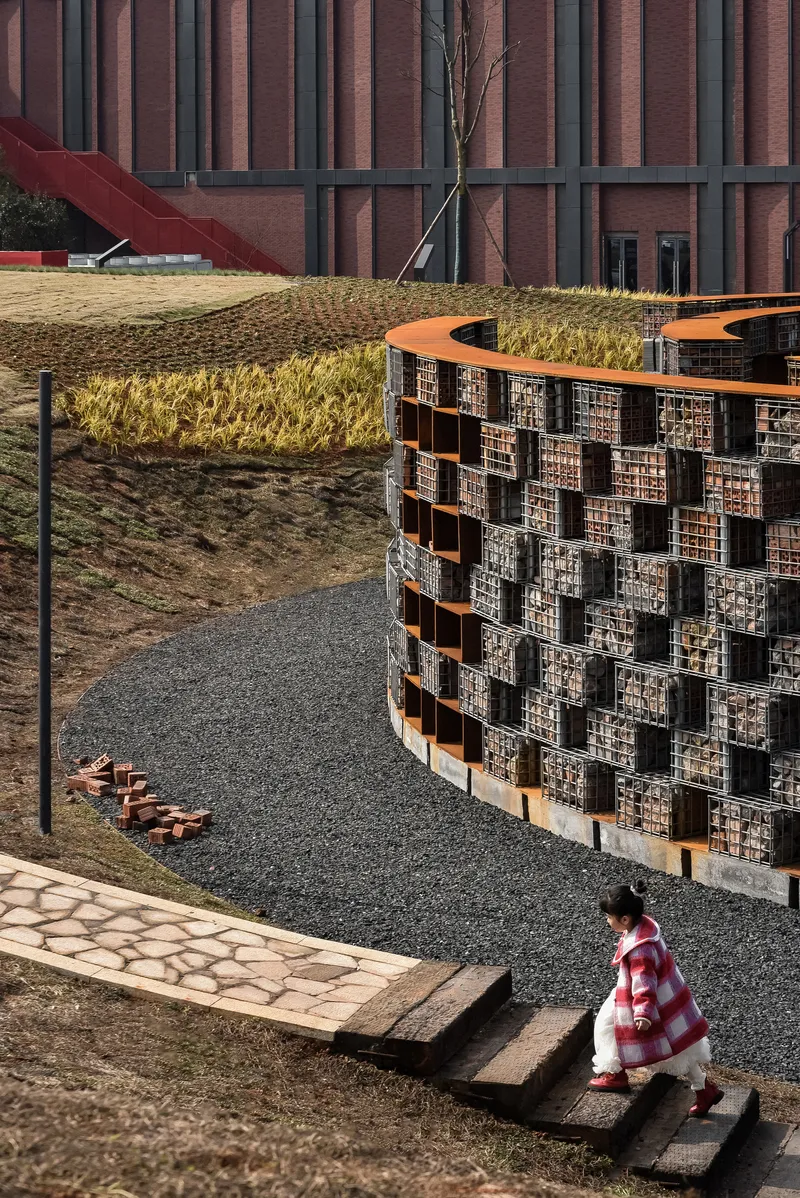

The experience of the museum is sequential and tactile. Narrow gravel corridors channel visitors between towering gabion walls, the crunch of stone underfoot mixing with whatever sound installation is playing from the embedded speakers. The curved geometry means you can never see far ahead; each turn reveals a new frame, a new sightline, a new acoustic condition. Weathered steel frames punctuate the walls, offering glimpses through layered openings into the courtyard beyond.
Stairs cut into the hillside beside the curving walls, and golden grasses spill over the top edges, blurring the line between architecture and landscape. The building never feels sealed or precious. Rain falls through it, wind moves across it, and the materials continue to weather. It is open-air in the fullest sense: no climate control, no artificial lighting, no glass.
The Courtyard as Stage


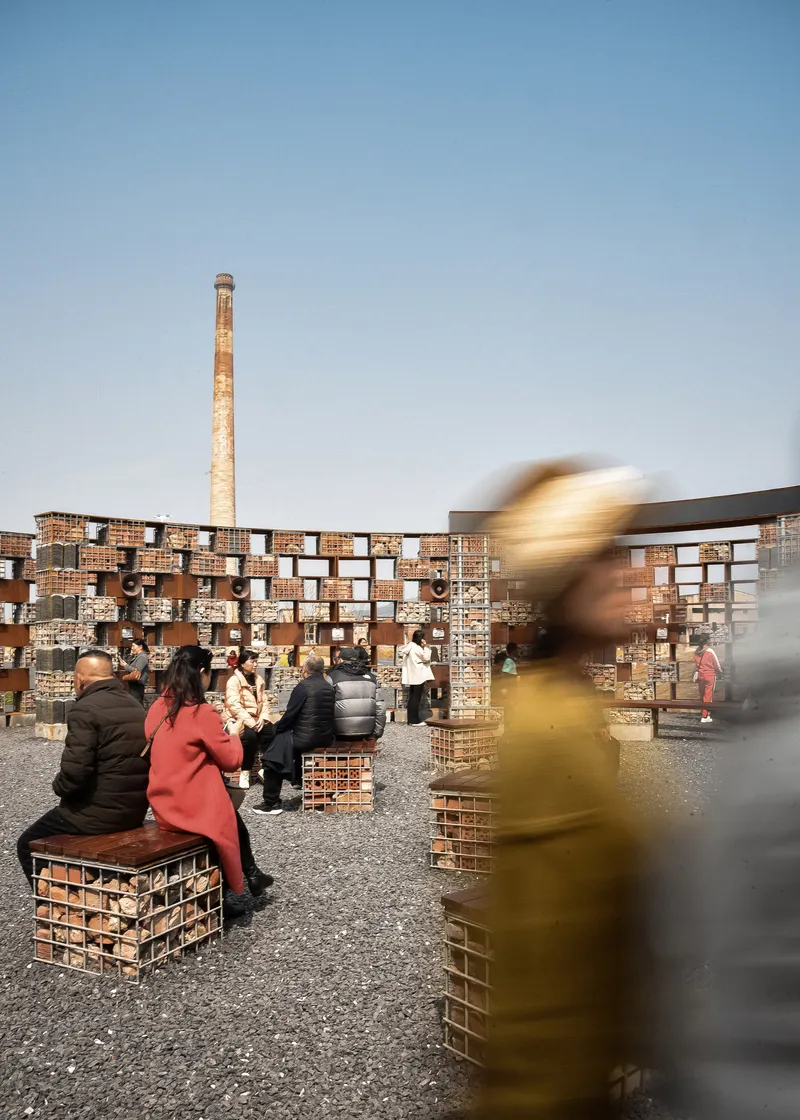
Echo Plaza, the central amphitheater, is paved in gravel with brick seating cubes scattered across it like oversized building blocks. The concentric rings of the surrounding walls create a natural acoustic bowl, collecting and reflecting sound in a way that justifies the museum's name. At dusk, visitors linger on the cubes while the weathered brick chimney of a surviving factory rises behind them, a vertical reminder of the district's former scale.
The courtyard works as both event space and contemplative pause. Families examine display niches set into the surrounding walls; others simply sit. The program is deliberately loose, because the architecture's real content is not objects in vitrines but the accumulated atmosphere of the place itself: the texture of reclaimed materials, the ambient sound, the framed views of chimneys and sky.
Sound as Program


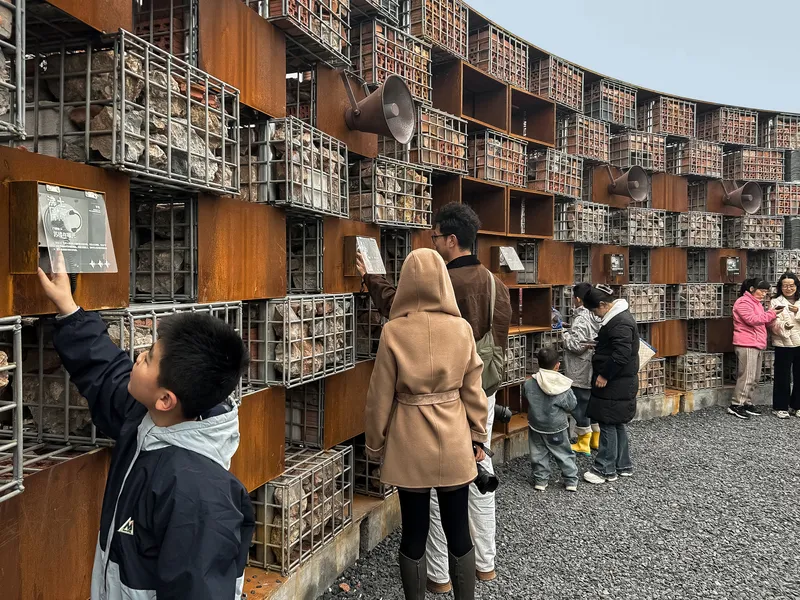
Mounted speaker horns, intercom boxes, and audio niches are embedded directly into the gabion and corten grid, turning the walls into instruments. The sound installations recall the industrial noises that once filled Qingshuitang: the clang of smelting, the rumble of machinery, the voices of workers. By housing audio equipment in rusted steel boxes that match the building's palette, 1Y Architects avoid the common pitfall of media installations feeling grafted onto architecture. Here, the speakers belong to the wall the way a window belongs to a facade.
Visitors photograph through layered steel frames and peer into niches, engaging with the building at arm's length. The interactivity is low-tech and physical, not screen-based. You lean in, you listen, you touch the wire mesh. It is a museum that asks for bodily presence rather than passive consumption.
Brick, Steel, and the Canopy Edge

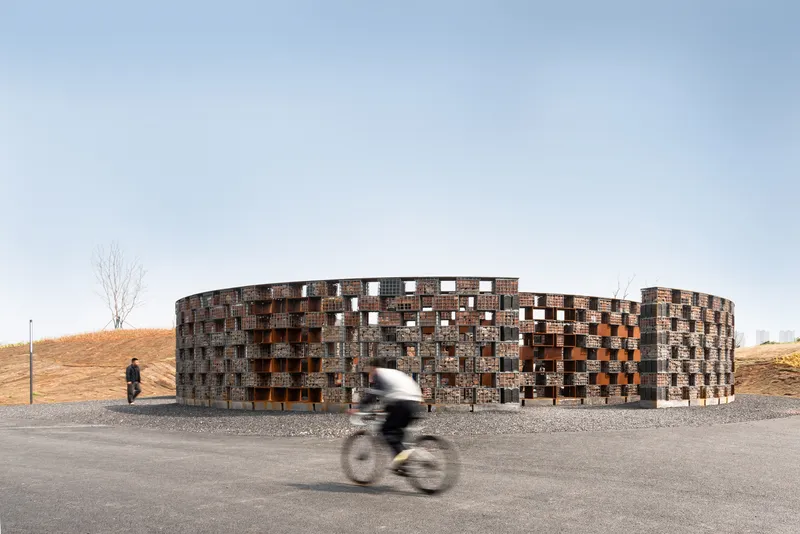
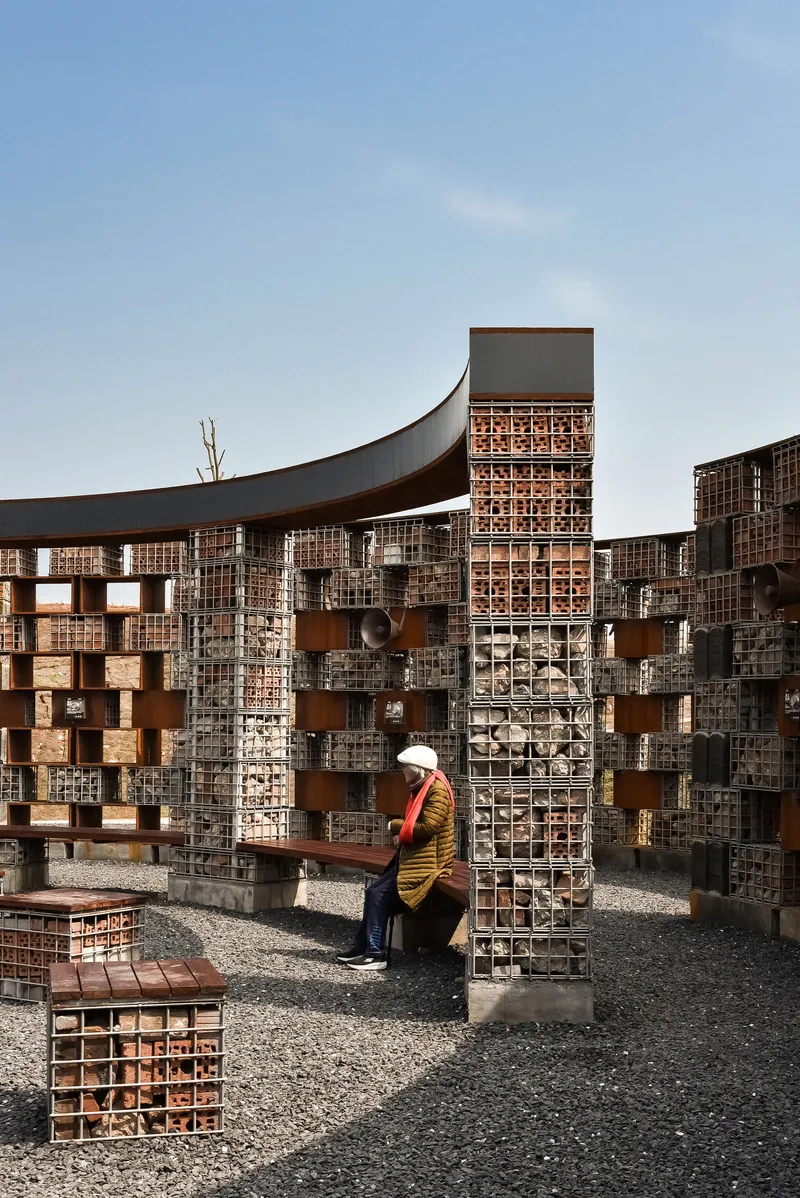
Where the museum meets the surrounding landscape, a sweeping canopy and perforated brick screen wall mediate the transition. Traditional bricks are laid in patterns that admit light and air, creating a gridded facade whose shadows shift throughout the day. Corten steel frames interrupt the brickwork, establishing a dialogue between the two primary materials. The cylindrical form of the pavilion is legible from the street, its patterned skin distinctive enough to draw a passing cyclist's attention without resorting to spectacle.
A surviving brick chimney rises directly behind the canopy, and the architects have clearly choreographed the relationship. The chimney's vertical mass anchors the composition, while the low, curving museum wraps around its base like an act of deference. Old and new share the same material language, the same palette of rust and terracotta, and the distinction between them softens with every season of weathering.
Framing What Remains


The museum's geometry is calculated to create visual frames for the district's iconic industrial landmarks. Small viewing openings in the gabion walls align with distant chimneys and factory rooflines, so that the act of looking through the building is also the act of looking at the neighborhood's history. The curved facade on the hillside, backed by dry grass and bare trees, reads as a defensive wall that simultaneously protects and reveals.
1Y Architects understand that preservation does not require freezing a site in time. By redistributing the physical matter of demolished buildings into a new form, the project extends memory without pretending that nothing has changed. The irregular pieces remain visible through the mesh, each one a small artifact of a structure that no longer stands.
Plans and Drawings


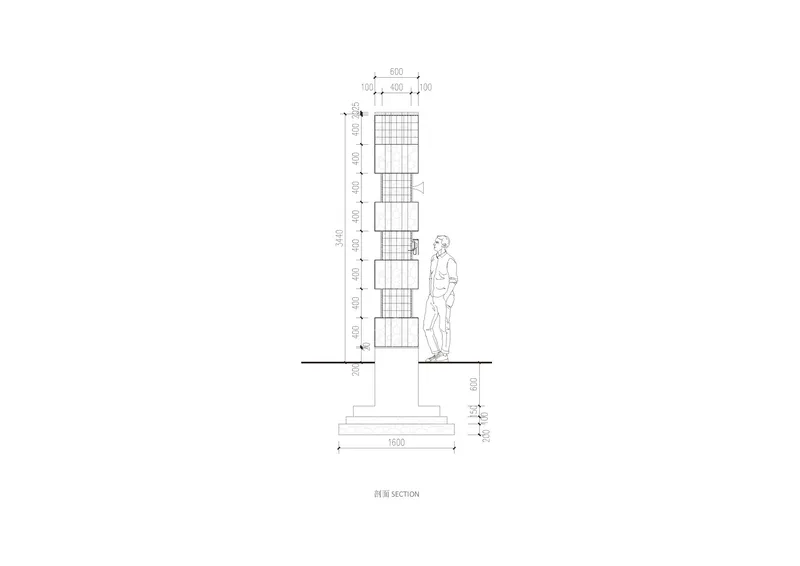
The technical detail drawing reveals how vertical acoustic devices are integrated into the wall assembly, slotting into the gabion and corten grid without disrupting the structural logic. The elevation drawing shows the regularity of the patterned brick facade, its openings spaced to balance transparency and enclosure. The section drawing exposes the stepped topography and a tall gridded tower element whose scale is anchored by a single human figure at its base. Together, these drawings confirm that the project's rough, almost improvised appearance is the product of careful calibration.
Why This Project Matters
Post-industrial sites across China face a familiar binary: demolish and rebuild, or preserve as heritage. The Echo of the Ruins museum proposes a third option, one in which the material of demolition becomes the material of construction and the building carries its own history in its walls rather than in a plaque. At 380 square meters, it is small enough to be legible as a single gesture yet complex enough in its concentric plan to reward repeated visits. The gabion system keeps costs low, avoids the carbon load of new masonry, and delivers a facade whose texture no rendering software could predict.
More broadly, the project demonstrates that a museum does not need climate-controlled galleries or white walls to hold meaning. Sound, gravel, weather, and reclaimed brick can do the work if the spatial choreography is right. 1Y Architects have built a container for human memory that is itself made of memory, and in doing so they have given Qingshuitang's industrial past a form that is neither ruin nor replica but something genuinely new.
"Echo of the Ruins" Open-Air Museum of Sound and Memory by 1Y Architects. Zhuzhou, China. 380 m². Completed 2026. Photography by Yifan Chen.
About the Studio
Share Your Own Work on uni.xyz
If projects like this are the kind of work you want to make, uni.xyz is a place to publish your own, find collaborators, and enter design competitions.


Popular Articles
Popular articles from the community

Extended Shell: Retrofitting Kolkata's Balconies as Living Urban Thresholds
A modular retrofit system recovers the social and environmental intelligence of Kolkata's historic verandas for contemporary Park Street residents.

Manzana Morphosis: Stretching Barcelona's Grid into a Living Landscape for 2050
A radical reworking of the Eixample manzana turns density into a tool for generous public space, vertical ecology, and environmental performance.

Opera on the Sea: Driftwood Logic Shapes a Timber Opera House on Estonia's Coast
Trevor Orgill's opera house translates the entangled drift of floating timber into a civic building where wood, water, and music converge.

The Amber Palace Opera: A Geological Fiction Surfaces on Tallinn's Baltic Waterfront
Pierre Brillard reimagines a Baltic legend as a public landscape, opera house, and waterfront promenade rooted in Tallinn's coastal identity.

Similar Reads
You might also enjoy these articles

Pixel Gardens: One Repeated Module Stacked Into a Terraced Social Housing Tower for Famagusta
Salem Bader's shortlisted housing tower builds a vertical neighbourhood from one repeated module, offsetting units to carve terraces, light and air.

Bao Huynh Watercolor Atelier: A Serene Art Retreat in Hội An
Bao Huynh Watercolor Atelier in Hội An blends multifunctional art spaces, sustainable design, local materials, and family-friendly living in a serene environment.

Atelier Macri Concept Store Interior Design by CASE-REAL
Atelier Macri store features a "ko" counter, walnut wood details, cork displays, blending retail, gallery, and seamless customer experiences.

Manuel Vargas Izquierdo Stadium and High-Performance Sports Center: Architectural Excellence in Jalpa de Méndez
The Manuel Vargas Izquierdo Stadium blends sustainable design, inclusive sports facilities, and cultural-inspired architecture, revitalizing Jalpa de Méndez’s public spaces.


Comments (0)
Please login or sign up to add comments
No comments yet. Be the first to comment!