
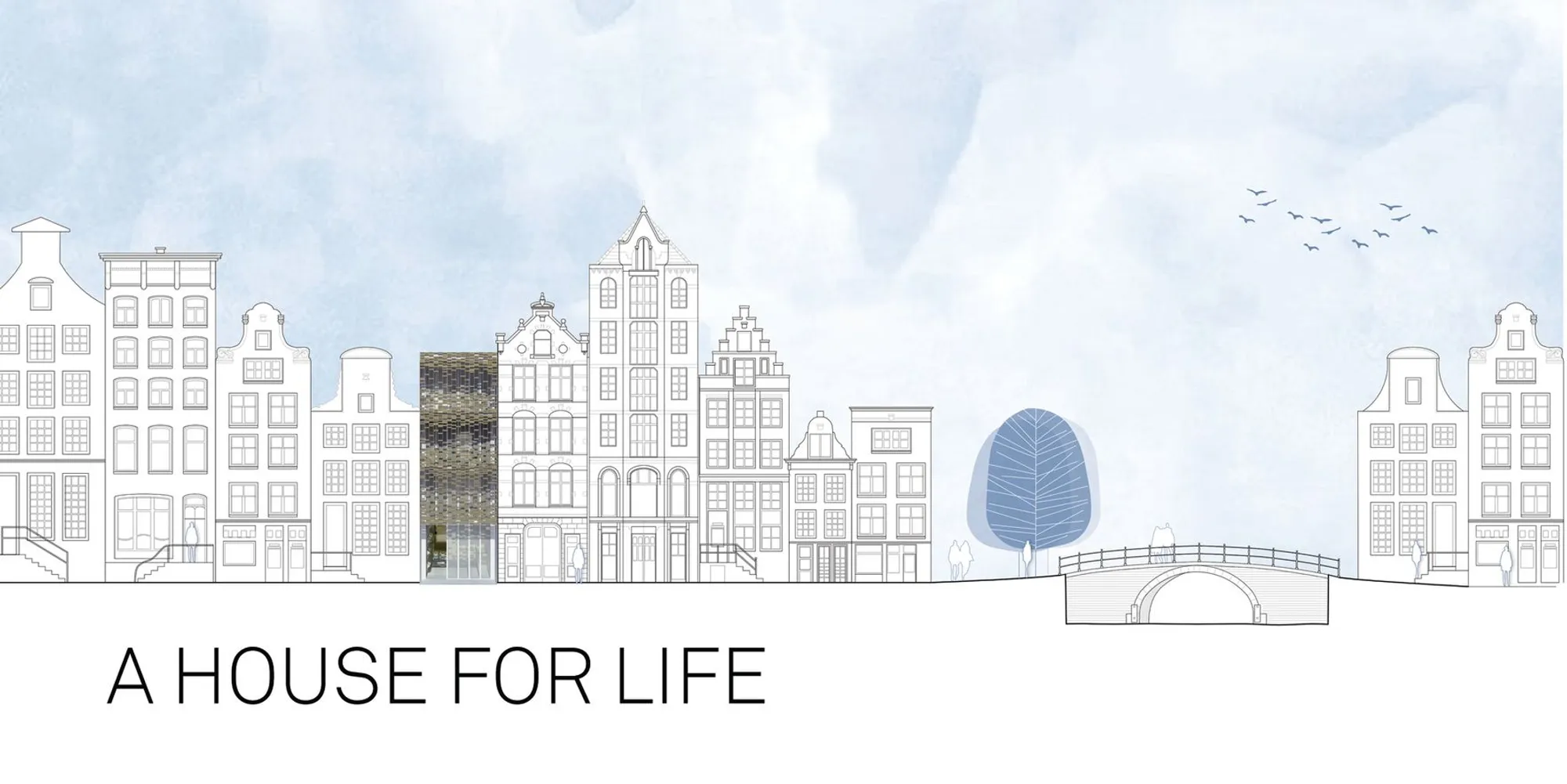
A House for Life: A Multigenerational Home That Evolves Over Three Decades
On a narrow Amsterdam lot, a vertically organized dwelling adapts from 2020 to 2050 through modular rooms, biophilic walls, and flexible layouts.


Most homes are designed for a snapshot in time: a young couple moving in, a family at its current size, a retiree settling down. Rarely does a residential project attempt to serve all three conditions simultaneously, and rarer still does it plan for the transitions between them. "A House for Life" does exactly that. Set on a narrow Amsterdam plot, the project houses three generations of one family and charts their spatial needs across a thirty-year timeline, from 2020 to 2050, treating the home not as a fixed object but as a living framework that sheds and grows rooms the way a tree sheds and grows branches.
Designed by Tassos Petridis and submitted as a runner-up entry in the Nano Nest 2020 competition hosted by UNI, the project takes the constraints of compact urban housing and reframes them as generative design tools. The Van Dijk family, six members across three generations, provides the narrative spine: children Jurre and Yara, parents Tiyo and Vincent, and retired grandparents Anne and Willem. Every square meter of the home must answer to all of them, now and in the decades ahead.
Stacking Generations on a Narrow Lot
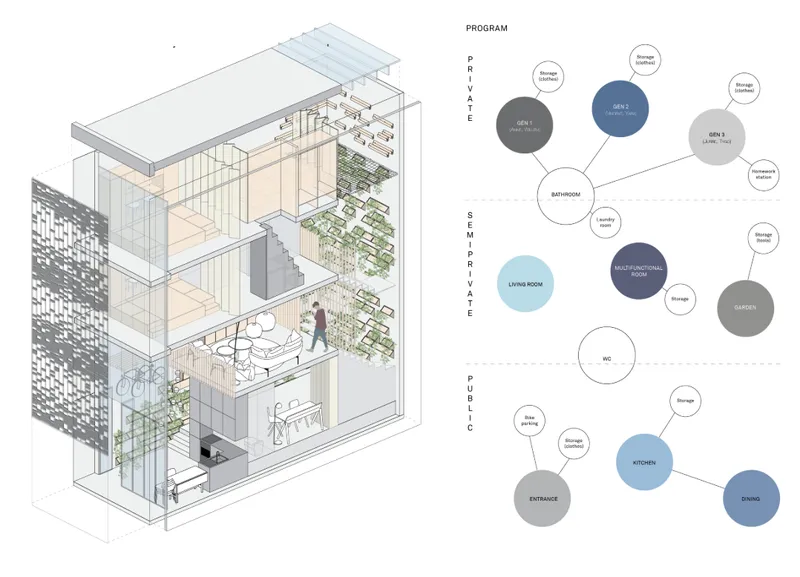
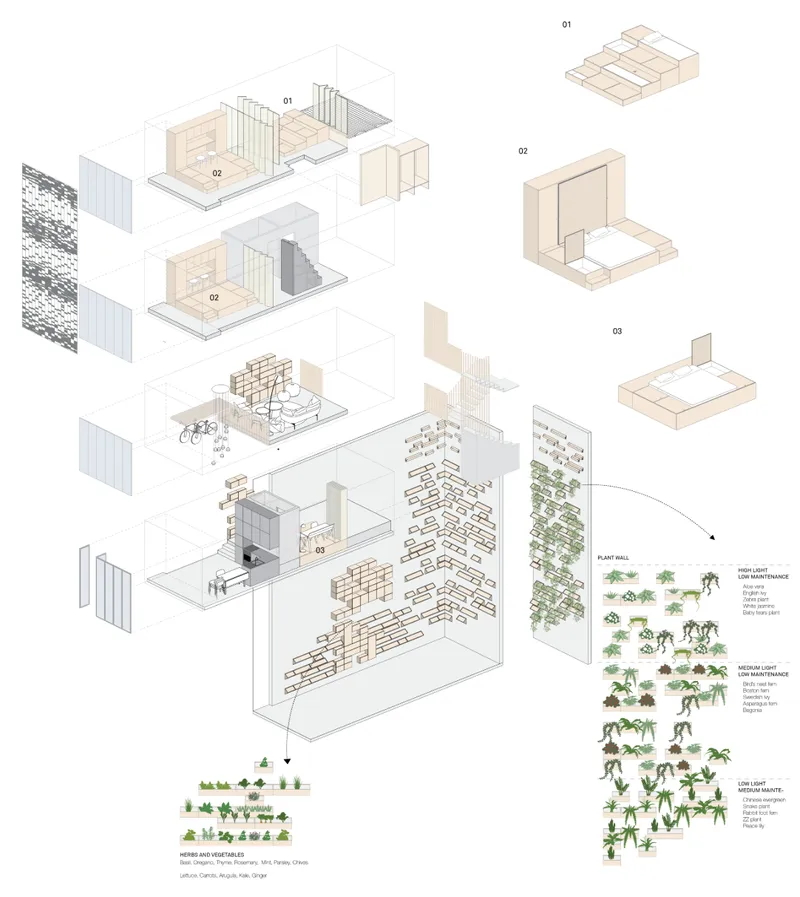
The axonometric section drawing reveals how the house resolves its compact footprint through rigorous vertical organization. Private, semi-private, and public zones stack from top to bottom, with integrated planters threading through the facade and connecting the levels visually. A program diagram alongside the section spells out how each floor serves different members of the family, while the exploded axonometric drawing peels back those layers to expose the interior furnishings, movable modules, and a carefully catalogued selection of plant species assigned to the green wall system.
What stands out here is the deliberate rejection of permanence. Beds retract into storage units. Seating areas convert into sleeping zones. Partitions move. The exploded view shows this modularity not as a gimmick but as a spatial strategy with real consequences: by allowing rooms to transform, the design avoids the demolition, renovation waste, and energy expenditure that typically accompany a family's changing needs. The plant species catalog is equally precise, categorized by light exposure and maintenance level, so the biophilic elements function as practical household systems rather than decorative afterthoughts.
Five Floors, One Evolving Ecosystem
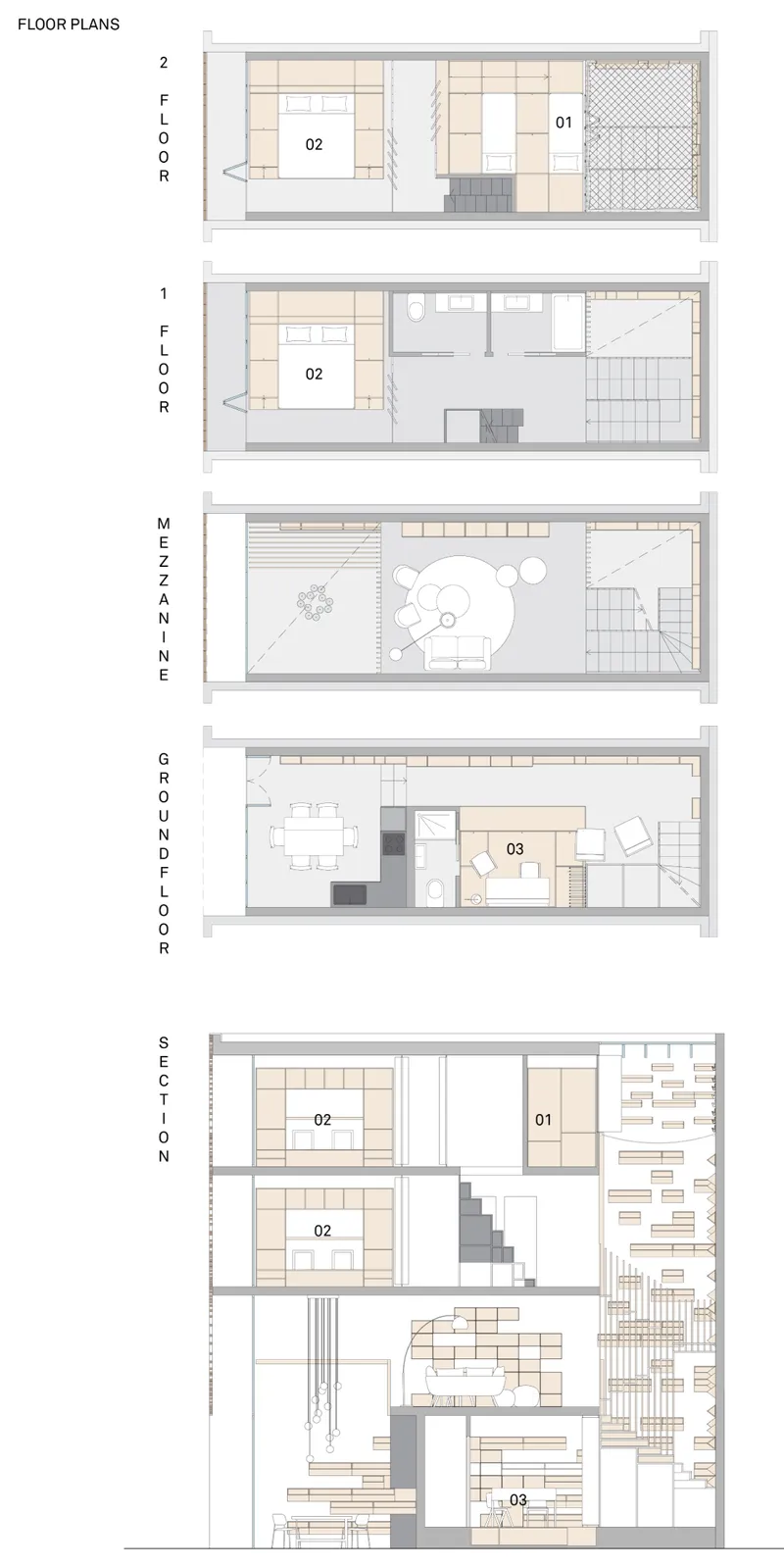
The floor plan drawings lay out five levels, each with numbered rooms and labeled sections that trace the family's daily choreography. The multifunctional ground level integrates dining, kitchen, bike storage, and direct garden access, positioning the base of the house as both shelter and social catalyst. Upper floors assign flexible spaces to individual family members, sized and configured to accommodate everything from early childhood play to aging-in-place adaptations for the grandparents.
Reading these plans against the projected 2020-to-2050 timeline, you begin to understand the ambition. As children grow, their rooms can absorb adjacent modules. As grandparents require less vertical movement, lower floors can be reconfigured to keep their daily life on a single level. The plans are not static blueprints; they are frames for a set of future possibilities, each one designed to extend the building's useful life without expanding its ecological footprint.
A Double-Height Core Where Daily Life Converges
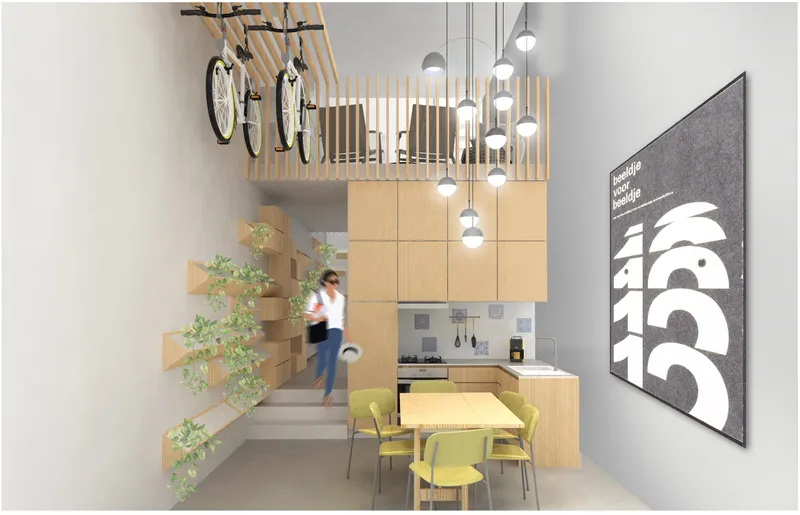
The rendered interior views bring the spatial logic to life. A double-height space anchored by a timber staircase, a yellow dining table, and a cluster of pendant lights serves as the gravitational center of the home. A bicycle hangs from the wall, a nod to Amsterdam's cycling culture and to the house's refusal to waste space on single-purpose storage. Light pours in through what appears to be the permeable brickwork double-skin facade described in the design brief, filtering daylight while accommodating climbing plants and vertical gardens on the exterior.
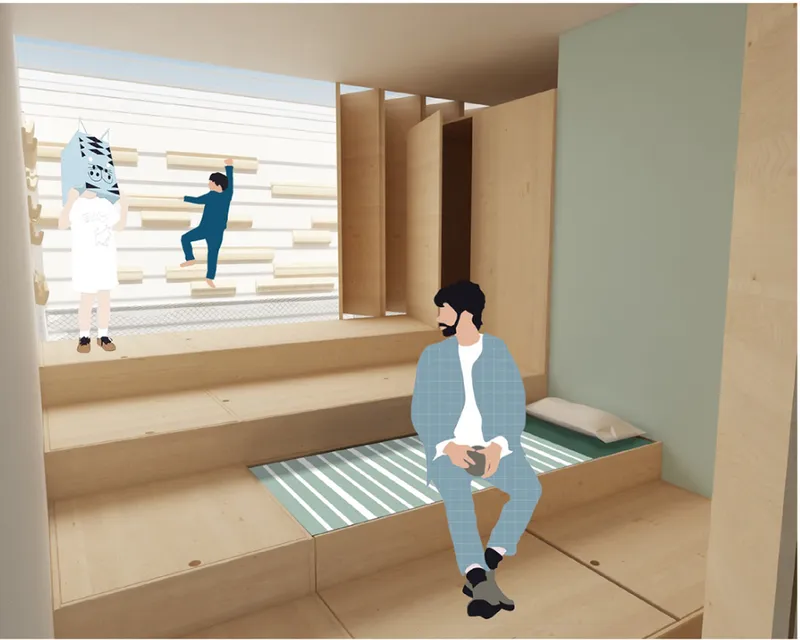
The second view shows a plywood staircase with integrated seating, flanked by horizontal slat screens that modulate privacy and light. Two figures occupy the space casually, reinforcing the idea that these are not showcase interiors but lived-in environments. The staircase doubles as a social surface, a place to sit, read, or watch someone cook below. A climbing wall, mentioned in the design brief, connects floors not just functionally but experientially, turning vertical circulation into a shared activity for children and parents. Cross-ventilation, natural daylighting, rainwater harvesting, and thermal zoning work as passive strategies behind these warm, tactile surfaces, minimizing energy dependence without announcing themselves.
Constraints as Creative Canvas
Amsterdam's narrow lots, strict zoning regulations, and small buildable footprints are, on paper, limitations. Petridis treats them as design generators. The vertical stacking creates intimacy without overcrowding. The double-skin facade turns a required envelope into a productive growing surface. The modular interiors transform the small square footage from a constraint on family size into an invitation for spatial invention. Even the multicultural context of the city informs the project: the home is conceived as a prototype for how diverse, multigenerational households can thrive in dense European cities without consuming more land or energy.
Why This Project Matters
"A House for Life" makes a quietly radical argument: that the most sustainable building is the one you never have to tear down, move out of, or fundamentally rebuild. By designing for thirty years of family change on a single compact lot, the project sidesteps the cycle of demolition, relocation, and new construction that defines so much of urban residential development. Its sustainability is not a checklist of green technologies bolted on at the end but a structural logic woven into every movable partition, retractable bed, and catalogued plant species.
For a competition focused on compact living, this entry distinguishes itself by insisting that small does not mean static. Homes can be organisms. They can grow with their residents, accommodate aging bodies and expanding imaginations, and do so within an ecological budget that respects both the city and the planet. It is a framework as much as a building, and that is precisely why it resonates.
View the Full Project
About the Designers
Designer: Tassos Petridis
Enter a Design Competition on uni.xyz
uni.xyz runs architecture and design competitions year-round that reward proposals with spatial conviction and real site intelligence.
Project credits: A House for Life by Tassos Petridis Nano Nest 2020 (uni.xyz).




Popular Articles
Popular articles from the community


Co-Life: Senior Housing Design That Reconnects Older Adults With the City
Co-Life reimagines senior housing design through healing gardens, shared streets, workshops, and a sustainable community across generations.

The Ocean Hive: Sustainable Architecture for a Self-Sufficient Civilization at Sea
The Ocean Hive imagines sustainable architecture at sea, where modular habitats, algae, wave power and ocean waste sustain a growing colony.

Co-life: Sustainable Architecture for Age-Friendly Community Living
Co-life reimagines sustainable architecture for seniors through courtyards, rammed earth, shared gardens, and spaces designed for belonging.

The Earth Pod: 3D Printed Homes for Resilient Refugee Communities
The Earth Pod reimagines refugee housing through 3D printed homes made from clay, combining resilience, self-sufficiency, and rapid shelter.


Similar Reads
You might also enjoy these articles

Day and Night Park: A Time-Based Urban Newsstand in Beijing
A temporary urban newsstand in Beijing blending travel, light, and reading through poetic colors, compact form, and community-focused design.

Modernist Patio Renovation in El Masnou, Barcelona by Oliver Segura Arquitectura + Cebrià Arquitectura
Modernist patio renovation blending tradition and innovation with a movable pool, leveled floors, and Catalan materials in El Masnou.
Alto Residencial Coop: Cooperative Housing Development in Santiago de Compostela by Carbajo Barrios Arquitectos
A linear cooperative housing complex blending white volumes and perforated metal façades, enhancing community living, natural light, privacy, and urban integration.
Vil Genis School by BPA ARCHITECTURE – Massy, France
Vil Genis School in Massy, France, features sustainable design, south-facing classrooms, community integration, accessible spaces, and modern educational architecture.


Explore Tiny House Competitions
Discover active competitions in this discipline


Challenge to design luxury tourism on rails


VR headsets Storefront design competition

Designing a staircase for a client


Design challenge to reuse E-waste
Comments (0)
Please login or sign up to add comments
No comments yet. Be the first to comment!