

Abon Studio Carves a Concrete Dwelling into the Rocky Coast of Hermanus, South Africa
On a slender 15-by-40-meter site between mountain and ocean, excavated stone becomes both structure and landscape.


Building on an exposed coastal edge means negotiating wind, salt air, strict height limits, and the blunt reality that rock is the ground you stand on. For the Coastal Dwelling in Hermanus, Abon Studio turned every one of those constraints into a generative idea: the lower floor is recessed into the earth to gain a full extra level without breaching the height cap, and the stone pulled from that excavation is returned to the building as wall cladding, courtyard surfaces, and a protective roof layer. Nothing leaves the site that doesn't have to.
The result is a 680 m² house that reads less like an object placed on the landscape and more like an outcrop that has been selectively hollowed. Off-shutter concrete forms the primary skeleton, timber screens filter light and view, and floor-to-ceiling glazing slides away entirely where orientation allows. Living spaces climb upward toward the sea; private rooms sink into a wind-sheltered garden oasis below. The whole composition sits on a site only ten meters wide and thirty-three meters long, which means every section cut through this house tells a different story of level change, light well, and horizon line.
Street Face and Entry Sequence


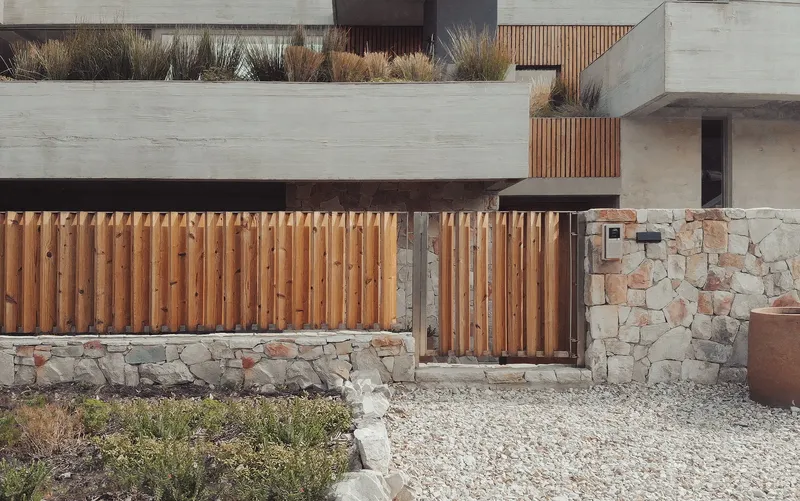
From the street, the Coastal Dwelling is deliberately reticent. Stacked concrete volumes step back behind vertical timber screens and a retained mature tree, giving the house the presence of a retaining wall rather than a facade. The base is fieldstone masonry pulled from the excavation, topped by concrete planes and horizontal timber cladding. A gravel forecourt leads to a courtyard framed by vertical timber slat gates and stone retaining walls, compressing your arrival before the view opens up.
This layered entrance strategy does two things at once. It shields the interior from the prevailing coastal wind, and it calibrates the visitor's expectations. You do not see the ocean from the front door. The house makes you earn the panorama.
Excavated Stone as Binding Material


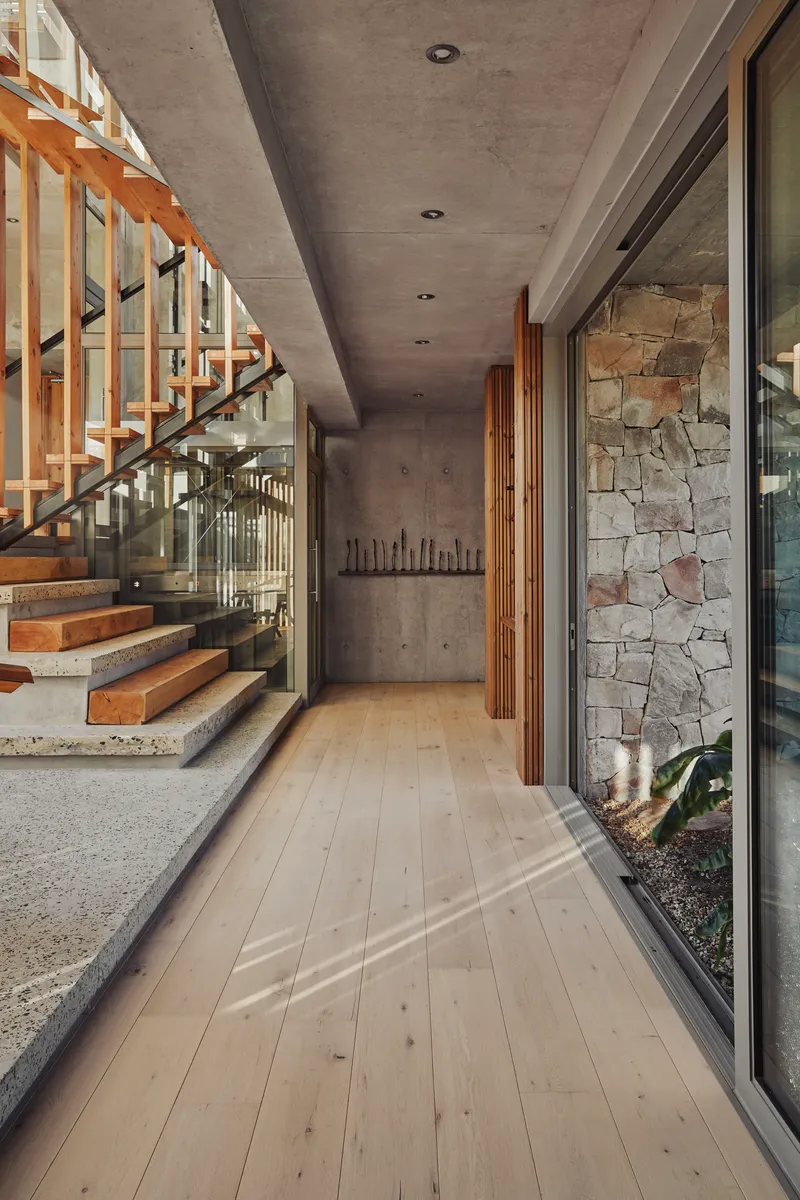
The decision to reuse excavated rock is more than a sustainability gesture. It gives the Coastal Dwelling a material palette that could not exist anywhere else. Rough fieldstone walls define the entry courtyard, where curved steel planters hold cascading succulents against a background of local aggregate. Inside, a stone accent wall anchors the open staircase and grounds the timber and concrete surfaces around it.
From the hillside, the terraced volumes appear to grow directly out of the vegetated slope. The indigenous landscape, irrigated by a borehole, blurs the line between garden and fynbos. There is no ornamental lawn, no tropical transplant. The planting is as site-specific as the stone.
Living Spaces That Open to the Horizon
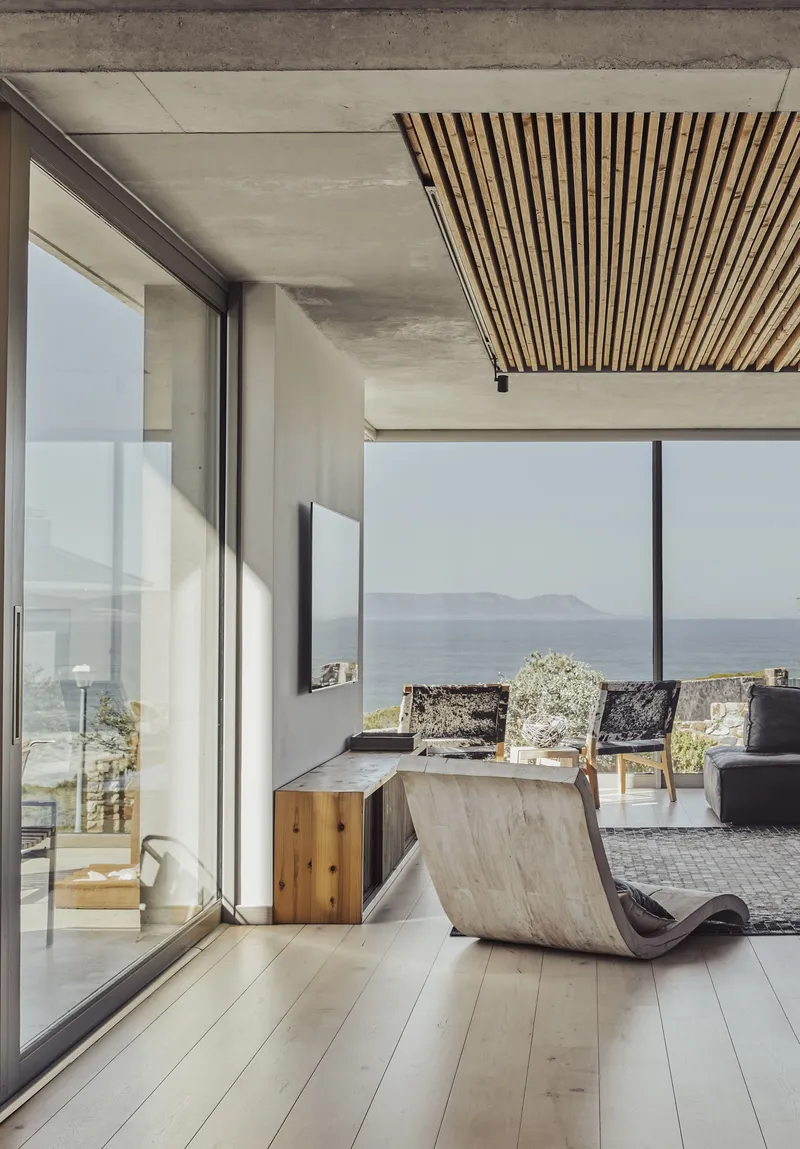


The upper levels are where the architecture fully commits to its coastal setting. A living room under a timber slatted ceiling panel and concrete soffit faces the sea through floor-to-ceiling glazing that slides entirely out of the way. Cantilevered concrete terraces push out over coastal grasses, framing the view as precisely as a camera lens. From the rear elevation, planted roof terraces step down toward the mountains, creating a second landscape above the inhabited one.
Generous overhangs and double-glazed openings manage solar gain passively, while a rooftop photovoltaic array handles active energy demand. The open plan allows cross-ventilation on the days when Hermanus cooperates, and on the days it does not, the concrete thermal mass and tight envelope keep conditions stable without mechanical intervention.
The Vertical Spine
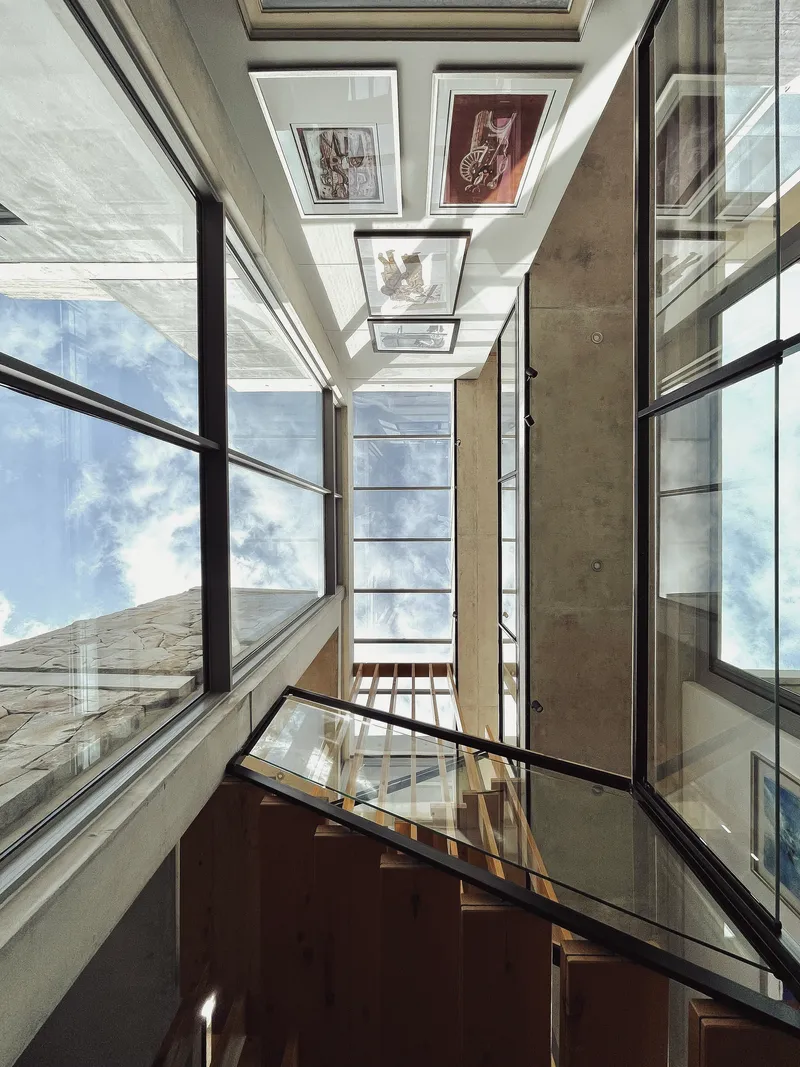

On a site this narrow, the staircase is not a secondary element. It is the organizing spine. A multi-story stairwell capped by skylights pulls daylight deep into the plan, its timber treads and glass balustrades creating a vertical garden of light that connects the sunken lower level to the roof terraces above. Every floor reads the sky differently because the stair changes orientation as it climbs.
Adjacent corridors double as inhabitable zones. One passage frames a timber platform bed against a vertical slatted wall, turning a circulation space into a sleeping alcove with an ocean-facing terminus. On a 10-meter-wide footprint, there is no room for single-purpose space.
Private Rooms Sheltered Below


The sunken lower level contains the bedrooms, and its recessed position does more than circumvent the height restriction. It creates a microclimate. Protected from wind by the earth on three sides, bedrooms open through glass doors to stone-walled courtyards that feel like outdoor rooms. The sense of enclosure is total, yet natural light floods in from above.
A concrete bathroom with a rainfall shower, ribbed tile, and a picture window framing coastal grasses and ocean exemplifies the level of specificity in these private spaces. Every opening is calibrated to a particular view condition: a sliver of dune grass, a band of ocean, or the underside of a planted terrace overhead. The infinity pool on the level above completes the sequence, its concrete coping aligning precisely with the horizon beyond.
Plans and Drawings


The floor plans reveal the extreme discipline required by the site's proportions. On the ground floor, living spaces occupy the full width with a central staircase and a garage pushed to the right edge. The first floor shifts the program to bedrooms and terraces, with the pool appearing as a blue rectangle at the plan's extremity. The second floor shows a split-level arrangement where planted terraces interleave with interior space, confirming that every roof surface is either inhabited or vegetated.
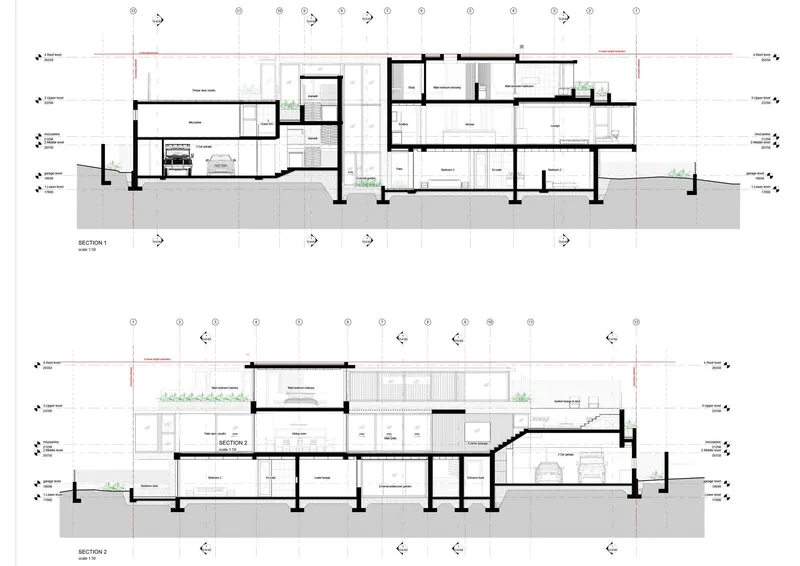
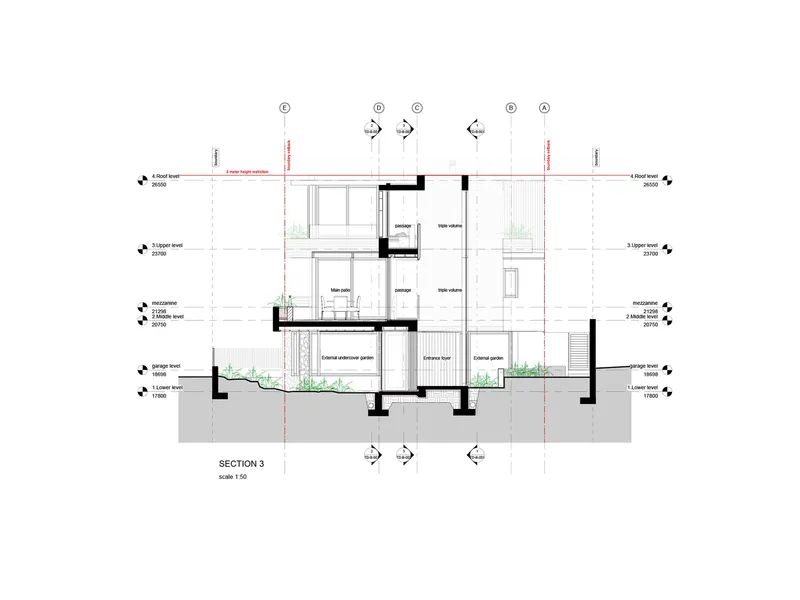

The sections are where the project's intelligence becomes fully legible. Three distinct cuts through the building reveal how the split-level strategy responds to the sloped topography: floor plates step with the terrain rather than fighting it, creating double-height voids in the lounge while keeping bedrooms at an intimate scale. Planted courtyards appear as pockets of green wedged between concrete plates, and the overall height stays well within the regulatory envelope despite accommodating three full levels.
Why This Project Matters
Coastal houses in spectacular settings tend to default to one of two modes: the transparent glass box that maximizes the view at the expense of everything else, or the defensive bunker that treats the environment as adversary. The Coastal Dwelling does neither. It negotiates. It sinks, it cantilevers, it recycles its own excavation, and it orients each room to a precise fragment of landscape rather than a generic panorama. The architecture is as much about what it withholds as what it reveals.
Abon Studio's approach here also offers a useful counter-narrative to the idea that sustainability in residential architecture requires visible technological apparatus. The passive strategies, the material reuse, the borehole-irrigated indigenous planting, and the photovoltaic roof are all present but none of them announce themselves. They are simply the logical consequences of designing with the site rather than on top of it. That quiet integration, on a site this constrained and this exposed, is the real achievement.
Coastal Dwelling by Abon Studio. Hermanus, South Africa. 680 m². Completed 2024. Photography by Greg Cox.
About the Studio
Share Your Own Work on uni.xyz
If projects like this are the kind of work you want to make, uni.xyz is a place to publish your own, find collaborators, and enter design competitions.


Popular Articles
Popular articles from the community

Temporary Home for Dogs: A Reversed Zoo Rethinks Animal Shelter Architecture
In Bucharest, a sinuous corridor and freed landscape flip the logic of containment, designing a shelter that works to make itself unnecessary.
Extended Shell: Retrofitting Kolkata's Balconies as Living Urban Thresholds
A modular retrofit system recovers the social and environmental intelligence of Kolkata's historic verandas for contemporary Park Street residents.
Faces of the Soviet Avant-Garde: Turning Moscow's Street Names into an Open-Air Museum
A network of sculptural installations across a Moscow residential district transforms forgotten architect names into spatial encounters with cultural memor

The Amber Palace Opera: A Geological Fiction Surfaces on Tallinn's Baltic Waterfront
Pierre Brillard reimagines a Baltic legend as a public landscape, opera house, and waterfront promenade rooted in Tallinn's coastal identity.

Similar Reads
You might also enjoy these articles

Bao Huynh Watercolor Atelier: A Serene Art Retreat in Hội An
Bao Huynh Watercolor Atelier in Hội An blends multifunctional art spaces, sustainable design, local materials, and family-friendly living in a serene environment.

Atelier Macri Concept Store Interior Design by CASE-REAL
Atelier Macri store features a "ko" counter, walnut wood details, cork displays, blending retail, gallery, and seamless customer experiences.

Manuel Vargas Izquierdo Stadium and High-Performance Sports Center: Architectural Excellence in Jalpa de Méndez
The Manuel Vargas Izquierdo Stadium blends sustainable design, inclusive sports facilities, and cultural-inspired architecture, revitalizing Jalpa de Méndez’s public spaces.

KAKR Buluh Awar Hall: Revitalizing Community and Ecology Through Bamboo Architecture
Community built bamboo hall revitalizes Buluh Awar village, empowering youth, restoring ecology, celebrating vernacular craftsmanship through sustainable architecture and culture.


Comments (0)
Please login or sign up to add comments
No comments yet. Be the first to comment!