

Fuller/Overby Architecture Weaves a White Steel Staircase Through a Historic New Jersey Farmhouse
A centuries-old stone and timber structure in rural New Jersey gains new life through precise interventions of steel, glass, and perforated metal.


The Ackerman Farmhouse is one of those projects that earns its complexity honestly. Rather than defaulting to the familiar restoration playbook of hiding new work behind period detailing, Fuller/Overby Architecture chose a strategy of visible contrast. The existing structure, a stone and timber farmhouse with deep roots in New Jersey's agricultural past, is allowed to keep its roughness. What's new is emphatically new: white steel, perforated metal, glass, and clean plaster surfaces that sit against aged rubble walls and hand-hewn beams without pretending they belong to the same century.
The most striking element is a white steel staircase that threads through the double-height core of the house, its perforated treads and landings acting as a kind of luminous scaffold inside the old timber frame. It is the single move that makes the renovation legible. You understand, instantly, where the historic fabric ends and the new intervention begins. That clarity is the project's greatest strength, and it produces spatial effects, especially with light, that neither the old building nor a ground-up design could achieve alone.
Old Stone, New Glass

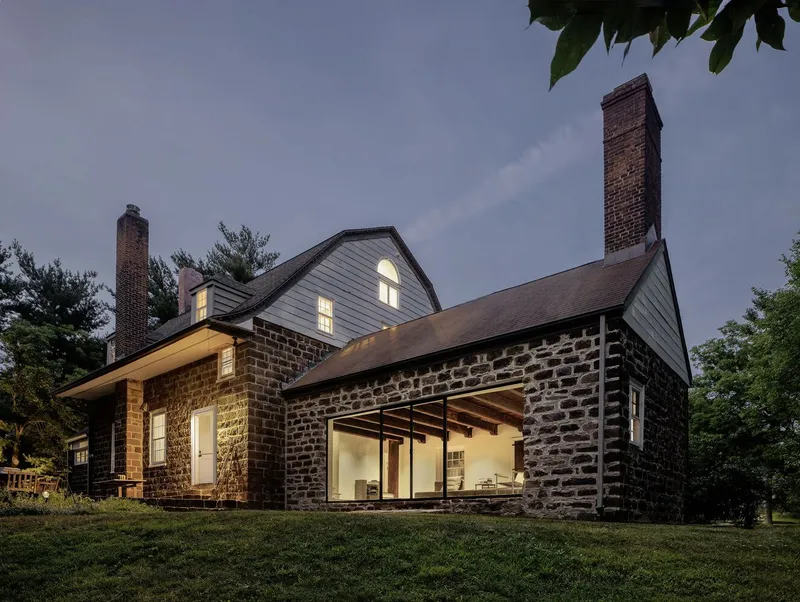
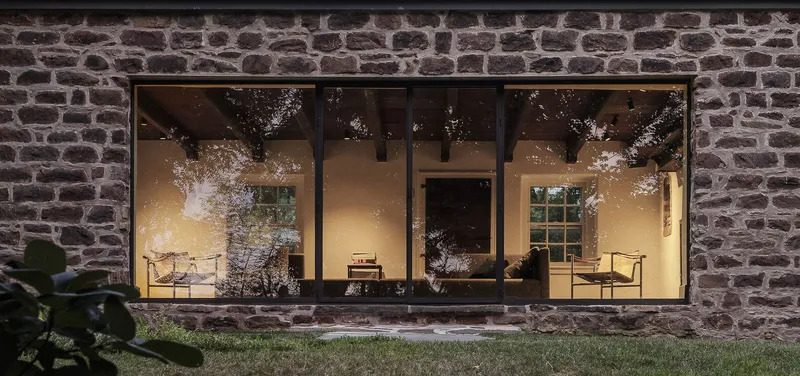
Seen at dusk, the exterior additions reveal the architects' tactic most clearly. A rubble stone wall, thick and uneven, is punctuated by large steel-framed windows that glow from within. A glass volume pushes out beside the original gabled forms, creating a lantern-like threshold between interior and landscape. The proportions are careful: the new openings are scaled to feel generous without overwhelming the mass of the masonry. Stone reads as weight, glass reads as air, and the two negotiate through sharp, clean steel frames.
The strategy avoids pastiche. There is no attempt to replicate the original window proportions or mortar color. Instead, the additions are set apart by material and geometry, which paradoxically makes the old stone look better. Its irregularity becomes a texture rather than a deficiency.
The Weathered Envelope
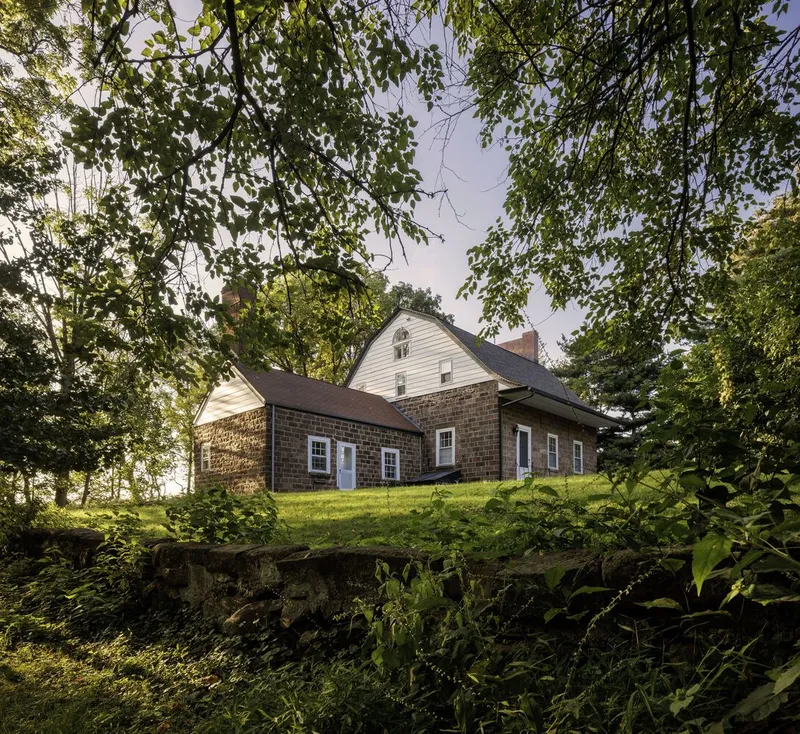

From the approach, the farmhouse presents itself modestly. Weathered shingle facades under gabled roofs sit on a grassy slope beneath mature deciduous trees. The palette is deliberately understated: silvered wood, grey stone, dark window frames. Nothing signals the precision waiting inside. The restraint here is smart. In a rural setting where vernacular buildings set the rhythm, an overtly contemporary exterior would have been a misstep.
The floor-to-ceiling glass doors at grade level offer the first hint. One photograph captures a deer standing calmly in dappled sunlight just beyond the threshold, an image that underscores how closely the house sits within its ecology. The glass walls dissolve the boundary without spectacle, framing the landscape as a series of quiet vignettes rather than panoramic reveals.
A Staircase as Architecture

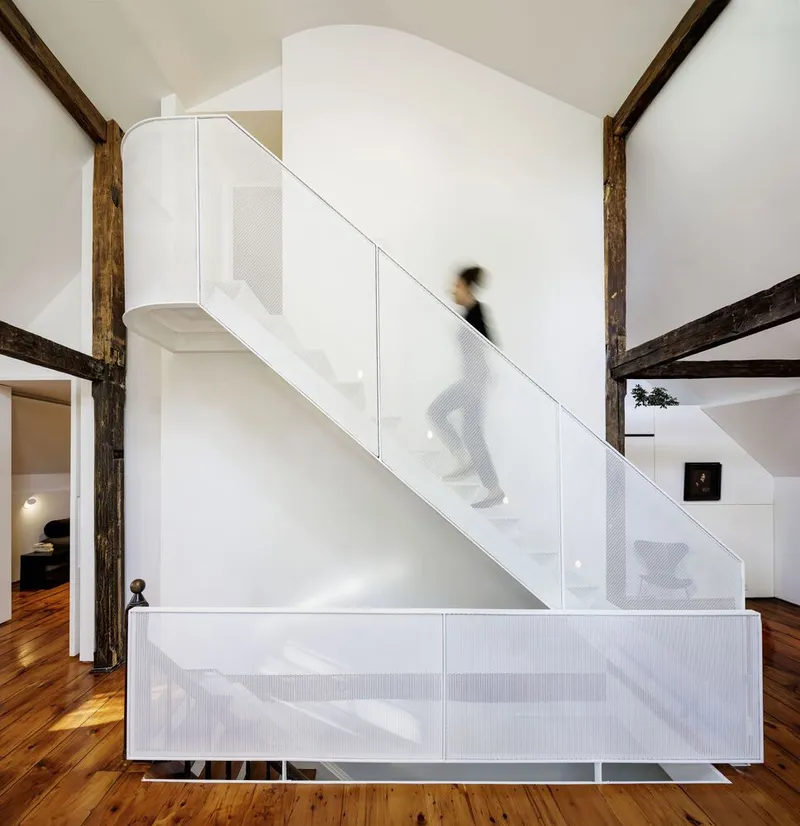

The white steel staircase is the project's protagonist. Rising between exposed timber beams under a vaulted white ceiling, it occupies the central void of the house and reorganizes circulation vertically. Its perforated metal treads allow light to filter through each level, so the stairwell functions as a distributed skylight. A figure ascending the stairs is captured passing dark timber columns, and the contrast between the industrial precision of the steel and the hand-worked timber is stark and deliberate.
Glass balustrades amplify the transparency. From certain angles, the staircase almost disappears against the white ceiling, leaving only the dark timber frame legible. From others, the perforations in the metal create a moiré effect that gives the structure visual weight. It is a single element doing multiple jobs: circulation, light distribution, spatial definition, and architectural narrative.
Light Through Perforated Metal
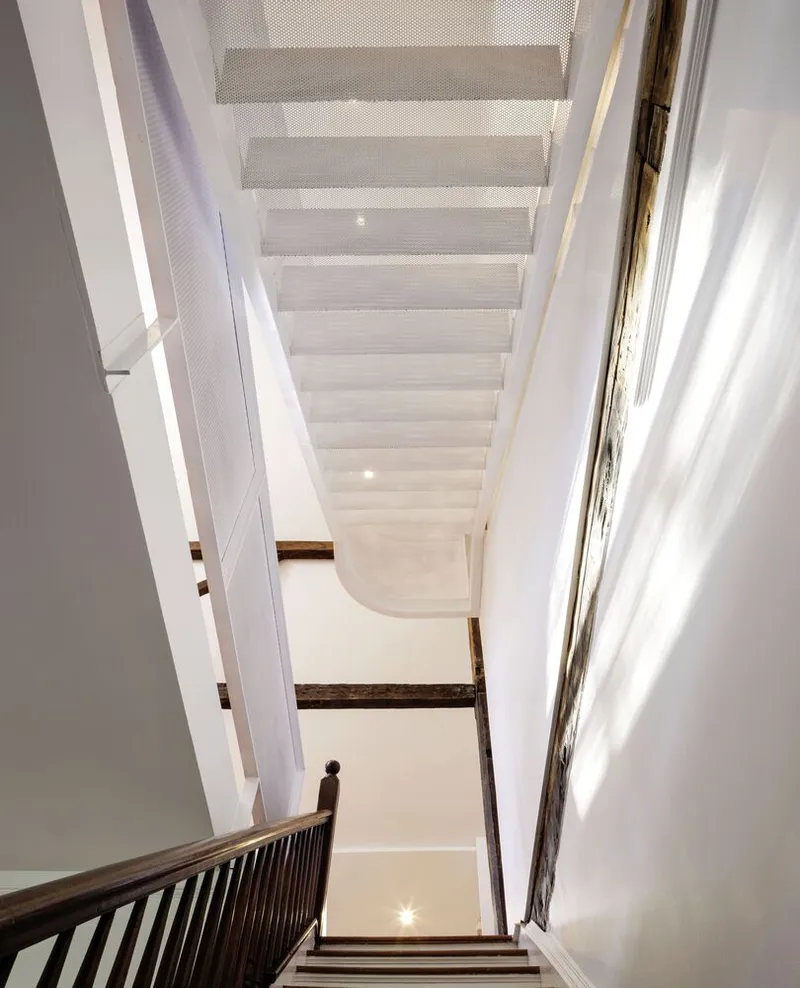


Fuller/Overby clearly understood that the perforated metal was not just a structural surface but an optical instrument. Looking up through the stairwell, the landings and treads filter daylight into a soft, diffused wash that changes character throughout the day. The perforation pattern is fine enough to read as a scrim from a distance but coarse enough to allow substantial light transmission.
Close-up views of the metal ceiling panels show how natural light catches at oblique angles, creating subtle gradients across the white surfaces. The result is an interior atmosphere that feels luminous without ever being harsh. It is a material choice that rewards the kind of sustained looking most renovation projects never invite.
Timber Frame as Inhabitable Sculpture

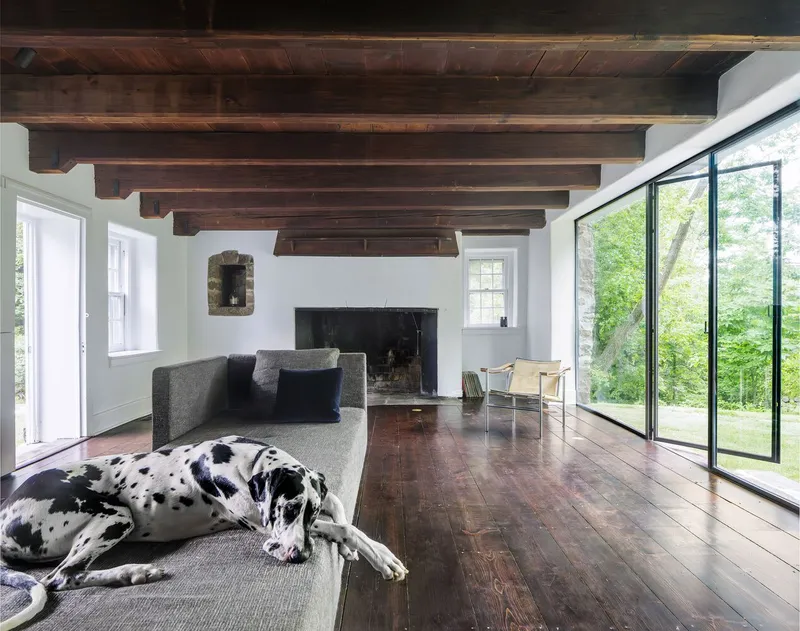
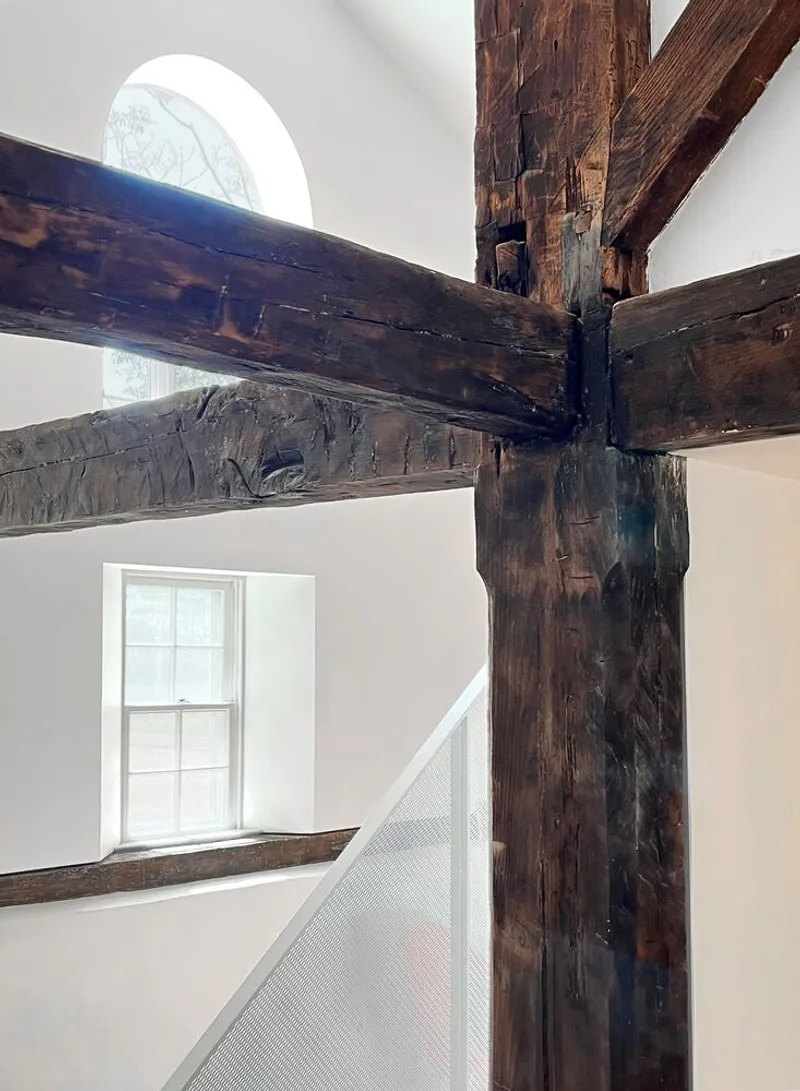
The exposed timber frame is the project's other structural narrative. In the double-height living space, heavy beams and diagonal bracing create a visible skeleton that the new white surfaces respect but do not mimic. A fireplace anchors the living room, where a dalmatian rests on the floor beneath centuries-old joinery. The domestic warmth of the scene is earned, not staged, because the proportions of the room and the honesty of the materials make it a genuinely comfortable space.
A detail shot of a post-and-beam joint reveals steel connectors and a circular window, a quiet moment where the structural logic of old and new overlaps. The connection hardware is not hidden. Like everything else in this renovation, it is visible, legible, and precise.
Domestic Rooms Under the Roof


The upper levels tuck private rooms beneath the pitched roof, where angled ceilings and dormer windows create intimate spaces that contrast sharply with the open volume below. An upper-level workspace sits within the exposed timber frame, the desk positioned beneath the ridge. A nook with built-in shelving and a dormer window reads as a carved pocket inside the roof mass, sunlight streaming in at steep angles.
Bedrooms feature reclaimed wood flooring and angular skylights that cut through the sloped ceiling, delivering daylight deep into the plan. The palette remains restrained: white walls, warm wood, minimal trim. The simplicity is deliberate. In a house where the structure itself provides all the visual richness you need, adding decorative layers would have been redundant.

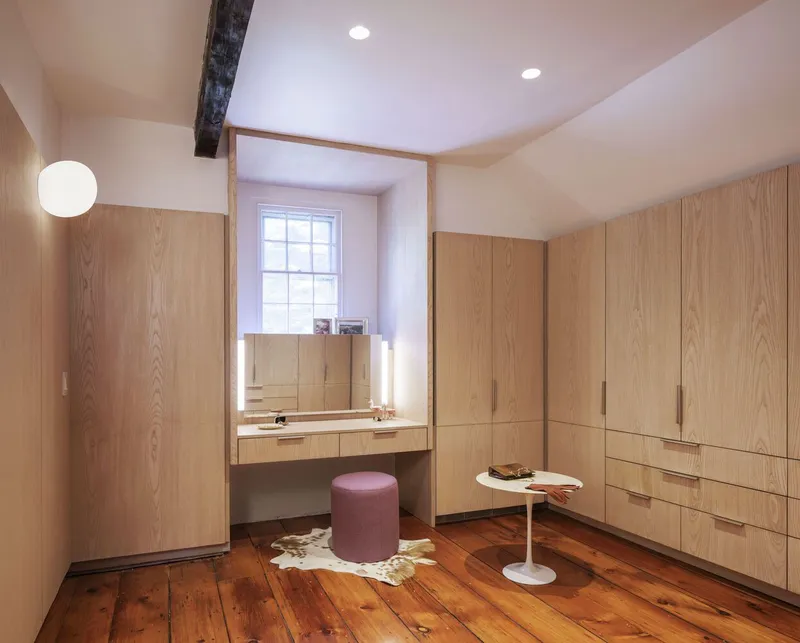
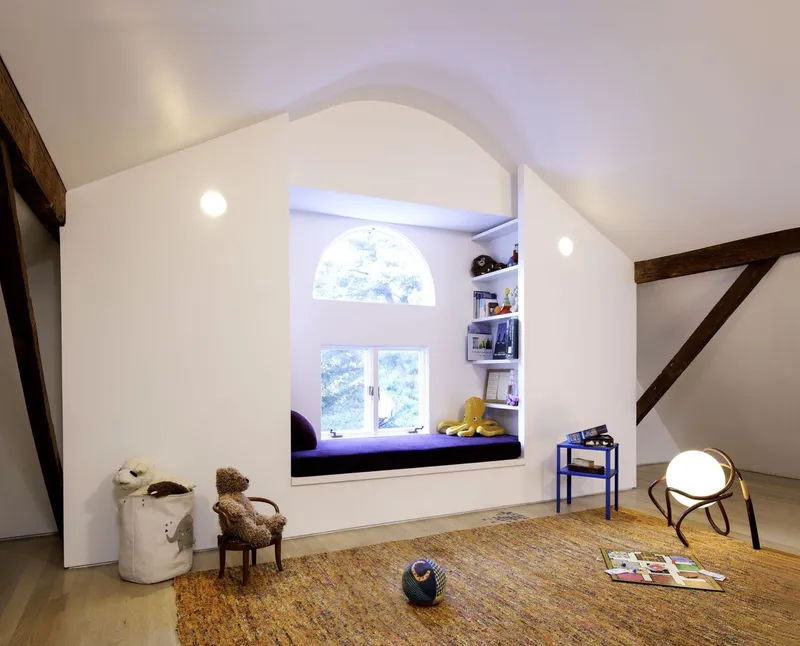
The sleeping areas and dressing rooms demonstrate a careful attention to the everyday rituals of domestic life. A dressing room with floor-to-ceiling oak veneer cabinetry and an integrated vanity desk beneath a vaulted ceiling treats a utilitarian program with real architectural dignity. An arched window alcove, fitted with a purple cushioned seat and built-in shelving, becomes a children's reading corner scattered with toys. These are rooms designed for use, not photography, which is exactly why they photograph so well.
Material Palettes in Wet Rooms


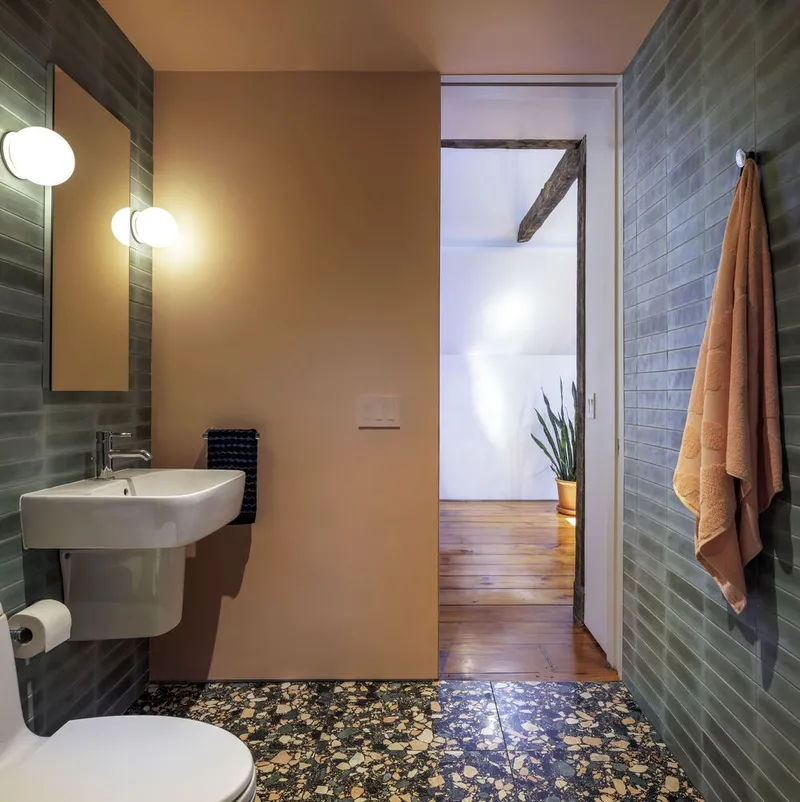
The bathrooms and powder rooms introduce tighter material palettes without departing from the project's overall restraint. Marble countertops sit on white oak base cabinets. Globe pendant lights flank a mirror with quiet symmetry. A glass shower partition and built-in niches sit beside a gridded window that maintains the geometry of the steel frames found elsewhere. A powder room with grey subway tile walls and a terrazzo floor offers a slightly bolder moment, the doorway framing a view through to the timber-floored hallway beyond.
What holds all of these rooms together is consistency of intent. Every material decision, from the large format floor tiles to the wall-hung sink, prioritizes clarity and texture over ornament. The wet rooms are treated as architecture, not as decorating exercises.
Threshold and Terrace

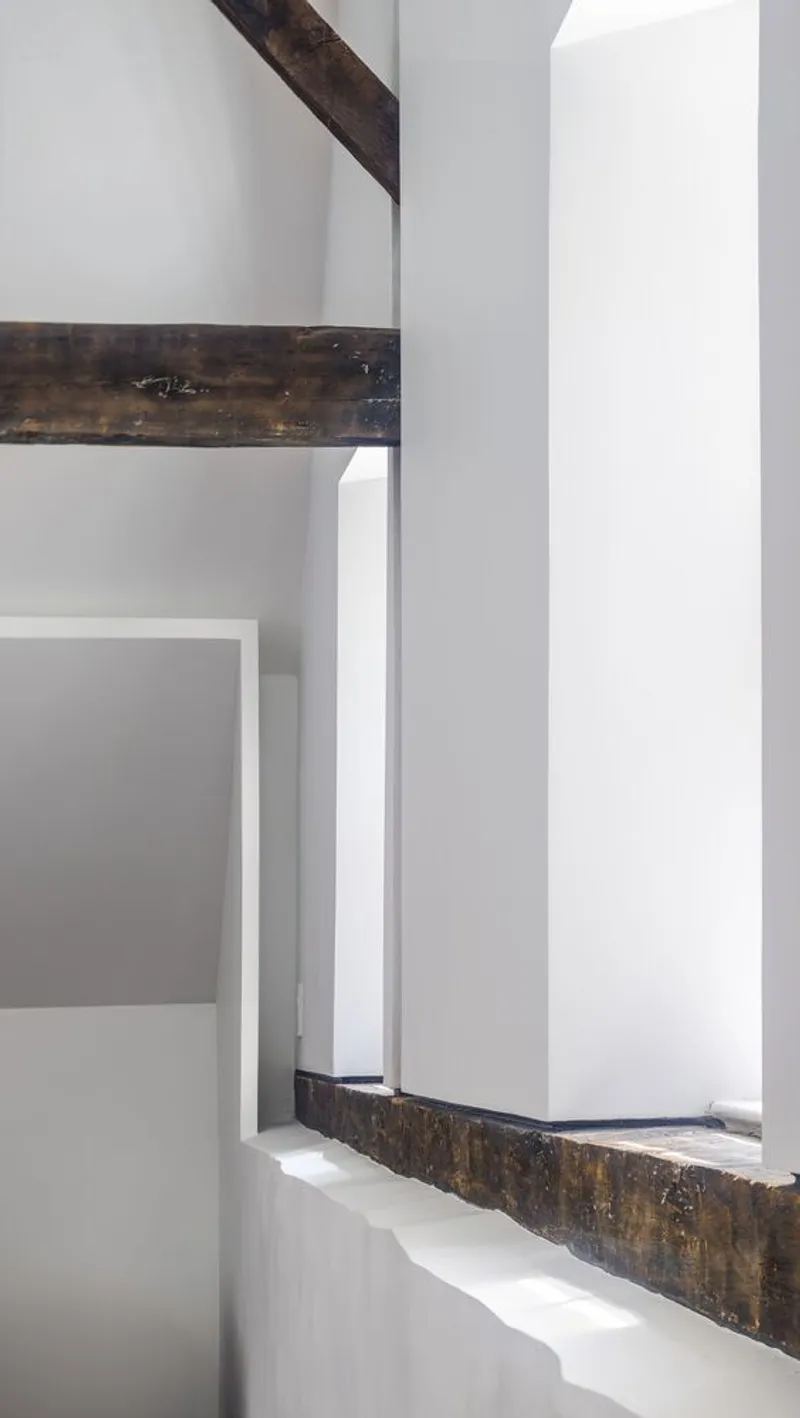
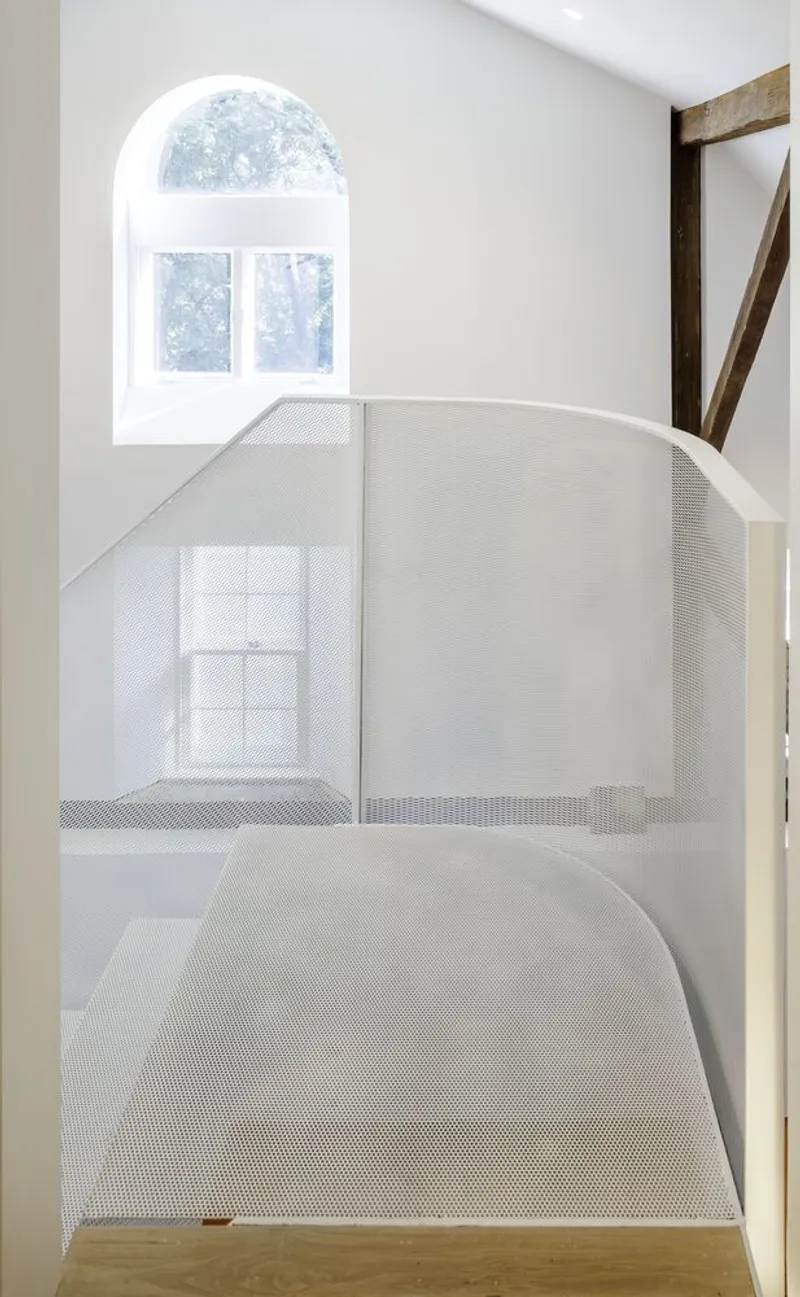
The relationship between interior and exterior is managed through a series of thresholds. Floor-to-ceiling glass walls open to a terrace where two dogs stand in morning light, collapsing the boundary between living room and lawn. The clean intersection of a white wall with an exposed timber beam, captured in a tight detail shot, encapsulates the entire renovation philosophy: two materials, two eras, meeting in a sharp, clean line.
Looking down through a perforated metal mezzanine floor toward an arched window with timber bracing visible beyond, you understand the spatial layering at work. The house operates on overlapping depths: stone, timber, glass, perforated metal, and daylight, each layer contributing to a reading experience that unfolds as you move through the building.
Plans and Drawings


The floor plans confirm what the photographs suggest: a compact plan organized around the central stairwell, with bedrooms, bathrooms, and a surrounding porch or deck arranged to maximize cross-ventilation and landscape views. The furniture layouts reveal modest room dimensions, reinforcing the sense that this is a working farmhouse rather than a country estate. The terrace wraps the upper level, extending the usable area outward and blurring the line between enclosed and open-air living.
Why This Project Matters
The Ackerman Farmhouse Renovation matters because it refuses the two most common approaches to historic residential work. It does not erase the past with a sleek, ahistorical interior, and it does not indulge in sentimental preservation that treats every old nail as sacred. Instead, Fuller/Overby Architecture identifies the qualities worth keeping, the timber frame, the stone walls, the agrarian proportions, and introduces new elements that are unmistakably contemporary but materially sympathetic. The white steel staircase is the project's signature, but the real achievement is the tonal consistency across every decision, from the bathroom tile to the window framing to the oak cabinetry.
For architects working on historic structures, this project offers a useful model: be honest about the intervention, invest in the quality of the new materials, and trust the old building to hold its own. The result is a house that feels neither frozen in time nor anxiously contemporary. It simply feels inhabited, which may be the highest compliment a renovated home can receive.
Ackerman Farmhouse Renovation by Fuller/Overby Architecture. Location: New Jersey, United States. Photography by Paul Warchol.
About the Studio
Share Your Own Work on uni.xyz
If projects like this are the kind of work you want to make, uni.xyz is a place to publish your own, find collaborators, and enter design competitions.


Popular Articles
Popular articles from the community


Manzana Morphosis: Stretching Barcelona's Grid into a Living Landscape for 2050
A radical reworking of the Eixample manzana turns density into a tool for generous public space, vertical ecology, and environmental performance.

Opera on the Sea: Driftwood Logic Shapes a Timber Opera House on Estonia's Coast
Trevor Orgill's opera house translates the entangled drift of floating timber into a civic building where wood, water, and music converge.


ETEH Reworks the Shared Spaces of São Domingos School in Brazil Around Timber, Color and Hanging Plants
At São Domingos School in Brazil, 436 m² of hall, refectory and library are recast with timber joinery, a yellow and blue code and trailing greenery.

graciastudio Turns a Viewless Tijuana Lot Inward Around a Courtyard of Concrete, Timber and Trees
In Tijuana, Jorge Gracia's GA2 House stacks a timber-clad private floor over exposed concrete and replaces a missing view with a planted interior patio.

Similar Reads
You might also enjoy these articles


Hodi-Mandai Geram
Project Function: Preservation and revitalization of the Intangible heritage and socio-spatial identity of the Hodi by Housing, Cultural Memory Center, Sacred Grove, landscape, local tourism economy


Olio Towers: A Mid-Rise for Performers That Fuses Housing, Rehearsal, and Stage
Located blocks from Houston's Theater District, this modular tower stacks living units around a central performance atrium.

Oasis: Modular Green Housing Carved into Dhaka's Urban Fabric
A shortlisted Plugin Housing entry reclaims unauthorized settlements in Dhaka with stepped concrete volumes, green roofs, and ventilation-driven design.

Black Hole: A Floating Megastructure for the Post-Physical Era
Emiliano Mazzarotto envisions a spherical, self-scaling arena where e-sports, digital hotels, and holographic stadiums replace traditional public space.

Explore Architecture Competitions
Discover active competitions in this discipline

Challenge to reimagine the Iron Throne

Photograph architecture without architects

Illustrate the lost glory of Angkor Wat - Render Challenge

Design challenge to reuse E-waste
Comments (0)
Please login or sign up to add comments
No comments yet. Be the first to comment!