
ACTIVATE SHELTER: An Adaptive Infrastructure for Nuclear Safety in Rooppur, Bangladesh
ACTIVATE SHELTER: Where Resilience Meets Community, Safeguarding the Future Together.

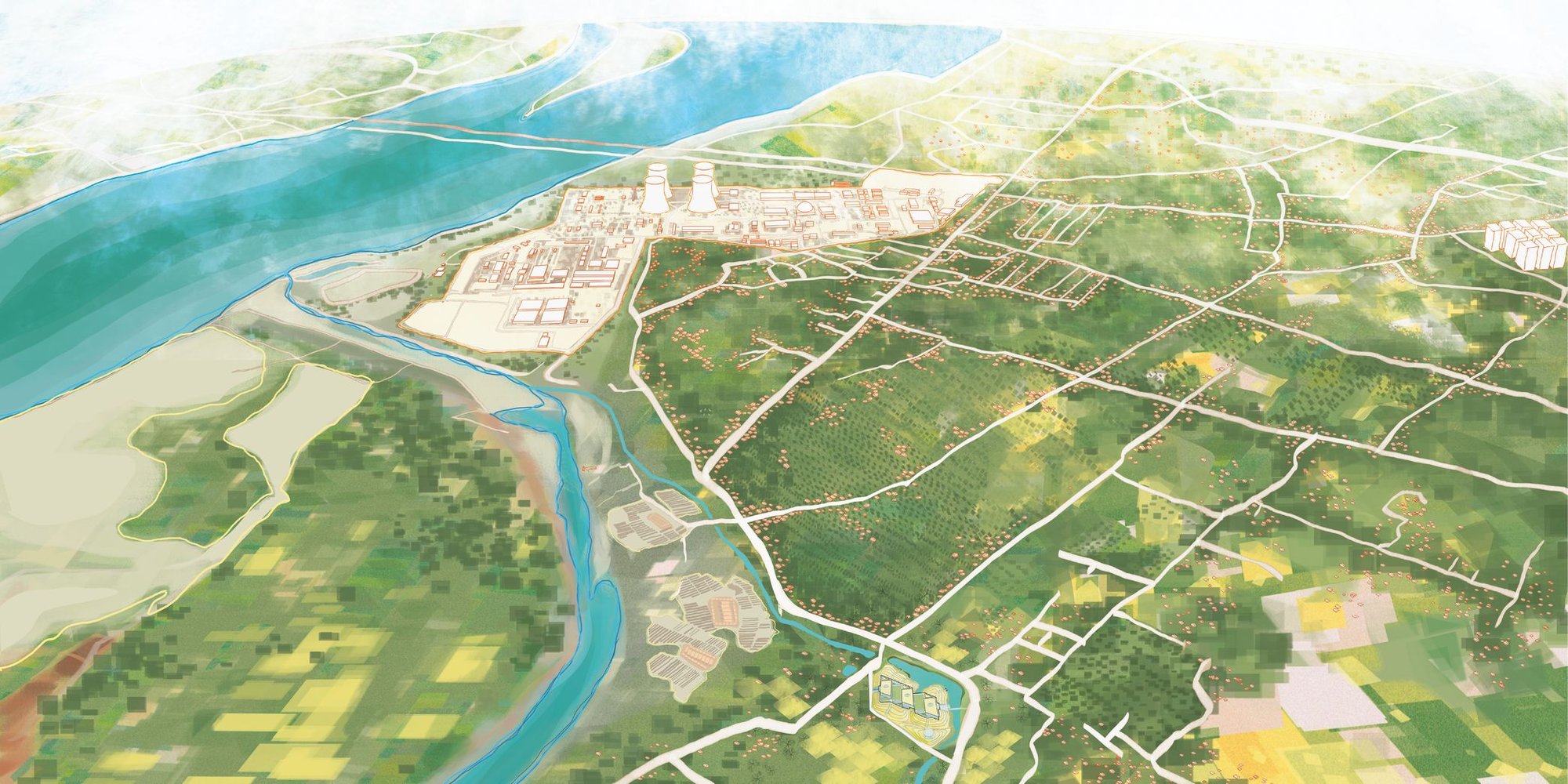
As Bangladesh forges ahead in addressing its energy demands, the Rooppur Nuclear Power Plant (RNPP) stands as a symbol of ambition and innovation. Yet, the introduction of nuclear energy has raised significant safety concerns, particularly regarding the well-being of the surrounding community. Nova Amin's ACTIVATE SHELTER, Shortlisted entry of UnIATA '24, explores this challenge, proposing an adaptive shelter system tailored to the unique environmental, social, and economic context of Rooppur, Bangladesh. This project seamlessly integrates a fallout shelter with a functional community facility, offering a profound architectural solution to a pressing problem.
Ambition Amid Vulnerabilities
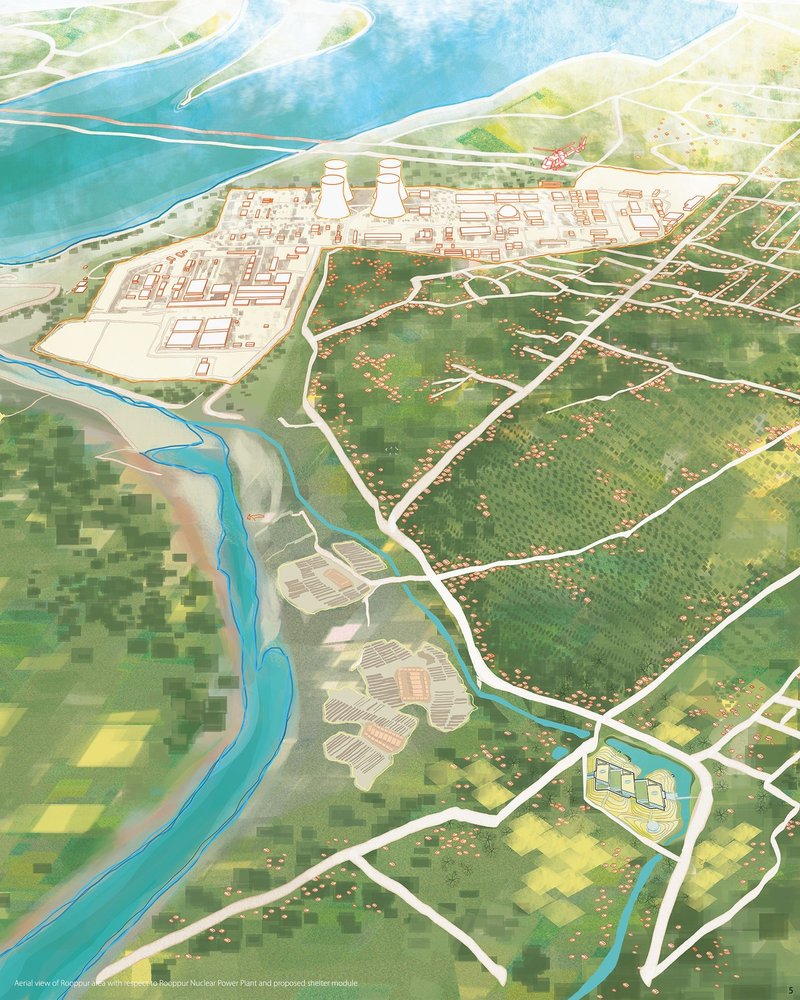
Bangladesh embarked on its nuclear journey on November 4, 2017, with the inauguration of the RNPP in Pabna. This ambitious project, aimed at alleviating the nation’s power crisis, features two 2.4GW reactors slated to begin operation by 2025. The project, managed in partnership with Russian company Rosatom, has attracted over 25,000 workers, including 5,000 Russian employees, necessitating new urban developments such as the 20-story Rooppur Green City residential complex.
However, the plant’s proximity to Rooppur Union, home to over 18,000 residents with a population density of 647 persons per square kilometer, raises concerns. The area’s outdoor-oriented lifestyle—dominated by agriculture, fishing, and construction work—renders it particularly vulnerable in the event of a nuclear disaster. This context underpins the design brief for
ACTIVATE SHELTER:
How can architecture mitigate radiation exposure for nearby communities?
What protective mechanisms can a shelter employ without compromising usability during non-disaster periods?
How can a shelter address Bangladesh’s climate and cultural nuances, such as the need for ventilation and daylight?
Can such a structure serve a dual purpose to engage the community?
Design Philosophy: Shelter Meets Community
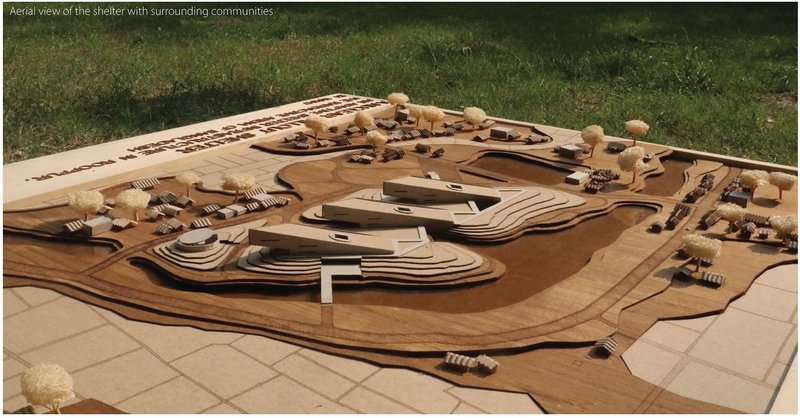
The ACTIVATE SHELTER concept intertwines emergency preparedness with community engagement. By designing a shelter that doubles as a school during normal circumstances, the project ensures relevance and accessibility while fostering a sense of familiarity and trust among local residents.
The structure is more than just a building; it is an adaptive system comprising two primary components:
The Landscape: Features such as earth mounds, mustard fields, water bodies, and roof gardens act as both physical barriers and community attractions.
The Building: Designed with multi-layered protection mechanisms, the building transitions seamlessly between its dual functions of a school and a fallout shelter.
Key Design Challenges: Radiation Protection and Ventilation
Radiation Pathways in Buildings
Nuclear fallout releases radioactive dust, which spreads rapidly through the air and settles on surfaces. Radiation enters buildings via:
Ground Contribution: Rays penetrating directly from radioactive particles on the ground..
Wall Scattering: Rays that scatter upon interaction with building materials.
Skyshine Contribution: Rays that interact with air particles before entering.
Roof Contribution: Rays emitted from radioactive particles that settle on roofs.
Effective radiation shielding requires mitigating these pathways through geometry, barriers, and distance:
Geometry: Orienting spaces to minimize direct radiation exposure.
Barriers: Using materials with high radiation absorption, such as concrete, water, or dense vegetation.
Distance: Placing occupants away from radioactive sources.
Balancing Protection with Climate Needs
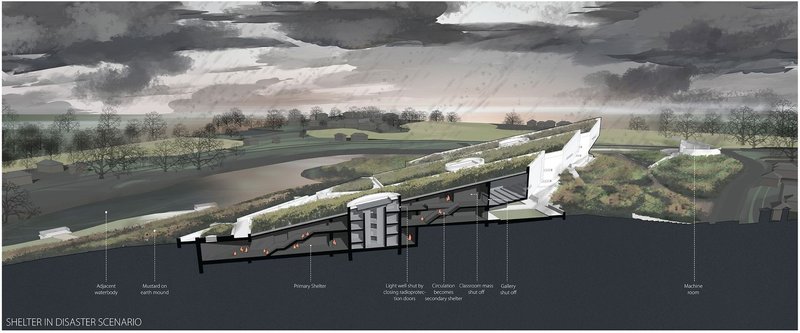
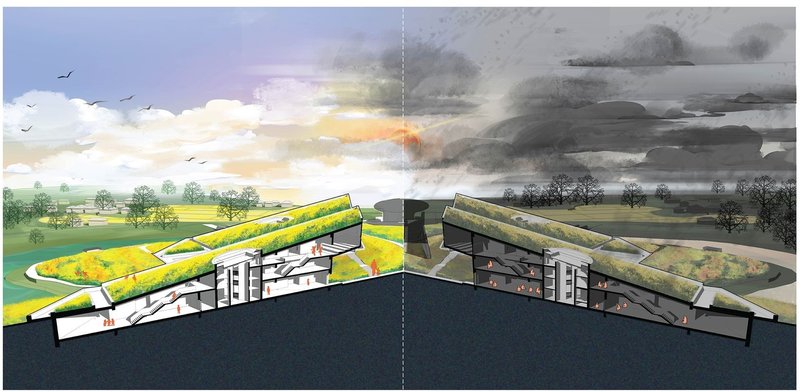
Bangladesh’s tropical climate necessitates buildings that maximize airflow and daylight, which are counterintuitive to traditional fallout shelters. ACTIVATE SHELTER resolves this contradiction with an innovative approach: during normal use, the structure encourages ventilation and natural light through operable windows and light wells. In a disaster scenario, these openings are sealed with radioprotective doors and panels.
Architectural Features: Dual-Functionality at Its Core
Primary Shelter (Immediate Response)
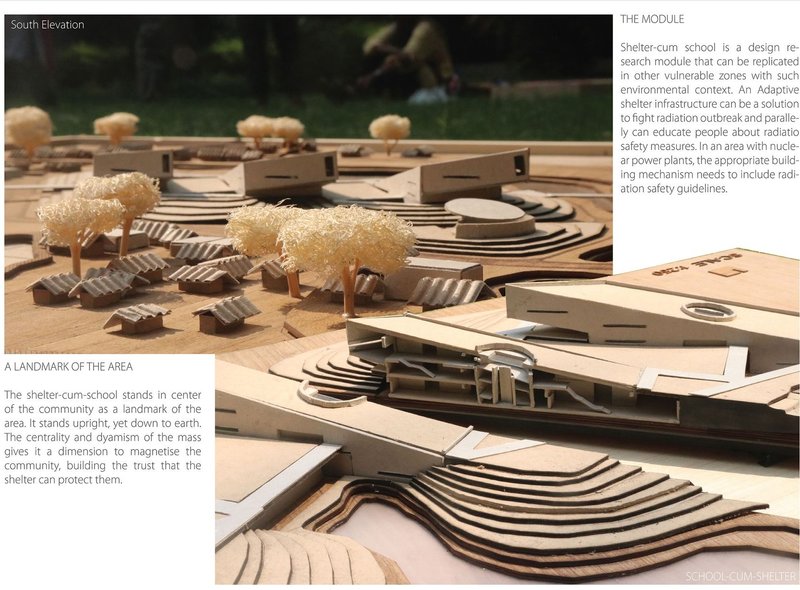
The primary shelter activates instantly during a disaster, providing protection for up to 1,000 people. Its features include:
Thick Concrete Shear Walls: High radiation absorption.
Radioprotective Doors: Made of hardwood and lead, sealing off external openings.
Earth Mounds: Surrounding the shelter, they act as natural barriers against ground radiation.
Mustard Fields: Known for their radiation absorption, they double as agricultural landscapes.
Water Bodies: Integrated into the site to absorb radiation and serve as cooling systems.
Secondary Shelter (Delayed Activation)
The secondary shelter, located on the upper floors, becomes operational after several days when radiation levels in the air subside. This space, typically used as classrooms, is shielded by the mass of the primary shelter below. Features include:
Tilted Roofs: Designed to direct radioactive fallout away from critical areas.
Mustard-Covered Roofs: Enhancing radiation absorption.
Circulation Spaces: Designed as protective zones during emergencies.
Everyday Use: A School Anchored in Community Life
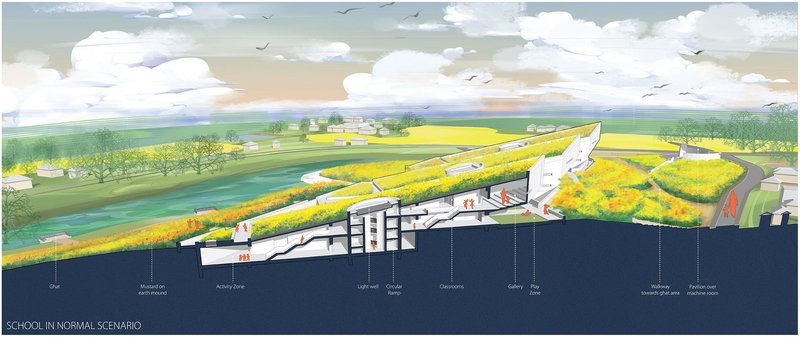
During normal times, the shelter functions as a school, fostering daily interaction between the structure and the community. The building’s open design and landscaped surroundings encourage children and families to engage with the space. Key features include:
Light Wells and Open Windows: Promoting natural ventilation and daylighting.
Playful Terrains: Earth mounds and mustard fields create an interactive environment for children.
Multipurpose Hall: Used for community gatherings and educational programs.
This dual-purpose design ensures that the shelter remains an integral part of the community, rather than an underutilized emergency facility.
Materiality and Construction: Locally Rooted Solutions
The shelter employs materials and techniques suited to the local context:
Textured Concrete Facade: Cast with bamboo molds, the rough surface diffuses radiation.
Radioprotective Glass: Used for skylights and select windows.
Local Vegetation: Integrated into the landscape for both functional and aesthetic purposes.
By prioritizing local resources and craftsmanship, the project minimizes costs while maximizing cultural relevance.
Masterplan and Vision
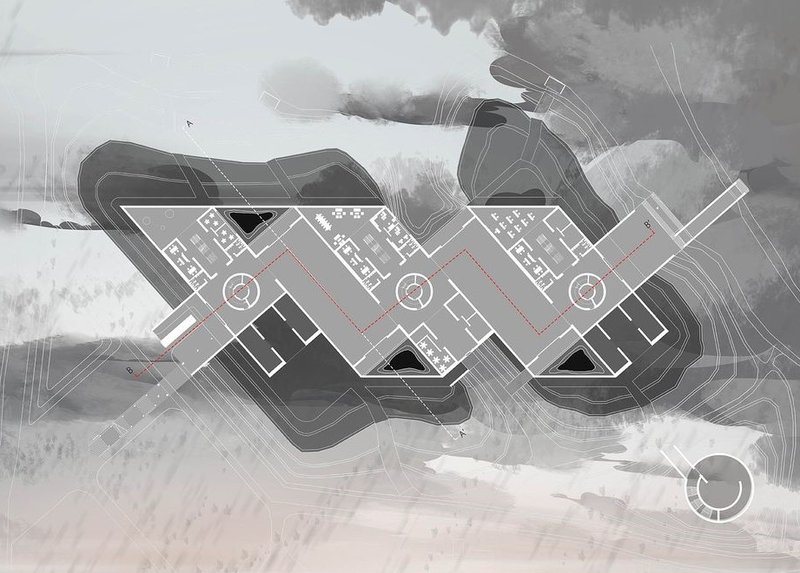
The masterplan integrates the shelter into the broader urban fabric of Rooppur. A roadside plaza and adjacent fields provide communal spaces, while the school’s open design fosters a sense of belonging. The architecture embodies resilience, blending safety with community engagement and climate-responsive design.


Popular Articles
Popular articles from the community

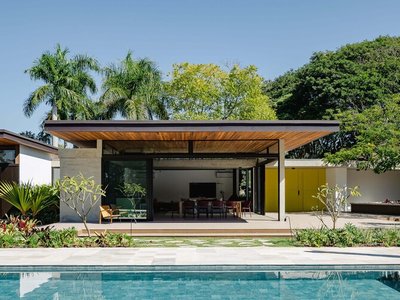
Flamboyant House by Juliana Camargo + Prumo Projetos
Modern Brazilian house integrating existing tree, pool, and volumes with glass, wood, and transitional spaces blending interior, exterior, and landscape seamlessly.
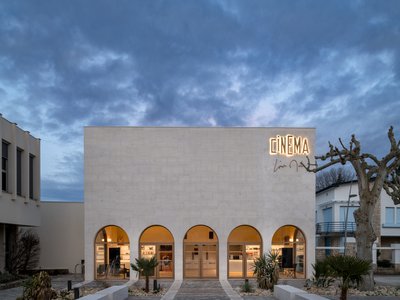
Louis Malle Cinema: A Limestone Cultural Landmark Revitalizing Community Life in Prayssac
Limestone cinema extension with public forecourt, blending heritage and modern design to create flexible cultural spaces and strengthen community interaction.
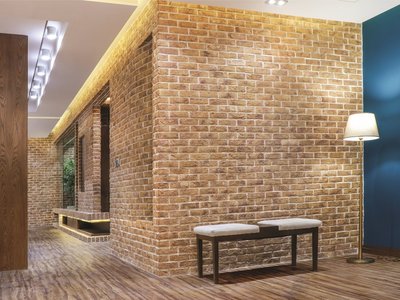
A Contemporary Take on Iranian Residential Architecture
A modern interior design in Mashhad that reinterprets brick, light, and spatial flow to create a warm, contemporary residential architecture.
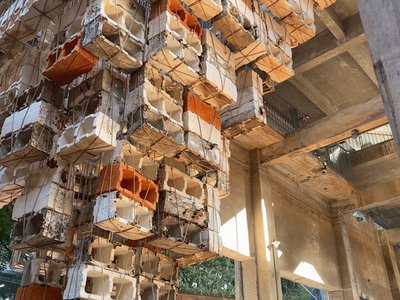
Inverted Architecture Installation by Studio Link-Arc: Exploring the Intersection of Architecture and Living Organisms
Inverted Architecture Installation by Studio Link-Arc blends mycelium, sustainability, inverted design, ecological cycles, and urban adaptive architecture in Shenzhen.


Similar Reads
You might also enjoy these articles


The Ken Roberts Memorial Delineation Competition (Krob)
As the most senior architectural drawing competition currently in operation anywhere in the world, it draws hundreds of entries each year, awarding the very best submissions in a series of medium-based categories.
A Contemporary Take on Iranian Residential Architecture
A modern interior design in Mashhad that reinterprets brick, light, and spatial flow to create a warm, contemporary residential architecture.
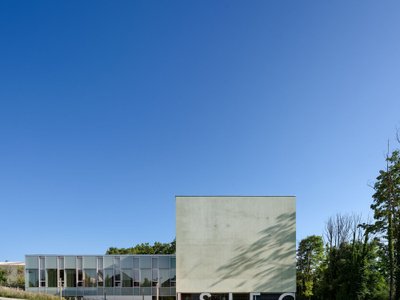
Franche-Comté Advanced School of Engineering by Dominique Coulon & associés, Besançon
A flexible engineering school immersed in woodland, combining concrete minimalism, adaptable spaces, and natural light to support evolving educational environments.

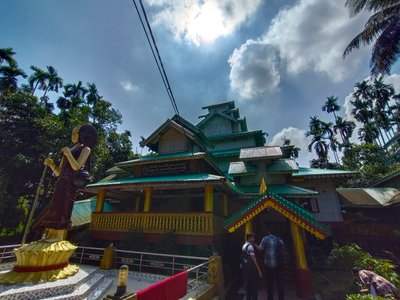
Documentation Work on Buddhist Wooden Temple
Architectural syncretism and cultural hybridity: A comparative study of the Buddhist temples in Chattogram Hill tracks


Explore Environmental Psychology Competitions
Discover active competitions in this discipline




The Global Benchmark for Architecture Dissertation Awards


Challenge to design public laboratory
Comments (0)
Please login or sign up to add comments
No comments yet. Be the first to comment!