

The Spider: A Walking Habitat Prototype for Saharan Nomadic Urbanism
Biomimetic legs, modular programming, and decentralized planning converge in a desert prototype that leaves no permanent footprint.


What if a building could walk? Not metaphorically, but structurally: lifting itself on minimal-point supports, adjusting its stance to shifting dunes, and leaving no permanent scar on the landscape beneath it. The Spider takes that premise seriously, proposing an architecture modeled on arachnid anatomy that can settle onto unstable Saharan terrain without conventional foundations. It is simultaneously a dwelling, a transit hub, a farm, and a civic center, reconfigured on demand by the communities it serves.
Designed by Key Studio, The Spider was shortlisted in the EHC - Sahara competition, which asked entrants to rethink human habitation under extreme desert conditions. The proposal goes well beyond a single building. It outlines a decentralized urban strategy of 1,000-person communities linked by sustainable transport networks, each functioning semi-autonomously while plugging into a larger territorial system. The ambition is nothing less than a new model for nomadic, climate-responsive settlement.
Punctual Supports: Standing on Sand Without Sinking In
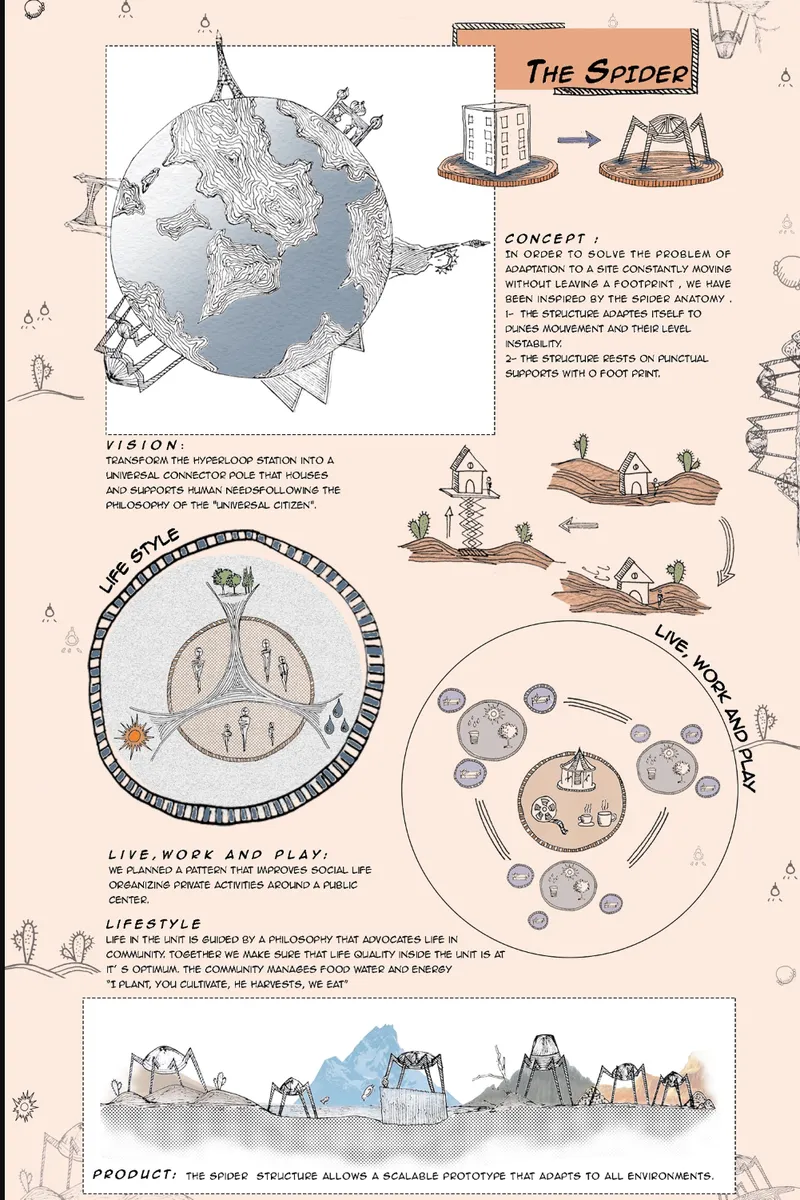
The conceptual diagram lays out the core biomimetic logic. Rather than spreading a conventional foundation across shifting ground, The Spider rests on articulated legs that distribute loads through minimal contact points. These adaptive supports mimic the way a spider's legs react to uneven surfaces, adjusting to changes in landscape elevation and dune displacement. The result is a structure that can inhabit terrain where traditional construction would either fail or cause ecological damage. Annotations on the diagram trace how forces travel through the legs, showing a clear structural rationale behind the biological metaphor.
A Desert Constellation of Tent-Like Modules
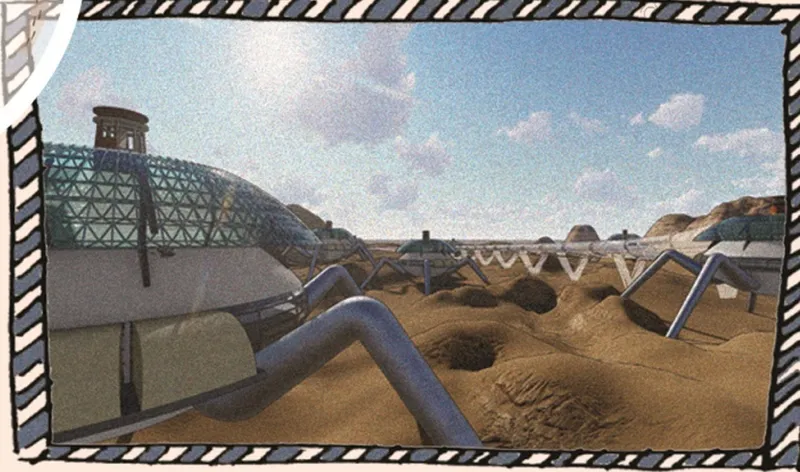
From above, the settlement reads as a constellation of tent-like forms connected by curving pathways across the desert floor. The aerial render reveals how the "Repetitive Urban Plan" works at the landscape scale: clusters of habitable modules distribute themselves organically rather than locking into a rigid grid. Curved connectors link individual units, establishing the cellular urban pattern that the designers describe as an alternative to hierarchical, centralized city planning. Each cluster is intended to serve a community of roughly 1,000 people, balancing autonomy with collective infrastructure.
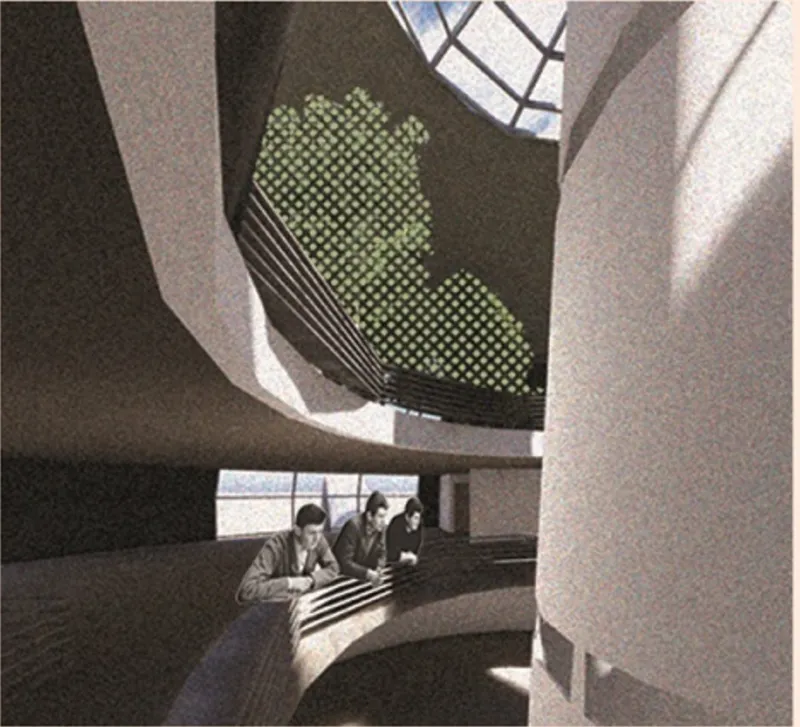
Step inside and the mood shifts dramatically. The interior view captures a workspace beneath a suspended green lattice screen, natural light filtering through a skylight above. The lattice performs double duty as shading device and vertical planting surface, reinforcing the project's commitment to passive climate strategies. People work below in diffused light, a reminder that even in extreme heat, careful manipulation of solar exposure and ventilation can produce comfortable interior environments without mechanical cooling.
Communal Agriculture Built Into the Architecture
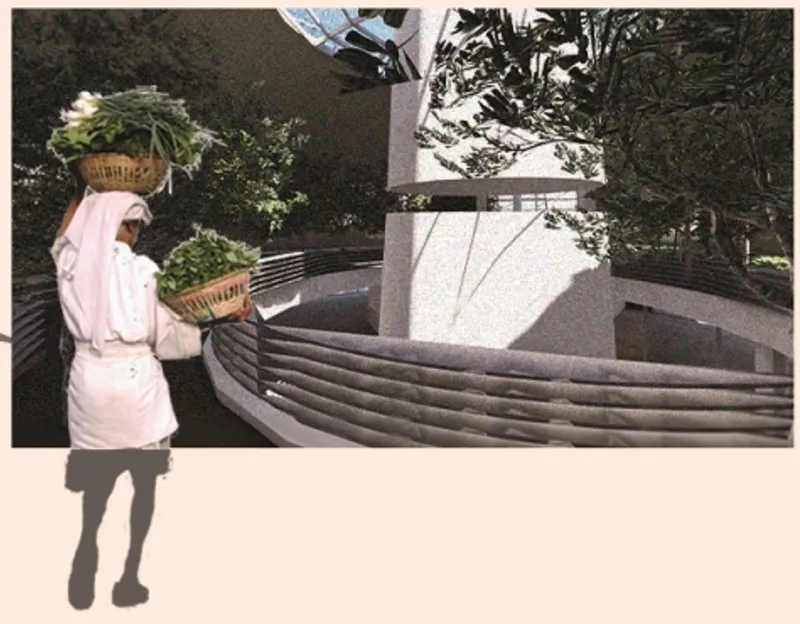
The project's communal philosophy finds its clearest expression in the terraced planter structure shown here. Stepped concrete walls create tiered growing beds where inhabitants manage food production collectively. The designers summarize this ethos with a motto: "I plant, you cultivate, he harvests, we eat." It is a deceptively simple statement that encodes a serious programmatic commitment. Food, water, and energy production are not outsourced but woven into daily life, making self-sufficiency a spatial condition rather than an abstract aspiration. The image of a person approaching with baskets underscores the intimate, hands-on relationship between inhabitant and habitat.
Vertical Stacking Around a Central Stem
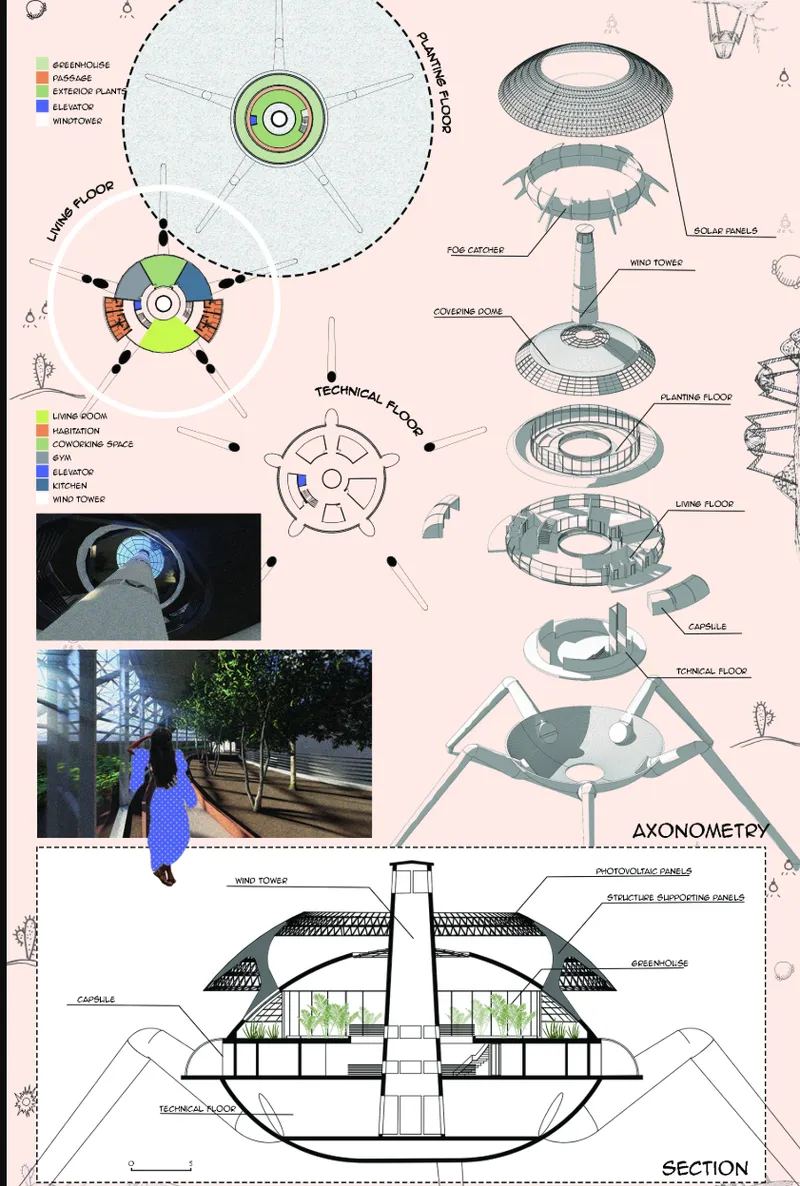
The axonometric drawing and section cut reveal how the prototype organizes program vertically. Circular floor plates stack around a central stem, which doubles as the structural spine and the conduit for environmental systems like wind towers and solar air extractors. Wind towers draw in and circulate fresh air through vertical shafts using prevailing wind forces, while solar-heated glazing panels generate convection currents for passive ventilation. The radial geometry maximizes perimeter exposure to air movement while keeping the footprint compact, a critical consideration when the entire structure needs to rest on adaptive point supports.
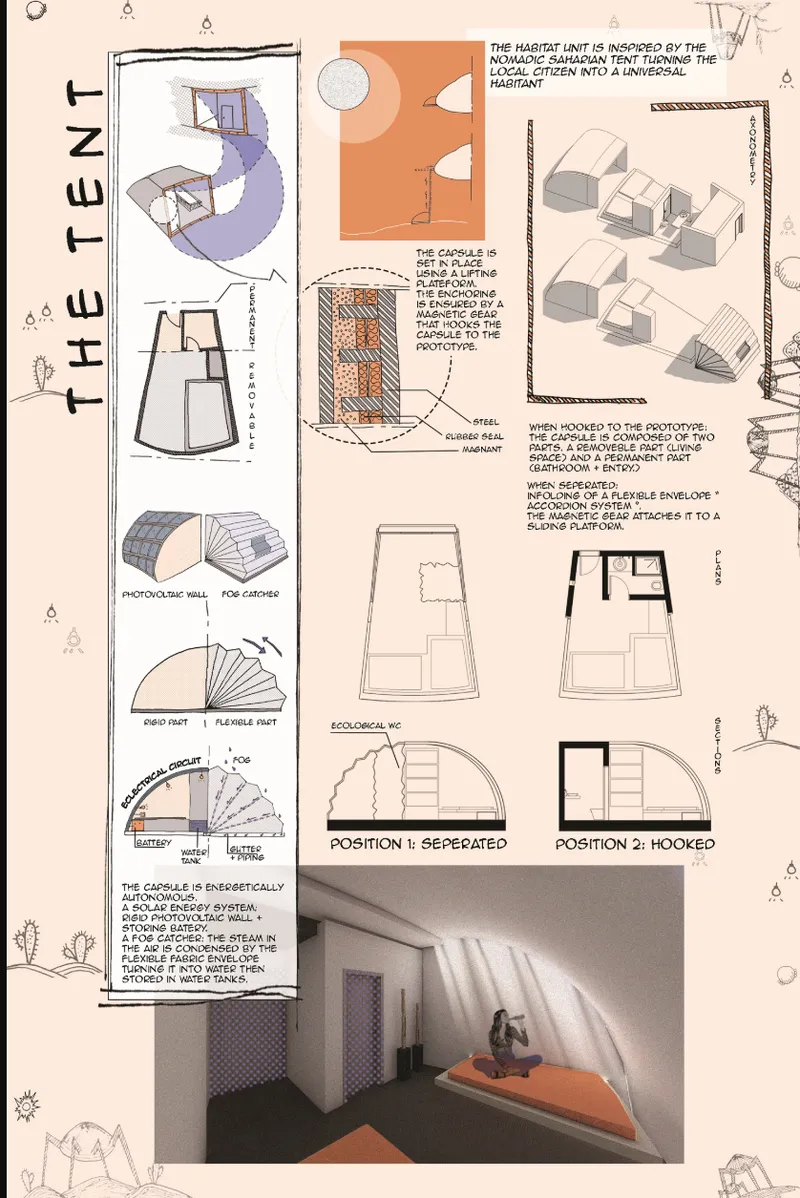
The presentation board rounds out the design argument with sketches exploring tent-like dwelling configurations and flexible envelope options. These drawings make clear that The Spider is not a fixed formal outcome but a system of possibilities. Envelope geometries shift between open and enclosed states, responding to wind, sun, and social program. The Hyperloop hub concept appears here too: not merely a transit station but what the designers call a "universal connector pole," housing essential human activities while linking communities across vast distances. It reframes infrastructure as inhabitable architecture.
Why This Project Matters
The Spider tackles one of architecture's most pressing questions: how do you build for communities that are not fixed in place, on ground that is not stable, under conditions that are not forgiving? The answer here is not a single clever detail but a layered system. Biomimetic structure addresses terrain instability. Modular programming absorbs changing social needs. Decentralized urbanism distributes risk and resources. Passive climate systems reduce dependence on external energy. Each layer reinforces the others, producing a proposal that is conceptually ambitious yet internally consistent.
What elevates the project beyond speculative imagery is its willingness to address the mundane alongside the visionary. Food production, waste cycles, community governance, and daily routine are given the same design attention as the dramatic spider-leg structure. That integration of the spectacular and the everyday is precisely what extreme habitat design demands. The Sahara does not reward formal gestures alone; it rewards systems that keep people alive, connected, and willing to stay.
View the Full Project
About the Designers
Designer: Key Studio
Enter a Design Competition on uni.xyz
uni.xyz runs architecture and design competitions year-round that reward proposals with spatial conviction and real site intelligence.
Project credits: The Spider by Key Studio EHC - Sahara (uni.xyz).


Popular Articles
Popular articles from the community


Riyadh For All: Intergenerational Urban Design for Active Aging in Rabat
Riyadh For All reimagines urban design in Rabat with intergenerational co-living, adaptive courtyards, and Moroccan cultural exchange today.

Co-life: Sustainable Architecture for Age-Friendly Community Living
Co-life reimagines sustainable architecture for seniors through courtyards, rammed earth, shared gardens, and spaces designed for belonging.
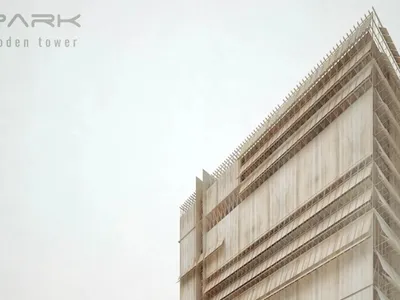
EW PARK: Sustainable Architecture Reimagines the Future of Urban Parking
EW PARK reimagines city parking as a modular wooden tower combining automation, solar energy, electric mobility, and adaptable urban design.

The Musturak Paradise: Senior Living Architecture for a Connected Future in Temara, Morocco
The Musturak Paradise reimagines senior living architecture in Temara via private homes, social spaces, culture, community, and shared care.

Similar Reads
You might also enjoy these articles

Day and Night Park: A Time-Based Urban Newsstand in Beijing
A temporary urban newsstand in Beijing blending travel, light, and reading through poetic colors, compact form, and community-focused design.

Modernist Patio Renovation in El Masnou, Barcelona by Oliver Segura Arquitectura + Cebrià Arquitectura
Modernist patio renovation blending tradition and innovation with a movable pool, leveled floors, and Catalan materials in El Masnou.

Alto Residencial Coop: Cooperative Housing Development in Santiago de Compostela by Carbajo Barrios Arquitectos
A linear cooperative housing complex blending white volumes and perforated metal façades, enhancing community living, natural light, privacy, and urban integration.

Vil Genis School by BPA ARCHITECTURE – Massy, France
Vil Genis School in Massy, France, features sustainable design, south-facing classrooms, community integration, accessible spaces, and modern educational architecture.

Comments (0)
Please login or sign up to add comments
No comments yet. Be the first to comment!