

Adjaye Associates Builds Its West African Headquarters from Rammed Earth and a 26-Meter Cantilever
A four-storey office in Accra's Cantonments neighborhood uses deep earth fins and local materials to filter tropical light.


When an architect builds a home for their own practice, the stakes shift. The project becomes a thesis statement, a built argument for how they believe work should happen. Adjaye Associates has made that argument in Accra's Cantonments district with a four-storey rammed earth building that cantilevers 26 meters over a ground-level parking structure, creating more than 1,300 square meters of column-free workspace for up to 180 people. The material is local. The climate strategy is passive. The ambition is unmistakable.
What makes the Accra Studio genuinely interesting is not the fact that a globally prominent firm chose to build its West African headquarters from earth, though that alone would be noteworthy. It is the way the building collapses distinctions between structure, envelope, and environmental control into a single system. The deep, closely spaced vertical fins that define the facade are not applied decoration. They are rammed earth, they are load-bearing, and they filter Accra's equatorial sun into soft interior light. The building is its own brise-soleil.
A Monolith Lifted Off the Ground


The primary structural gesture is bold and legible: a dense, heavy volume of rammed earth hovers above a colonnade of cylindrical concrete columns. The 26-meter cantilever is not merely an engineering feat paraded for effect. It liberates the ground plane, creating a shaded outdoor court where terracotta pavers, motorcycle shadows, and tree canopies establish a semi-public threshold between the street and the workspace above. In a city where outdoor life is not seasonal but perpetual, this is not wasted space. It is the most socially charged zone in the building.
The concrete beam at the edge of the cantilever reads as a sharp horizontal line against the verticality of the fins above. Cylindrical grey columns below carry the load with an almost casual regularity, their smooth surfaces contrasting with the layered, tactile earth walls. The result is a building that feels simultaneously massive and weightless, grounded by its material and airborne by its structure.
Earth Fins as Environmental Filter
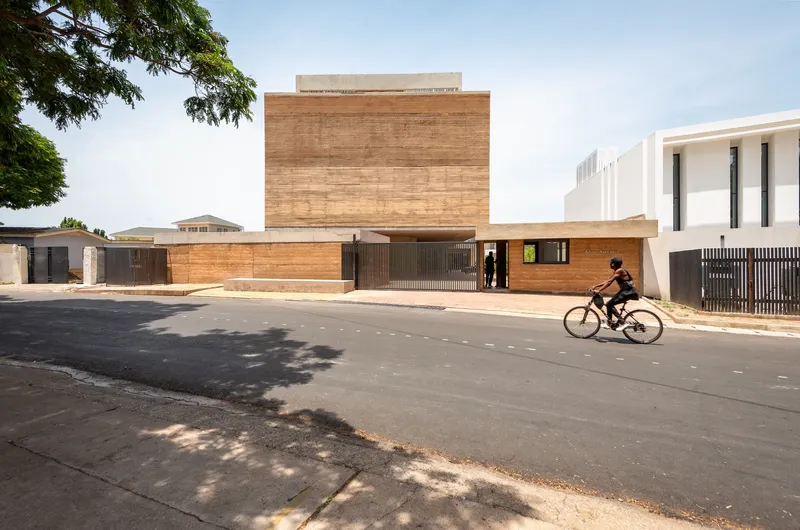

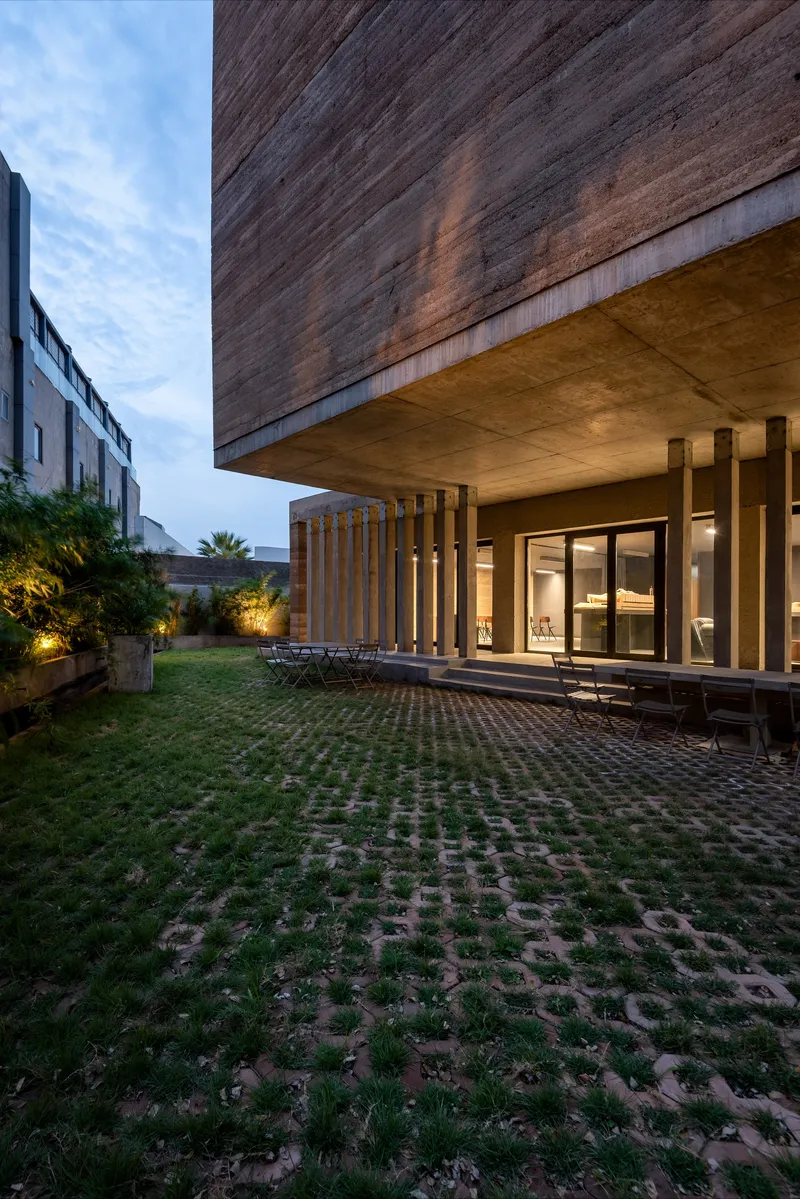
The facade is the project's most disciplined move. Deep, closely spaced rammed earth fins run vertically around the perimeter, creating a rhythm that is at once structural, thermal, and aesthetic. Between each pair of fins, glazed openings admit daylight that has already been softened and redirected. No external louvers, no motorized shading systems, no double-skin curtain walls. The earth itself does the work. In a tropical context where solar gain is the enemy of comfort, this is low-tech precision with high-design consequences.
At street level, the fins extend downward to form a shaded pergola. The effect at dusk is particularly striking: the building glows from within, its vertical slots of light turning the heavy mass into something almost lantern-like. The consistency of material, from ground-level pergola to upper-floor workspace, gives the building a monolithic presence that resists the tendency of contemporary offices to fragment into a collage of systems and surfaces.
Workspaces That Breathe

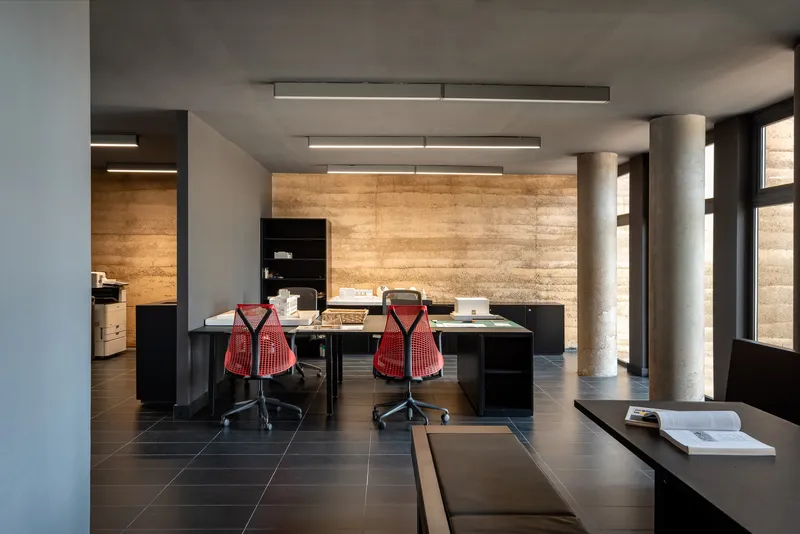
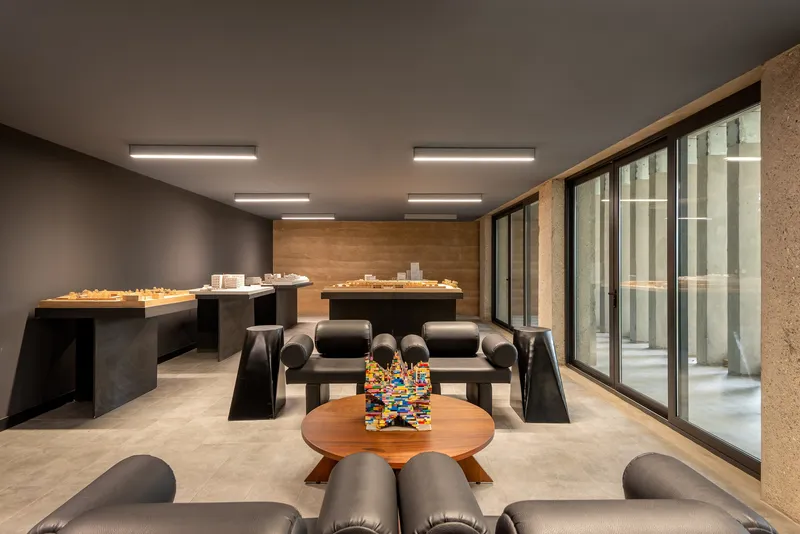
Inside, the column-free office floors deliver on the promise of the cantilever. Workstations sit beneath concrete ceilings with recessed linear lighting, and high clerestory windows bring in ambient daylight from above. The palette is restrained: concrete, timber, and the omnipresent rammed earth, which is expressed internally with the same honesty as on the exterior. Red mesh chairs provide the only real burst of color against the grey and ochre tones.
The studio workspace is particularly well composed. Model tables and lounge seating overlook a glazed courtyard framed by the vertical fins, collapsing the distance between making and thinking. For an architecture practice, this is not incidental. The ability to see your colleagues' work, to share a sightline with a model in progress, is a spatial decision with cultural consequences. The office is designed to make collaboration visible.
Beyond the Desk


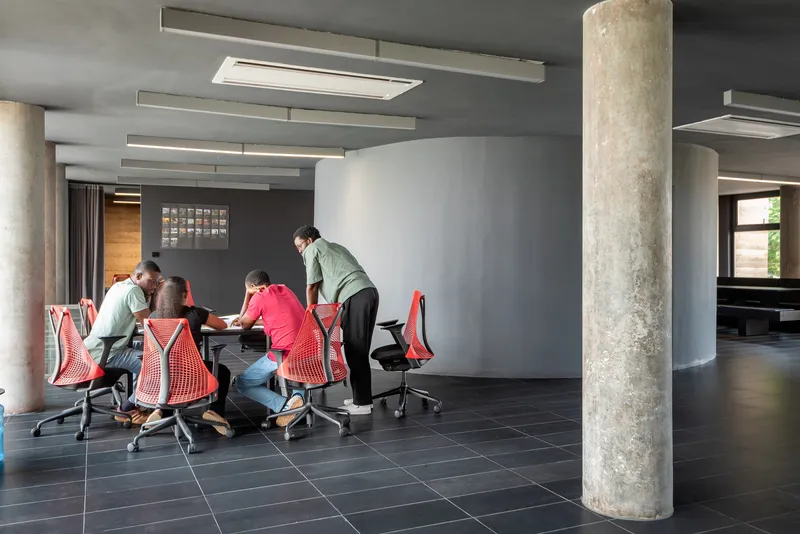
The program extends well beyond conventional office territory. An on-site crèche with pale green walls, alphabet letters, and colorful furniture signals a workplace that acknowledges the full lives of its employees. A conference suite with floor-to-ceiling bookshelves operates as a serious, almost library-like space. Collaborative zones with clusters of red mesh chairs provide for the kind of spontaneous gatherings that rigid floor plans tend to suppress.
These are not afterthoughts. Childcare, shared meals, informal meeting: these are programmatic commitments embedded in the building's section, not amenities tacked on to a spec office. The inclusion of a crèche in a headquarters building in West Africa carries particular weight, normalizing a workplace infrastructure that remains rare globally.
Rooftop and Circulation
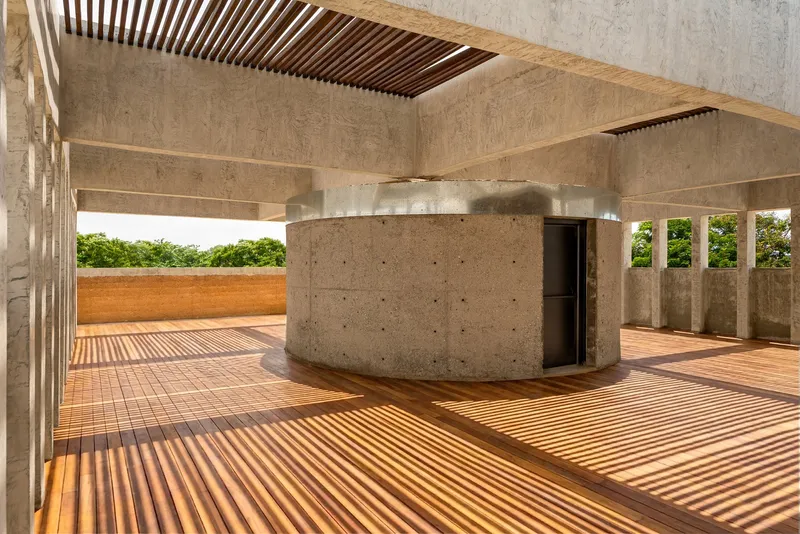
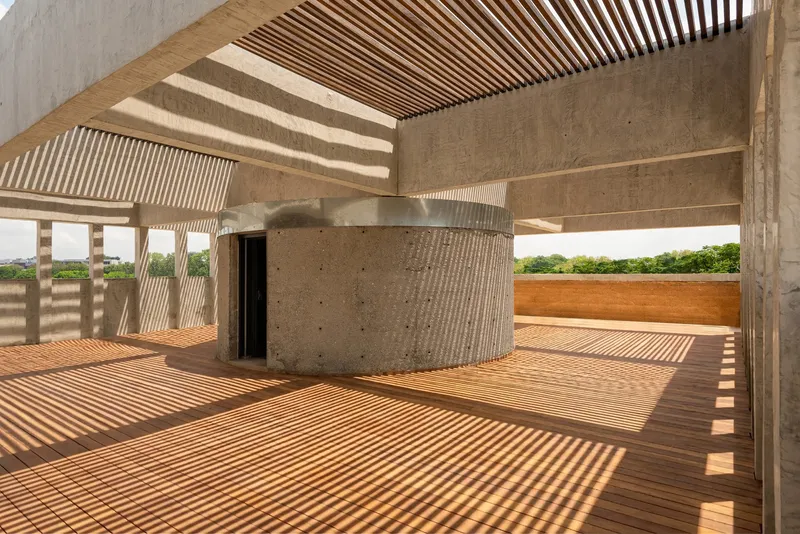
The rooftop terrace completes the vertical sequence. Timber slat flooring and a slatted ceiling overhead create a layered canopy of shadow, with the curved concrete core of the stairwell punctuating the open deck. An outdoor kitchen makes this a place for extended occupation, not just a fire escape with a view. The relationship between the rooftop and the ground-level pergola establishes a clear dialogue: both are spaces of shade, sociality, and relief from the sun, bookending the working floors between them.
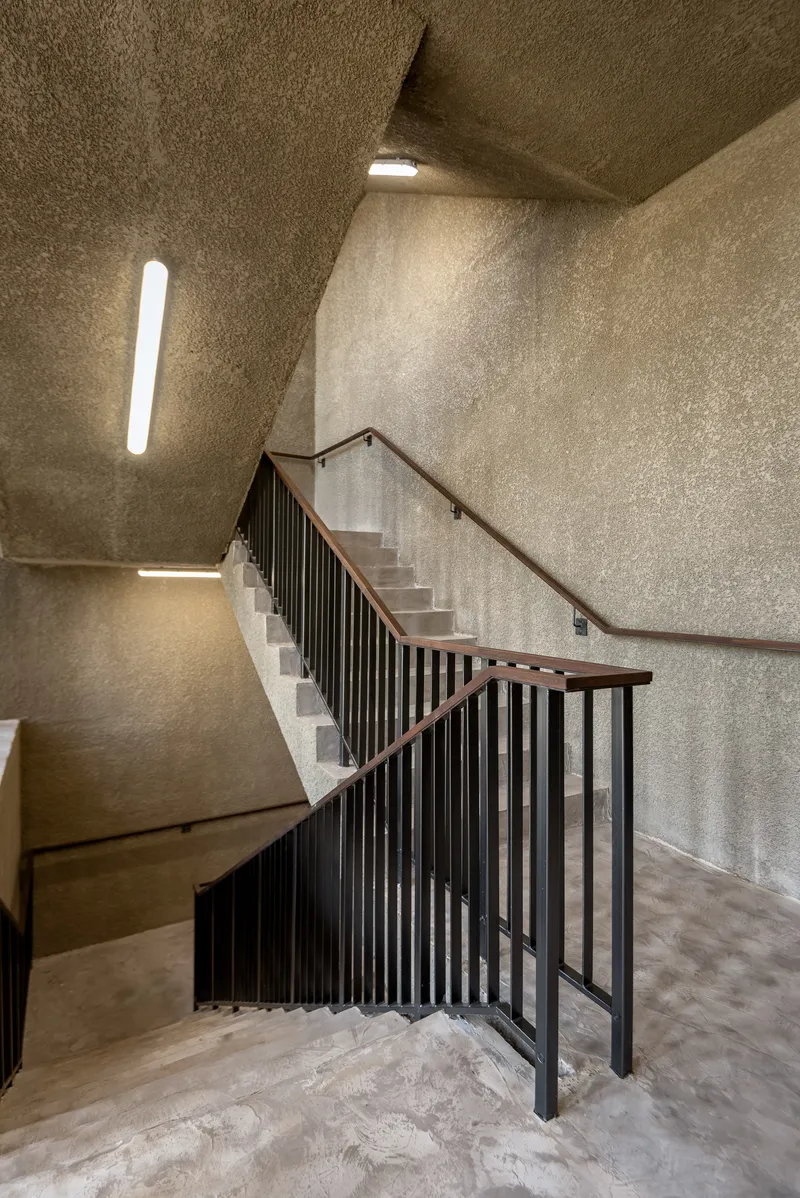
Vertical circulation is handled through concrete stairwells with metal railings and narrow vertical skylights that pull natural light deep into what would otherwise be opaque cores. The stairwell detailing, with its textured walls and linear skylights, treats a service space as an opportunity for material richness. A spiral stair with red carpet treads and brass handrails adds a note of intentional theatricality, a reminder that this is a design studio, not a developer's shell.
Colonnades and Corridors
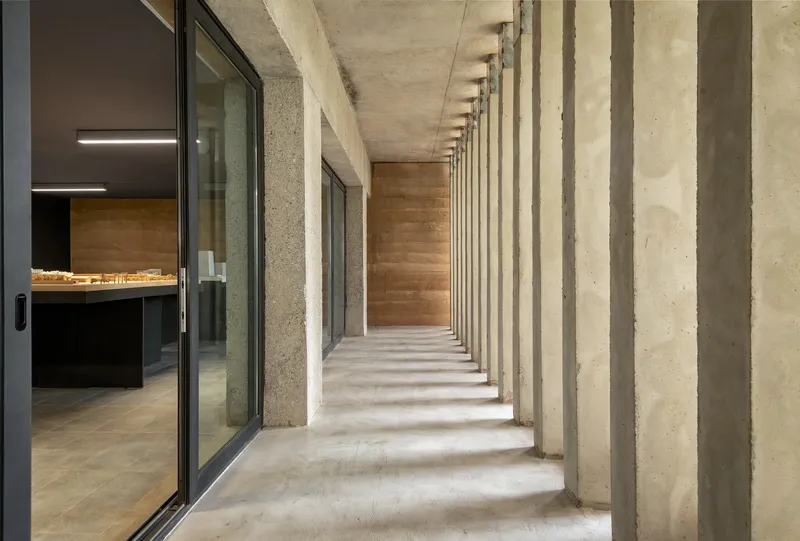


The covered walkways that run along the building's edges deserve attention. Rhythmic concrete columns cast sharp parallel shadows across polished concrete and timber floors, creating corridors that function as inhabited thresholds between inside and out. The herringbone floor pattern alongside glazed offices in the interior corridor adds texture without distraction. These are spaces designed for movement, but their quality of light and proportion invites you to slow down.
The colonnade is a persistent motif in Adjaye's work, and here it serves a specific climatic purpose. Shaded, ventilated circulation reduces the thermal load on the conditioned interior spaces and provides a transitional zone where the body adjusts between the heat of the street and the cool of the office. It is both promenade and passive cooling strategy.
Material Consistency as Argument


A row of wooden chairs set against a horizontal layered rammed earth wall captures the building's ethos in a single image. The striations in the earth tell you how it was made. The material is not hidden behind plaster or paint. Rammed earth is simultaneously structure, finish, and narrative, connecting the building to centuries of West African construction while operating at a contemporary scale. The choice of low-carbon concrete for the structural frame and timber for interior finishes reinforces a material logic rooted in regional availability and environmental responsibility.
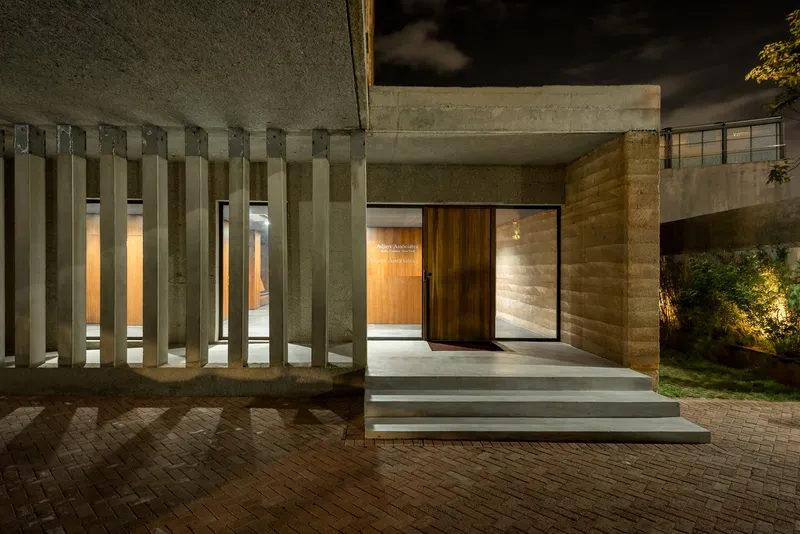
At night, the entrance reveals the building at its most precise: vertical concrete fins frame a timber pivot door above brick pavers, with light spilling out through the narrow gaps. The detailing is crisp without being precious. Every joint, every shadow line, every material transition has been considered, but the overall effect is warmth rather than austerity.
Plans and Drawings

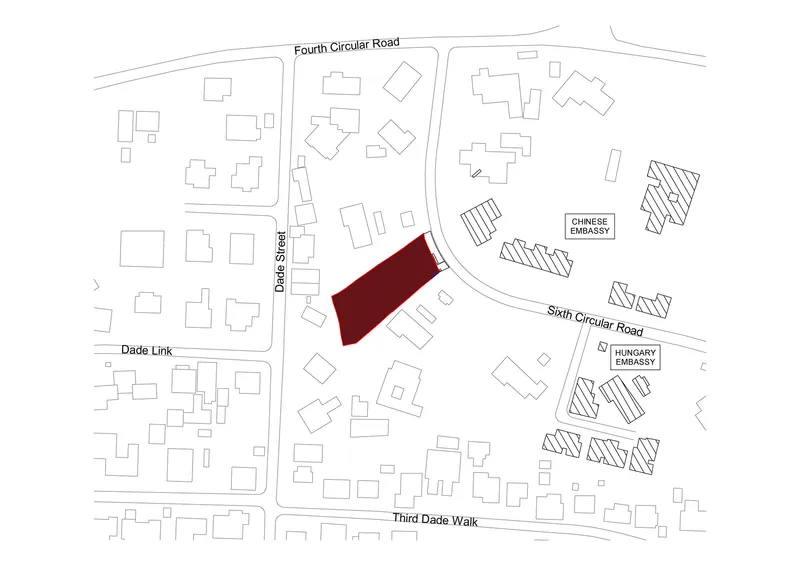
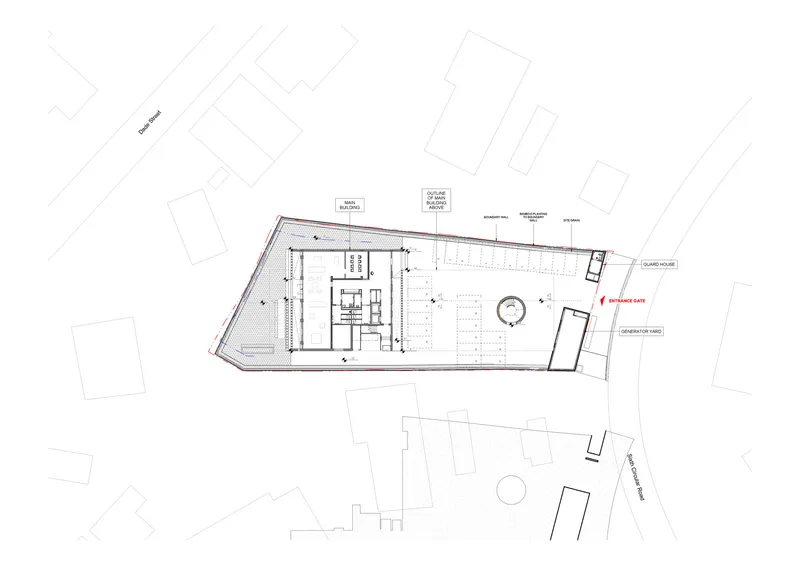


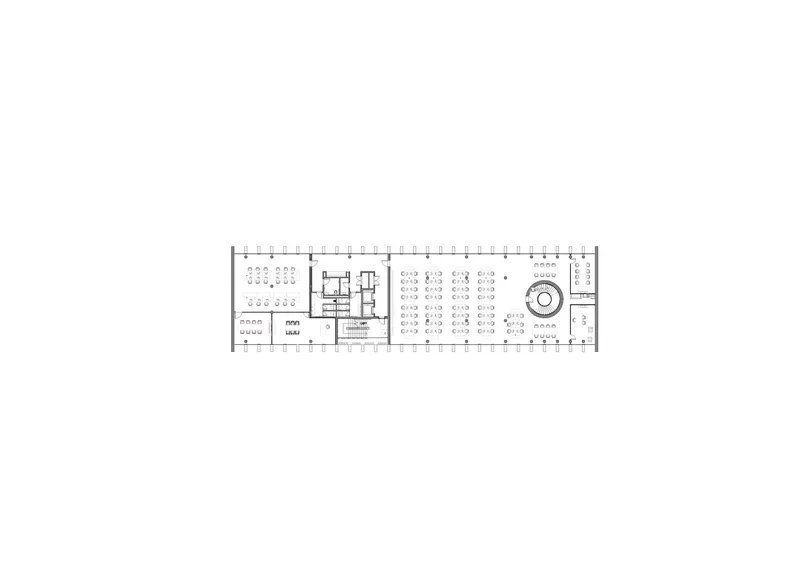

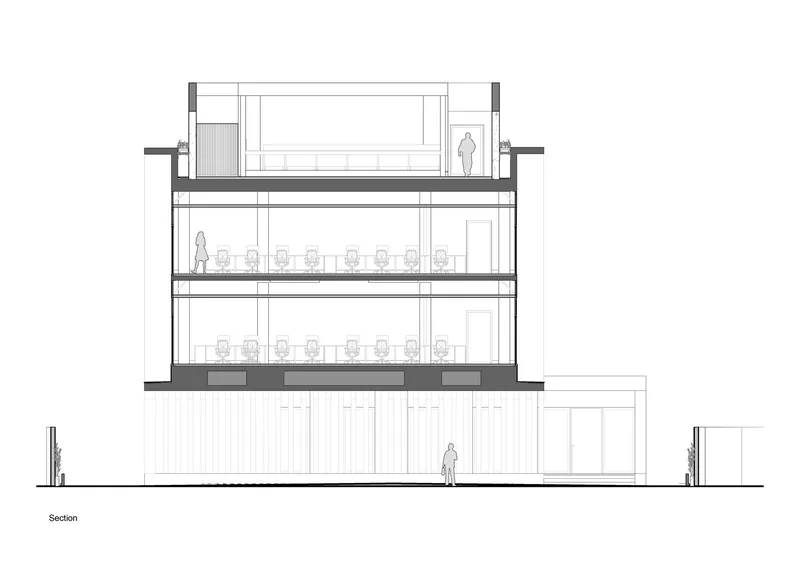
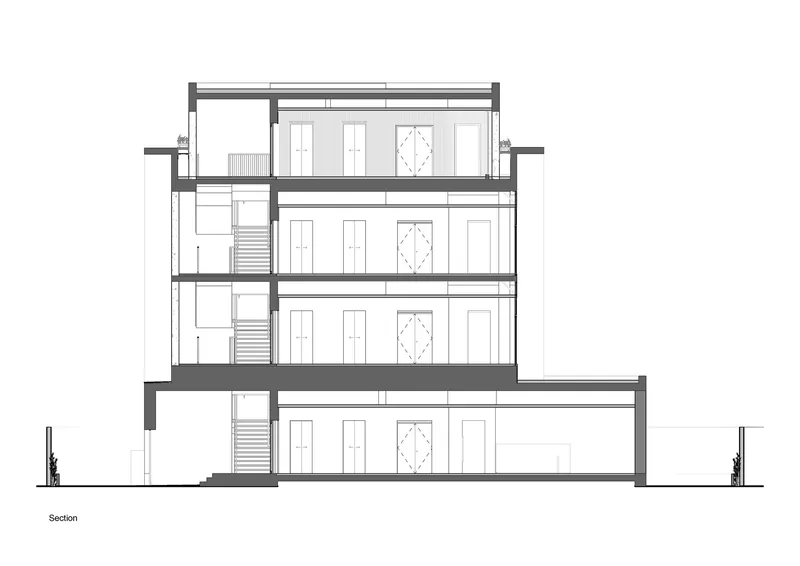

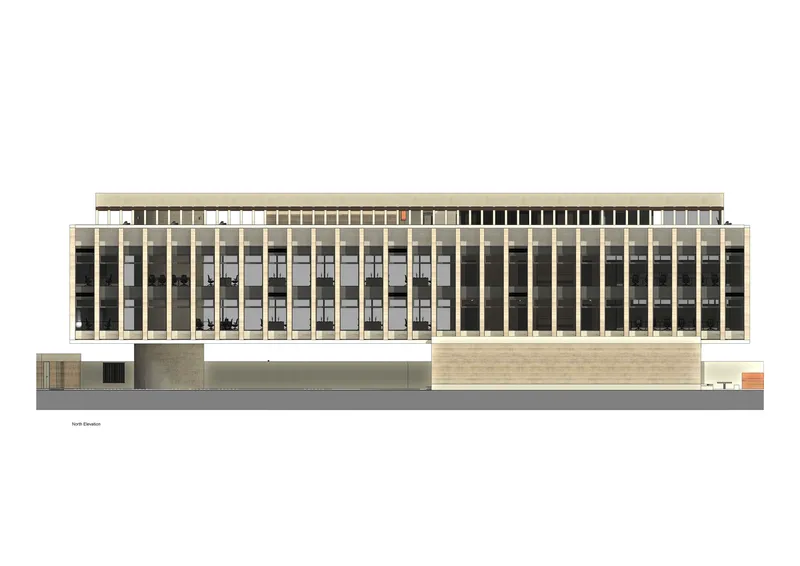


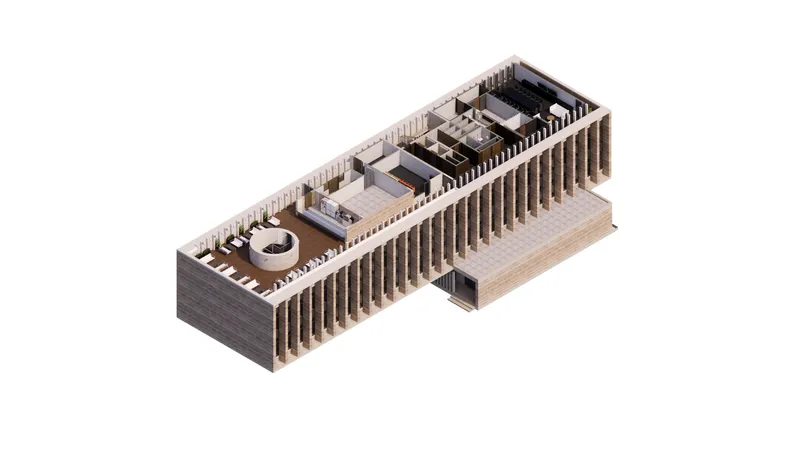

The site plans reveal a trapezoidal footprint wedged into the Cantonments urban fabric, surrounded by embassy complexes and residential plots. The building works with the site's angular geometry rather than fighting it, and the floor plans show how the angled perimeter is absorbed into a rational interior layout of workstations, meeting rooms, and a circular sculptural element that anchors the plan at one end.
The sections are the most revealing drawings. The four-level stack reads clearly: parking and shaded ground plane, two floors of column-free workspace, and the rooftop terrace. Scissor stairs at one end and a central circulation core provide vertical access without consuming usable floor area. The longitudinal section shows the full extent of the double-height spaces and the repetitive window openings that correspond to the exterior fin rhythm. The axonometric cutaways confirm what the photographs suggest: the courtyard and colonnade are not residual voids but primary organizing elements of the plan.
Why This Project Matters
The Accra Studio matters because it refuses the false choice between local material culture and global ambition. Rammed earth is not deployed here as a nostalgic gesture or an exercise in poverty aesthetics. It is the structural, environmental, and expressive basis of a sophisticated four-storey office building with a 26-meter cantilever. The building demonstrates that passive climate strategies and regional construction techniques can produce architecture that is uncompromising in its spatial and programmatic complexity. That is a lesson with relevance far beyond Accra.
It also matters as a statement about what a workplace can be. The inclusion of a crèche, an outdoor kitchen, gallery space, and shaded public ground plane alongside workstations for 180 people redefines the office as a social institution rather than a container for productivity. When the architect is also the client, these choices become legible as convictions rather than compromises. Adjaye Associates has built itself a home that argues for a different relationship between work, place, and the public life of the city.
Accra Studio by Adjaye Associates, Cantonments, Accra, Ghana. 1,300 m². Completed 2026. Photography by Mutahi Chiira.
About the Studio
Share Your Own Work on uni.xyz
If projects like this are the kind of work you want to make, uni.xyz is a place to publish your own, find collaborators, and enter design competitions.


Popular Articles
Popular articles from the community


Tsunami Convergenics: Turning Catastrophic Ocean Forces into Underwater Housing Infrastructure
A speculative underwater settlement off the coast of Onagawa, Japan, treats tsunamis and typhoons as energy sources rather than threats.
Faces of the Soviet Avant-Garde: Turning Moscow's Street Names into an Open-Air Museum
A network of sculptural installations across a Moscow residential district transforms forgotten architect names into spatial encounters with cultural memor

Cloaked Colonization: A Mobile Underwater Habitat That Moves Like a Fish
Micah Abaya's shortlisted EHC Pacific entry reimagines ocean settlement as a dispersed network of self-sustaining architectural organisms.

Opera on the Sea: Driftwood Logic Shapes a Timber Opera House on Estonia's Coast
Trevor Orgill's opera house translates the entangled drift of floating timber into a civic building where wood, water, and music converge.

Similar Reads
You might also enjoy these articles

Bao Huynh Watercolor Atelier: A Serene Art Retreat in Hội An
Bao Huynh Watercolor Atelier in Hội An blends multifunctional art spaces, sustainable design, local materials, and family-friendly living in a serene environment.

Atelier Macri Concept Store Interior Design by CASE-REAL
Atelier Macri store features a "ko" counter, walnut wood details, cork displays, blending retail, gallery, and seamless customer experiences.

Manuel Vargas Izquierdo Stadium and High-Performance Sports Center: Architectural Excellence in Jalpa de Méndez
The Manuel Vargas Izquierdo Stadium blends sustainable design, inclusive sports facilities, and cultural-inspired architecture, revitalizing Jalpa de Méndez’s public spaces.

KAKR Buluh Awar Hall: Revitalizing Community and Ecology Through Bamboo Architecture
Community built bamboo hall revitalizes Buluh Awar village, empowering youth, restoring ecology, celebrating vernacular craftsmanship through sustainable architecture and culture.

Comments (0)
Please login or sign up to add comments
No comments yet. Be the first to comment!